
Power balancing strategies An element of negotiation jujitsu
Power balancing strategies An element of negotiation jujitsu Use with attribution to Craig Engstrom
Learning Objectives/Outcomes LO 1. Explain the relationship between power (control) and resource dependence. LO 2. List strategies for balancing relationships to regain power. LO 3. Practice or discuss strategies for balancing power based on situations.
A relational theory of power Highlights from Richard Emerson (1962) • Your perception of power may be inaccurate: It is NOT an attribute of a person. • Power is not “owned” by an individual but is a product of the social relationship in which certain qualities become situationally important and valuable to others. • Power is based on one’s dependence on resources that another person controls or seems to “possess. ”
• Key claim: “Power resides implicitly in the other’s dependency” (p. 32). Power. Dependence Relations • Which means: a person’s power is directly tied to the nature of the relationship. • Goal: Change the relational dynamics.
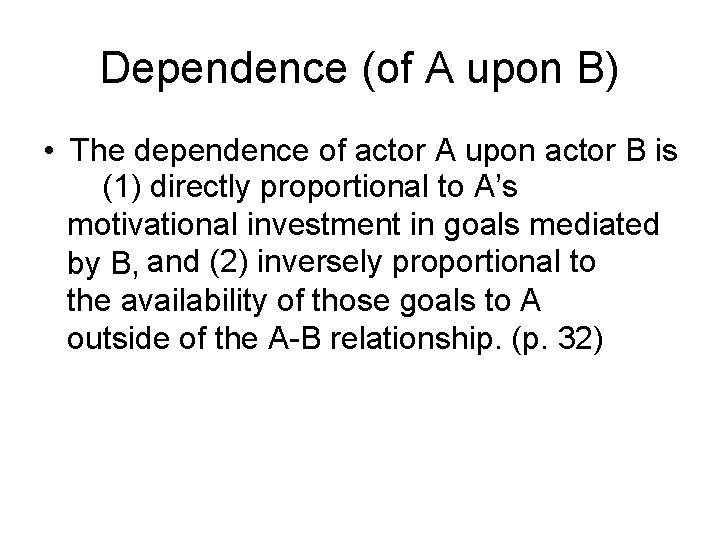
Dependence (of A upon B) • The dependence of actor A upon actor B is (1) directly proportional to A’s motivational investment in goals mediated by B, and (2) inversely proportional to the availability of those goals to A outside of the A-B relationship. (p. 32)
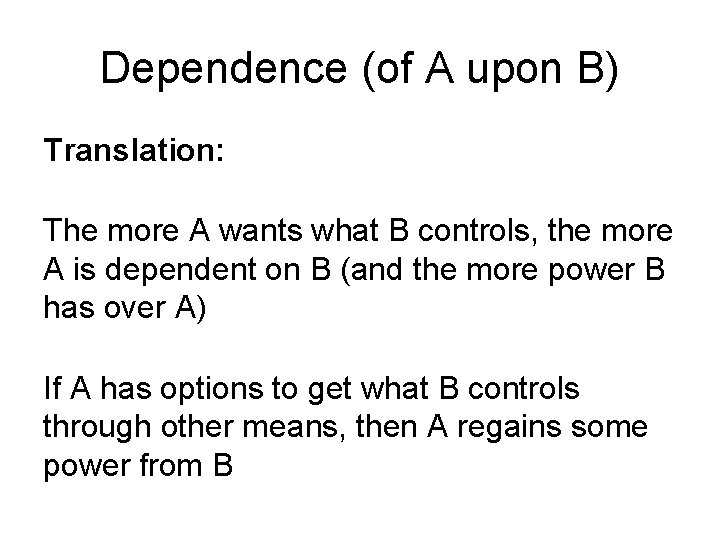
Dependence (of A upon B) Translation: The more A wants what B controls, the more A is dependent on B (and the more power B has over A) If A has options to get what B controls through other means, then A regains some power from B

Balance and Imbalance • Balanced relationship: – When A and B are of equal dependence on each other. • Imbalanced relationship – When either A or B have more dependence on the other than the other has dependence on them.
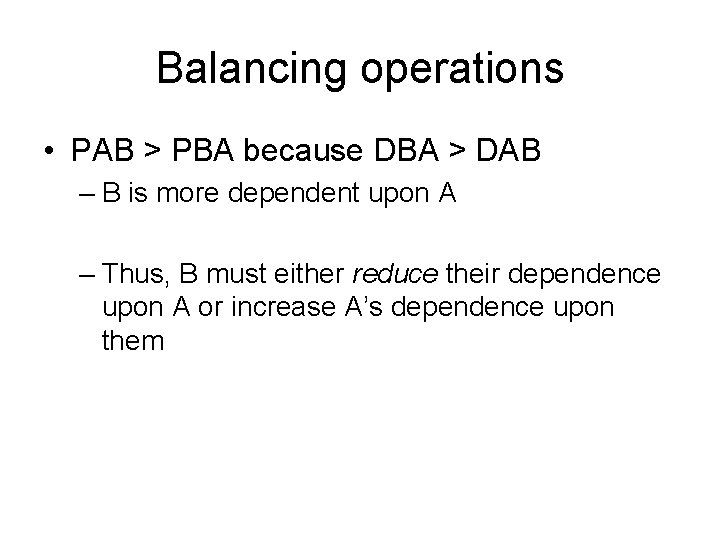
Balancing operations • PAB > PBA because DBA > DAB – B is more dependent upon A – Thus, B must either reduce their dependence upon A or increase A’s dependence upon them
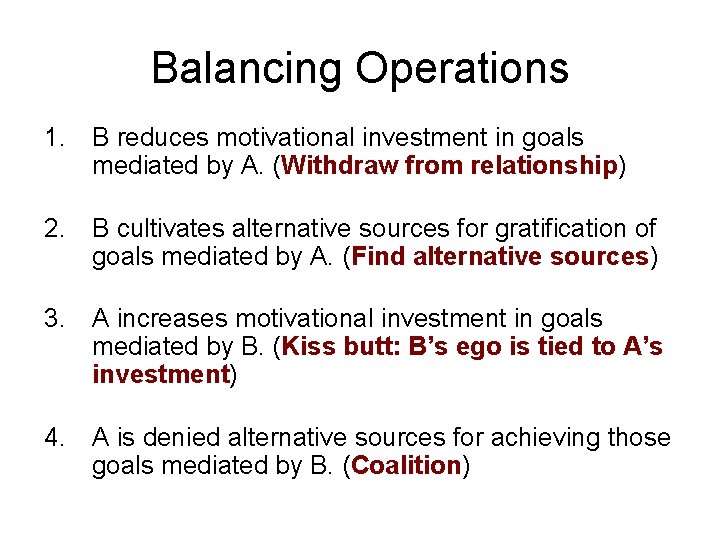
Balancing Operations 1. B reduces motivational investment in goals mediated by A. (Withdraw from relationship) 2. B cultivates alternative sources for gratification of goals mediated by A. (Find alternative sources) 3. A increases motivational investment in goals mediated by B. (Kiss butt: B’s ego is tied to A’s investment) 4. A is denied alternative sources for achieving those goals mediated by B. (Coalition)
Samples
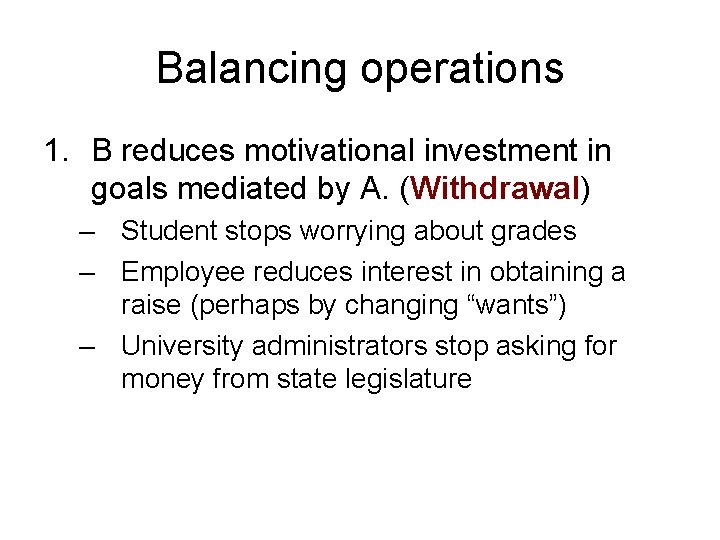
Balancing operations 1. B reduces motivational investment in goals mediated by A. (Withdrawal) – Student stops worrying about grades – Employee reduces interest in obtaining a raise (perhaps by changing “wants”) – University administrators stop asking for money from state legislature
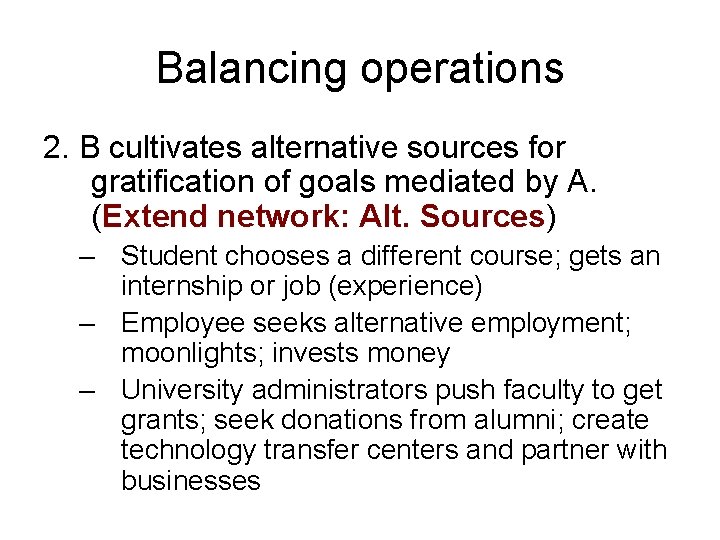
Balancing operations 2. B cultivates alternative sources for gratification of goals mediated by A. (Extend network: Alt. Sources) – Student chooses a different course; gets an internship or job (experience) – Employee seeks alternative employment; moonlights; invests money – University administrators push faculty to get grants; seek donations from alumni; create technology transfer centers and partner with businesses
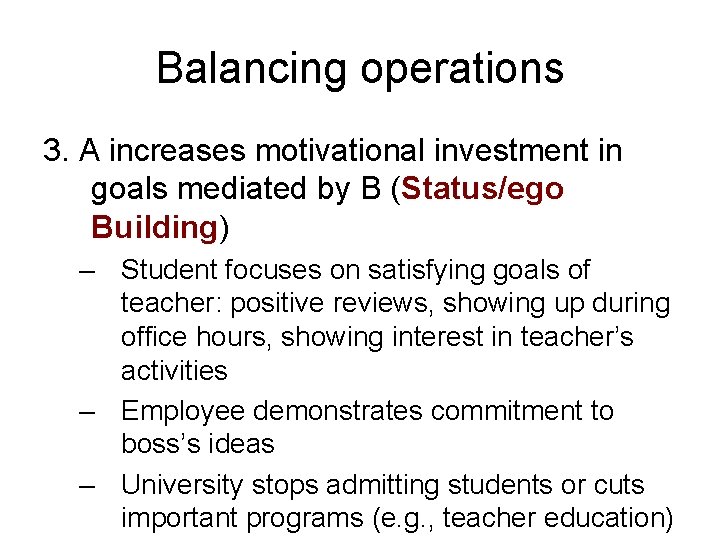
Balancing operations 3. A increases motivational investment in goals mediated by B (Status/ego Building) – Student focuses on satisfying goals of teacher: positive reviews, showing up during office hours, showing interest in teacher’s activities – Employee demonstrates commitment to boss’s ideas – University stops admitting students or cuts important programs (e. g. , teacher education)
Balancing operations 4. A is denied alternative sources for achieving goals mediated by B (Coalition building) – Student works to change others’ opinions of teacher – Employees form a union – Universities join together to lobby the legislature for more funding (perhaps with threat to “shut down”)
Summary & other points Your dependence on another is a function of 1. the importance of the goals the other can influence and 2. the availability of other avenues for you to accomplish what you want.
Summary & other points • In a mutually beneficial relationship, power is not fixed, but shifting as each becomes dependent in a positive way on the resources the other person may offer. • Increasing another’s dependencies on you can be constructive or destructive.
Suggested Activities • Get students/trainees into groups and have them discuss recent scenarios of conflict related to power imbalance and what they did or could do to balance the relationship. Challenge them to provide specific examples. • Provide a case study or simulation that demonstrates or highlights power imbalance due to dependency. (Trainees should practice actual communication tactics of withdrawal, ego building, and so on. )
- Slides: 17