
Power and Privilege Part Three A poststructuralist View


- Slides: 29
Power and Privilege Part Three: A poststructuralist View of Power Authors: Monk, G. Winslade, J. and Sinclair, S. By: La. Trenda Terrell
What is Poststructuralist view of Power � A major theme of poststructuralism is instability in the human sciences, due to the complexity of humans themselves and the impossibility of fully escaping structures in order to study them �Associated loosely with a postmodern worldview- reality cannot be known nor described objectively �Is influenced by French philosopher Michel Foucault
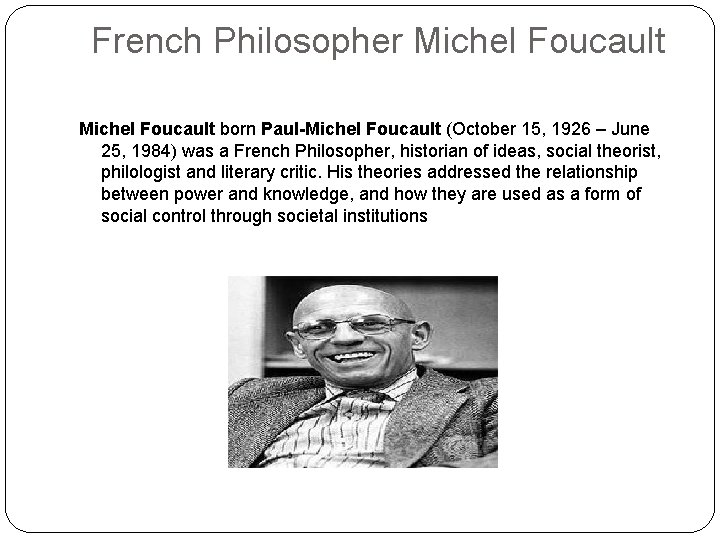
French Philosopher Michel Foucault born Paul-Michel Foucault (October 15, 1926 – June 25, 1984) was a French Philosopher, historian of ideas, social theorist, philologist and literary critic. His theories addressed the relationship between power and knowledge, and how they are used as a form of social control through societal institutions
Authors Beliefs �Foucault's analysis of power has potential for a very different approach to counseling �It gives cultural influences a much greater place of importance in psychology than previously been given
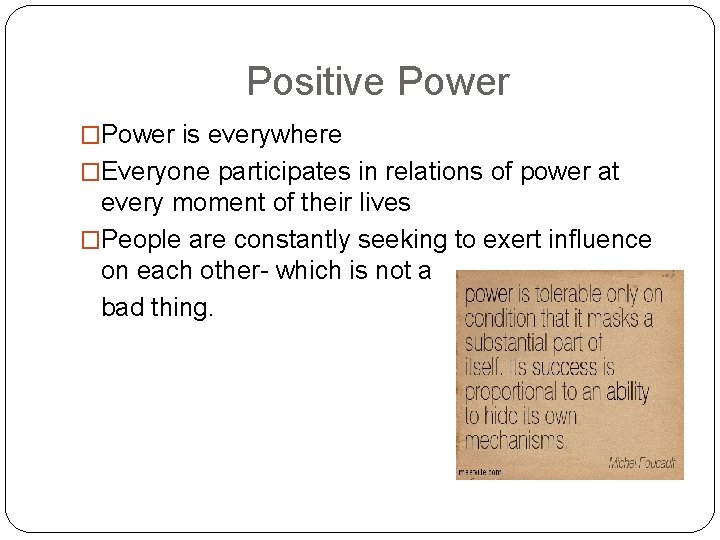
Positive Power �Power is everywhere �Everyone participates in relations of power at every moment of their lives �People are constantly seeking to exert influence on each other- which is not a bad thing.
Positive Power Cont. Foucault argues that it is not enough to follow the common path of assuming that Power is basically about stopping people from doing things � Most analyses of power focus on the negative functions � Prevents from opportunities � Blocks from participating in own decision making � Silences � Excludes from social benefits This negative emphasis is not so much as wrong but is insufficient and “skeletal”- represents the bones of power without muscles and nervous system
Positive Power cont. �Foucault didn’t argue against the existence of oppression or repression �Power is primarily productive �Power works to get people to do things rather than just stop them from doing them “It makes people act and Speak”
Power is everywhere. . � Foucault uses the metaphor “Capillary”- referring to the tiny blood vessels that carry life to the extremities of the body… � There are those who more easily access the authority to shape the lives of others and those for whom the path to that access is overgrown with obstacles � There authorities in many places who exercise the right to govern the lives of other people and their positions are not just organized around race, gender, and class
Who governs? �We often assume that the exercise of authority refers to the government or state but, �There are many places where authority is exercised over the lives of people �Bankers govern peoples financial lives �Teachers govern children lives in school �Fashion industry governs clothing tastes
Who governs? cont. �Marketing and advertising govern consumption patterns �Captains govern crew �Employers govern employees Foucault uses the word govern in the sense of producing or eliciting the desired forms of behavior in a population of people.
Power Relations and Domination � Power relations are in a constant fluid exchange of relational expression � Whenever someone attempts to govern the conduct of others, he must engage in a strategy of struggle and contest in which there is always the possibility that the others may refuse to submit � There is always a reciprocal relation � Domination occurs when the reciprocal process is no longer possible
Sovereign Power and Disciplinary Power �Modern world and power as it was in premodern times �It is necessary to study the technologies by which peoples lives are governed in order to understand how power operates and the modern world can be distinguished from earlier times by the development of some sophisticated new technologies of power
Sovereign Power �Based on instilling in the general populace a fear of the authority of the sovereign �Through punishing wrongdoers by enacting all manner of physical torture on their bodies or putting them to death �It was maintained by making a show of power by hangings and beheadings �Lynching's in the South served the function of keeping black people afraid and docile
Disciplinary Power �From about the 17 th century has become the chief means by which modern states get their citizens to be loyal law-abiding citizens �We are more civilized now!!!!
Disciplinary Power cont. Foucault would say that its not that we are more civilized but that we have developed new technologies of power that often work far more effectively and there is less need for the exercise of sovereign power to the degree that it was exercised formerly
Disciplinary Power cont. The general movement to place the mechanisms by which power operates inside peoples heads so that they have to monitor themselves and keep themselves in line rather than be afraid of the power of the king to kill and maim
Modern Prisons �Before the 17 th century prisons were mainly places where people were held temporarily until they were put to death or were places where torture took place �In the 17 th century the idea of holding people in prison to teach them to correct their ways and become law abiding again came into play �Rehabilitate?
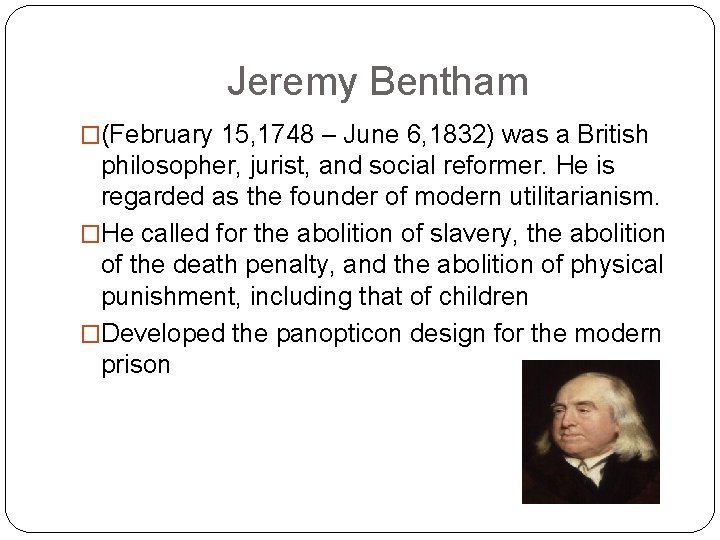
Jeremy Bentham �(February 15, 1748 – June 6, 1832) was a British philosopher, jurist, and social reformer. He is regarded as the founder of modern utilitarianism. �He called for the abolition of slavery, the abolition of the death penalty, and the abolition of physical punishment, including that of children �Developed the panopticon design for the modern prison
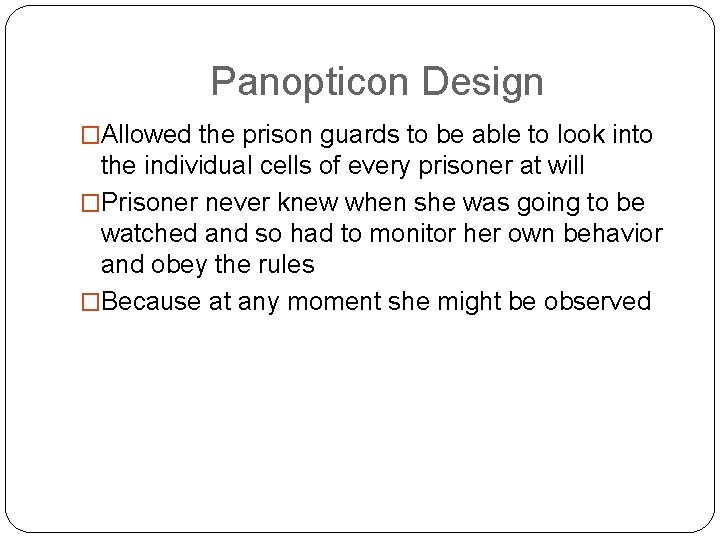
Panopticon Design �Allowed the prison guards to be able to look into the individual cells of every prisoner at will �Prisoner never knew when she was going to be watched and so had to monitor her own behavior and obey the rules �Because at any moment she might be observed
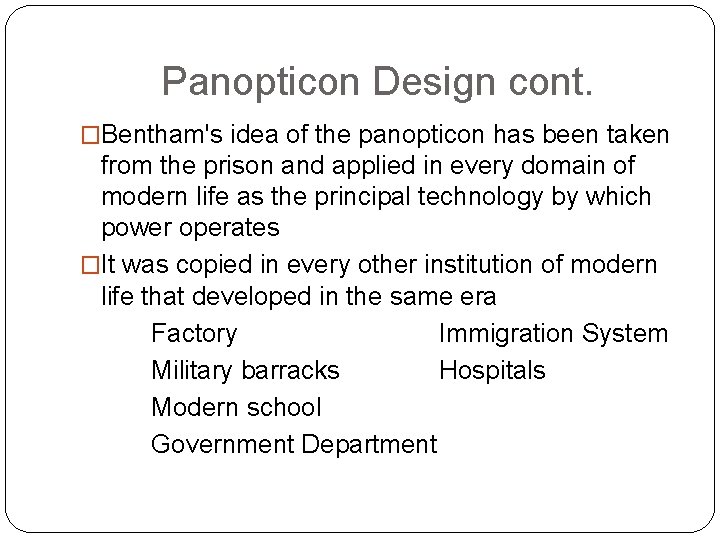
Panopticon Design cont. �Bentham's idea of the panopticon has been taken from the prison and applied in every domain of modern life as the principal technology by which power operates �It was copied in every other institution of modern life that developed in the same era Factory Immigration System Military barracks Hospitals Modern school Government Department
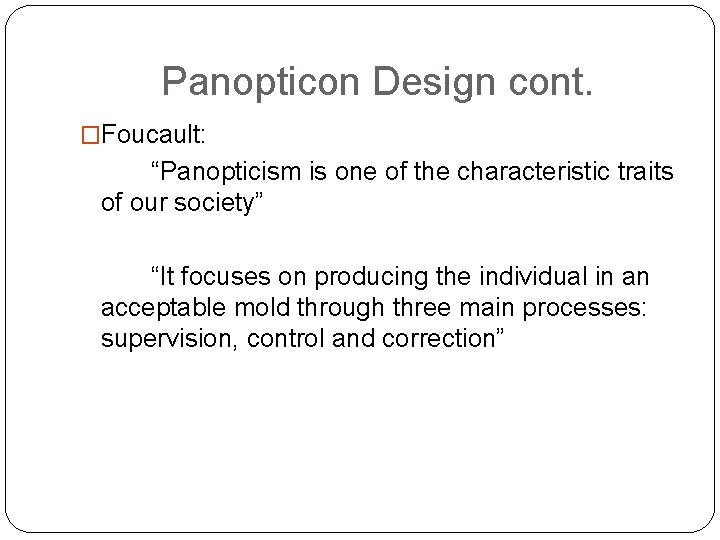
Panopticon Design cont. �Foucault: “Panopticism is one of the characteristic traits of our society” “It focuses on producing the individual in an acceptable mold through three main processes: supervision, control and correction”
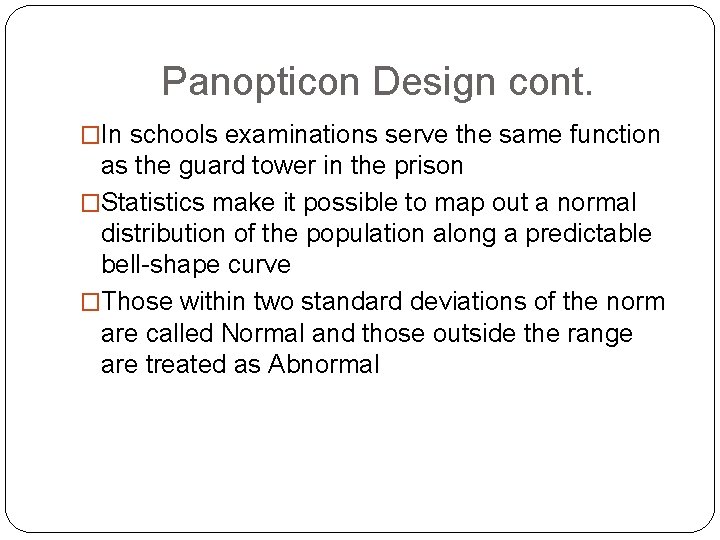
Panopticon Design cont. �In schools examinations serve the same function as the guard tower in the prison �Statistics make it possible to map out a normal distribution of the population along a predictable bell-shape curve �Those within two standard deviations of the norm are called Normal and those outside the range are treated as Abnormal
Power/Knowledge �Human sciences is far from maintaining a neutral or objective stance in relation to political and social issues �Provides the tool for the production of modern practices of governing peoples lives �Medicine, psychiatry, psychology, and education in particular with enthusiastic complicity(state of being involved with others in wrongdoing) in the operation of power in peoples lives
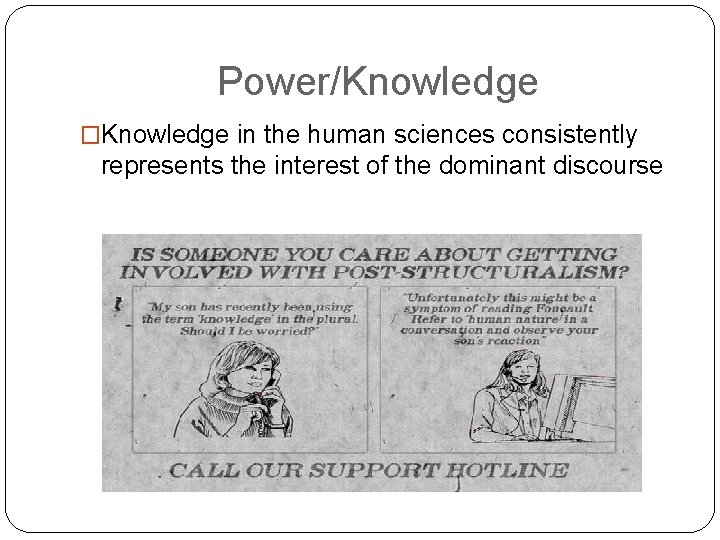
Power/Knowledge �Knowledge in the human sciences consistently represents the interest of the dominant discourse
Confessional Society �Process of the government of peoples lives in ways that produce ourselves to fit the dominant norms by confessing our inner deviations from norms and then to set about aligning ourselves more fully with those norms �Use of counseling as a social practice where people go to confess. �As a result of confessional society counselors should consider whether or not they are being used to adjust people to fit the social norms of the day (one size fits all)
Dividing Practices �Those that mark out and define the social categories in a social sphere that will be used to allocate status to individuals as legitimate or not, as having a voice that can be heard or that will be ignored �Separates the mad and the sane, the sick and the healthy, the criminal and the law abiding , the good student and the poor student, the normal and the abnormal �Every society has them
Advantages for Counselors of a Poststructuralist Analysis of Power �It helps us see that power does not always operate in terms of structures �Allows a more extensive vision of the operation of power �It spotlights the practices of power in counseling itself �It focuses our attention on its cultural nature
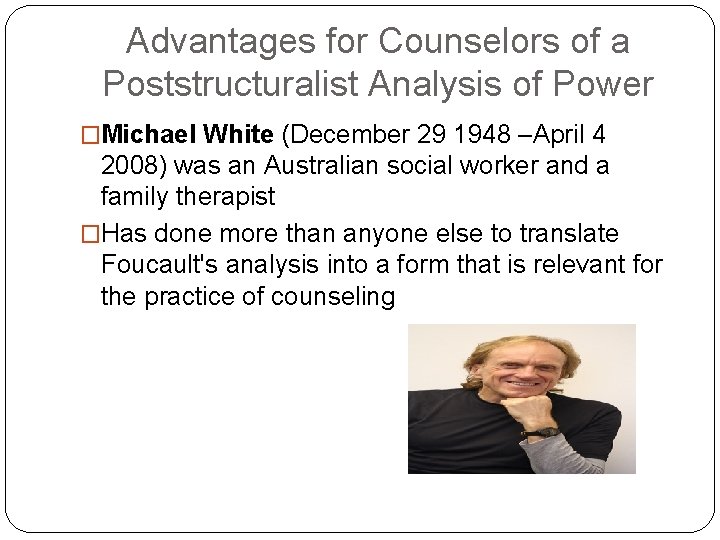
Advantages for Counselors of a Poststructuralist Analysis of Power �Michael White (December 29 1948 –April 4 2008) was an Australian social worker and a family therapist �Has done more than anyone else to translate Foucault's analysis into a form that is relevant for the practice of counseling
The End