
Power and Performance Analysis of PDA Architectures 6
- Slides: 25
Power and Performance Analysis of PDA Architectures 6. 893 Advanced VLSI Computer Architecture Fall 2000 Robert Lee Ripal Nathuji
Power and Performance Analysis of PDA Architectures Motivation • Provide standard performance and power benchmarks for PDA architectures • Run benchmarks on existing platforms and hypothesize areas of weakness
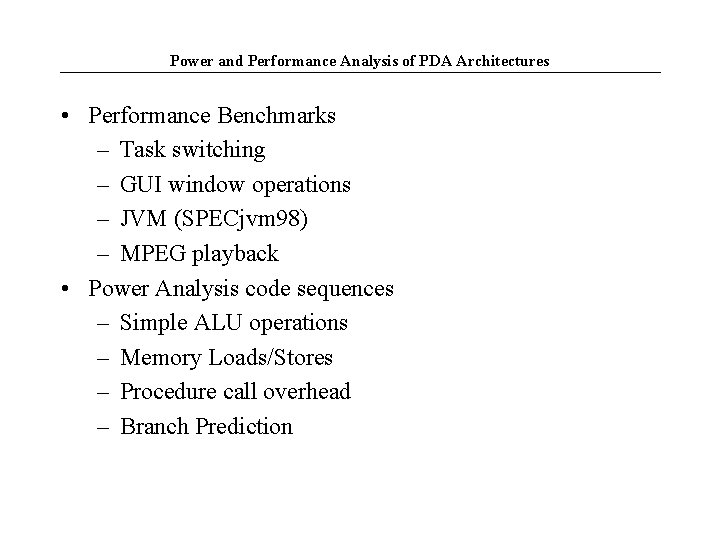
Power and Performance Analysis of PDA Architectures • Performance Benchmarks – Task switching – GUI window operations – JVM (SPECjvm 98) – MPEG playback • Power Analysis code sequences – Simple ALU operations – Memory Loads/Stores – Procedure call overhead – Branch Prediction
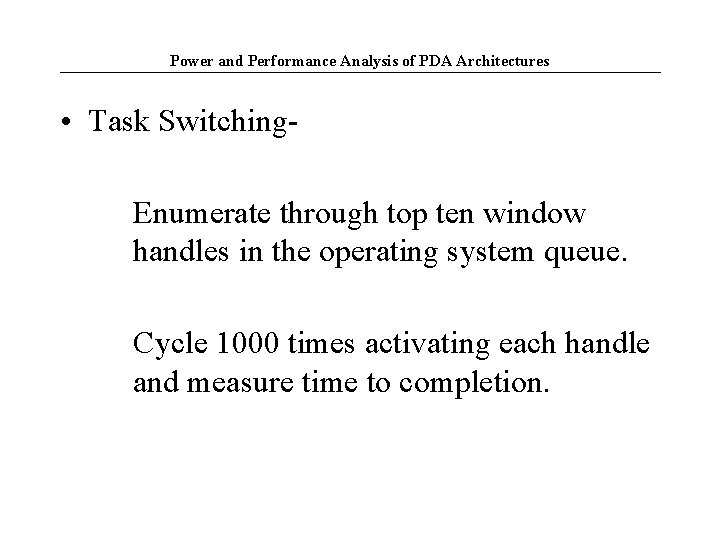
Power and Performance Analysis of PDA Architectures • Task Switching. Enumerate through top ten window handles in the operating system queue. Cycle 1000 times activating each handle and measure time to completion.
Power and Performance Analysis of PDA Architectures • GUI window operations. Creation of single window with multiple MFC elements (command bar, text fields, label…etc). Repositioned window forcing system to redraw 1000 times and measured time to completion.
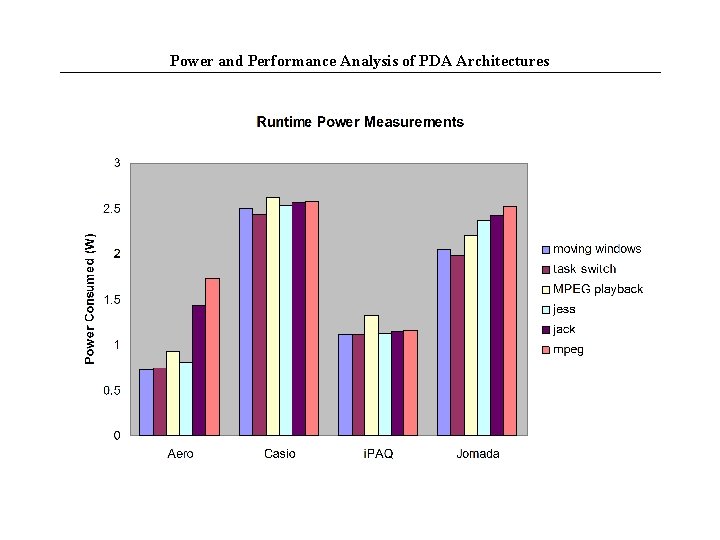
Power and Performance Analysis of PDA Architectures • JVM (SPECjvm 98) -jess: LISP like expert shell system -jack: parser generator modeled after yac -mpeg: MPEG layer-3 decoding
Power and Performance Analysis of PDA Architectures • MPEG playback Used Pocket. TV to play an MPEG clip (1. 06 MB). Measured power and subjectively judged quality of playback.
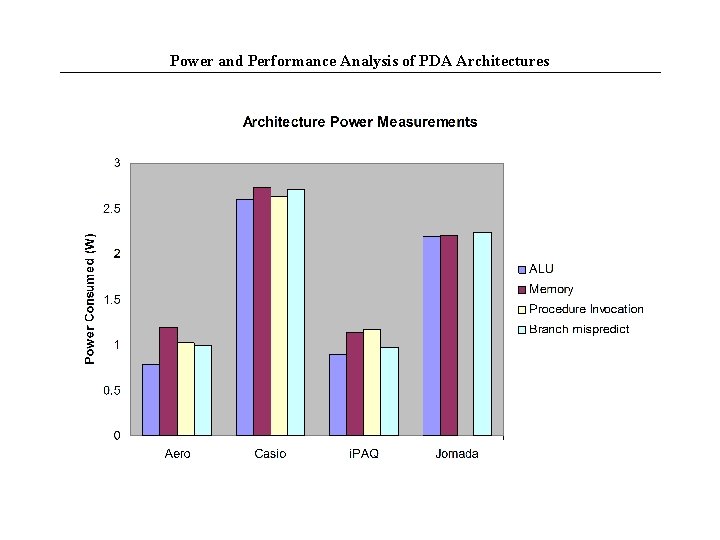
Power and Performance Analysis of PDA Architectures • ALU Test. Chose two distinct registers and performed addition, subtraction, and multiplication operations. Measured power during loop of instructions.
Power and Performance Analysis of PDA Architectures • Memory Loads/Stores. Read value from memory and write value back to same address. Ensures 100% cache hit. Measured power during loop of instructions.
Power and Performance Analysis of PDA Architectures • Procedure Call Overhead. Motivation: After looking at assembly code generated by GUI benchmarks, large percentage of instructions were related to operating system level or shared library call outs. Called a procedure with four arguments. Action of procedure was to simply return. Measured power during loop.
Power and Performance Analysis of PDA Architectures • Branch Prediction. Randomly jump between 8 lines of code. After jumping program moves back to initial position through an unconditional branch. Measured power during loop.
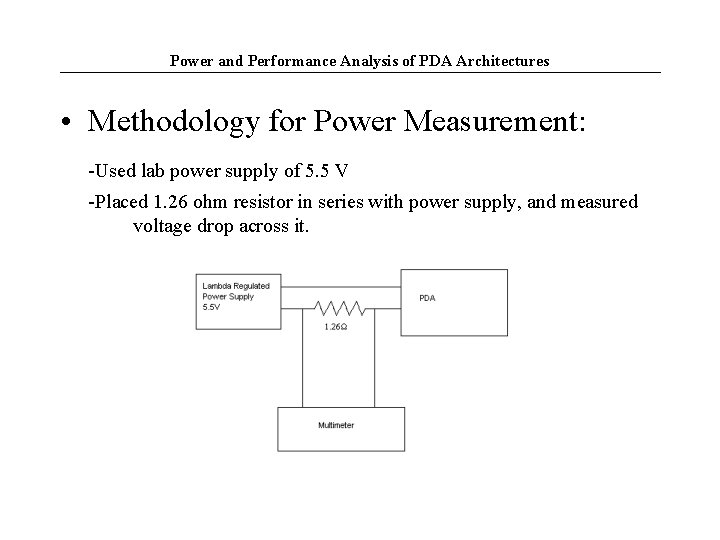
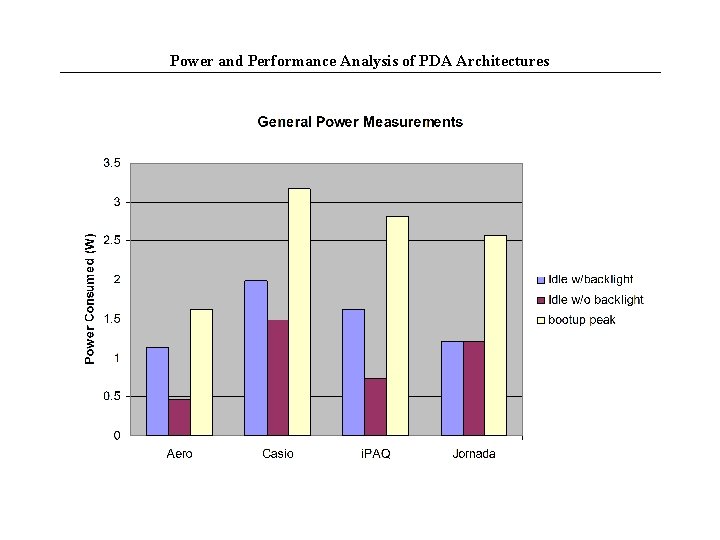
Power and Performance Analysis of PDA Architectures • Methodology for Power Measurement: -Used lab power supply of 5. 5 V -Placed 1. 26 ohm resistor in series with power supply, and measured voltage drop across it.
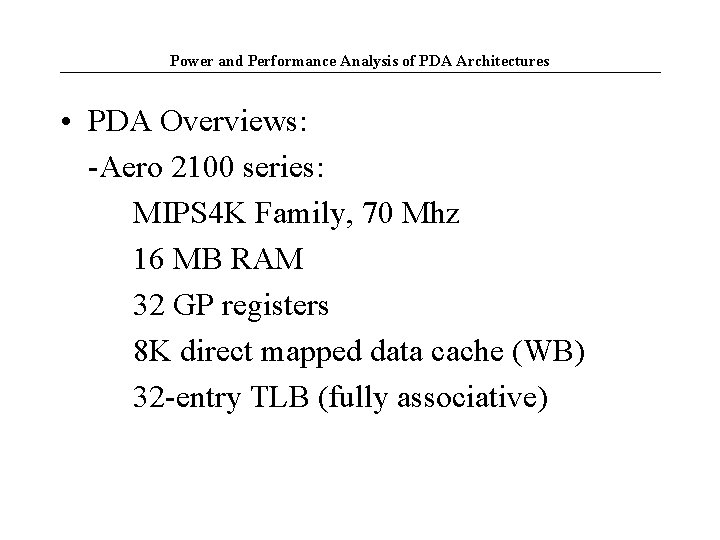
Power and Performance Analysis of PDA Architectures • PDA Overviews: -Aero 2100 series: MIPS 4 K Family, 70 Mhz 16 MB RAM 32 GP registers 8 K direct mapped data cache (WB) 32 -entry TLB (fully associative)
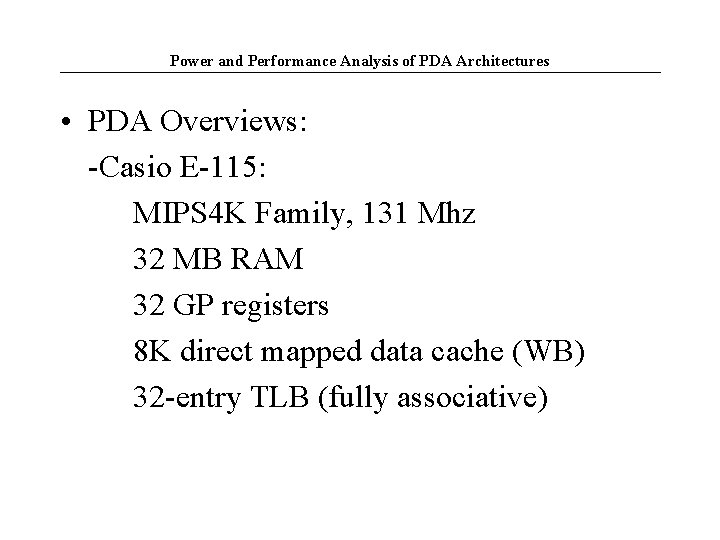
Power and Performance Analysis of PDA Architectures • PDA Overviews: -Casio E-115: MIPS 4 K Family, 131 Mhz 32 MB RAM 32 GP registers 8 K direct mapped data cache (WB) 32 -entry TLB (fully associative)
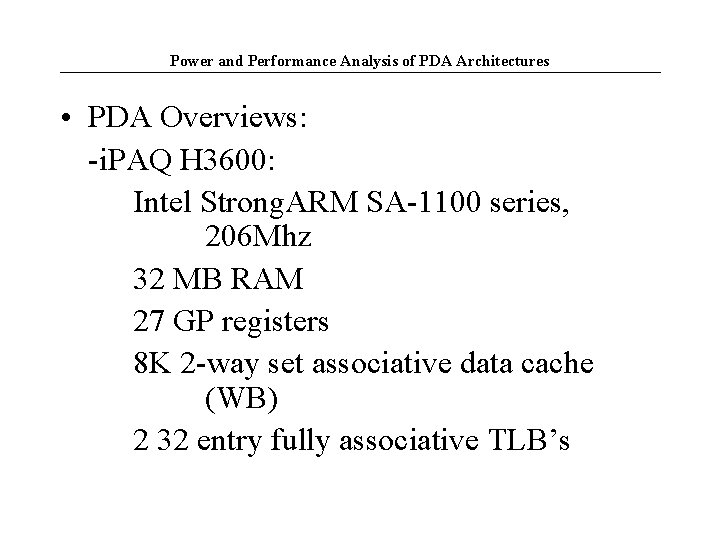
Power and Performance Analysis of PDA Architectures • PDA Overviews: -i. PAQ H 3600: Intel Strong. ARM SA-1100 series, 206 Mhz 32 MB RAM 27 GP registers 8 K 2 -way set associative data cache (WB) 2 32 entry fully associative TLB’s
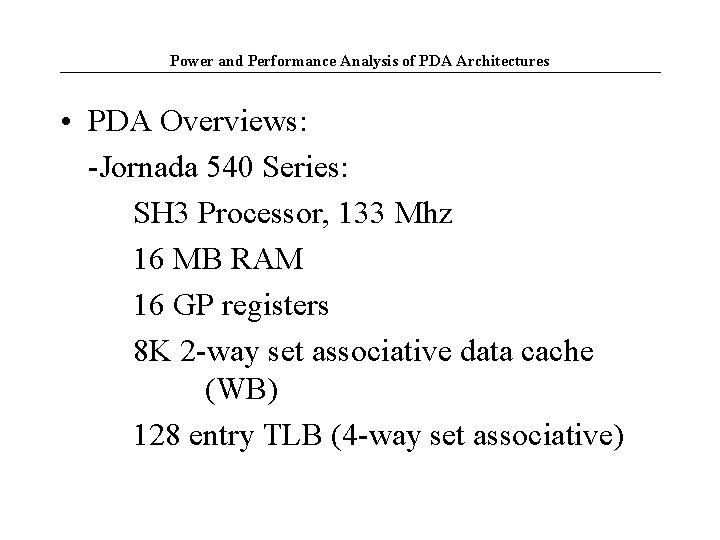
Power and Performance Analysis of PDA Architectures • PDA Overviews: -Jornada 540 Series: SH 3 Processor, 133 Mhz 16 MB RAM 16 GP registers 8 K 2 -way set associative data cache (WB) 128 entry TLB (4 -way set associative)
Power and Performance Analysis of PDA Architectures • Results - Performance Tests - General Power Measurements - Runtime Power Measurements - Architecture Power Measurements
Power and Performance Analysis of PDA Architectures
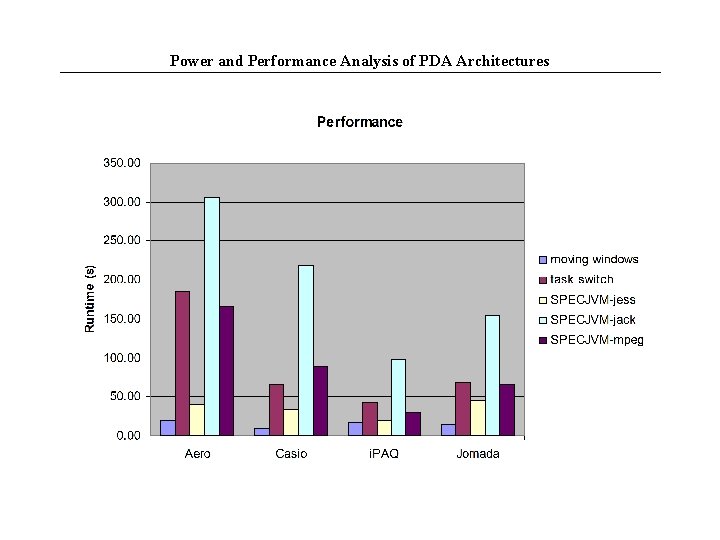
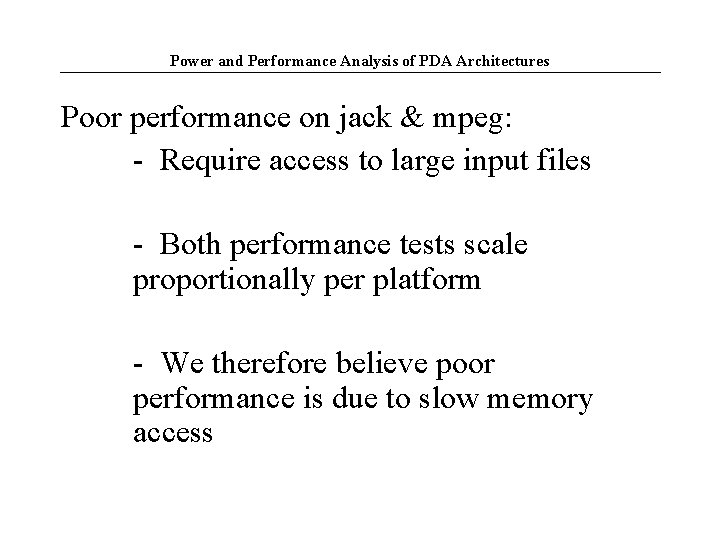
Power and Performance Analysis of PDA Architectures Poor performance on jack & mpeg: - Require access to large input files - Both performance tests scale proportionally per platform - We therefore believe poor performance is due to slow memory access
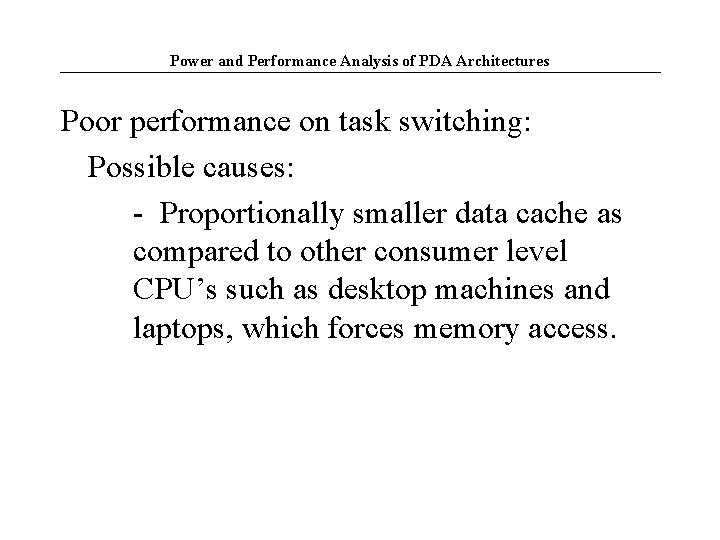
Power and Performance Analysis of PDA Architectures Poor performance on task switching: Possible causes: - Proportionally smaller data cache as compared to other consumer level CPU’s such as desktop machines and laptops, which forces memory access.
Power and Performance Analysis of PDA Architectures
Power and Performance Analysis of PDA Architectures
Power and Performance Analysis of PDA Architectures General trends between platforms seem similar. Interesting observation: Aero and Jornada peak more on memory intensive tests. Both have 16 MB of RAM as opposed to 32 MB of i. PAQ and Casio. Could be due to memory fragmentation.
Power and Performance Analysis of PDA Architectures
Power and Performance Analysis of PDA Architectures Conclusions • Current PDAs suffer issues similar to issues in desktop and laptop computers (memory latency, data caching…) • Particularly weak areas seem to be task switching and file I/O