
Power Amplifiers Slide 1 Definitions In smallsignal amplifiers
- Slides: 32
Power Amplifiers
Slide 1 Definitions In small-signal amplifiers the main factors are • amplification • linearity • gain Large-signal or power amplifiers function primarily to provide sufficient power to drive the output device. These amplifier circuits will handle large voltage signals and high current levels. The main factors are • efficiency • maximum power capability • impedance matching to the output device
Amplifier Types Slide 2 • Class A • Class B • Class AB • Class C • Class D
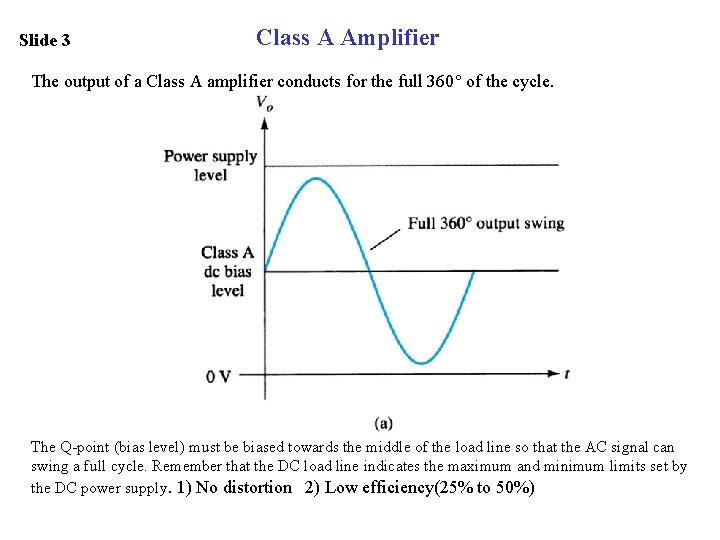
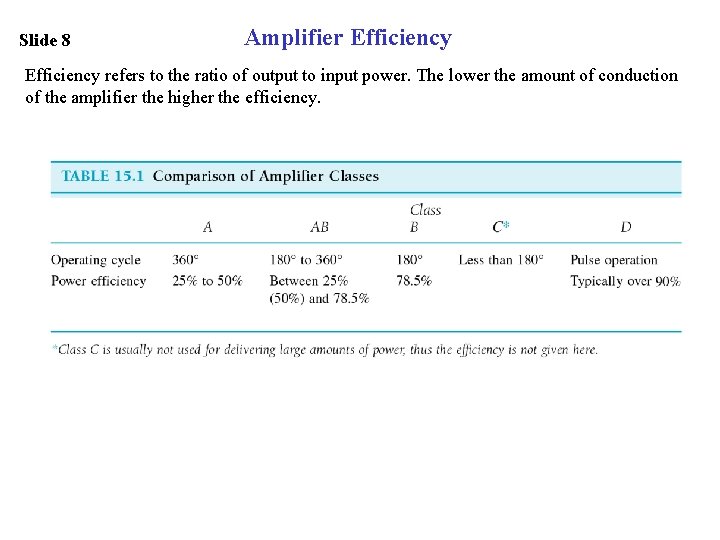
Slide 3 Class A Amplifier The output of a Class A amplifier conducts for the full 360 of the cycle. The Q-point (bias level) must be biased towards the middle of the load line so that the AC signal can swing a full cycle. Remember that the DC load line indicates the maximum and minimum limits set by the DC power supply. 1) No distortion 2) Low efficiency(25% to 50%)
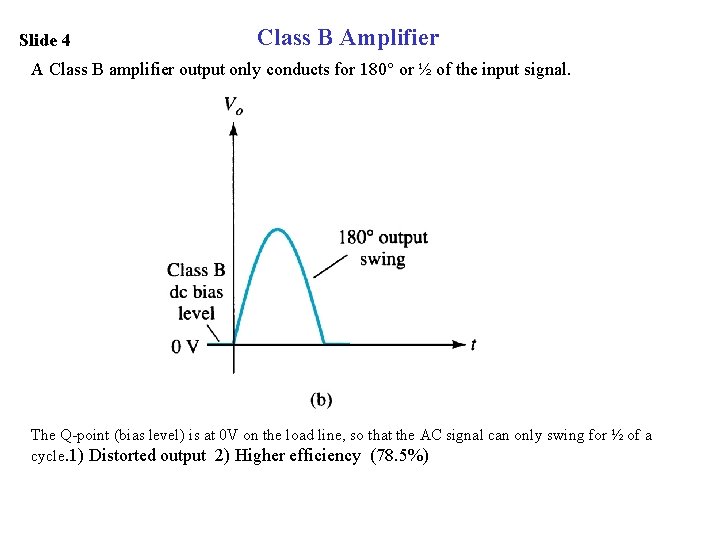
Slide 4 Class B Amplifier A Class B amplifier output only conducts for 180 or ½ of the input signal. The Q-point (bias level) is at 0 V on the load line, so that the AC signal can only swing for ½ of a cycle. 1) Distorted output 2) Higher efficiency (78. 5%)
Slide 5 Class AB Amplifier This amplifier is in between the Class A and Class B. The Q-point (bias level) is above the Class B but below the Class A. The output conducts between 180 and 360 of the AC input signal. 1) Lower distortion than Class B 2) Higher efficiency
Slide 6 Class C The output of the Class C conducts for less than 180 of the AC cycle. The Q-point (bias level) is at cutoff, the output signal is very small. 1) Higher efficiency (90%)
Slide 7 Class D The Class D output is more like a pulse. It does not resemble the AC sinewave input. 1) Very high efficiency (> 90%)
Slide 8 Amplifier Efficiency refers to the ratio of output to input power. The lower the amount of conduction of the amplifier the higher the efficiency.
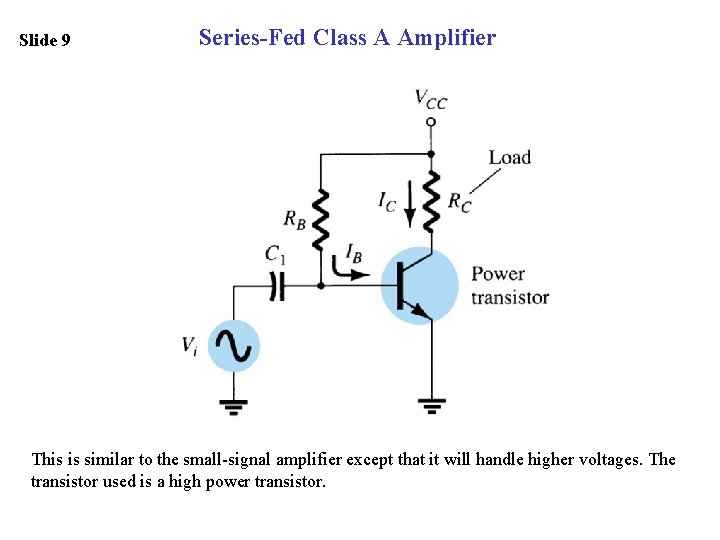
Slide 9 Series-Fed Class A Amplifier This is similar to the small-signal amplifier except that it will handle higher voltages. The transistor used is a high power transistor.
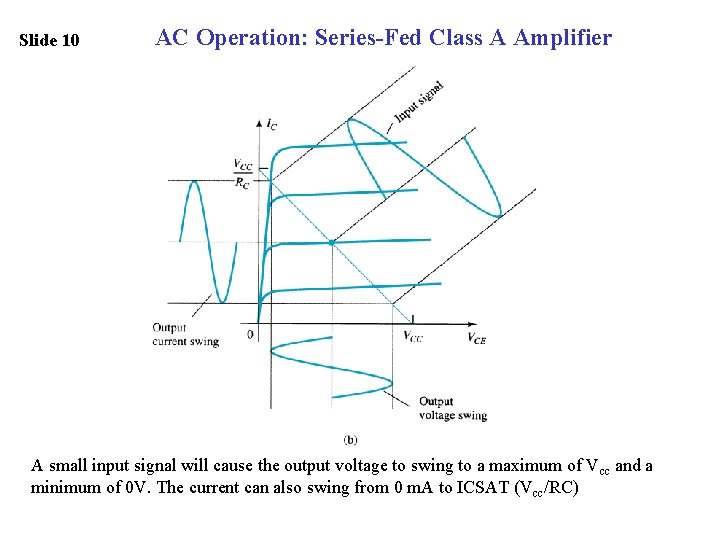
Slide 10 AC Operation: Series-Fed Class A Amplifier A small input signal will cause the output voltage to swing to a maximum of Vcc and a minimum of 0 V. The current can also swing from 0 m. A to ICSAT (Vcc/RC)
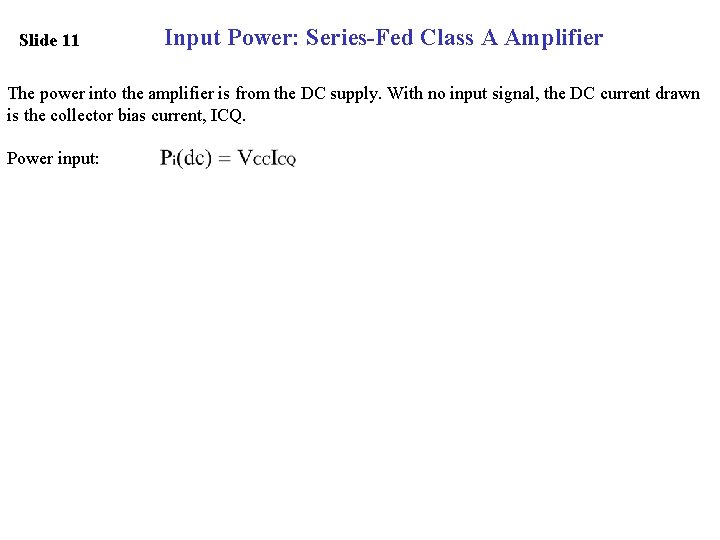
Slide 11 Input Power: Series-Fed Class A Amplifier The power into the amplifier is from the DC supply. With no input signal, the DC current drawn is the collector bias current, ICQ. Power input:
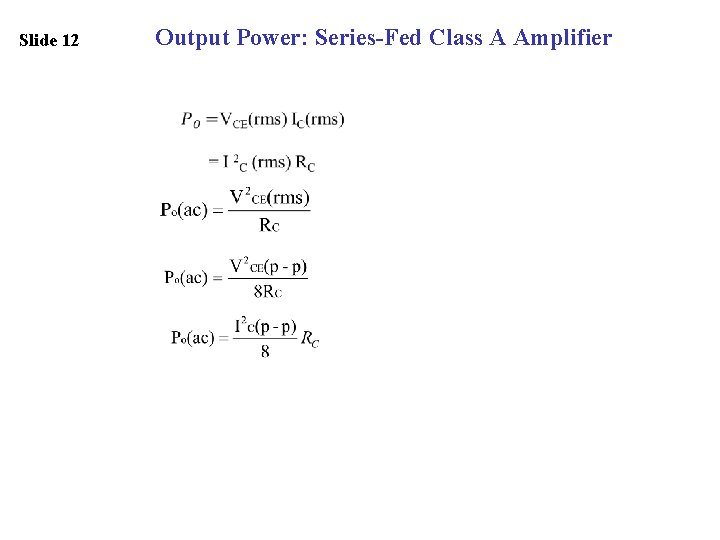
Slide 12 Output Power: Series-Fed Class A Amplifier
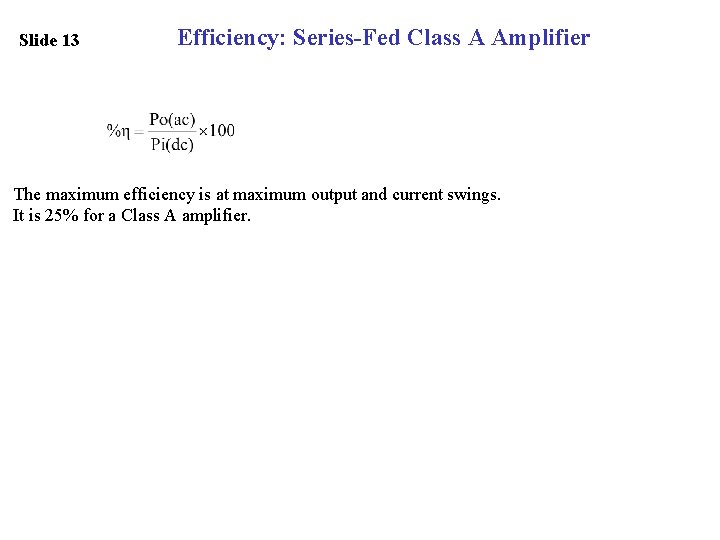
Slide 13 Efficiency: Series-Fed Class A Amplifier The maximum efficiency is at maximum output and current swings. It is 25% for a Class A amplifier.
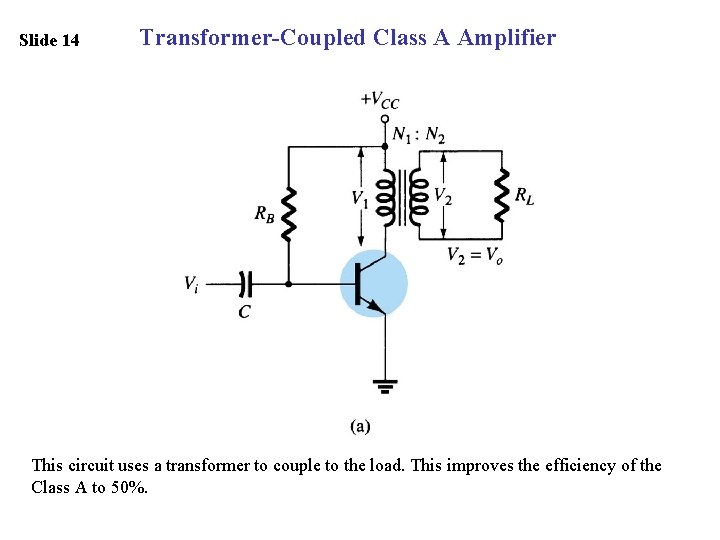
Slide 14 Transformer-Coupled Class A Amplifier This circuit uses a transformer to couple to the load. This improves the efficiency of the Class A to 50%.
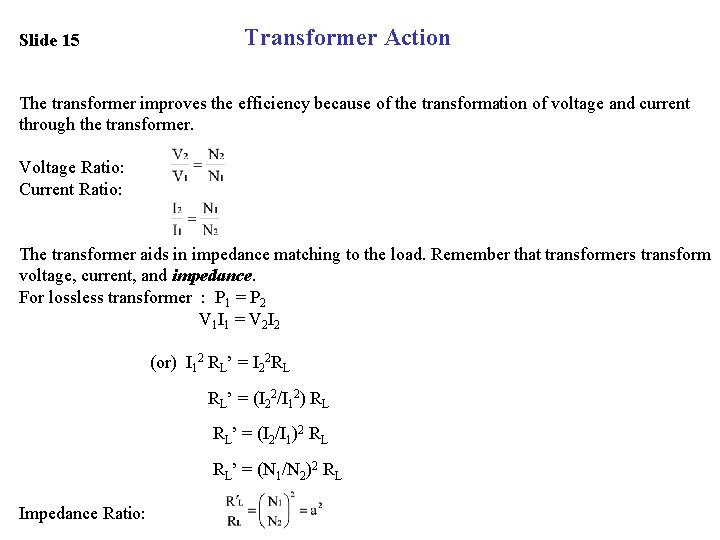
Slide 15 Transformer Action The transformer improves the efficiency because of the transformation of voltage and current through the transformer. Voltage Ratio: Current Ratio: The transformer aids in impedance matching to the load. Remember that transformers transform voltage, current, and impedance. For lossless transformer : P 1 = P 2 V 1 I 1 = V 2 I 2 (or) I 12 RL’ = I 22 RL RL’ = (I 22/I 12) RL RL’ = (I 2/I 1)2 RL RL’ = (N 1/N 2)2 RL Impedance Ratio:
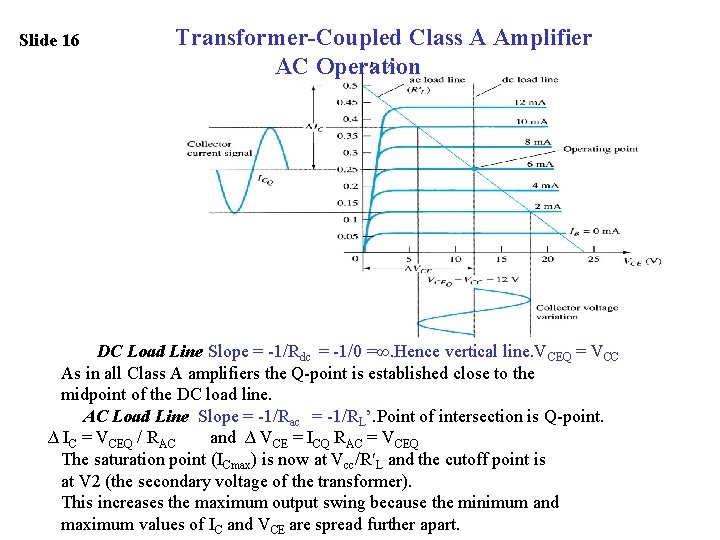
Slide 16 Transformer-Coupled Class A Amplifier AC Operation DC Load Line Slope = -1/Rdc = -1/0 =∞. Hence vertical line. VCEQ = VCC As in all Class A amplifiers the Q-point is established close to the midpoint of the DC load line. AC Load Line Slope = -1/Rac = -1/RL’. Point of intersection is Q-point. ∆ IC = VCEQ / RAC and ∆ VCE = ICQ RAC = VCEQ The saturation point (ICmax) is now at Vcc/R L and the cutoff point is at V 2 (the secondary voltage of the transformer). This increases the maximum output swing because the minimum and maximum values of IC and VCE are spread further apart.
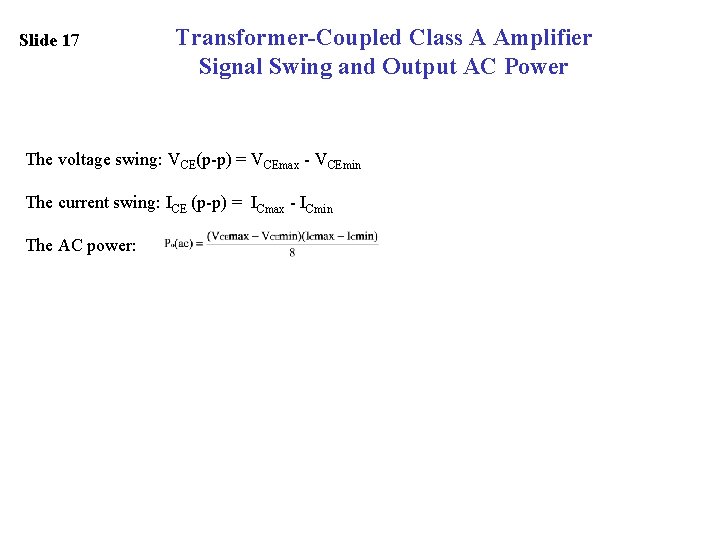
Slide 17 Transformer-Coupled Class A Amplifier Signal Swing and Output AC Power The voltage swing: VCE(p-p) = VCEmax - VCEmin The current swing: ICE (p-p) = ICmax - ICmin The AC power:
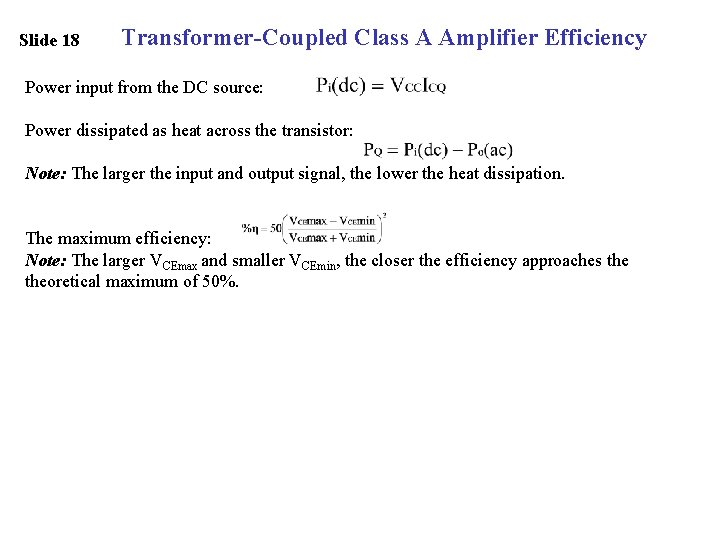
Slide 18 Transformer-Coupled Class A Amplifier Efficiency Power input from the DC source: Power dissipated as heat across the transistor: Note: The larger the input and output signal, the lower the heat dissipation. The maximum efficiency: Note: The larger VCEmax and smaller VCEmin, the closer the efficiency approaches theoretical maximum of 50%.
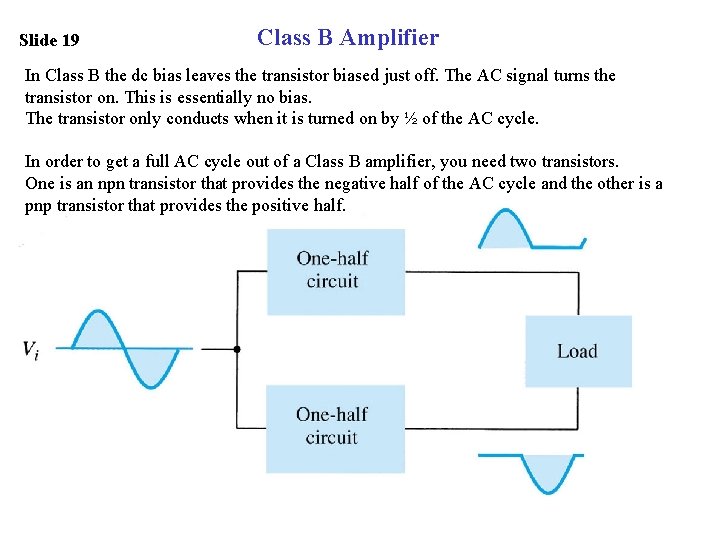
Slide 19 Class B Amplifier In Class B the dc bias leaves the transistor biased just off. The AC signal turns the transistor on. This is essentially no bias. The transistor only conducts when it is turned on by ½ of the AC cycle. In order to get a full AC cycle out of a Class B amplifier, you need two transistors. One is an npn transistor that provides the negative half of the AC cycle and the other is a pnp transistor that provides the positive half.
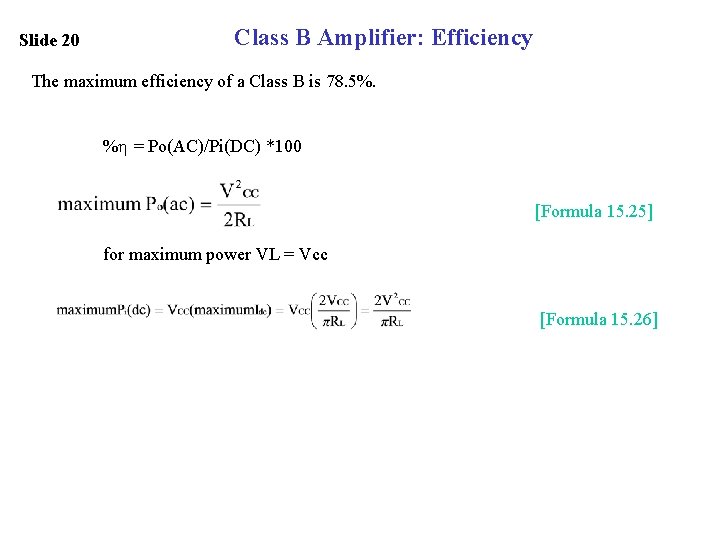
Slide 20 Class B Amplifier: Efficiency The maximum efficiency of a Class B is 78. 5%. % = Po(AC)/Pi(DC) *100 [Formula 15. 25] for maximum power VL = Vcc [Formula 15. 26]
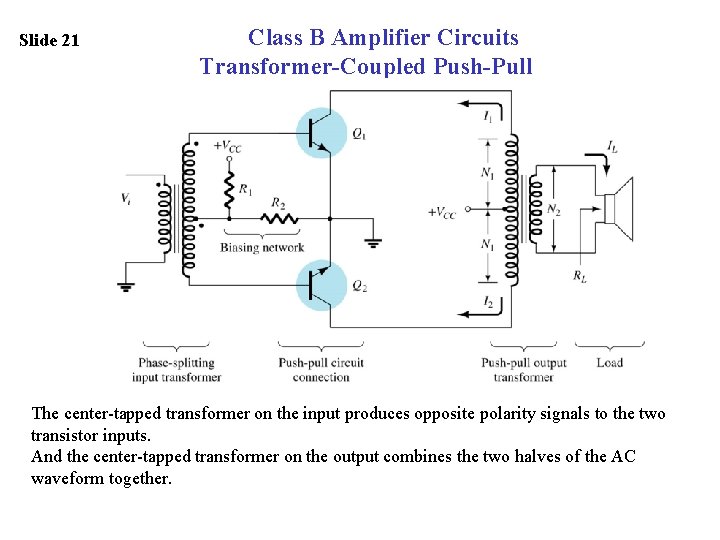
Slide 21 Class B Amplifier Circuits Transformer-Coupled Push-Pull The center-tapped transformer on the input produces opposite polarity signals to the two transistor inputs. And the center-tapped transformer on the output combines the two halves of the AC waveform together.
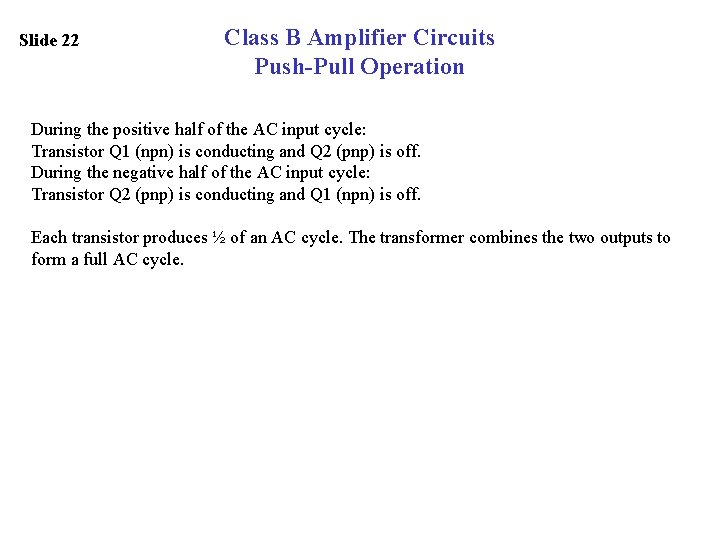
Slide 22 Class B Amplifier Circuits Push-Pull Operation During the positive half of the AC input cycle: Transistor Q 1 (npn) is conducting and Q 2 (pnp) is off. During the negative half of the AC input cycle: Transistor Q 2 (pnp) is conducting and Q 1 (npn) is off. Each transistor produces ½ of an AC cycle. The transformer combines the two outputs to form a full AC cycle.
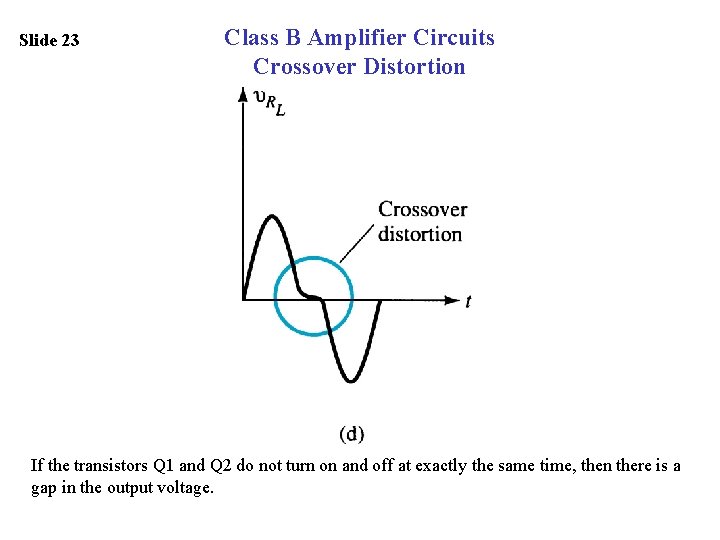
Slide 23 Class B Amplifier Circuits Crossover Distortion If the transistors Q 1 and Q 2 do not turn on and off at exactly the same time, then there is a gap in the output voltage.
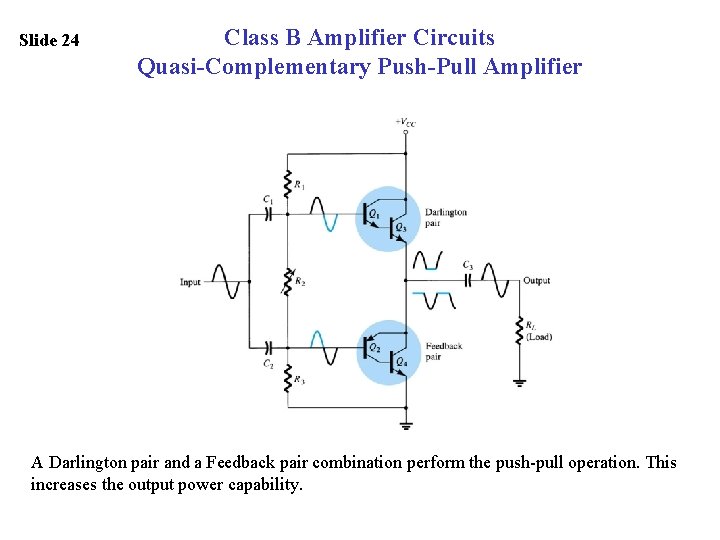
Slide 24 Class B Amplifier Circuits Quasi-Complementary Push-Pull Amplifier A Darlington pair and a Feedback pair combination perform the push-pull operation. This increases the output power capability.
Slide 25 Amplifier Distortion If the output of an amplifier is not a complete AC sinewave, then it is distorting the output. The amplifier is non-linear. This distortion can be analyzed using Fourier analysis. In Fourier analysis any distorted periodic waveform can be broken down into frequency components. These components are harmonics of the fundamental frequency.
Slide 26 Harmonics are integer multiples of a fundamental frequency. Fundamental frequency: 5 k. Hz 1 st harmonic: 1 x 5 k. Hz 2 nd harmonic: 2 x 5 k. Hz 3 rd harmonic: 3 x 5 k. Hz 4 th harmonic: 4 x 5 k. Hz etc. Note that the 1 st and 3 rd harmonics are called odd harmonics and the 2 nd and 4 th are called even harmonics.
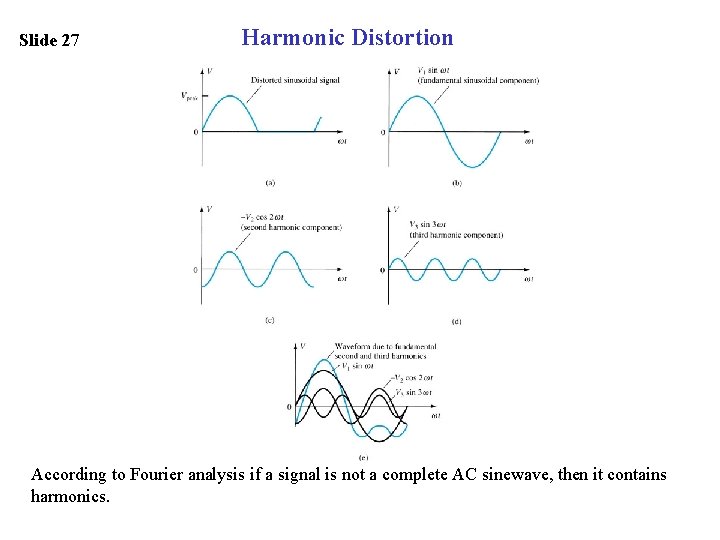
Slide 27 Harmonic Distortion According to Fourier analysis if a signal is not a complete AC sinewave, then it contains harmonics.
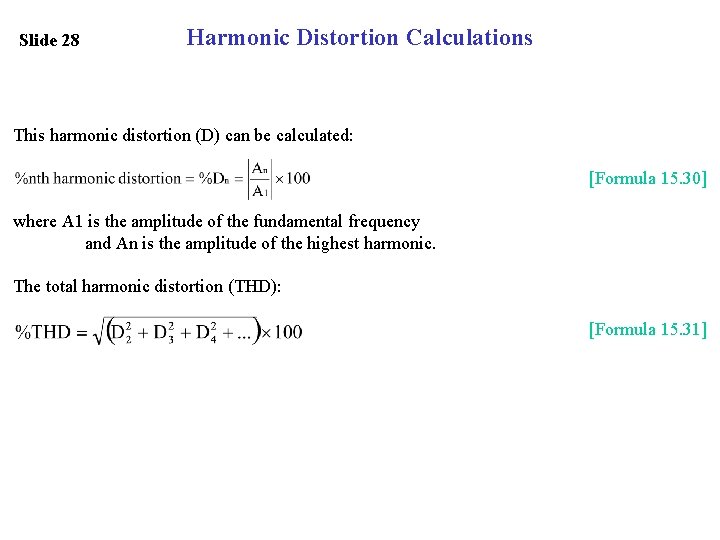
Slide 28 Harmonic Distortion Calculations This harmonic distortion (D) can be calculated: [Formula 15. 30] where A 1 is the amplitude of the fundamental frequency and An is the amplitude of the highest harmonic. The total harmonic distortion (THD): [Formula 15. 31]
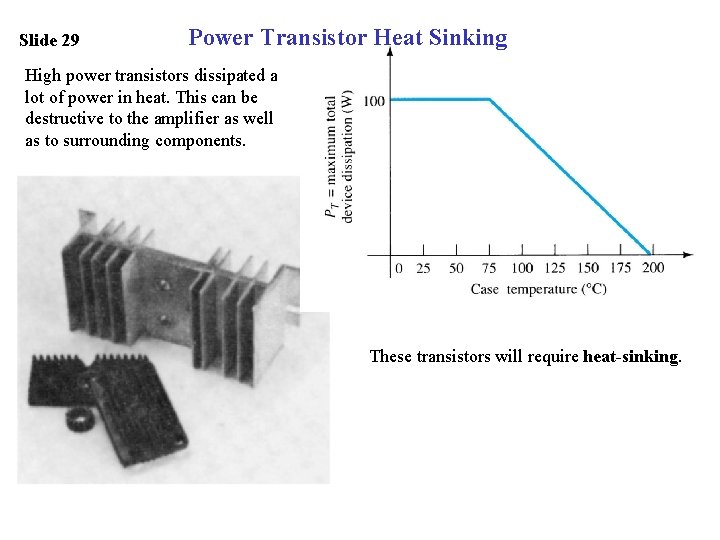
Slide 29 Power Transistor Heat Sinking High power transistors dissipated a lot of power in heat. This can be destructive to the amplifier as well as to surrounding components. These transistors will require heat-sinking.
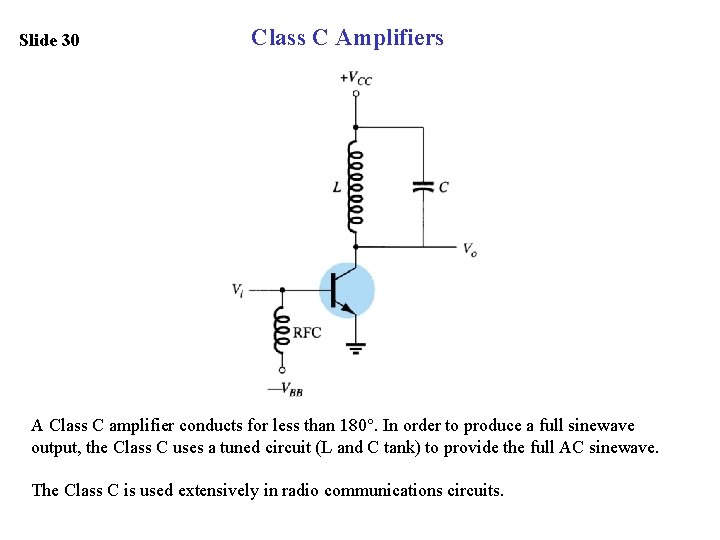
Slide 30 Class C Amplifiers A Class C amplifier conducts for less than 180. In order to produce a full sinewave output, the Class C uses a tuned circuit (L and C tank) to provide the full AC sinewave. The Class C is used extensively in radio communications circuits.
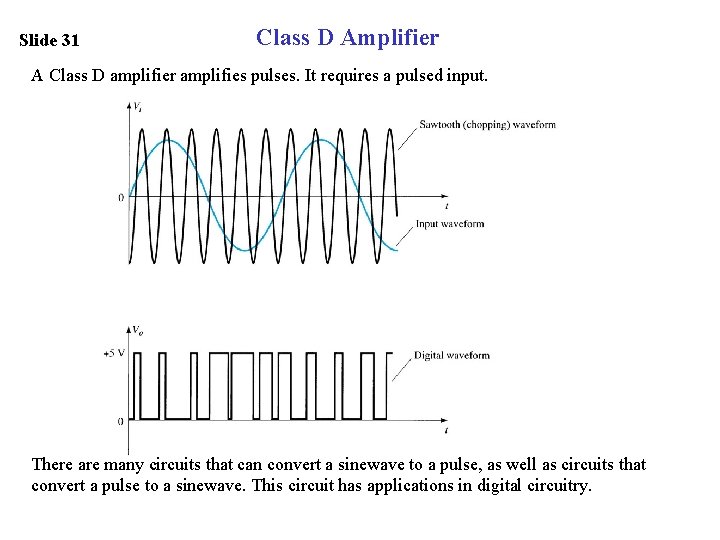
Slide 31 Class D Amplifier A Class D amplifier amplifies pulses. It requires a pulsed input. There are many circuits that can convert a sinewave to a pulse, as well as circuits that convert a pulse to a sinewave. This circuit has applications in digital circuitry.