
Power Amplifier Nonlinearity Estimation and Predistortion with Correlation

- Slides: 15
Power Amplifier Nonlinearity Estimation and Predistortion with Correlation Techniques Mingyuan Li, Ian Galton, Larry Larson, Peter Asbeck University of California, San Diego La Jolla, CA 92093 -0407
Outline l Nonlinearity extraction in frequency and time domain l Correlation techniques for nonlinearity estimation l Mathematical analysis and simulation results l Application in adaptive predistortion and measured results l Summary and conclusion
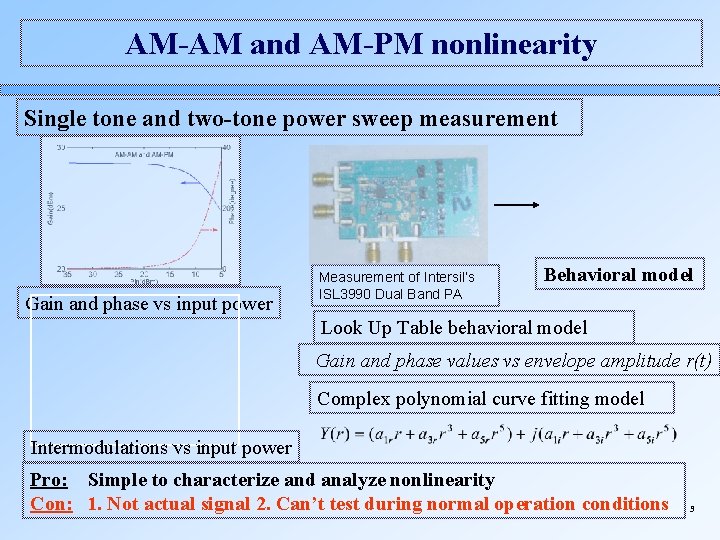
AM-AM and AM-PM nonlinearity Single tone and two-tone power sweep measurement Gain and phase vs input power Measurement of Intersil’s ISL 3990 Dual Band PA Behavioral model Look Up Table behavioral model Gain and phase values vs envelope amplitude r(t) Complex polynomial curve fitting model Intermodulations vs input power Pro: Simple to characterize and analyze nonlinearity Con: 1. Not actual signal 2. Can’t test during normal operation conditions 3
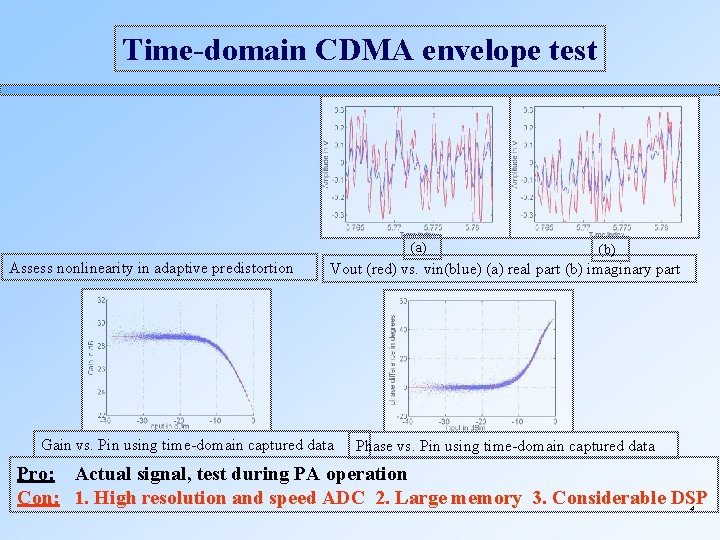
Time-domain CDMA envelope test (a) Assess nonlinearity in adaptive predistortion (b) Vout (red) vs. vin(blue) (a) real part (b) imaginary part Gain vs. Pin using time-domain captured data Phase vs. Pin using time-domain captured data Pro: Actual signal, test during PA operation Con: 1. High resolution and speed ADC 2. Large memory 3. Considerable DSP 4
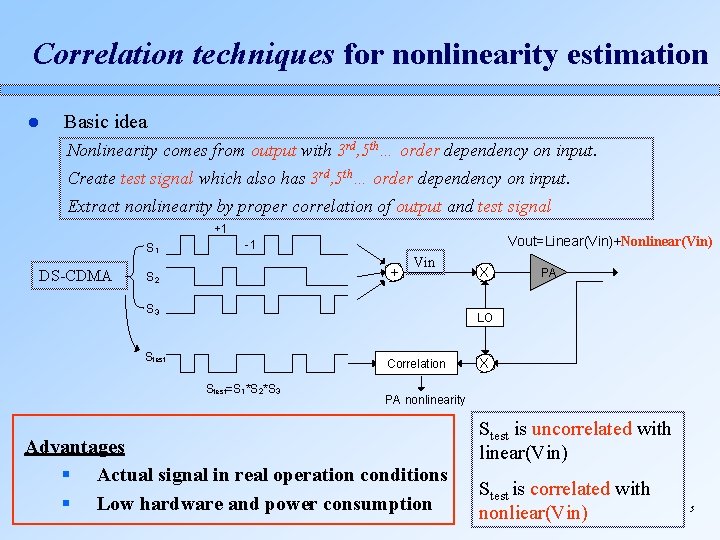
Correlation techniques for nonlinearity estimation l Basic idea Nonlinearity comes from output with 3 rd, 5 th… order dependency on input. Create test signal which also has 3 rd, 5 th… order dependency on input. Extract nonlinearity by proper correlation of output and test signal +1 S 1 DS-CDMA Vout=Linear(Vin)+Nonlinear(Vin) -1 + S 2 Vin S 3 X PA LO Stest Correlation Stest=S 1*S 2*S 3 X PA nonlinearity Advantages § Actual signal in real operation conditions § Low hardware and power consumption Stest is uncorrelated with linear(Vin) Stest is correlated with nonliear(Vin) 5
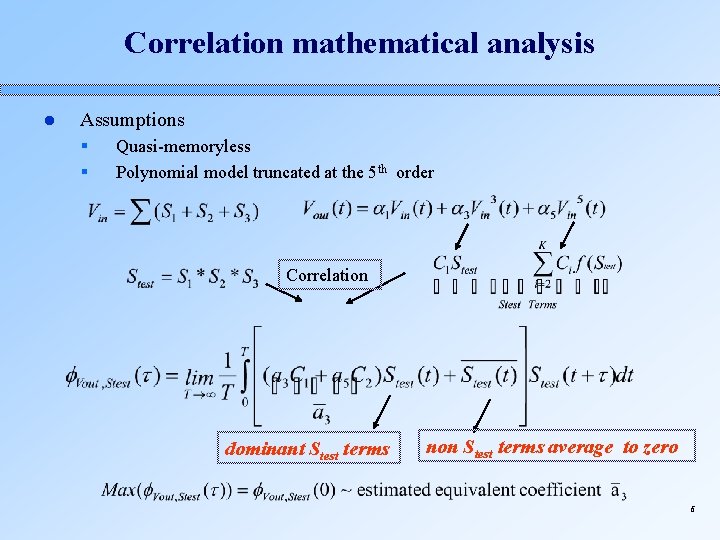
Correlation mathematical analysis l Assumptions § § Quasi-memoryless Polynomial model truncated at the 5 th order Correlation dominant Stest terms non Stest terms average to zero 6
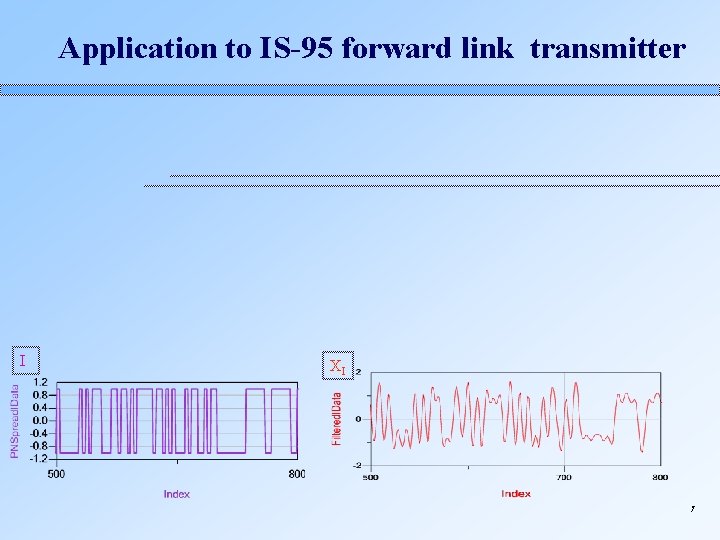
Application to IS-95 forward link transmitter I XI 7
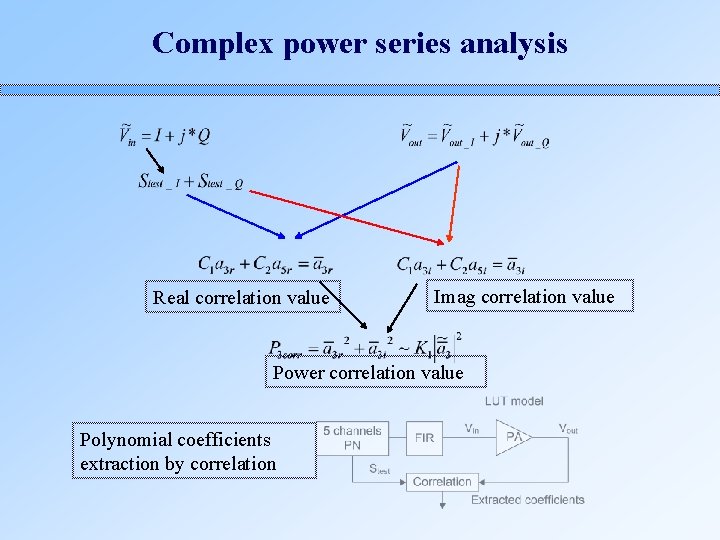
Complex power series analysis Real correlation value Imag correlation value Power correlation value Polynomial coefficients extraction by correlation
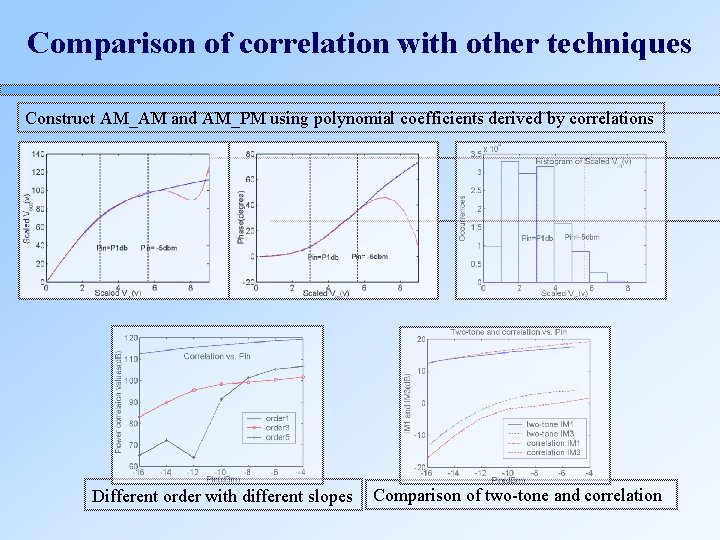
Comparison of correlation with other techniques Construct AM_AM and AM_PM using polynomial coefficients derived by correlations Different order with different slopes Comparison of two-tone and correlation
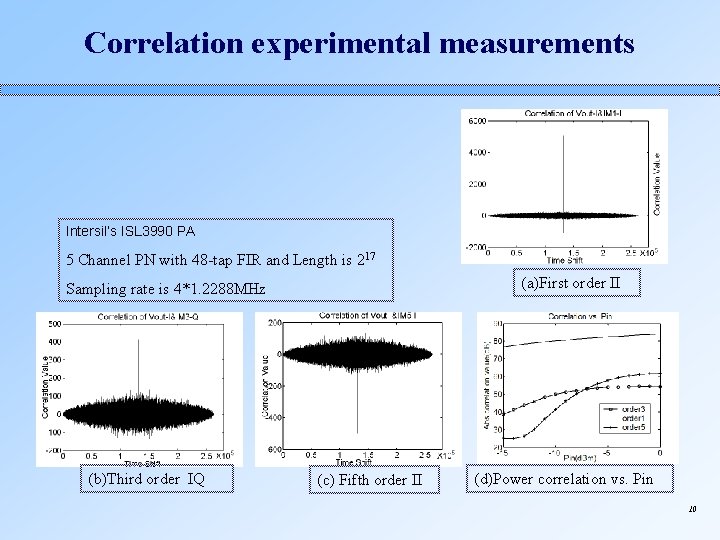
Correlation experimental measurements Intersil’s ISL 3990 PA 5 Channel PN with 48 -tap FIR and Length is 217 (a)First order II Sampling rate is 4*1. 2288 MHz (b)Third order IQ (c) Fifth order II (d)Power correlation vs. Pin 10
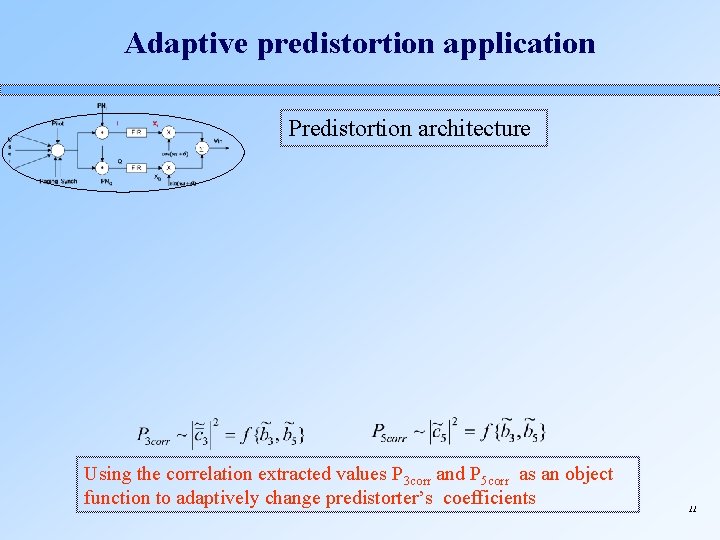
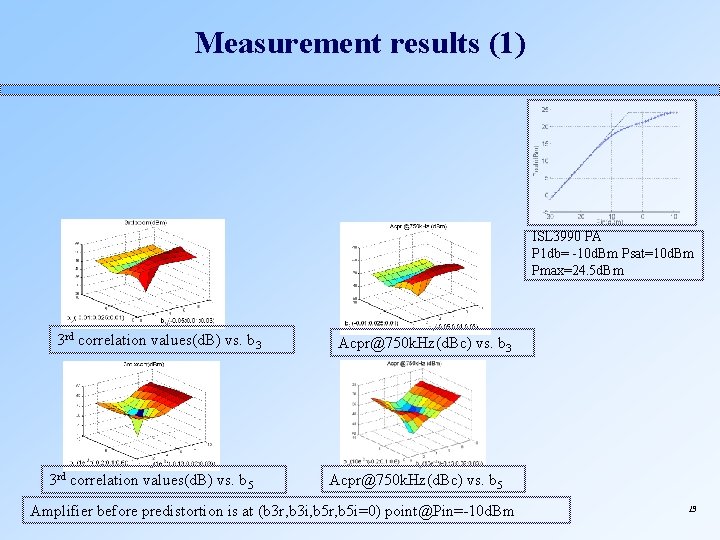
Adaptive predistortion application Predistortion architecture Using the correlation extracted values P 3 corr and P 5 corr as an object function to adaptively change predistorter’s coefficients 11
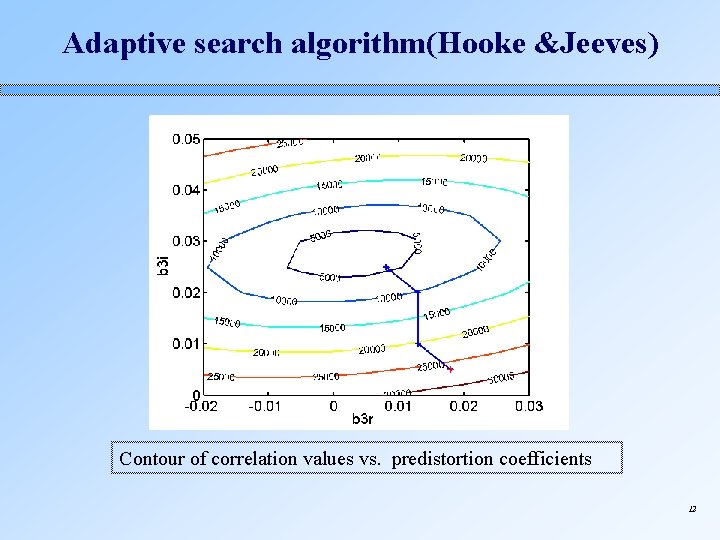
Adaptive search algorithm(Hooke &Jeeves) Contour of correlation values vs. predistortion coefficients 12
Measurement results (1) ISL 3990 PA P 1 db= -10 d. Bm Psat=10 d. Bm Pmax=24. 5 d. Bm 3 rd correlation values(d. B) vs. b 3 3 rd correlation values(d. B) vs. b 5 Acpr@750 k. Hz(d. Bc) vs. b 3 Acpr@750 k. Hz(d. Bc) vs. b 5 Amplifier before predistortion is at (b 3 r, b 3 i, b 5 r, b 5 i=0) point@Pin=-10 d. Bm 13
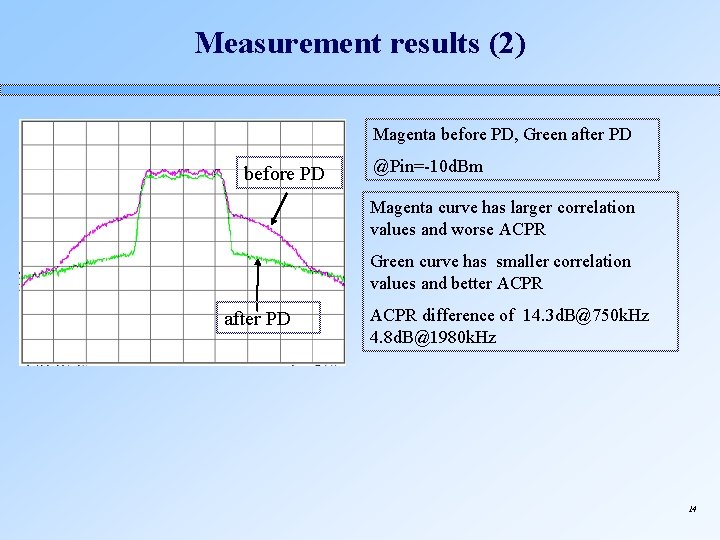
Measurement results (2) Magenta before PD, Green after PD before PD @Pin=-10 d. Bm Magenta curve has larger correlation values and worse ACPR Green curve has smaller correlation values and better ACPR after PD ACPR difference of 14. 3 d. B@750 k. Hz 4. 8 d. B@1980 k. Hz 14
Summary and conclusion l Simple correlation techniques have been used to estimate nonlinearity l Simulation and measurement results show promise of technique l Application in forward link adaptive predistortion transmitter was shown experimentally l Optimization algorithm was developed to adaptively change coefficients l For future, expect that simple analog correlation circuit can be implemented and memory effects can be considered