
Powder density Lab 4 Industrial pharmacy Powder bulk
Powder density Lab 4 Industrial pharmacy
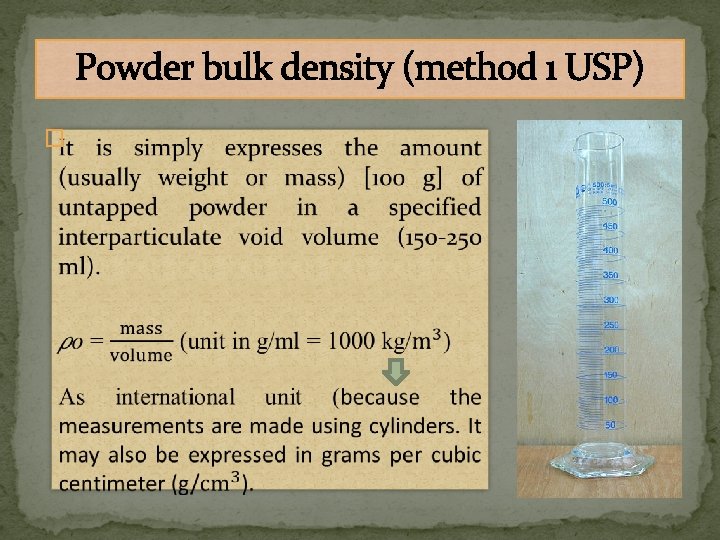
Powder bulk density (method 1 USP) �
Composition of powders and there relation with volume � Powders are composed of: particles and voids. � The volume occupied by a given number of particles depends on how closely they are packed. � The packing of particles depends on: A- shape & size B- cohesiveness C- short-range motion D- external forces.
Tapped density (method 1 USP) Describe the bulk-density of a powder (or granules) after consolidation/compression ("tapping“) the container (100 or 250 ml) of powder (1 min) a measured number of times (either 300 or 250 tap), usually from a predetermined height [14 or 3 mm]. The method of "tapping" is best described as lifting and dropping.

Measuring Bulk density Is determined by pouring pre-sieved (≥ 1 mm) bulk drug into a graduated cylinder (25 o ml with 2 ml readable) via a large funnel and measuring the volume and weight. Measuring tapped density �Tapped density measured by tapping graduated glass measuring cylinder manually or by mechanical device. Note: Devices that rotate the cylinder or vessel during tapping may be preferred to minimize any possible separation of the mass during tapping down.

Types of tapping: 1. Manual tapping 2. Mechanical tapping 1. Manual tapping: The raising and lowering of the cylinder by hand is done either without reference to the height traversed and arbitrary acceleration in both upward and downward directions; the hand remaining in contact with the cylinder at all times (hand tapping). (The cylinder containing the powder is tapped by repeatedly striking its base down onto a hard surface).
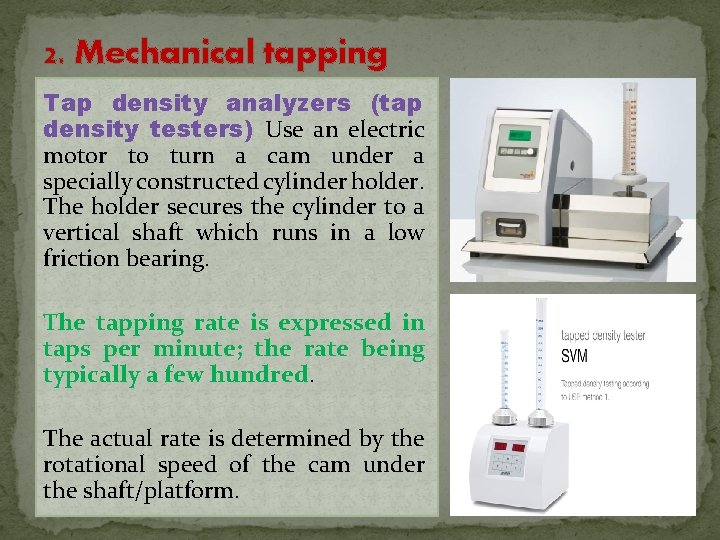
2. Mechanical tapping Tap density analyzers (tap density testers) Use an electric motor to turn a cam under a specially constructed cylinder holder. The holder secures the cylinder to a vertical shaft which runs in a low friction bearing. The tapping rate is expressed in taps per minute; the rate being typically a few hundred. The actual rate is determined by the rotational speed of the cam under the shaft/platform.
� Digital or electromechanical counters are usually incorporated in the device to automatically stop the cam rotation after a predetermined (yet adjustable) number of taps. (Carry out 10, 500, and 1250 taps on the same powder sample and read the corresponding volumes V 10, V 500, and V 1250 to the nearest graduated unit. If the difference between V 500 and V 1250 is ≤ 2 m. L, V 1250 is the tapped volume. If the difference between V 500 and V 1250 > 2 m. L, repeat in increments such as 1250 taps, until the difference between measurements ≤ 2 ml). � The height through which the container falls is (drop height or stroke). It is set by the distance between the highest point on the cam and the striking surface.
How to correct the density problem: Milling 2. Slugging 3. Formulation 1.
Benefits of bulk density: �Important in the consideration the size of high dose capsule product. �The homogeneity of a low dose formulation in which there are large differences in drug and excipient densities. �knowing the dose and formulation density to determine the appropriate size for a capsule formulation.
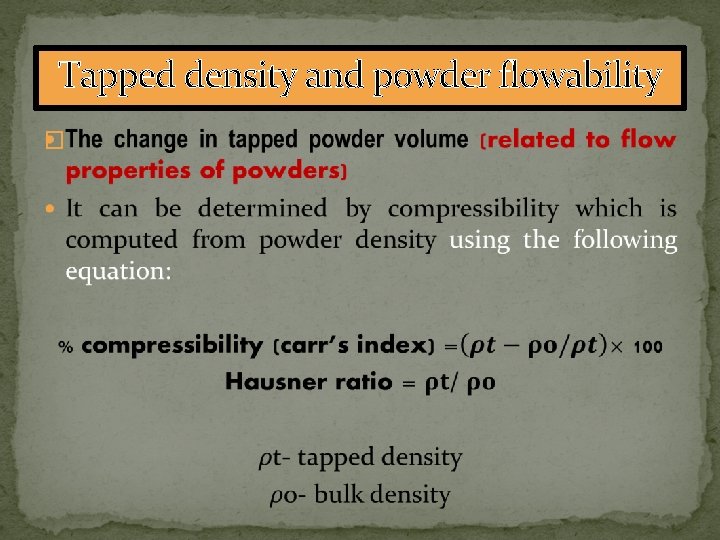
Tapped density and powder flowability �
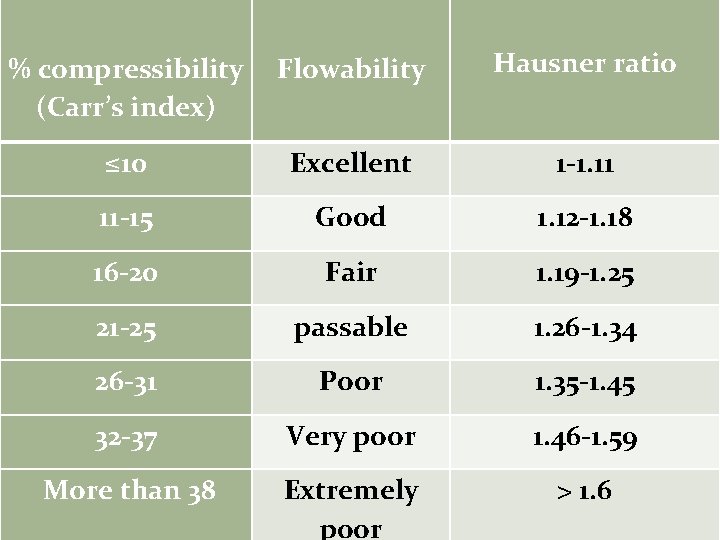
% compressibility (Carr’s index) Flowability Hausner ratio ≤ 10 Excellent 1 -1. 11 11 -15 Good 1. 12 -1. 18 16 -20 Fair 1. 19 -1. 25 21 -25 passable 1. 26 -1. 34 26 -31 Poor 1. 35 -1. 45 32 -37 Very poor 1. 46 -1. 59 More than 38 Extremely poor > 1. 6

Please follow these links to watch the videos: �https: //www. youtube. com/watch? v=ba. FHhei. G 3 H c �https: //www. youtube. com/watch? v=-p. Ea 8 U 40 Pb. A �https: //www. youtube. com/watch? v=72 j. Ul. Idh. Fc. A �https: //www. youtube. com/watch? v=g. Dv. Ebkuhuv c

- Slides: 14