
POVERTY RANKING AT SCHOOLS Presentation to the Western

- Slides: 17
POVERTY RANKING AT SCHOOLS Presentation to the Western Cape Provincial Parliament’s Standing Committee on Education 25 August 2020
PRESENTATION OUTLINE Purpose Background Policy prescripts regarding poverty scoring of schools 2020 per learner allocation Actual no. vs Policy target 2020 No fee vs fee paying learners Dispute of correctness of the Quintile ranking The process and procedures that a school will need to follow to have its quintile ranking changed • Challenges experienced with poverty profiling of schools • Recommendation • • 2
PURPOSE To report on poverty ranking at school level against the 2020 policy Target. 3
BACKGROUND • Section 35(1) of SASA requires the Minister to determine national quintiles for public schools. • Section 39(7) of SASA and Par. 157 of the National Norms and Standards for School Funding (NNSSF) requires the Minister to annually determine and publish information on which quintiles will comprise no fee schools in the following school year. • Section 39(9) of SASA specify that MECs must identify which schools qualify as no fee schools and the MEC must submit the no fee schools list to the Minister of Education for publication as required by Section 39(10) of SASA. • The NNSSF (Par. 100 to 107) provides criteria for a system in terms of which all public schools as well as all learners at these schools can be placed into quintiles, according to financial means. 4
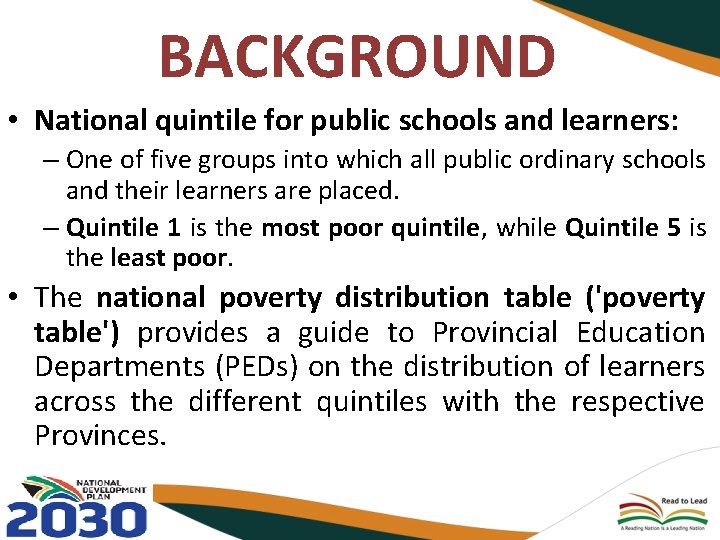
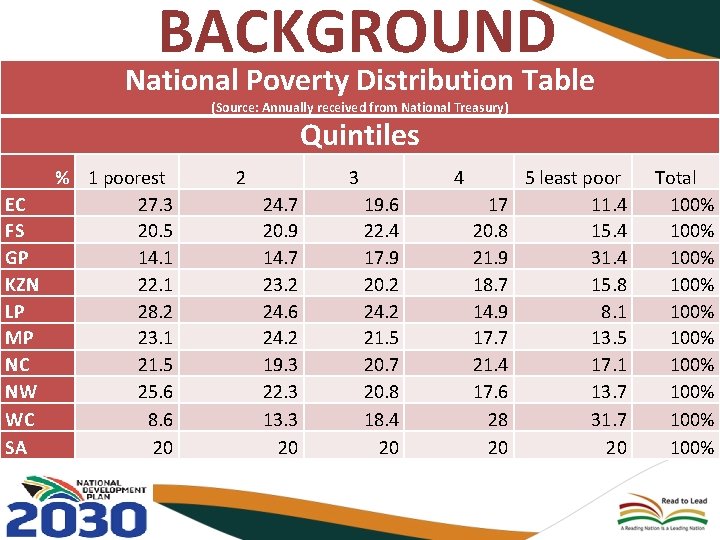
BACKGROUND • National quintile for public schools and learners: – One of five groups into which all public ordinary schools and their learners are placed. – Quintile 1 is the most poor quintile, while Quintile 5 is the least poor. • The national poverty distribution table ('poverty table') provides a guide to Provincial Education Departments (PEDs) on the distribution of learners across the different quintiles with the respective Provinces.
BACKGROUND National Poverty Distribution Table (Source: Annually received from National Treasury) Quintiles % 1 poorest EC 27. 3 FS 20. 5 GP 14. 1 KZN 22. 1 LP 28. 2 MP 23. 1 NC 21. 5 NW 25. 6 WC 8. 6 SA 20 2 3 24. 7 20. 9 14. 7 23. 2 24. 6 24. 2 19. 3 22. 3 13. 3 20 4 19. 6 22. 4 17. 9 20. 2 24. 2 21. 5 20. 7 20. 8 18. 4 20 17 20. 8 21. 9 18. 7 14. 9 17. 7 21. 4 17. 6 28 20 5 least poor 11. 4 15. 4 31. 4 15. 8 8. 1 13. 5 17. 1 13. 7 31. 7 20 Total 100% 100% 100%
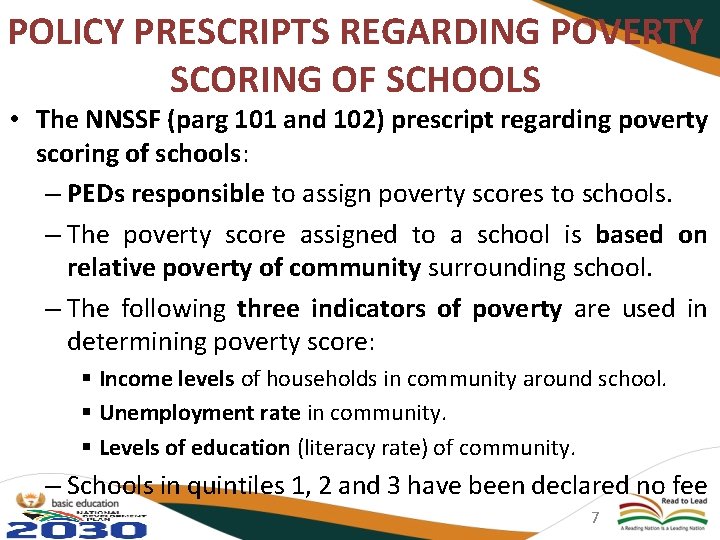
POLICY PRESCRIPTS REGARDING POVERTY SCORING OF SCHOOLS • The NNSSF (parg 101 and 102) prescript regarding poverty scoring of schools: – PEDs responsible to assign poverty scores to schools. – The poverty score assigned to a school is based on relative poverty of community surrounding school. – The following three indicators of poverty are used in determining poverty score: § Income levels of households in community around school. § Unemployment rate in community. § Levels of education (literacy rate) of community. – Schools in quintiles 1, 2 and 3 have been declared no fee 7 schools
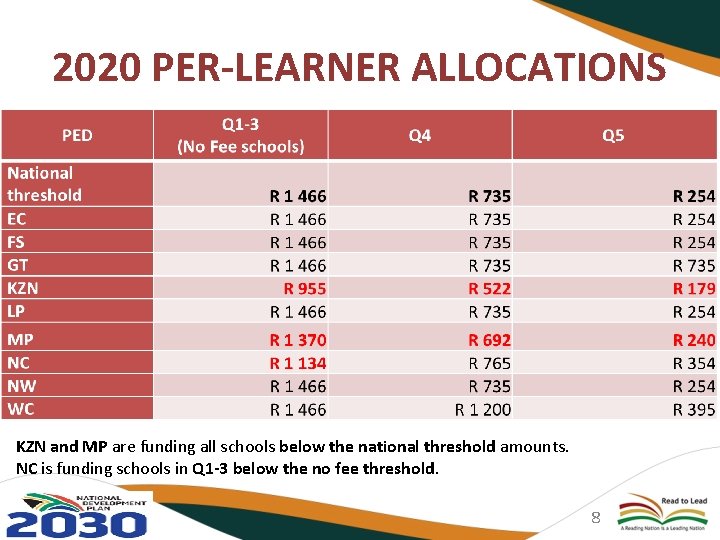
2020 PER-LEARNER ALLOCATIONS KZN and MP are funding all schools below the national threshold amounts. NC is funding schools in Q 1 -3 below the no fee threshold. 8
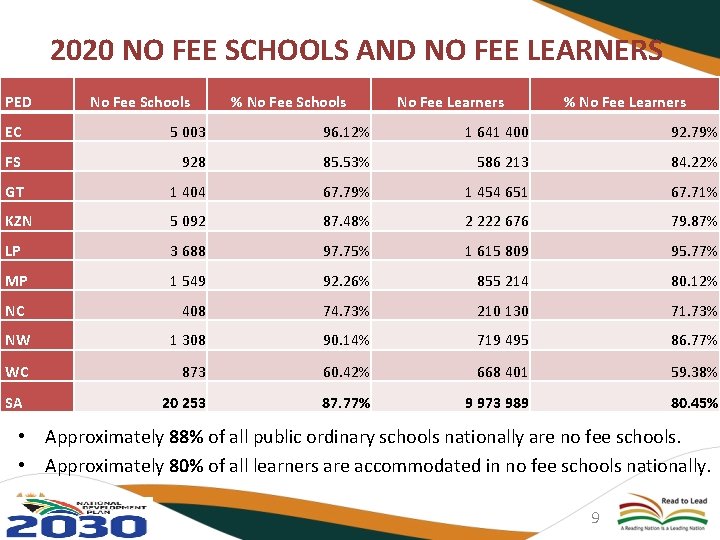
2020 NO FEE SCHOOLS AND NO FEE LEARNERS PED No Fee Schools % No Fee Schools No Fee Learners % No Fee Learners EC 5 003 96. 12% 1 641 400 92. 79% FS 928 85. 53% 586 213 84. 22% GT 1 404 67. 79% 1 454 651 67. 71% KZN 5 092 87. 48% 2 222 676 79. 87% LP 3 688 97. 75% 1 615 809 95. 77% MP 1 549 92. 26% 855 214 80. 12% NC 408 74. 73% 210 130 71. 73% NW 1 308 90. 14% 719 495 86. 77% WC 873 60. 42% 668 401 59. 38% 20 253 87. 77% 9 973 989 80. 45% SA • Approximately 88% of all public ordinary schools nationally are no fee schools. • Approximately 80% of all learners are accommodated in no fee schools nationally. 9
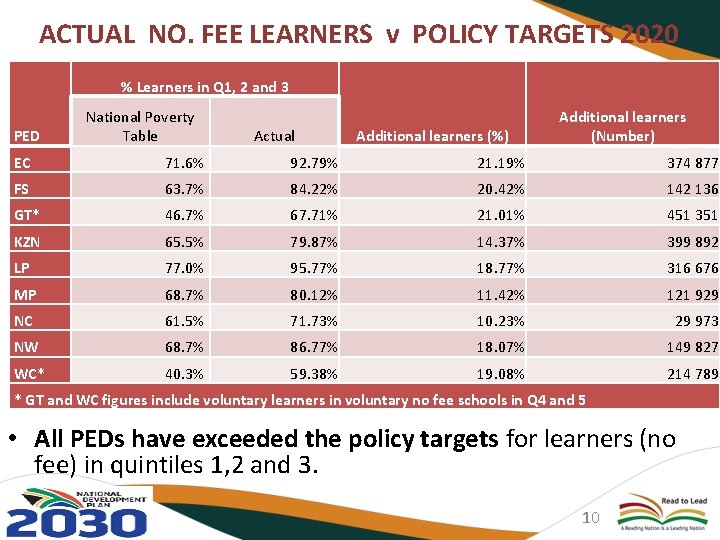
ACTUAL NO. FEE LEARNERS v POLICY TARGETS 2020 % Learners in Q 1, 2 and 3 PED National Poverty Table Actual Additional learners (%) Additional learners (Number) EC 71. 6% 92. 79% 21. 19% 374 877 FS 63. 7% 84. 22% 20. 42% 142 136 GT* 46. 7% 67. 71% 21. 01% 451 351 KZN 65. 5% 79. 87% 14. 37% 399 892 LP 77. 0% 95. 77% 18. 77% 316 676 MP 68. 7% 80. 12% 11. 42% 121 929 NC 61. 5% 71. 73% 10. 23% 29 973 NW 68. 7% 86. 77% 18. 07% 149 827 WC* 40. 3% 59. 38% 19. 08% 214 789 * GT and WC figures include voluntary learners in voluntary no fee schools in Q 4 and 5 • All PEDs have exceeded the policy targets for learners (no fee) in quintiles 1, 2 and 3. 10
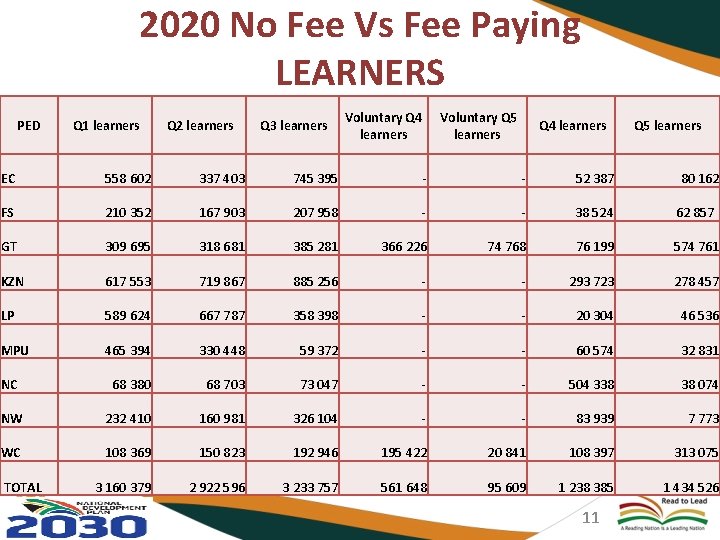
2020 No Fee Vs Fee Paying LEARNERS PED Q 1 learners Q 2 learners Q 3 learners Voluntary Q 4 learners Voluntary Q 5 learners Q 4 learners Q 5 learners EC 558 602 337 403 745 395 - - 52 387 FS 210 352 167 903 207 958 - - 38 524 62 857 GT 309 695 318 681 385 281 366 226 74 768 76 199 574 761 KZN 617 553 719 867 885 256 - - 293 723 278 457 LP 589 624 667 787 358 398 - - 20 304 46 536 MPU 465 394 330 448 59 372 - - 60 574 32 831 NC 68 380 68 703 73 047 - - 504 338 38 074 NW 232 410 160 981 326 104 - - 83 939 7 773 WC 108 369 150 823 192 946 195 422 20 841 108 397 313 075 3 160 379 2 922 596 3 233 757 561 648 95 609 1 238 385 1 434 526 TOTAL 11 80 162
DISPUTE OF CORRECTNESS OF THE QUINTILE RANKING • When a school is not satisfied with the ranking of their school, the governing body may dispute the correctness of the ranking it is assigned to through representation to the Head of the Provincial Education Department. South African Schools Act 1996 (SASA) (Act 84 of 1996). • The PED considers each case on its merits and provides a formal response. • Schools in Quintiles 4 and 5 can apply on invitation from the Minister of Education or submit an appeal in writing to the Head of Department to challenge the quintile allocation. • The continued application of these measures however depends on the availability of budgets. 12
THE PROCESS AND PROCEDURES THAT A SCHOOL WILL NEED TO FOLLOW TO HAVE ITS QUINTILE RANKING CHANGED • All PEDs should have established processes and procedures to deal with such queries. These processes and procedures should not exceed six months to complete: • A school will be required to submit an appeal in writing on its letterhead, signed by the principal and SGB chairperson to their relevant district office. • The appeal should clearly indicate the purpose thereof. The appeal should be well-motivated including the factors that are placing the school in financial difficulties. • Further details must also be provided on the action that has been taken by the school to address these factors. • The application should be sent to the relevant Circuit Manager at the District Office. 13
CHALLENGES EXPERIENCED WITH POVERTY PROFILING OF SCHOOLS • The changing poverty profile of schools: – A number of learners do not attend the closest public school. – Schools in less-poor communities increasingly accommodate learners from a different (usually poorer) socio-economic background. – Data on surrounding households becoming a less reliable indicator of the socio-economic status of learners in many schools. – Unemployment rates dramatically having recently increased and not taken into account when determining poverty scores for schools. – Some fee paying schools in Quintiles 4 and 5 experience a level of funding that is below the no fee threshold. 14
RECOMMENDATION TO ADDRESS THE CHALLENGES • Voluntary reclassification of certain quintile 4 and 5 schools as no fee schools. • Western Cape has declared following number of Q 4 and Q 5 schools as no fee : - Q 4 – 206 Schools and 195 422 Learners; and - Q 5 – 22 Schools and 20 841 Learners. • Compensation for fee exemption for learners who are not able to pay school fees. 15
Recommendation It is recommended that the Standing Committee on Education discusses the presentation. 16