
POVERTY OF NATIONS Kenneth Nehrbass Transformational Development POVERTY
POVERTY OF NATIONS Kenneth Nehrbass Transformational Development
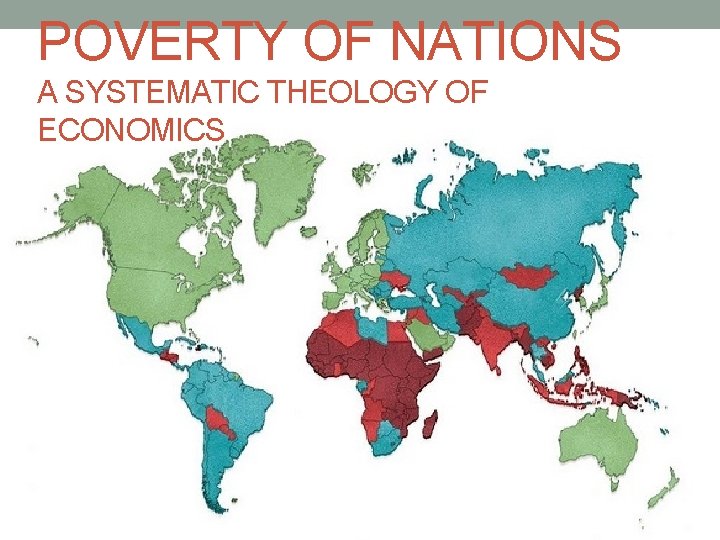
POVERTY OF NATIONS A SYSTEMATIC THEOLOGY OF ECONOMICS
At the level of the nation • “It’s at the level of the nation that poverty and wealth are determined” • God did not promise Israel donations from other nations, or debt forgiveness. He promised them gardens they would have to till and grapes they would have to tend Deut 8: 7 -10 • NO nation has ever escaped poverty through foreign aid -Wayne Grudem https: //www. youtube. com/watch? v=1 p 10 x. ACGX 38 at 25 mins 34: 43
Grudem and Asmus’ solution: • The solution is to increase the amt of goods and services (GDP) since that’s the measure of poverty • “A nation must produce wealth before it can distribute or enjoy wealth” • So the answer is NOT directly: • • • Changing distribution policies Tariffs Blaming (eg colonialism) Aid Sell more cultural artefacts Debt forgiveness Removing trade barriers “Fair trade” (artificially puts price higher than demand) Restraining big businesses (MNCs) Printing money (doesn’t increase GDP)
Free market vs. controlling MNCs • Two scenarios • Under more control: If Nike pays bribes to local governments to keep out the competition, and in the absence of competition, Nike can keep the pay artificially low, Nike is partially to blame • Under a free market: Nike will pay whatever it takes to get labor. And in some cases, the labor will be extremely low. The market sets the price. • People work for a ‘fair wage’ since they think that their labor is worth more than they can make on subsistence farming
Is aid working? • The US gave 2. 3 trillion in aid over the last 50 years, but still failed to get twelve cent medicines to half of the children in Africa- those who died of the disease.
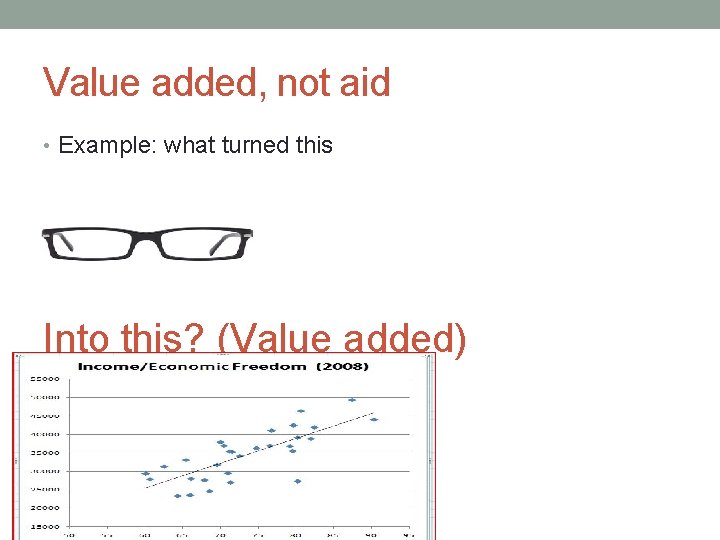
Value added, not aid • Example: what turned this Into this? (Value added)
A nation will expand its GDP not by taking products from other nations, but by creating more goods and services within the nation itself When you give a poor man your shirt, it is biblical, but does nothing to increase GDP It is possible to grow a nation’s GDP without aid- all the developed nations did so.
Complicated problem, complicated solutions • Can’t just say certain nations are less developed because of colonialism, or natural resources, or tribalism. • Can’t be an easy fix like “send more aid” or “stop sending aid” • Economics is the most complicated discipline, combining human behavior with politics. • There are dozens of contributing factors
The bottom billion live in 4 traps • 58 poorest countries seem to exhibit one of four traps hindering them from poverty 1. 2. 3. 4. Conflict Natural resource trap Landlocked with bad neighbors Bad governance
What kind of economists disagree that JOBS are the answer • Fatalists • Professional donors • Socialists • Cultural equalizers (don’t transform culture) • Pure economists (don’t recognize culture)
How population is tied to poverty • If the population grows faster than the GDP, people will get poorer, since per capita income is the GDP divided by the population • If the GDP grows faster than the population, people get richer. That’s one reason why industrialized nations (with population control) quickly get richer.
Grudem and Asmus’ 79 factors that increase GDP • Economic system • Stable currency, low taxes, economic freedom • National government • high GDP + corrupt government still leads to poverty • Corrupt courts stifle GDP • Bribery and corruption stifle GDP • National freedoms • National culture and values • Lying, violating contracts

Example of difficulty of being productive in the 3 rd world • De Soto, et. al tried to open a garment factory in Lima, Peru • They spent six hours a day for 289 days filling out paperwork, paying bribes, and visiting government officials till they could open the factory • The cost was 31 x the monthly minimum wage (3 yrs salary) • 207 administrative steps • 52 government offices • Obtaining the legal title took 728 steps • Hard to identify who owns what; no addresses, no deeds • De Soto, Mystery of Capital p 20
End of lecture
- Slides: 16