
Poverty African Economic Development Renata Serra Jan 25
- Slides: 14
Poverty African Economic Development Renata Serra – Jan 25 th 2007
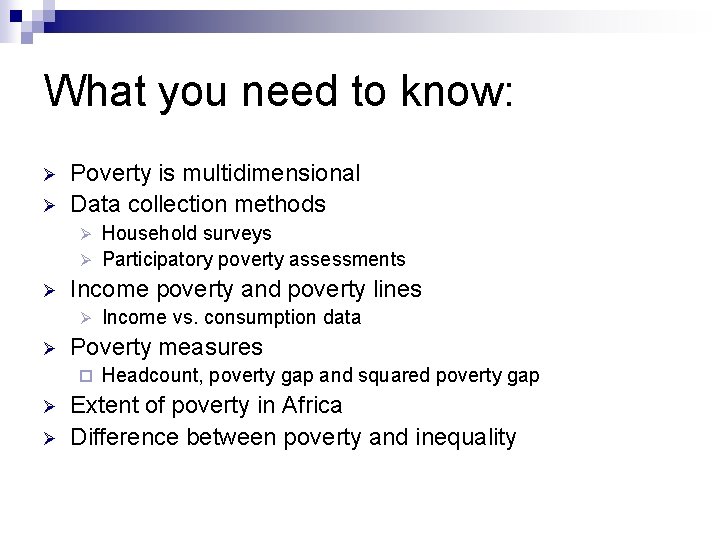
What you need to know: Ø Ø Poverty is multidimensional Data collection methods Household surveys Ø Participatory poverty assessments Ø Ø Income poverty and poverty lines Ø Ø Poverty measures ¨ Ø Ø Income vs. consumption data Headcount, poverty gap and squared poverty gap Extent of poverty in Africa Difference between poverty and inequality
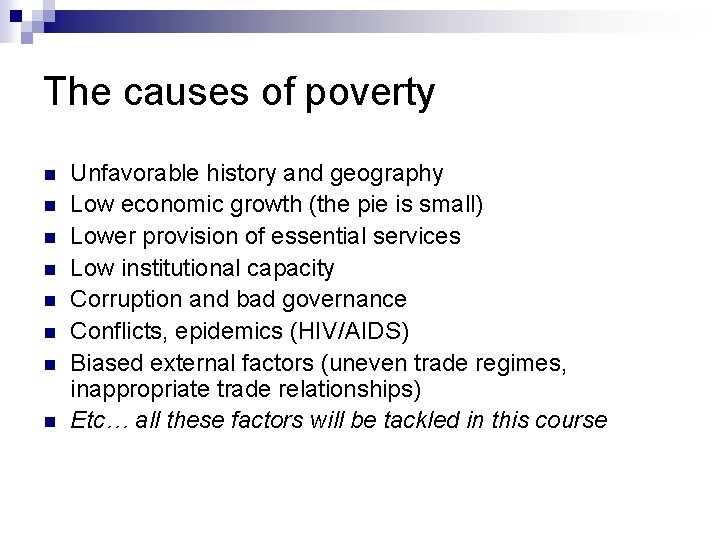
The causes of poverty n n n n Unfavorable history and geography Low economic growth (the pie is small) Lower provision of essential services Low institutional capacity Corruption and bad governance Conflicts, epidemics (HIV/AIDS) Biased external factors (uneven trade regimes, inappropriate trade relationships) Etc… all these factors will be tackled in this course
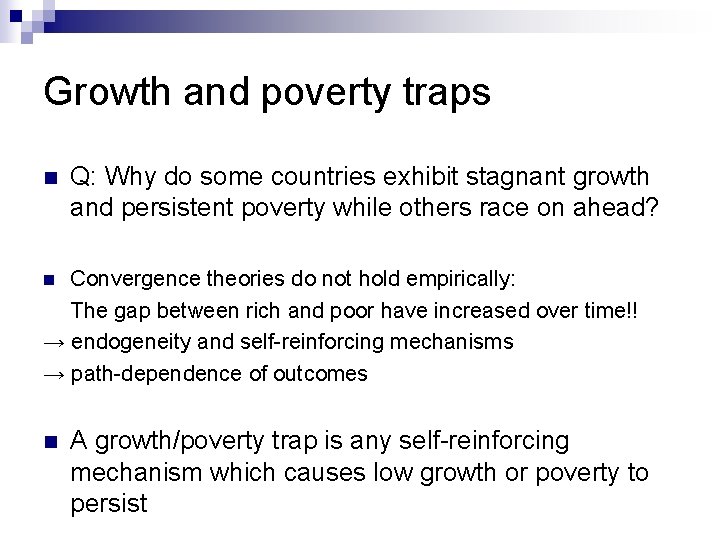
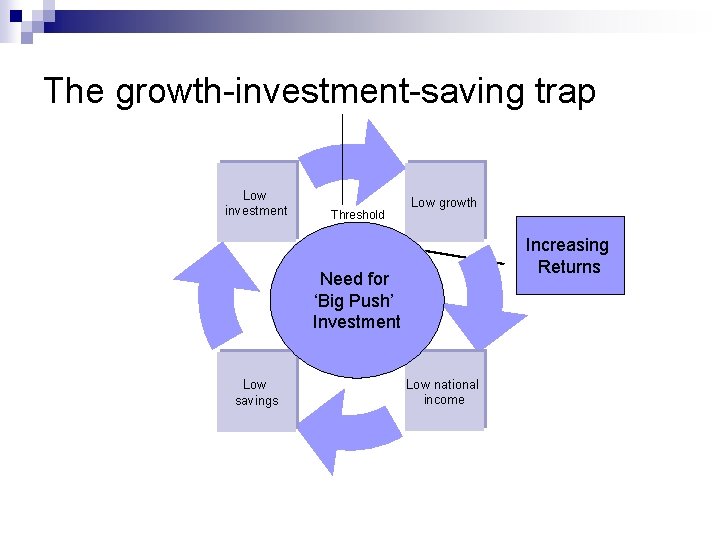
Growth and poverty traps n Q: Why do some countries exhibit stagnant growth and persistent poverty while others race on ahead? Convergence theories do not hold empirically: The gap between rich and poor have increased over time!! → endogeneity and self-reinforcing mechanisms → path-dependence of outcomes n n A growth/poverty trap is any self-reinforcing mechanism which causes low growth or poverty to persist
The growth-investment-saving trap Low investment Threshold GDP p. c. Low growth Increasing Returns Need for ‘Big Push’ Investment Low savings Low national income
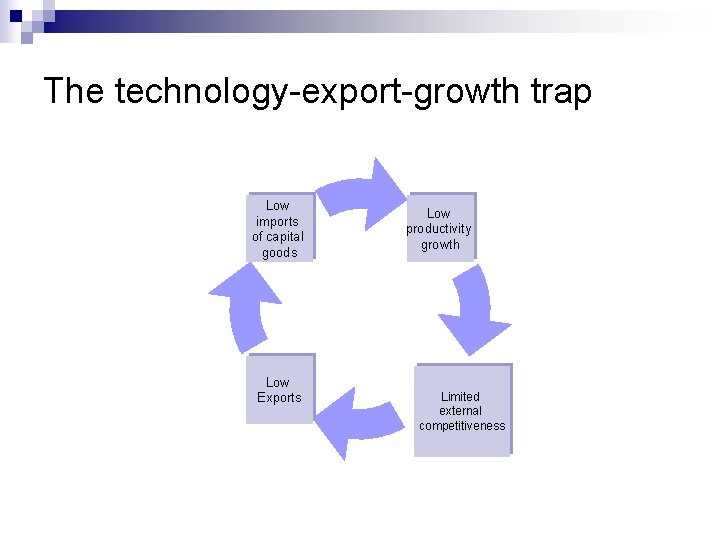
The technology-export-growth trap Low imports of capital goods Low Exports Low productivity growth Limited external competitiveness
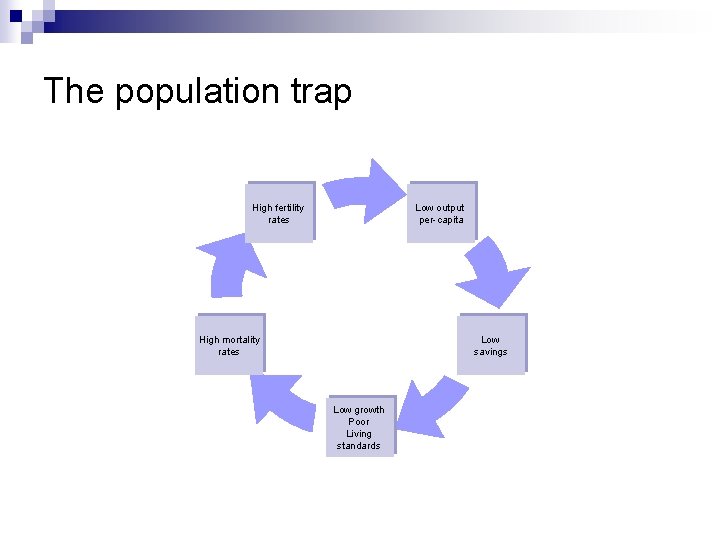
The population trap Low output per-capita High fertility rates Low savings High mortality rates Low growth Poor Living standards
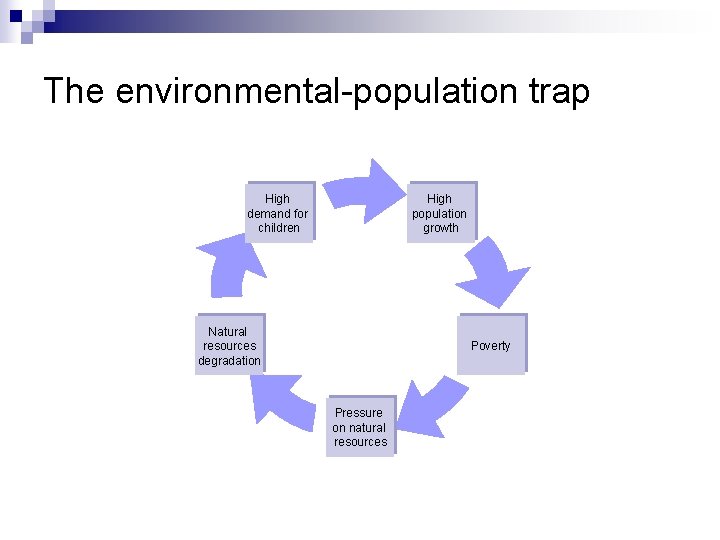
The environmental-population trap High population growth High demand for children Natural resources degradation Poverty Pressure on natural resources
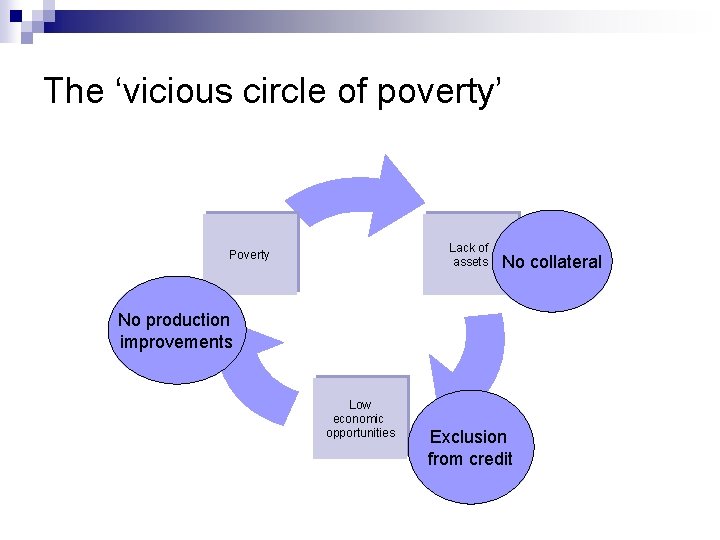
The ‘vicious circle of poverty’ Lack of assets Poverty No collateral No production improvements Low economic opportunities Exclusion from credit
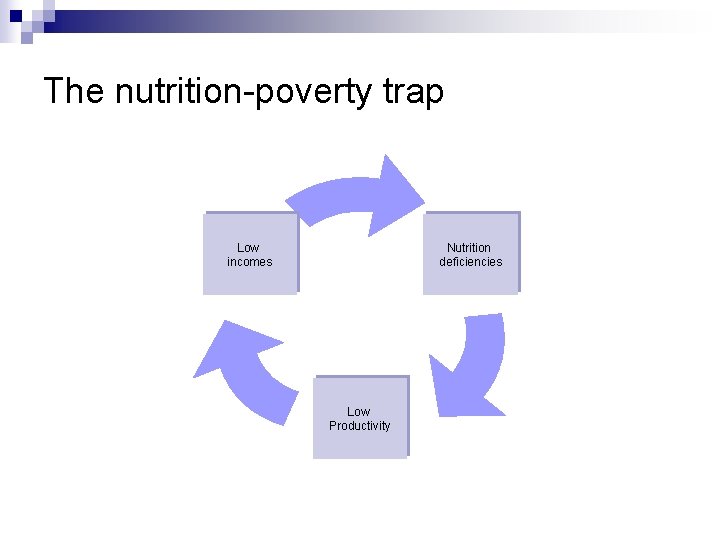
The nutrition-poverty trap Low incomes Nutrition deficiencies Low Productivity
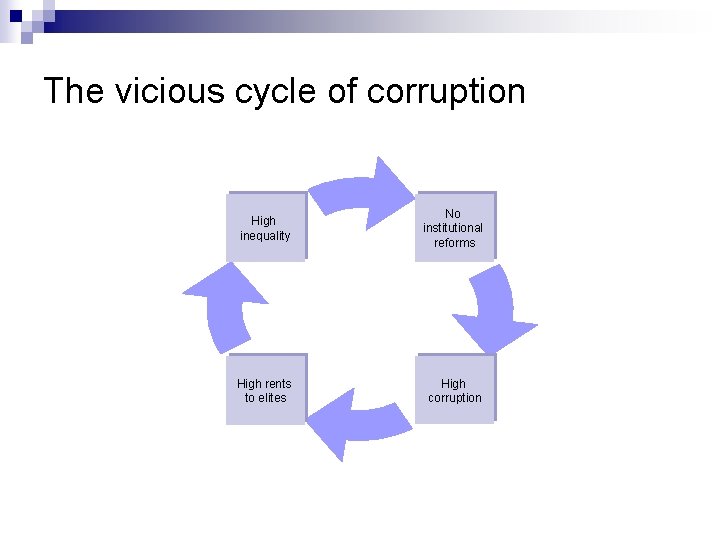
The vicious cycle of corruption High inequality No institutional reforms High rents to elites High corruption
What solutions? n Path-dependence can be broken only by exogenous factors: ¨ Government intervention ¨ Massive domestic or foreign investment ¨ Changes in institutions and policies n But are institutions and policies really exogenous? ?
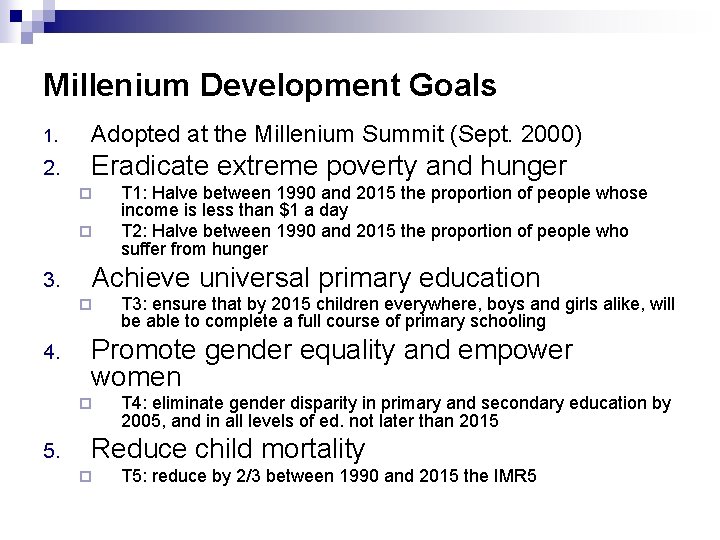
Millenium Development Goals 1. Adopted at the Millenium Summit (Sept. 2000) 2. Eradicate extreme poverty and hunger ¨ ¨ 3. Achieve universal primary education ¨ 4. T 3: ensure that by 2015 children everywhere, boys and girls alike, will be able to complete a full course of primary schooling Promote gender equality and empower women ¨ 5. T 1: Halve between 1990 and 2015 the proportion of people whose income is less than $1 a day T 2: Halve between 1990 and 2015 the proportion of people who suffer from hunger T 4: eliminate gender disparity in primary and secondary education by 2005, and in all levels of ed. not later than 2015 Reduce child mortality ¨ T 5: reduce by 2/3 between 1990 and 2015 the IMR 5
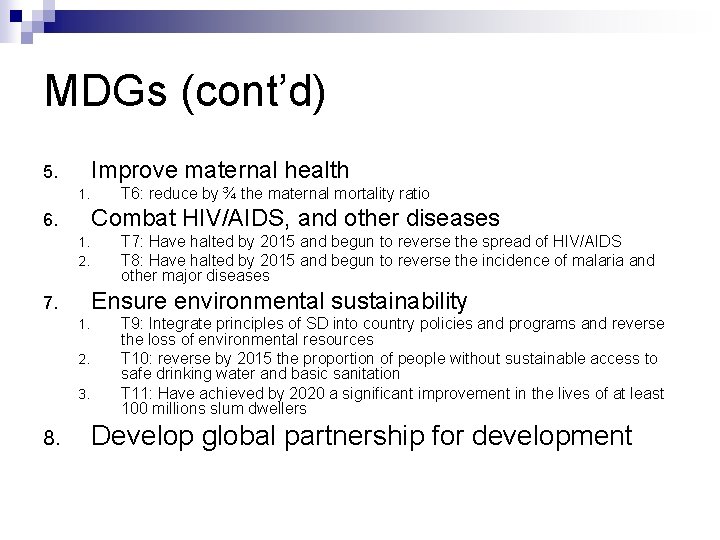
MDGs (cont’d) Improve maternal health 5. 1. Combat HIV/AIDS, and other diseases 6. 1. 2. T 7: Have halted by 2015 and begun to reverse the spread of HIV/AIDS T 8: Have halted by 2015 and begun to reverse the incidence of malaria and other major diseases Ensure environmental sustainability 7. 1. 2. 3. 8. T 6: reduce by ¾ the maternal mortality ratio T 9: Integrate principles of SD into country policies and programs and reverse the loss of environmental resources T 10: reverse by 2015 the proportion of people without sustainable access to safe drinking water and basic sanitation T 11: Have achieved by 2020 a significant improvement in the lives of at least 100 millions slum dwellers Develop global partnership for development