
POULTRY SCIENCE Broiler Breeders Unit 10 Poultry Science
POULTRY SCIENCE: Broiler Breeders Unit 10
Poultry Science: Broiler Breeders Unit 10: Segment 1 Terminology & Introduction to Broiler Breeders
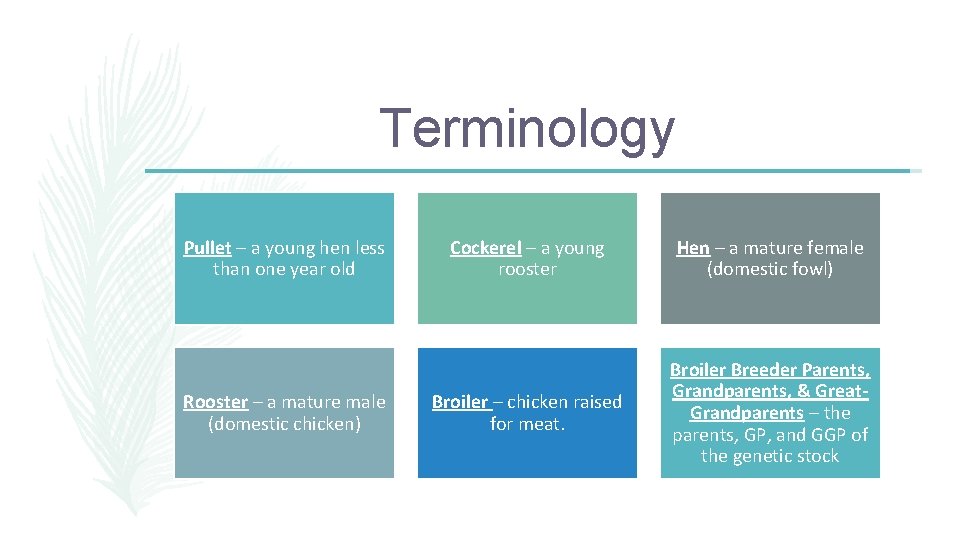
Terminology Pullet – a young hen less than one year old Rooster – a mature male (domestic chicken) Cockerel – a young rooster Hen – a mature female (domestic fowl) Broiler – chicken raised for meat. Broiler Breeder Parents, Grandparents, & Great. Grandparents – the parents, GP, and GGP of the genetic stock
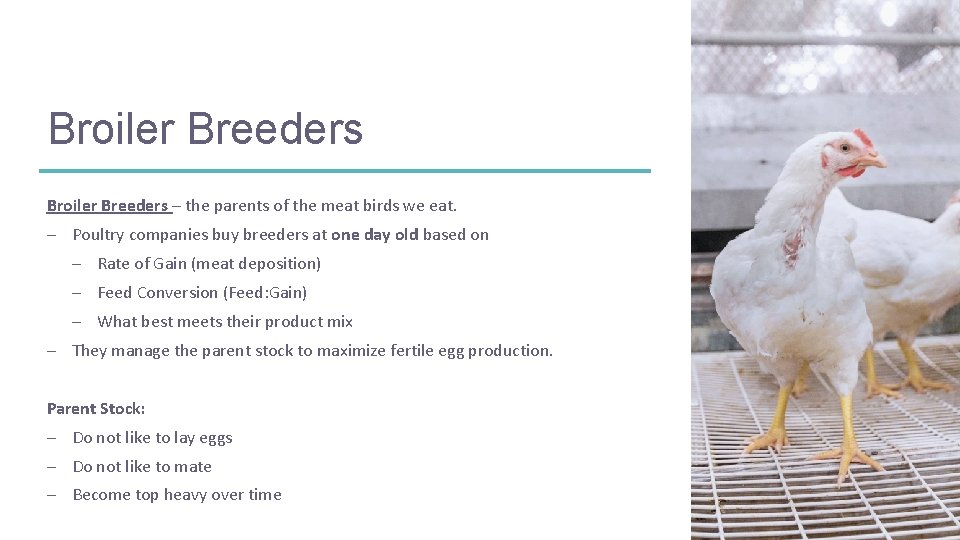
Broiler Breeders – the parents of the meat birds we eat. – Poultry companies buy breeders at one day old based on – Rate of Gain (meat deposition) – Feed Conversion (Feed: Gain) – What best meets their product mix – They manage the parent stock to maximize fertile egg production. Parent Stock: – Do not like to lay eggs – Do not like to mate – Become top heavy over time
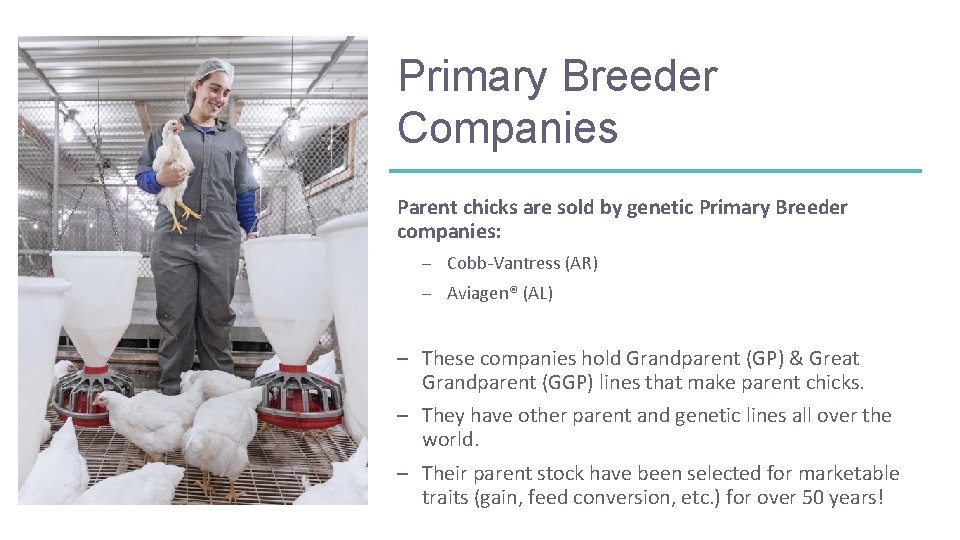
Primary Breeder Companies Parent chicks are sold by genetic Primary Breeder companies: – Cobb-Vantress (AR) – Aviagen® (AL) – These companies hold Grandparent (GP) & Great Grandparent (GGP) lines that make parent chicks. – They have other parent and genetic lines all over the world. – Their parent stock have been selected for marketable traits (gain, feed conversion, etc. ) for over 50 years!
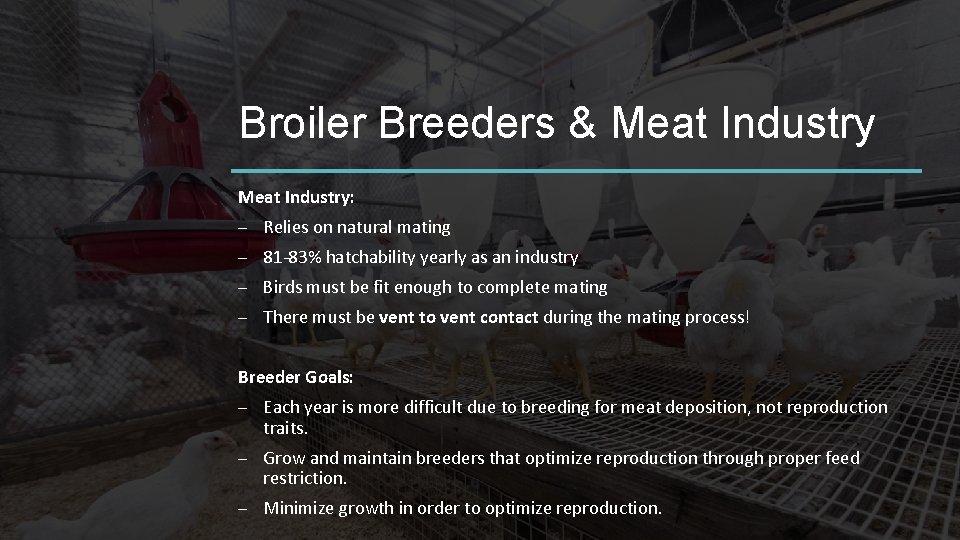
Broiler Breeders & Meat Industry: – Relies on natural mating – 81 -83% hatchability yearly as an industry – Birds must be fit enough to complete mating – There must be vent to vent contact during the mating process! Breeder Goals: – Each year is more difficult due to breeding for meat deposition, not reproduction traits. – Grow and maintain breeders that optimize reproduction through proper feed restriction. – Minimize growth in order to optimize reproduction.


Broiler Breeders Males and Females are Reared Separately: – Pans or chain feeders for males – ¼ to ½ lb. per pullet of feed can be saved using pan feeders instead of chain feeders because they give more space between feeders! – Pancake feeders for brooders – Air inlets (dark-out materials) – Exhaust fans – Slats to train the birds to perch – When grown together, the males are restricted which can lead to decreased teste quality as well as easily overfeeding pullets
Poultry Science: Broiler Breeders Unit 10: Segment 2 Photostimulation & Nesting Behaviors
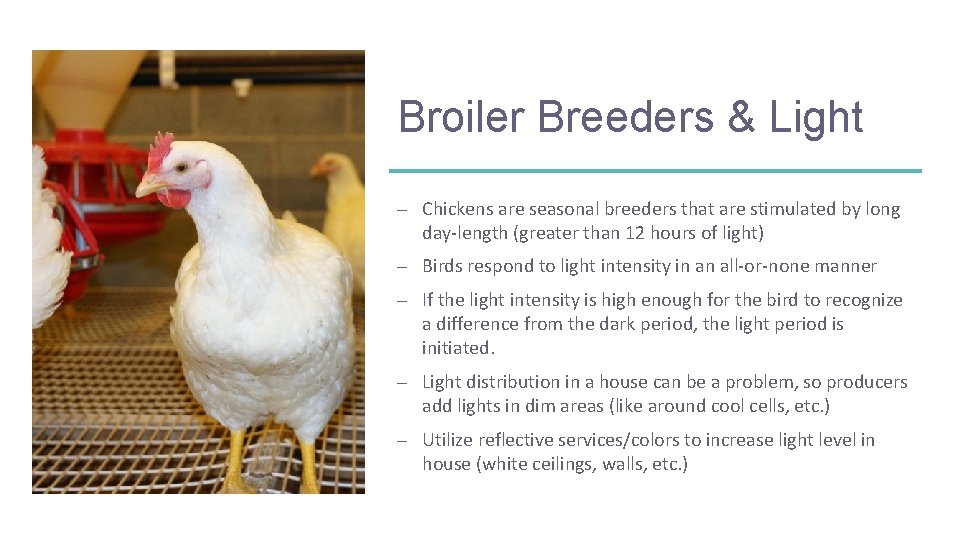
Broiler Breeders & Light – Chickens are seasonal breeders that are stimulated by long day-length (greater than 12 hours of light) – Birds respond to light intensity in an all-or-none manner – If the light intensity is high enough for the bird to recognize a difference from the dark period, the light period is initiated. – Light distribution in a house can be a problem, so producers add lights in dim areas (like around cool cells, etc. ) – Utilize reflective services/colors to increase light level in house (white ceilings, walls, etc. )
Photostimulation – the use of light to artificially activate biological compounds, cells, tissues, or even entire organisms. – Causes the birds to initiate hormone production – At 20 -21 weeks of age, go to 14 -16 hours of light to photostimulate to sexual maturity – Birds respond to long wave-length or spectrum of light (red, yellow, orange colors)
Photostimulation: Important Points Birds must be near adult body weight and age at time of photostimulation If underweight, the birds will ignore the long day length and mature when they reach adult body weight which will result in lower egg production. If flock is in good condition (uniform body weight), the first eggs can be expected in 2 -3 weeks after the birds are given long day length.
Broiler Breeders Where the hen decides to lay eggs affects how many eggs that can be harvested: – When hot, they may not want to get in the nests. – Bell drinker causes ”false nest” (anything they can get underneath). – Broken eggs attract rodents and flies. – Alternative sites for lay will often result in a decrease in eggs sent to the hatchery. Egg Room: – Broiler Breeder farms have egg rooms, where the fertilized eggs are stored. – It is vital for this room to stay clean and free of clutter to deter rodents, etc. – Eggs are picked up twice a week.
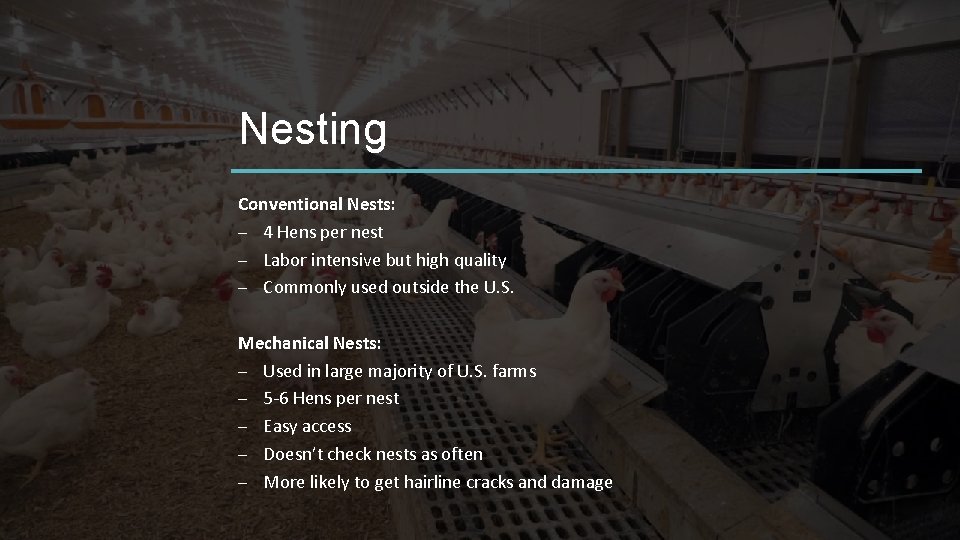
Nesting Conventional Nests: – 4 Hens per nest – Labor intensive but high quality – Commonly used outside the U. S. Mechanical Nests: – Used in large majority of U. S. farms – 5 -6 Hens per nest – Easy access – Doesn’t check nests as often – More likely to get hairline cracks and damage
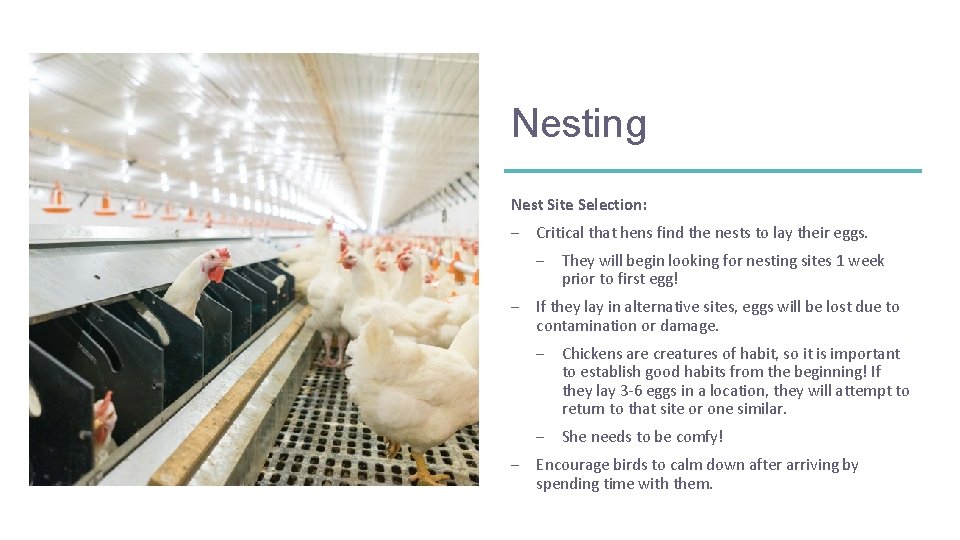
Nesting Nest Site Selection: – Critical that hens find the nests to lay their eggs. – They will begin looking for nesting sites 1 week prior to first egg! – If they lay in alternative sites, eggs will be lost due to contamination or damage. – Chickens are creatures of habit, so it is important to establish good habits from the beginning! If they lay 3 -6 eggs in a location, they will attempt to return to that site or one similar. – She needs to be comfy! – Encourage birds to calm down after arriving by spending time with them.
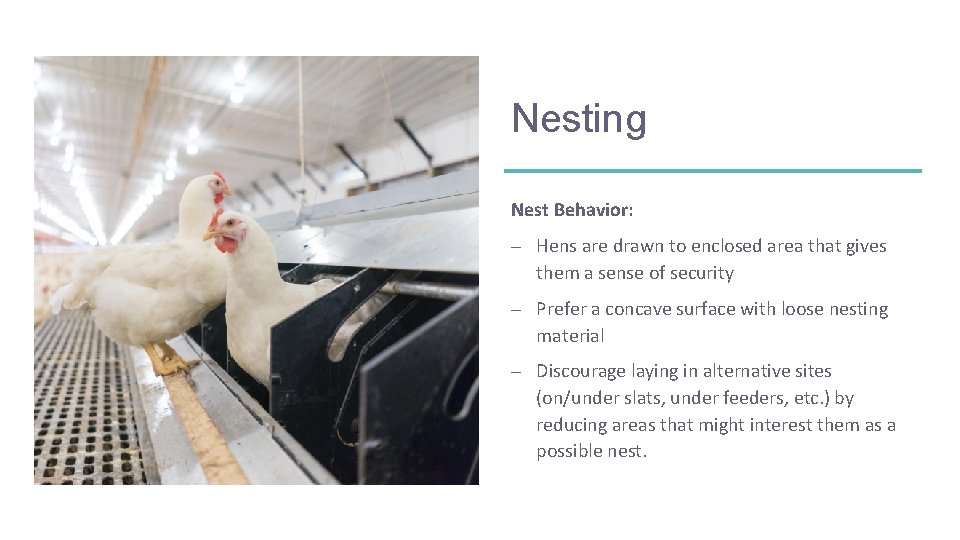
Nesting Nest Behavior: – Hens are drawn to enclosed area that gives them a sense of security – Prefer a concave surface with loose nesting material – Discourage laying in alternative sites (on/under slats, under feeders, etc. ) by reducing areas that might interest them as a possible nest.
Poultry Science: Broiler Breeders Unit 10: Segment 3 Mating Behavior & Artificial Insemination
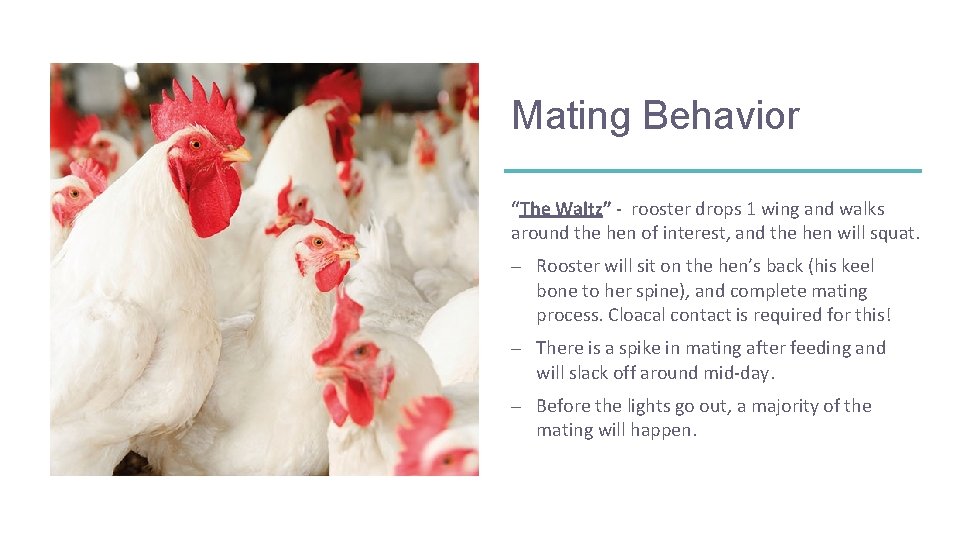
Mating Behavior “The Waltz” - rooster drops 1 wing and walks around the hen of interest, and the hen will squat. – Rooster will sit on the hen’s back (his keel bone to her spine), and complete mating process. Cloacal contact is required for this! – There is a spike in mating after feeding and will slack off around mid-day. – Before the lights go out, a majority of the mating will happen.
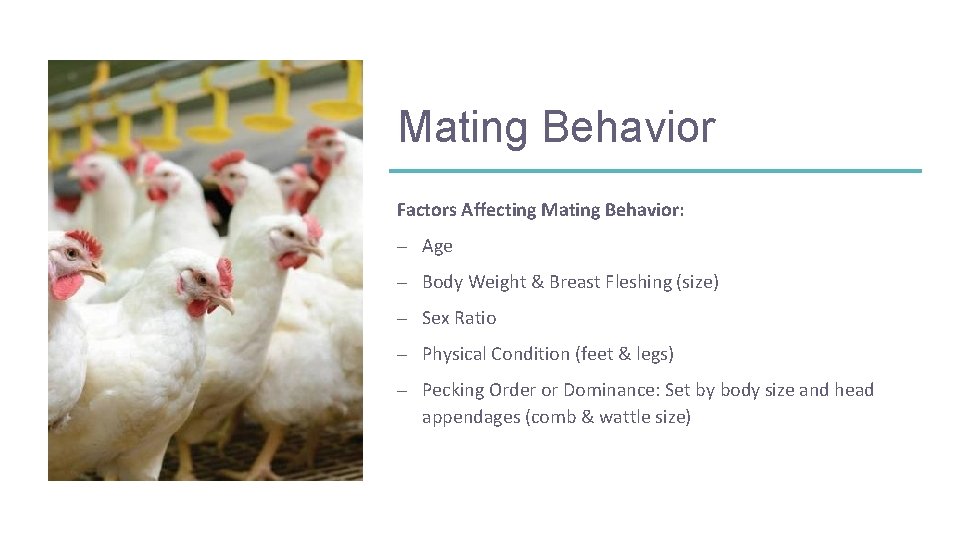
Mating Behavior Factors Affecting Mating Behavior: – Age – Body Weight & Breast Fleshing (size) – Sex Ratio – Physical Condition (feet & legs) – Pecking Order or Dominance: Set by body size and head appendages (comb & wattle size)
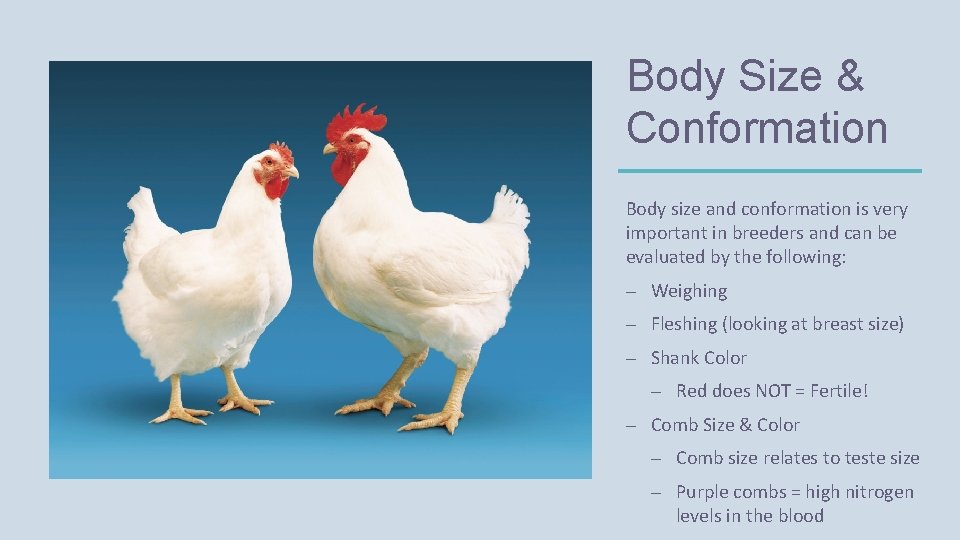
Body Size & Conformation Body size and conformation is very important in breeders and can be evaluated by the following: – Weighing – Fleshing (looking at breast size) – Shank Color – Red does NOT = Fertile! – Comb Size & Color – Comb size relates to teste size – Purple combs = high nitrogen levels in the blood
Sex Ratio Too Low Sex Ratio: – Can result in low fertility due to low mating frequency – Can be fixed with the addition of more males – Will lose early fertility and hatch if not corrected early! Too High Sex Ratio: – Hens learn to run/avoid the males – Poor fertility – High mortality/injury – Too high competition among males for feed and females
Artificial Insemination (AI) Insemination: Fertility: – A minimum of 100, 000 spermatozoa into the vagina every 7 days will provide 9598% fertility. – Spermatozoa must penetrate the germinal disc – Rooster semen is more concentrated – 3. 5 - 5. 5 million spermatozoa per ml – Avian semen does not freeze well. – Hens are inseminated after 3 pm to ensure that the spermatozoa can reach the sperm storage tubules. – If done prior to 3 pm, an egg in the shell gland of the oviduct will impede the sperm from traveling through the oviduct. – Majority of mating during the last 4 hours of light
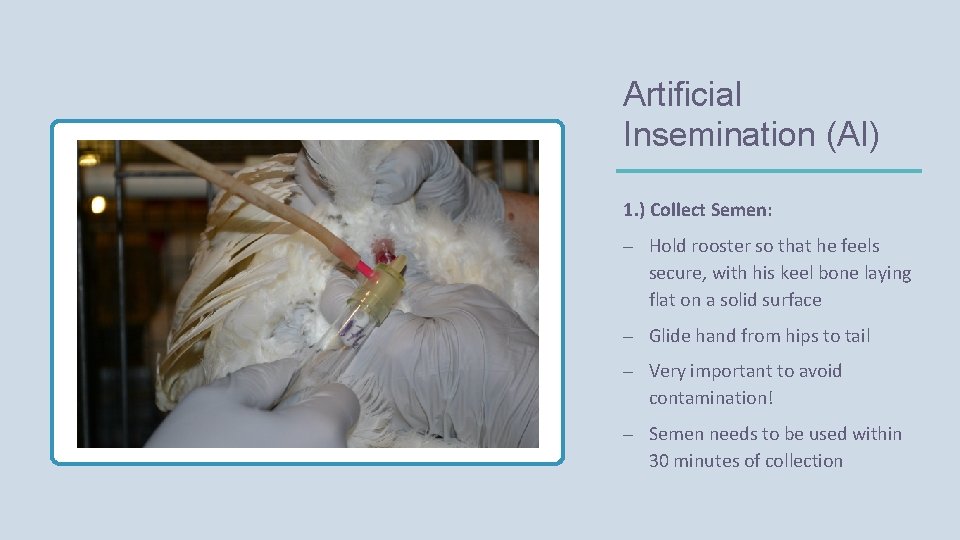
Artificial Insemination (AI) 1. ) Collect Semen: – Hold rooster so that he feels secure, with his keel bone laying flat on a solid surface – Glide hand from hips to tail – Very important to avoid contamination! – Semen needs to be used within 30 minutes of collection
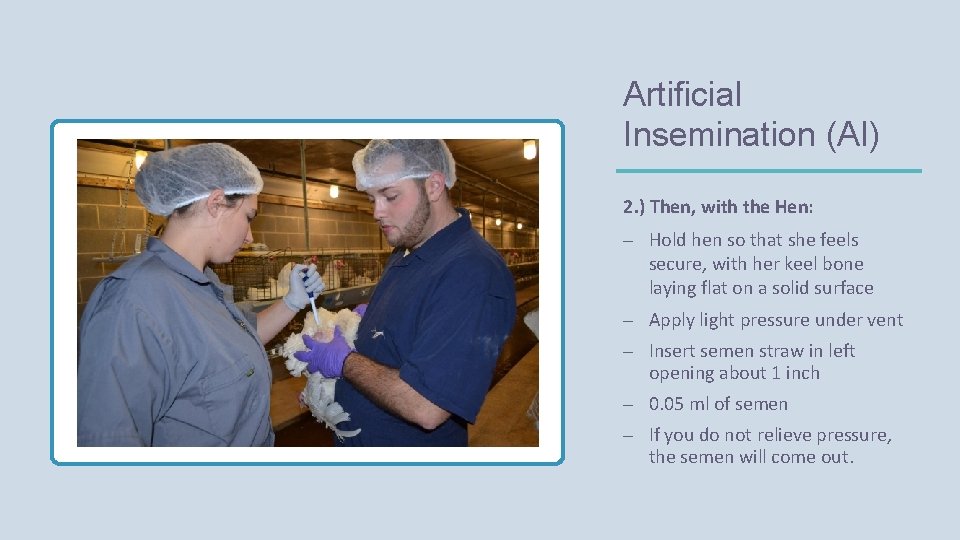
Artificial Insemination (AI) 2. ) Then, with the Hen: – Hold hen so that she feels secure, with her keel bone laying flat on a solid surface – Apply light pressure under vent – Insert semen straw in left opening about 1 inch – 0. 05 ml of semen – If you do not relieve pressure, the semen will come out.
Poultry Science: Broiler Breeders Unit 10: Segment 4 Broiler Breeder Housing
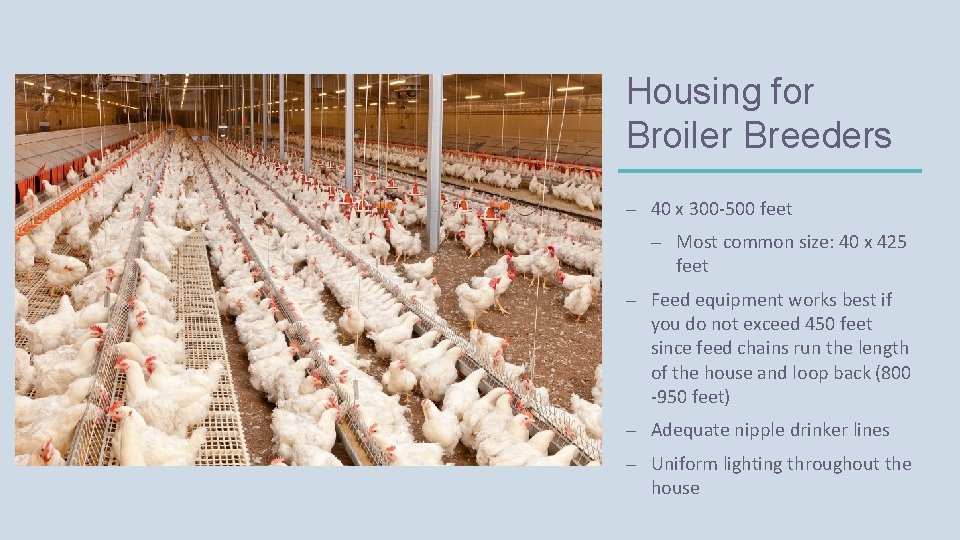
Housing for Broiler Breeders – 40 x 300 -500 feet – Most common size: 40 x 425 feet – Feed equipment works best if you do not exceed 450 feet since feed chains run the length of the house and loop back (800 -950 feet) – Adequate nipple drinker lines – Uniform lighting throughout the house
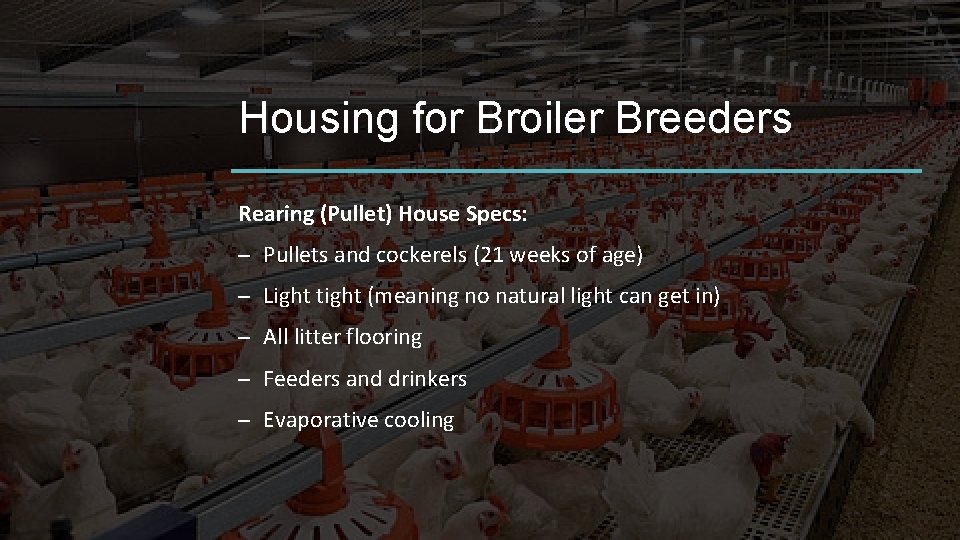
Housing for Broiler Breeders Rearing (Pullet) House Specs: – Pullets and cockerels (21 weeks of age) – Light tight (meaning no natural light can get in) – All litter flooring – Feeders and drinkers – Evaporative cooling
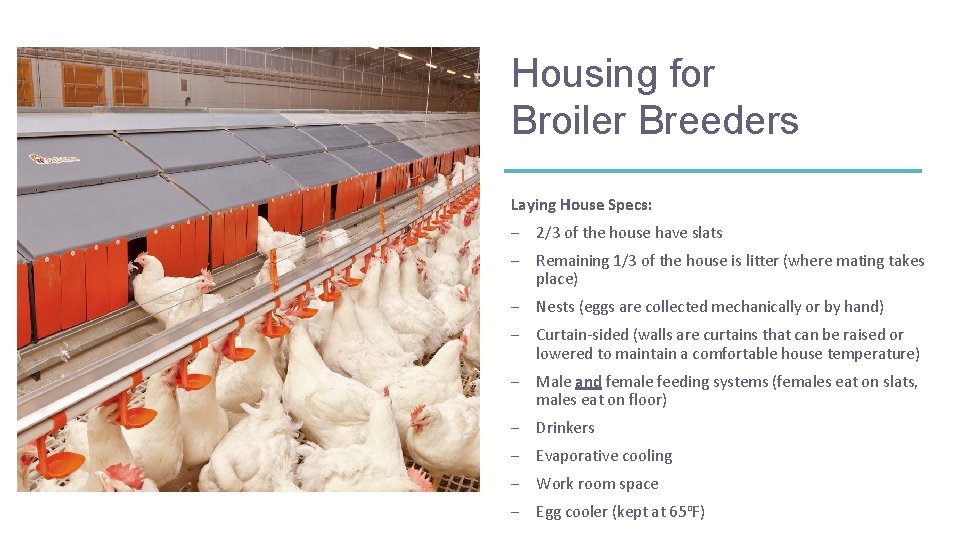
Housing for Broiler Breeders Laying House Specs: – 2/3 of the house have slats – Remaining 1/3 of the house is litter (where mating takes place) – Nests (eggs are collected mechanically or by hand) – Curtain-sided (walls are curtains that can be raised or lowered to maintain a comfortable house temperature) – Male and female feeding systems (females eat on slats, males eat on floor) – Drinkers – Evaporative cooling – Work room space – Egg cooler (kept at 65 o. F)
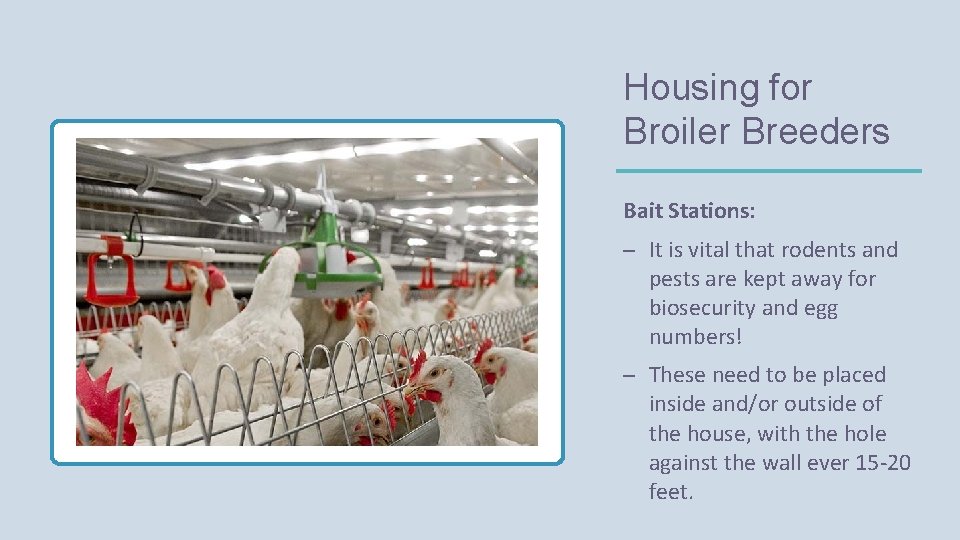
Housing for Broiler Breeders Bait Stations: – It is vital that rodents and pests are kept away for biosecurity and egg numbers! – These need to be placed inside and/or outside of the house, with the hole against the wall ever 15 -20 feet.
Poultry Science Curriculum References – – – – Jessica Fife, UGA Dept. of Poultry Science Outreach Coordinator, UGA Dept. of Agricultural Leadership, Education, & Communication MAEE Candidate – Julia Gaskin, UGA Dept. of Crop and Soil Sciences Sr. Public Service Associate – Jeanna Wilson, UGA Dept. of Poultry Science Professor – Glendon Harris, UGA Dept. of Crop and Soil – Sciences Professor & Extension Agronomist Kelly Sweeney, UGA Dept. of Poultry Science Ph. D Candidate Brian Kiepper, UGA Dept. of Poultry Science– Associate Professor – Claudia Dunkley, UGA Dept. of Poultry – Science Public Service Associate Merck Veterinary Manual Barry Croom, UGA Dept. of Agricultural Leadership, Education, & Communication – Professor – Ashley Yopp, UGA Dept. of Agricultural Leadership, Education, & Communication Assistant Professor – Georgia Agriculture Education Andrew Benson, UGA Dept. of Poultry Science Assistant Professor Brian Jordan, UGA Dept. of Poultry Science Assistant Professor, UGA College of Veterinary Medicine Assistant Professor – – University of Arkansas Bumpers College of Poultry Science – Poultry Science Dual – Curriculum Course Casey Ritz, UGA Dept. of Poultry Science Professor – USPOULTRY & USPOULTRY Poultry Science – Curriculum – Tom Tabler, Mississippi State University Department of Poultry Science Extension Professor Jacquie Jacob, University of Kentucky University of Maryland Extension Poultry Hub Brian Fairchild, University of Georgia Department of Poultry Science Professor Centers for Disease Control National FFA Organization
- Slides: 30