
POULTRY PROCESSING TECHNIQUIES WHY PROCESS To prepare a




- Slides: 37
POULTRY PROCESSING TECHNIQUIES
WHY PROCESS? • To prepare a product suitable for human consumption. • To preserve the meat for future use. • To increase consumption by changing the form and use of the meat carcass. • Fresh or fresh-frozen: raw halves, quarters and parts, etc.
FURTHER PROCESSED • Deboned to make roasts, pies, TV dinners, baby food, etc. • Pre-cooked and usually breaded and deep fat fried, this type of processed product is becoming increasingly popular with institutional and rapid-use food service installations where labor costs are of major concern in preparing foods.
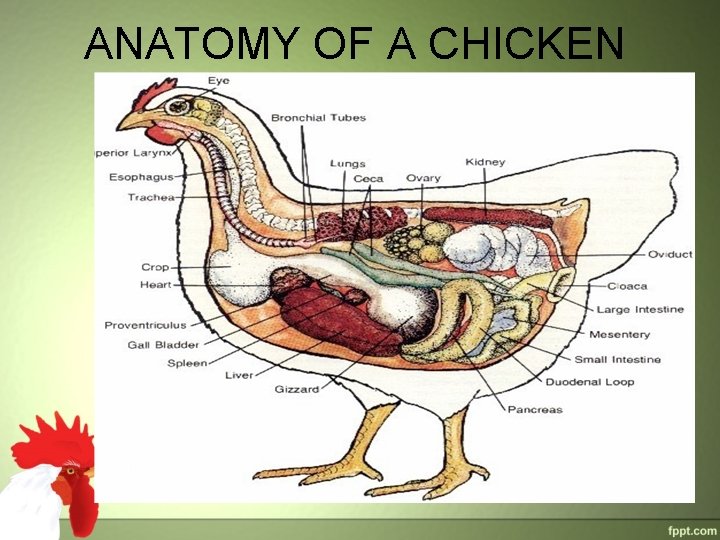
ANATOMY OF A CHICKEN
PROCESSED PARTS
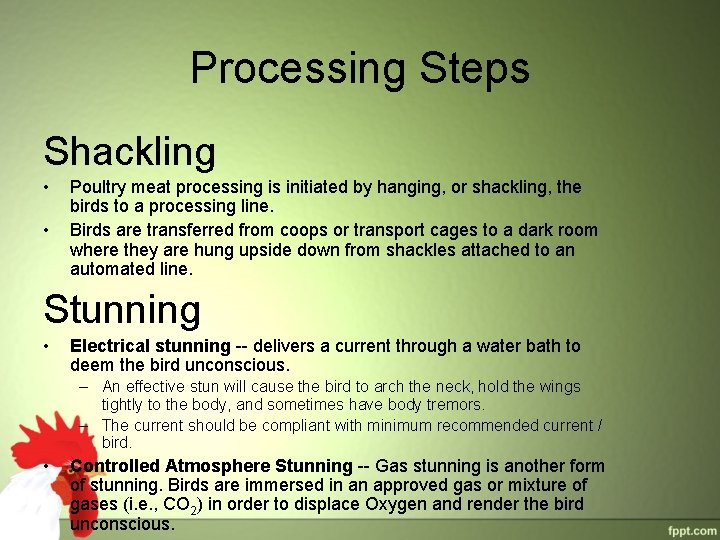
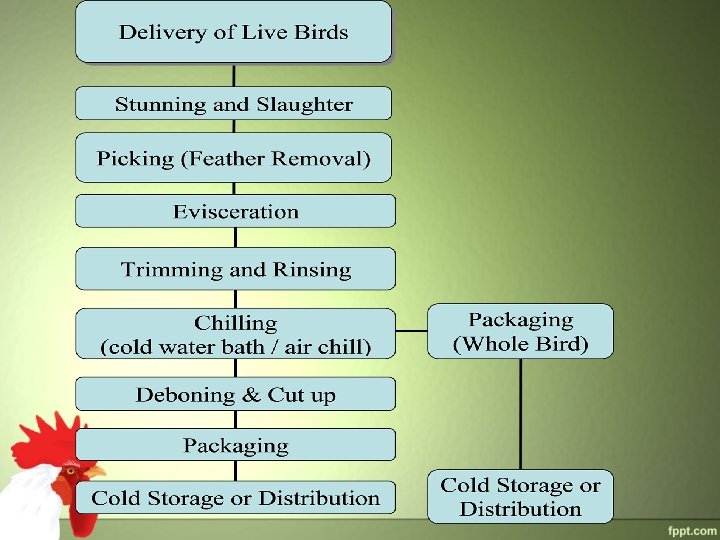
Processing Steps Shackling • • Poultry meat processing is initiated by hanging, or shackling, the birds to a processing line. Birds are transferred from coops or transport cages to a dark room where they are hung upside down from shackles attached to an automated line. Stunning • Electrical stunning -- delivers a current through a water bath to deem the bird unconscious. – An effective stun will cause the bird to arch the neck, hold the wings tightly to the body, and sometimes have body tremors. – The current should be compliant with minimum recommended current / bird. • Controlled Atmosphere Stunning -- Gas stunning is another form of stunning. Birds are immersed in an approved gas or mixture of gases (i. e. , CO 2) in order to displace Oxygen and render the bird unconscious.
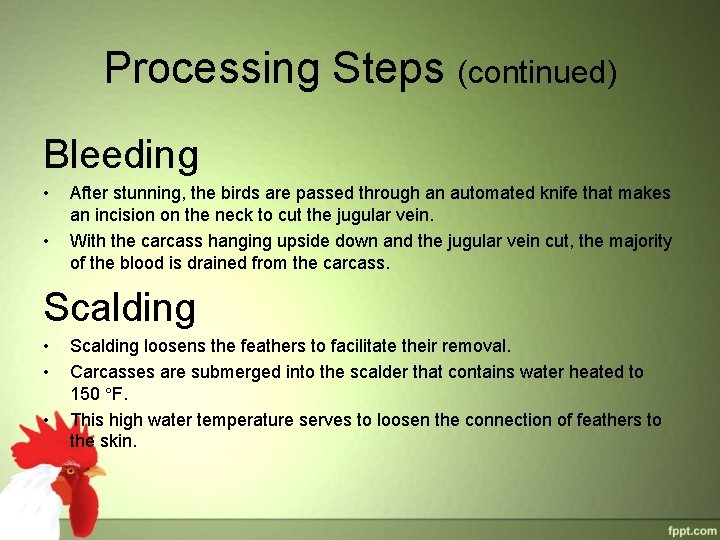
Processing Steps (continued) Bleeding • • After stunning, the birds are passed through an automated knife that makes an incision on the neck to cut the jugular vein. With the carcass hanging upside down and the jugular vein cut, the majority of the blood is drained from the carcass. Scalding • • • Scalding loosens the feathers to facilitate their removal. Carcasses are submerged into the scalder that contains water heated to 150 F. This high water temperature serves to loosen the connection of feathers to the skin.
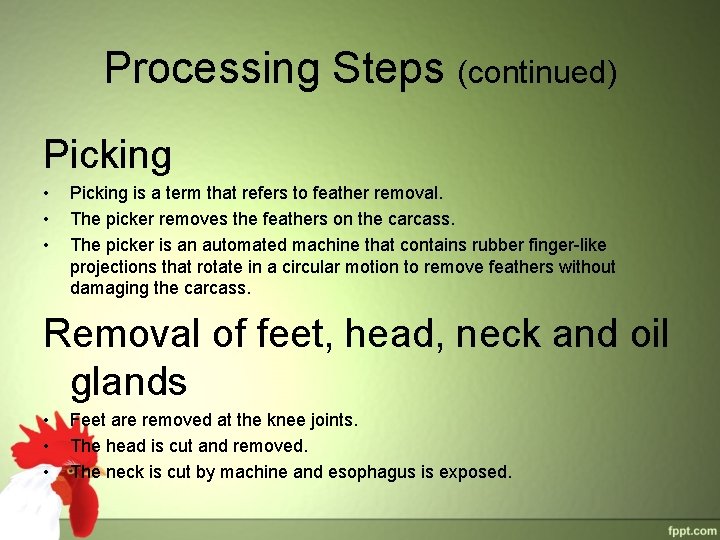
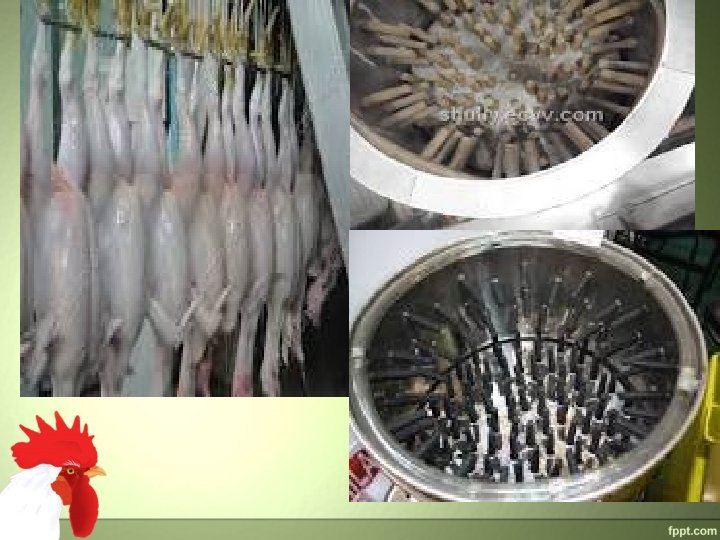
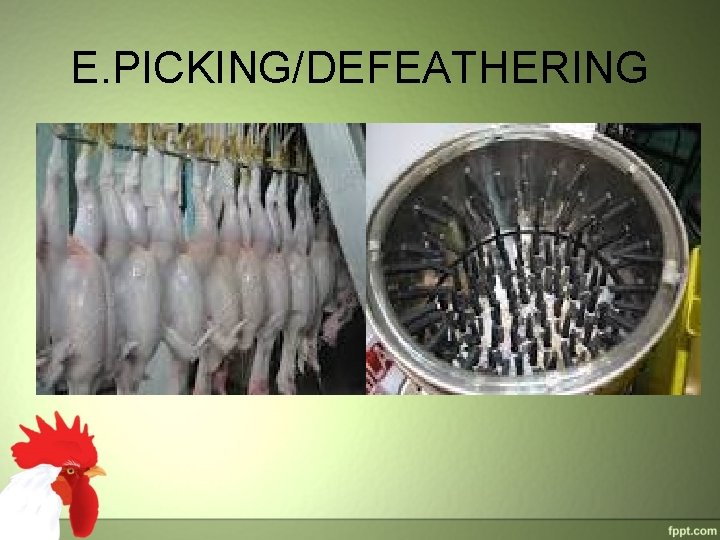
Processing Steps (continued) Picking • • • Picking is a term that refers to feather removal. The picker removes the feathers on the carcass. The picker is an automated machine that contains rubber finger-like projections that rotate in a circular motion to remove feathers without damaging the carcass. Removal of feet, head, neck and oil glands • • • Feet are removed at the knee joints. The head is cut and removed. The neck is cut by machine and esophagus is exposed.
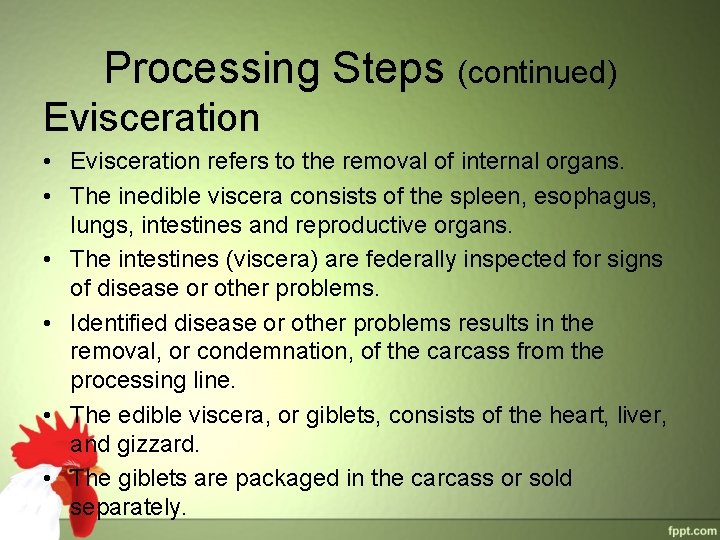
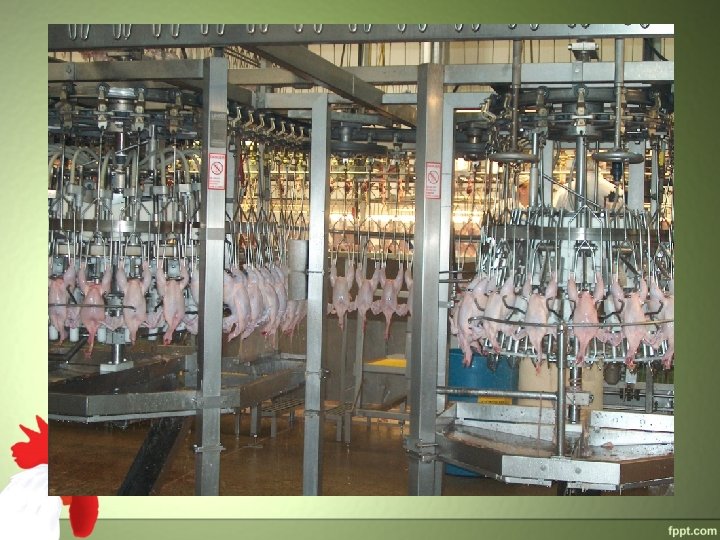
Processing Steps (continued) Evisceration • Evisceration refers to the removal of internal organs. • The inedible viscera consists of the spleen, esophagus, lungs, intestines and reproductive organs. • The intestines (viscera) are federally inspected for signs of disease or other problems. • Identified disease or other problems results in the removal, or condemnation, of the carcass from the processing line. • The edible viscera, or giblets, consists of the heart, liver, and gizzard. • The giblets are packaged in the carcass or sold separately.
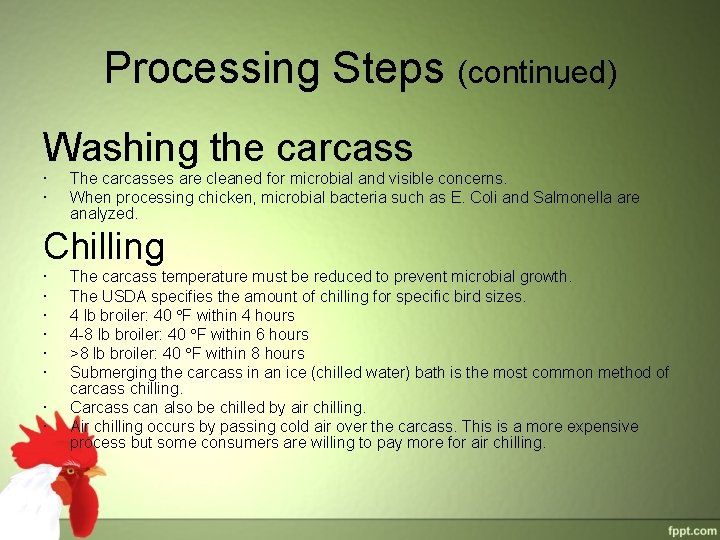
Processing Steps (continued) Washing the carcass The carcasses are cleaned for microbial and visible concerns. When processing chicken, microbial bacteria such as E. Coli and Salmonella are analyzed. Chilling The carcass temperature must be reduced to prevent microbial growth. The USDA specifies the amount of chilling for specific bird sizes. 4 lb broiler: 40 F within 4 hours 4 -8 lb broiler: 40 F within 6 hours >8 lb broiler: 40 F within 8 hours Submerging the carcass in an ice (chilled water) bath is the most common method of carcass chilling. Carcass can also be chilled by air chilling. Air chilling occurs by passing cold air over the carcass. This is a more expensive process but some consumers are willing to pay more for air chilling.
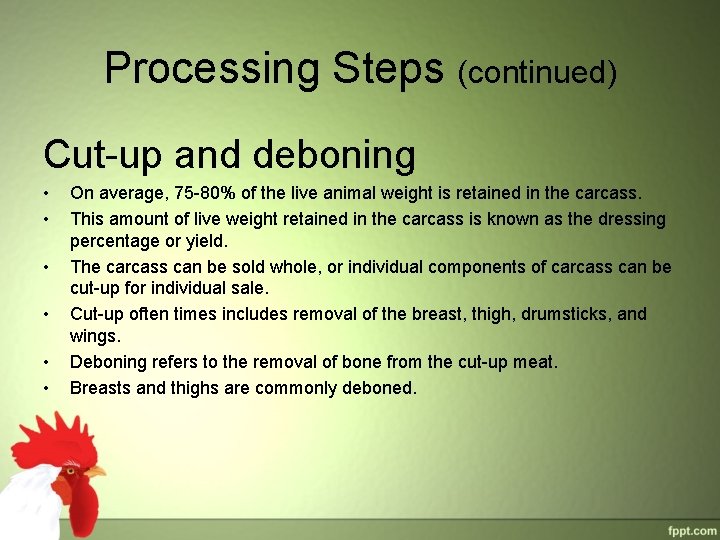
Processing Steps (continued) Cut-up and deboning • • • On average, 75 -80% of the live animal weight is retained in the carcass. This amount of live weight retained in the carcass is known as the dressing percentage or yield. The carcass can be sold whole, or individual components of carcass can be cut-up for individual sale. Cut-up often times includes removal of the breast, thigh, drumsticks, and wings. Deboning refers to the removal of bone from the cut-up meat. Breasts and thighs are commonly deboned.
E. PICKING/DEFEATHERING
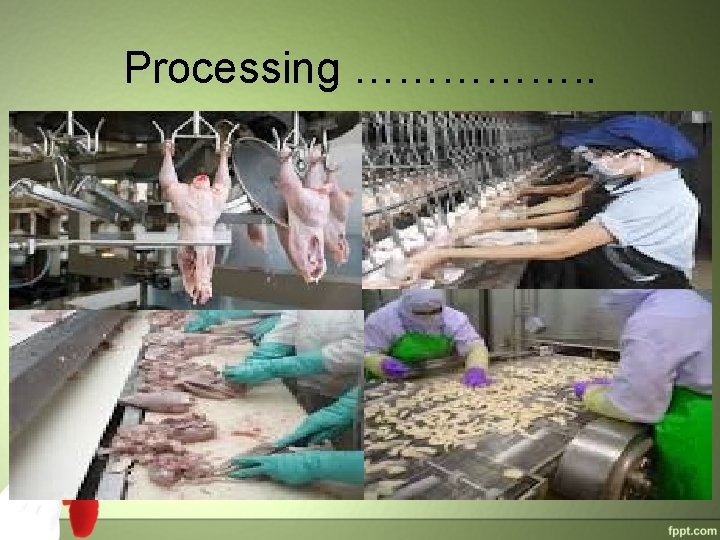
Processing ……………. .
FURTHER PROCESSING • May include forming, curing, smoking, and cooking of products. • Forming product requires a change in particle size and often includes the addition of nutrients to add flavor. • ii. Forming product also requires the use of a mold to obtain desired shape. • iii. Formed products include hot dogs, chicken nuggets, or sausage.
FURTHER PROCESSING 3. Curing involves the addition of preservatives, often nitrates, to the meat to improve flavor and product shelf-life. 4. Smoking also acts as a preservative while providing additional flavor to the product. 5. Some product may prepared in a form that is edible without additional preparation and is known as “ready-to-eat”.
Storage Poultry meat should be refrigerated around 30 °F. Keeping the poultry below 40 °F reduces the risk of microbial growth. Refrigeration and freezing does not kill all microbes, some will survive. Careful handling as not to damage whole cuts of meat is important.
EQUIPMENTS FOR PROCESSING
Equipment Used in Plant Stunning cabinet – Electrical circuit passes through the whole body and usually delivers about 200 m. A, depending on the setting. Automated knife blade – Cuts the throat and jugular vein allowing the blood to flow out of the bird. All birds are stunned and insensible to pain prior to entering the automated knife machine. Scalding tank – The purpose is to loosen the feather follicles of the bird so that the picker can remove the feathers. Picker – Soft, rubber projections are installed throughout the inside and the purpose is to remove all of the feathers so the bird is ready for processing. Pneumatic shears – A n air powered device to remove the neck and head.
What equipment is used during processing? • I. Stunning Cabinet • a. Electrical circuit passes through the whole body and usually delivers about 200 m. A, depending on the setting.
What equipment is used during processing? • II. Automated Knife Blade • Cuts the throat and jugular vein allowing the blood to flow out of the bird. • All birds are stunned and insensible to pain prior to entering the automated knife machine.
What equipment is used during processing? • III. Scalding Tank • a. The purpose is to loosen the feather follicles of the bird so that the picker • can remove the feathers.
What equipment is used during processing? • IV. Picker • a. Soft, rubber projections are installed throughout the inside and the purpose is to remove all of the feathers so the bird is ready for processing.
What equipment is used during processing? • V. Pneumatic shears • a. A gun-like structure that is powered by air to help in the removal of the neck.
Layout of Plant Flow of operations • Poultry processing plants are highly organized and mechanized facilities that contain state-of-the-art technology to ensure the safe preparation of poultry meat products. • Processed product should travel from the area of highest potential contamination to the lowest potential contamination. Personnel traffic flow • Personnel traffic flow should be restricted to prevent potential contamination of product. • Personnel should be restricted to their routine work area. Separation of raw and ready-to-eat product • Ready-to-eat products must be located in a separate facility from raw product in order to prevent potential contamination. • Ventilation systems should direct airflow away from cooked products.
To understand the layout of a poultry processing facility. I. Flow of operations • 1. Poultry processing plants are highly organized and mechanized facilities that contain state-of-the-art technology to ensure the safe preparation of • poultry meat products. • 2. Processed product should travel from the area of highest potential contamination to the lowest potential contamination.
To understand the layout of a poultry processing facility. • II. Personnel traffic flow • 1. Personnel traffic flow should be restricted to prevent potential • contamination of product. • 2. Personnel should be restricted to their routine work area.
To understand the layout of a poultry processing facility. • III. Separation of raw and ready-to-eat product • 1. Ready-to-eat products must be located in a separate facility from raw • product in order to prevent potential contamination. • 2. Ventilation systems should direct airflow away from cooked products.
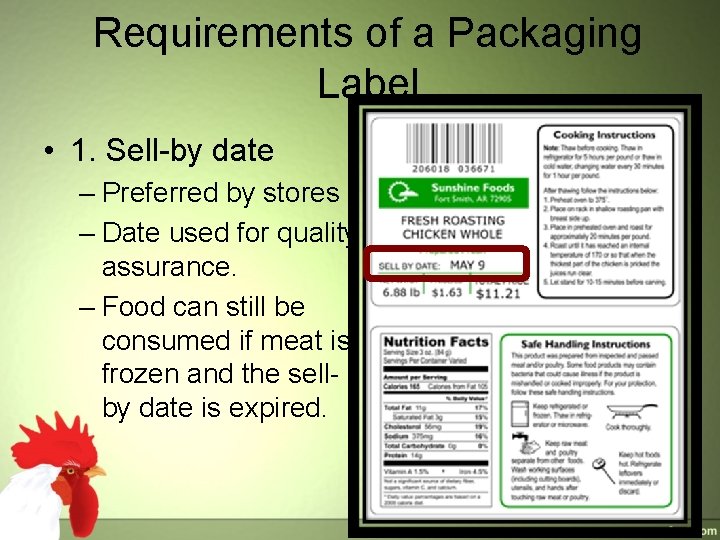
Requirements of a Packaging Label • 1. Sell-by date – Preferred by stores – Date used for quality assurance. – Food can still be consumed if meat is frozen and the sellby date is expired.
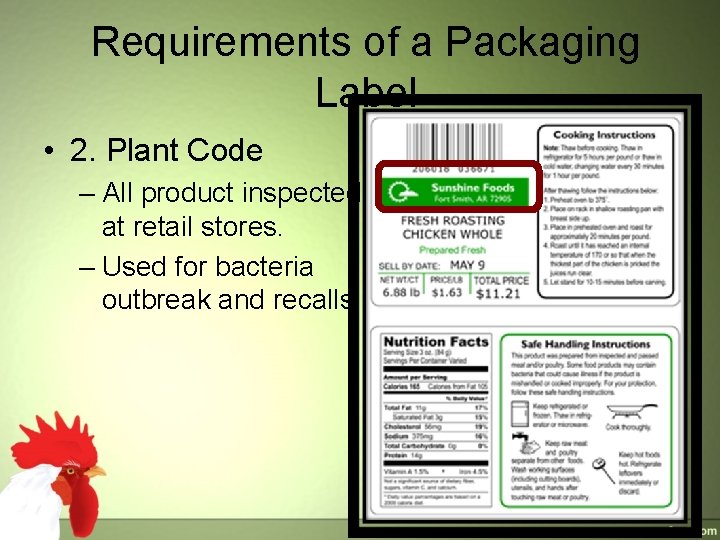
Requirements of a Packaging Label • 2. Plant Code – All product inspected at retail stores. – Used for bacteria outbreak and recalls.
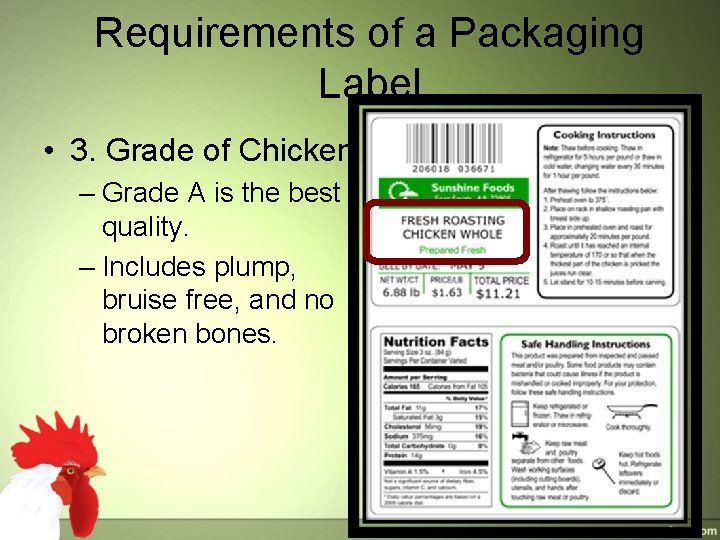
Requirements of a Packaging Label • 3. Grade of Chicken – Grade A is the best quality. – Includes plump, bruise free, and no broken bones.
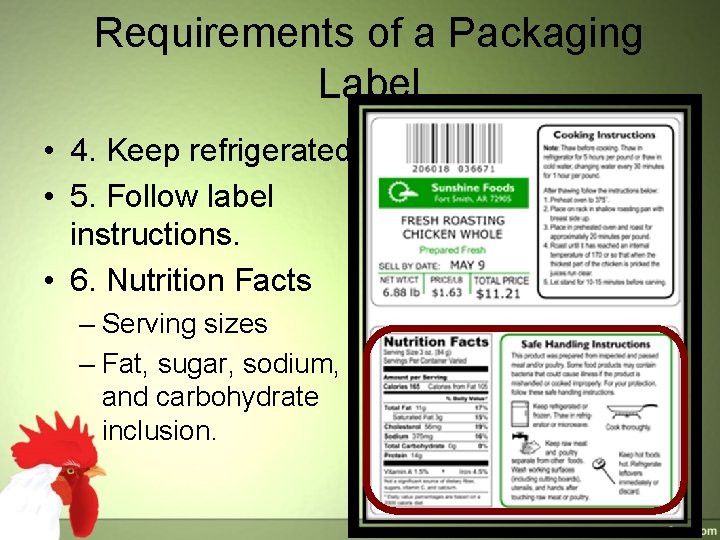
Requirements of a Packaging Label • 4. Keep refrigerated. • 5. Follow label instructions. • 6. Nutrition Facts – Serving sizes – Fat, sugar, sodium, and carbohydrate inclusion.
Identify the requirements of a packaging label • Follow all claims • 1. For example: if labeled “Organic”, the bird must have truly been raised organically and certified organic. • ii. Some labels are misleading • 1. For example: “No hormones or steroids” – It is illegal to use hormones or steroids in poultry production. •
REFERENCES 1. Leo M. L. Nollet , “Handbook of Meat, Poultry and Seafood, Quality” Blackwell Publishing, 2007 2. G. C. Mead “ Microbiological analysis of red meat, poultry and eggs”, CRC press, Woodhead publishing limited, 2007 3. G. C. Mead and Richardson , “ Poultry Meat Science” , CABI Publishing ( 1999)