
POTTERY HISTORY OF POTTERY Archaeological evidence together with


- Slides: 33
“POTTERY”
HISTORY OF POTTERY Archaeological evidence, together with the example of primitive tribes in recent times, suggests that the earliest containers used by Neolithic man range from hollowed out pieces of stone or wood to more elaborate artefacts such as bags of animal skin and, above all, baskets. Basketry is one of the earliest crafts to be developed. Almost every region of the world has suitable materials, in grasses, reeds or willows, and the resulting object is both cheap and light.
But baskets are not good for containing liquids. For that purpose early technology soon finds another material which is cheap, widely available and (by comparison with stone) relatively light. This material is CLAY. Not all societies have developed the useful craft of pottery. Nomads tend not to be potters. The technical demands of pottery do not fit well with life on the move, and pots are too fragile for a nomadic existence. Equally, in areas where nature provides admirable pots in the form of gourds, the potter's trade seems an unnecessary labour.
But most communities, tending their crops in the Neolithic Revolution, soon discover the technique and use of pottery. With one remarkable exception, at Dolni Vestonice in the Czech Republic (where models of animals and a Venus figurine have been dated to about 25, 000 years ago), the earliest examples come from the Middle East, the region where agriculture first develops. Pottery fragments from about 6500 BC have been found at Catal Huyuk in Turkey. The earliest wares at Catal Huyuk are made by one of the standard methods of primitive potters
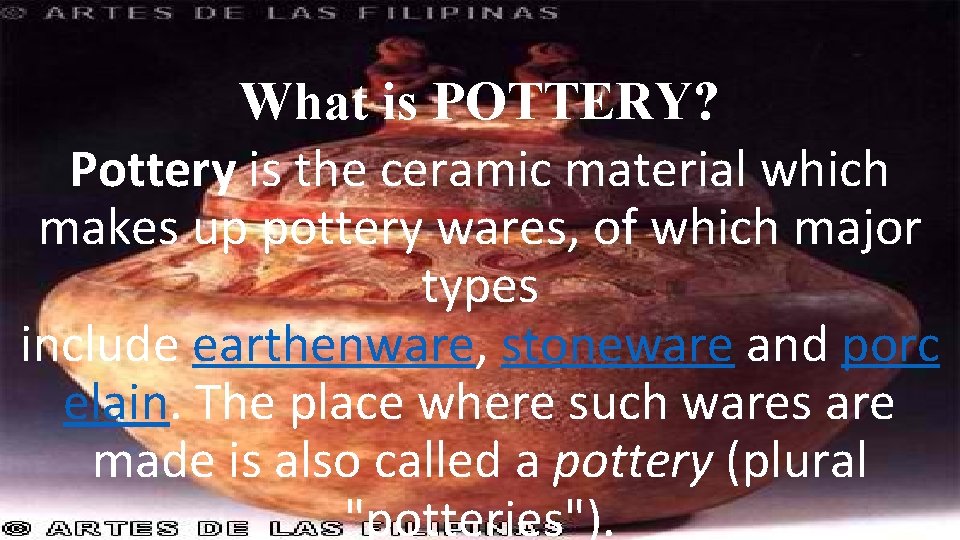
What is POTTERY? Pottery is the ceramic material which makes up pottery wares, of which major types include earthenware, stoneware and porc elain. The place where such wares are made is also called a pottery (plural "potteries").
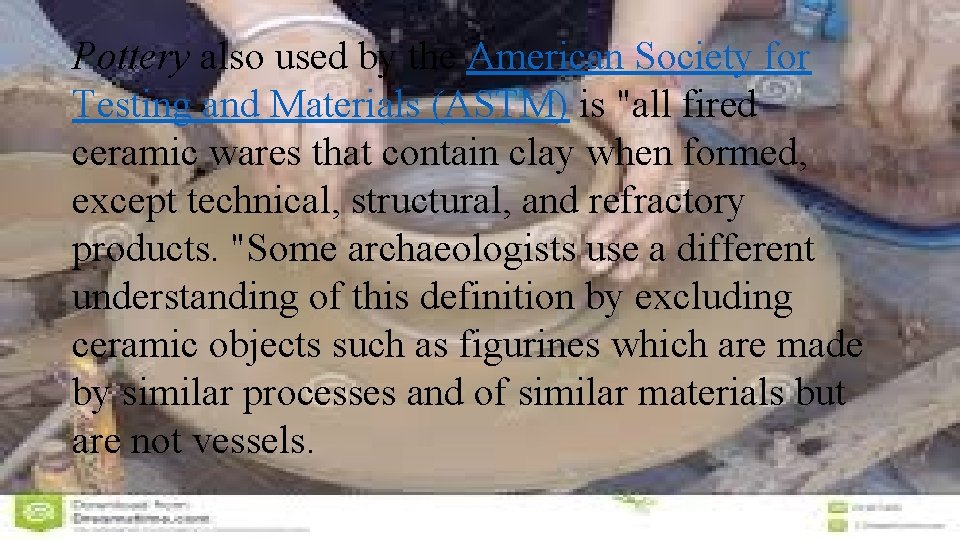
Pottery also used by the American Society for Testing and Materials (ASTM) is "all fired ceramic wares that contain clay when formed, except technical, structural, and refractory products. "Some archaeologists use a different understanding of this definition by excluding ceramic objects such as figurines which are made by similar processes and of similar materials but are not vessels.
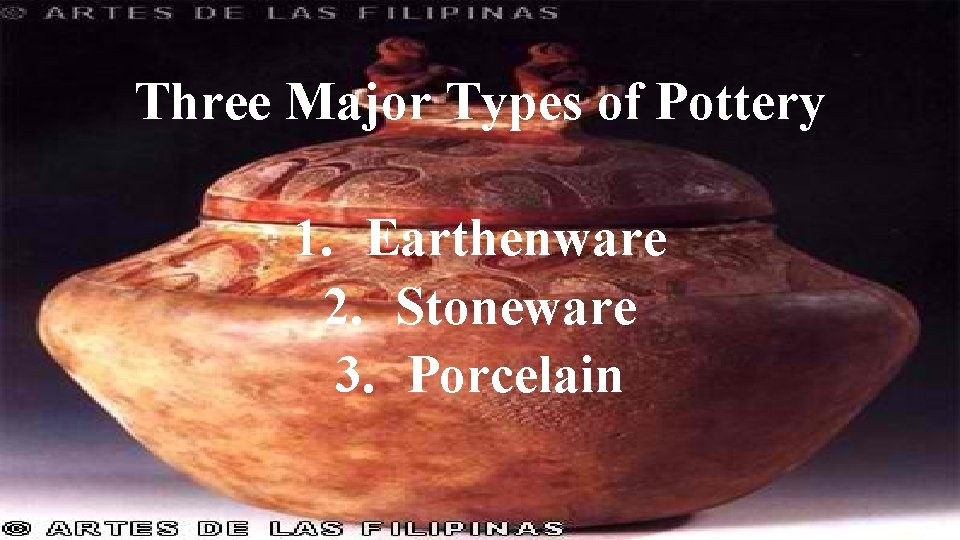
Three Major Types of Pottery 1. Earthenware 2. Stoneware 3. Porcelain
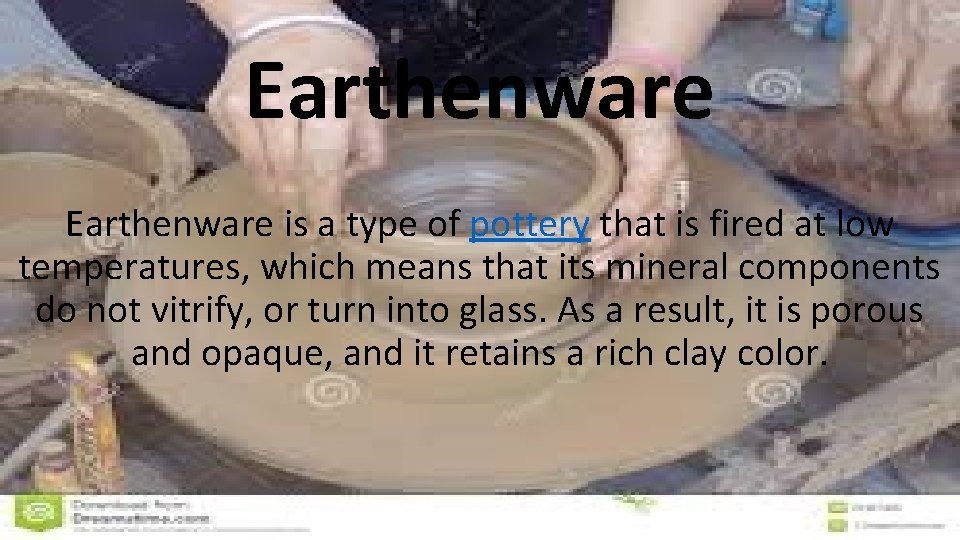
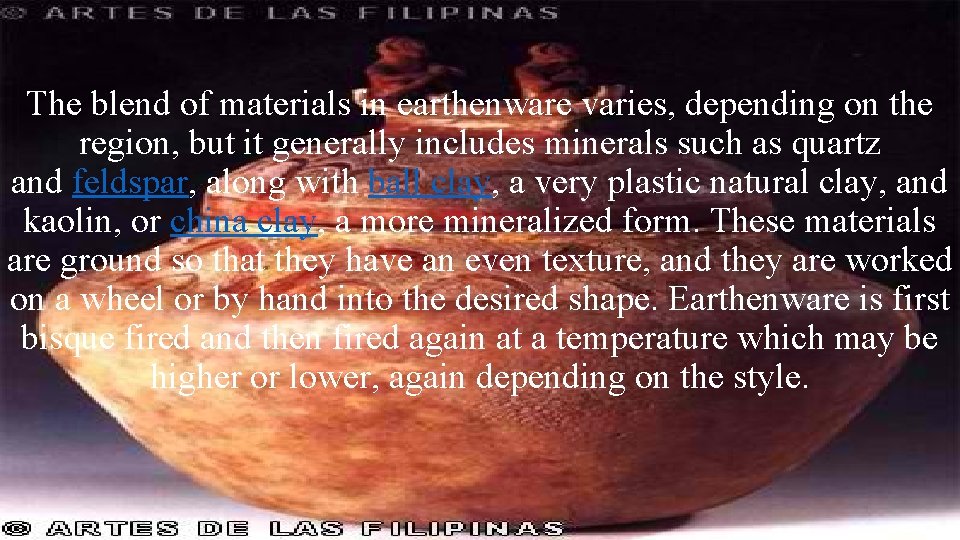
F Earthenware is a type of pottery that is fired at low temperatures, which means that its mineral components do not vitrify, or turn into glass. As a result, it is porous and opaque, and it retains a rich clay color.
The blend of materials in earthenware varies, depending on the region, but it generally includes minerals such as quartz and feldspar, along with ball clay, a very plastic natural clay, and kaolin, or china clay, a more mineralized form. These materials are ground so that they have an even texture, and they are worked on a wheel or by hand into the desired shape. Earthenware is first bisque fired and then fired again at a temperature which may be higher or lower, again depending on the style.
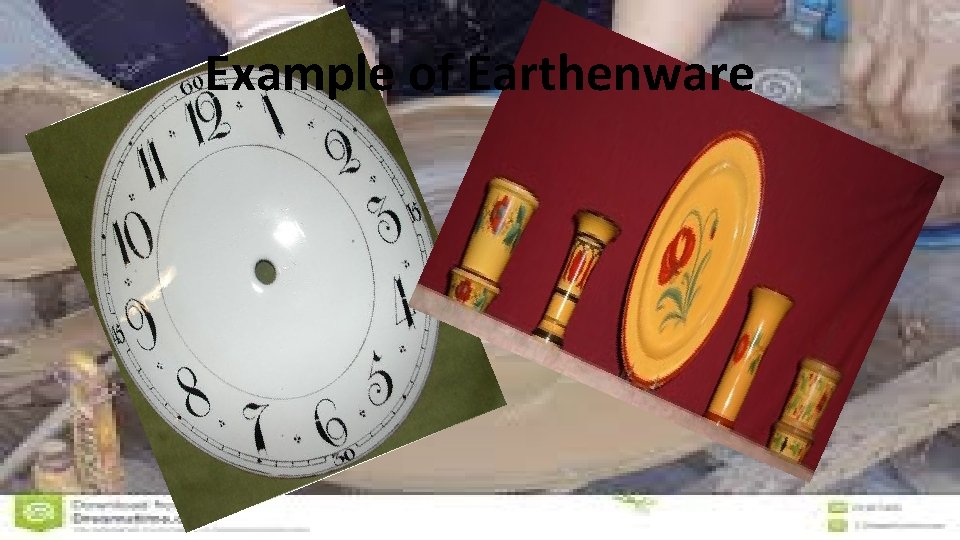
Example of Earthenware
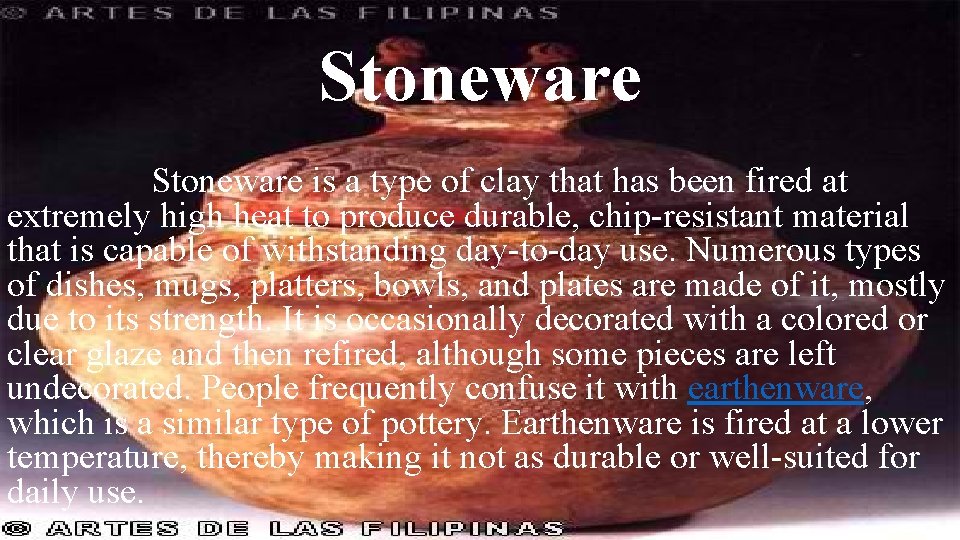
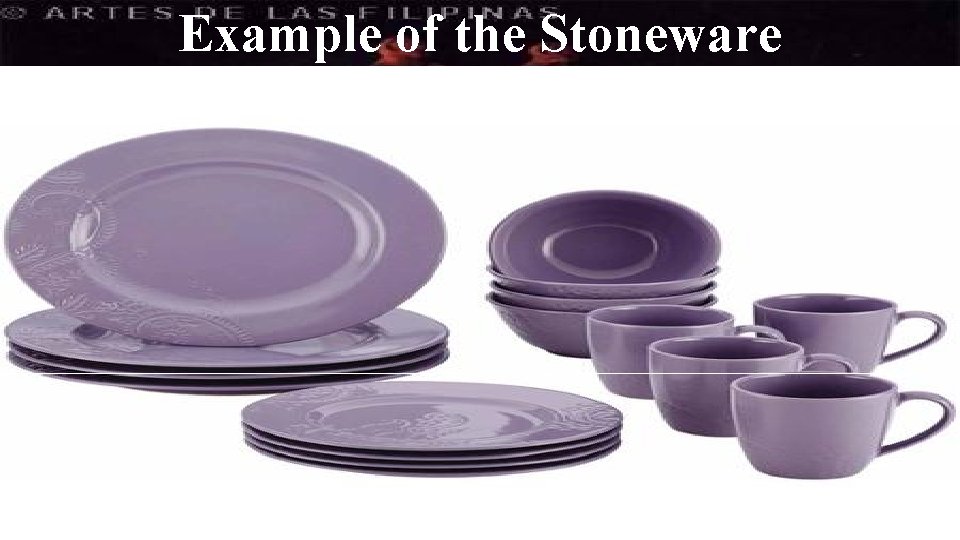
Stoneware is a type of clay that has been fired at extremely high heat to produce durable, chip-resistant material that is capable of withstanding day-to-day use. Numerous types of dishes, mugs, platters, bowls, and plates are made of it, mostly due to its strength. It is occasionally decorated with a colored or clear glaze and then refired, although some pieces are left undecorated. People frequently confuse it with earthenware, which is a similar type of pottery. Earthenware is fired at a lower temperature, thereby making it not as durable or well-suited for daily use.
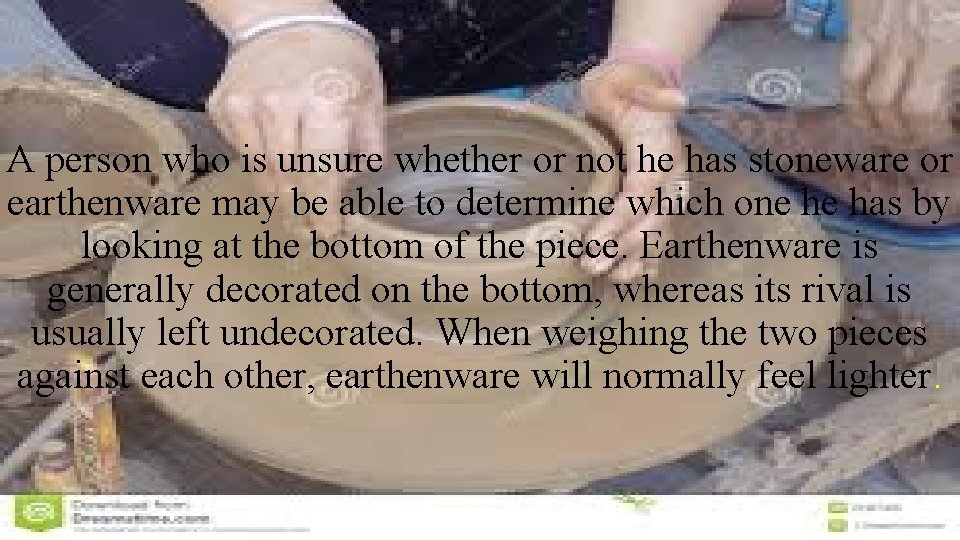
A person who is unsure whether or not he has stoneware or earthenware may be able to determine which one he has by looking at the bottom of the piece. Earthenware is generally decorated on the bottom, whereas its rival is usually left undecorated. When weighing the two pieces against each other, earthenware will normally feel lighter.
Example of the Stoneware
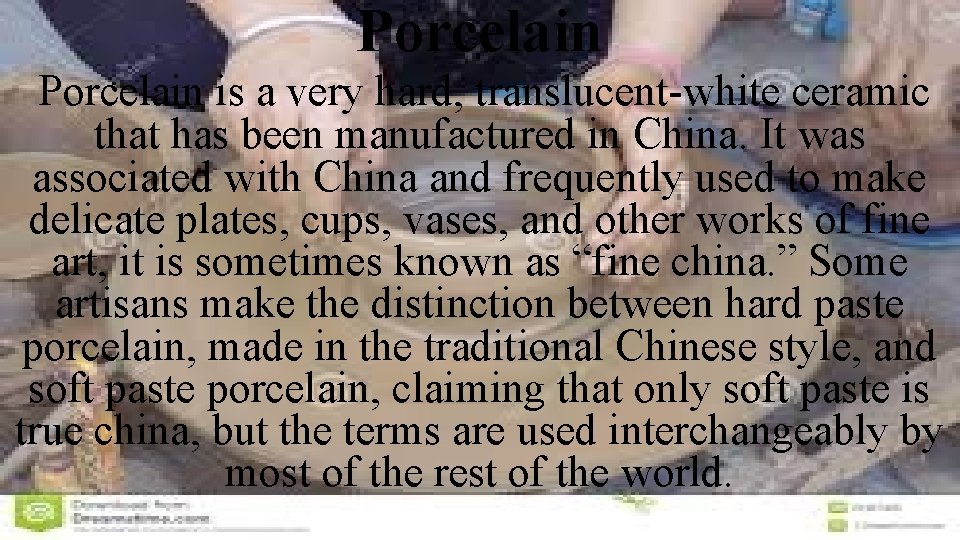
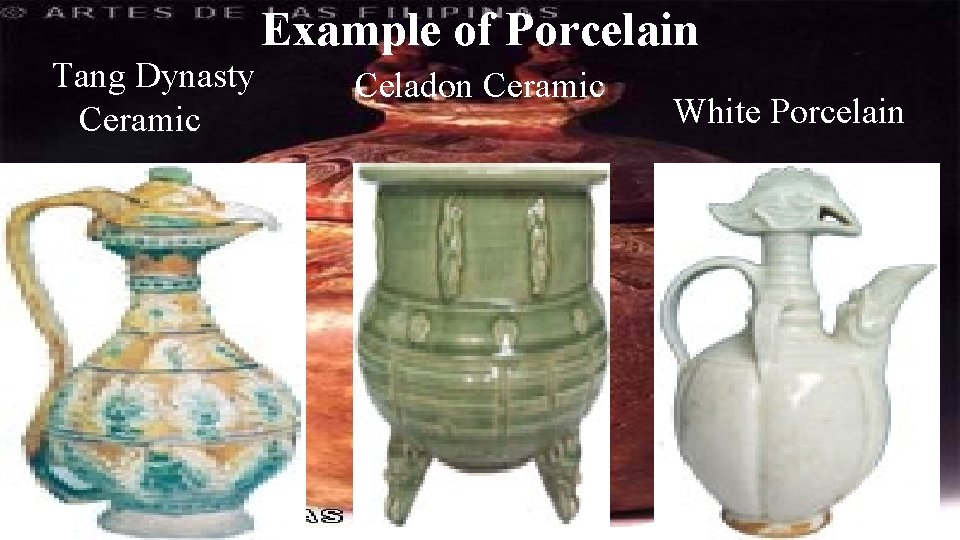
Porcelain is a very hard, translucent-white ceramic that has been manufactured in China. It was associated with China and frequently used to make delicate plates, cups, vases, and other works of fine art, it is sometimes known as “fine china. ” Some artisans make the distinction between hard paste porcelain, made in the traditional Chinese style, and soft paste porcelain, claiming that only soft paste is true china, but the terms are used interchangeably by most of the rest of the world.
Tang Dynasty Ceramic Example of Porcelain Celadon Ceramic White Porcelain
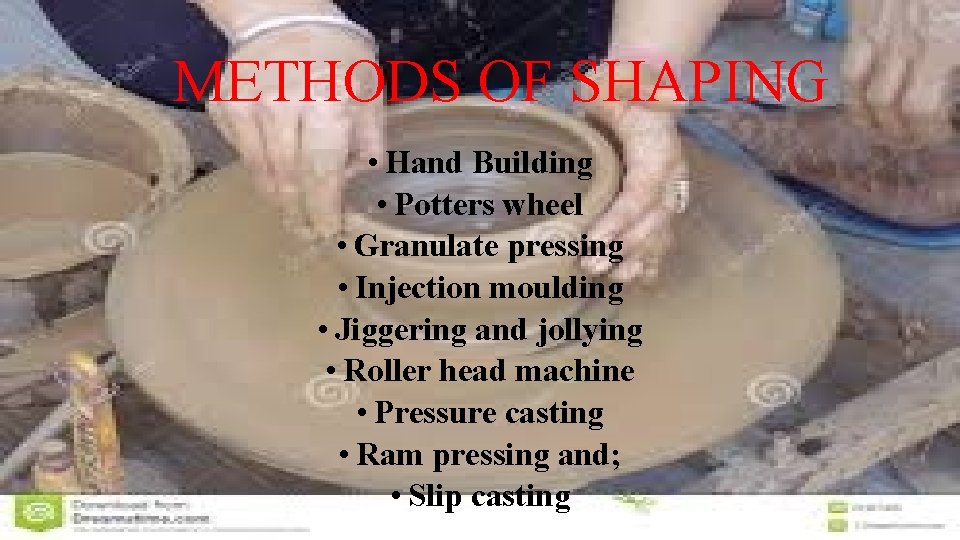
METHODS OF SHAPING • Hand Building • Potters wheel • Granulate pressing • Injection moulding • Jiggering and jollying • Roller head machine • Pressure casting • Ram pressing and; • Slip casting
Hand Building is the earliest forming method Parts of hand-built vessels are often joined together with the aid of slip, an aqueous suspension of clay body and water. A clay body can be decorated before or after firing. Prior to some shaping processes, clay must be prepared such a stable wares although some studio potters find hand-building more conducive to create one-of-a-kind works of art.
The potter's wheel - a process called "throwing". a ball of clay is placed in the centre of a turntable, called the wheel-head, which the potter rotates with a stick, with foot power or with a variablespeed electric motor. wheel rotates while the solid ball of soft clay is pressed, squeezed and pulled gently upwards and outwards into a hollow shape. The first step of pressing the rough ball of clay downward and inward into perfect rotational symmetry is called centring the clay—a most important skill to master before the next steps: opening (making a centred hollow into the solid ball of clay), flooring (making the flat or rounded bottom inside the pot), throwing or pulling(drawing up and shaping the walls to an even thickness), and trimming or turning(removing excess clay to refine the shape or to create a foot).
Granulate Pressing is the operation of shaping pottery by pressing clay in a semi-dry and granulated condition in a mould. The clay is pressed into the mould by a porous die through which water is pumped at high pressure. The granulated clay is prepared by spray-drying to produce a fine and freeflowing material having a moisture content of between about 5 and 6 per cent. Granulate pressing, also known as dust pressing, is widely used in the manufacture of ceramic tiles and, increasingly, of plates.
Injection moulding is a shape-forming process adapted for the tableware industry from the method long established for the forming of thermoplastic and some metal components. It has been called Porcelain Injection Moulding, or PIM. Suited to the mass production of complex-shaped articles, one significant advantage of the technique is that it allows the production of a cup, including the handle, in a single process, and thereby eliminates the handle-fixing operation and produces a stronger bond between cup and handle. The feed to the mould die is a mix of approximately 50 to 60 percent unfired body in powder form, together with 40 to 50 percent organic additives composed of binders, lubricants and plasticisers. The technique is not as widely used as other shaping methods.
Jiggering and Jollying These operations are carried out on the potter's wheel and allow the time taken to bring wares to a standardized form to be reduced Jiggering is the operation of bringing a shaped tool into contact with the plastic clay of a piece under construction, the piece itself being set on a rotating plaster mould on the wheel. The jigger tool shapes one face while the mould shapes the other. Jiggering is used only in the production of flat wares, such as plates, but a similar operation, jolleying, is used in the production of hollow-wares such as cups. Jiggering and jolleying have been used in the production of pottery since at least the 18 th century. In large-scale factory production, jiggering and jolleying are usually automated, which allows the operations to be carried out by semi-skilled labour.
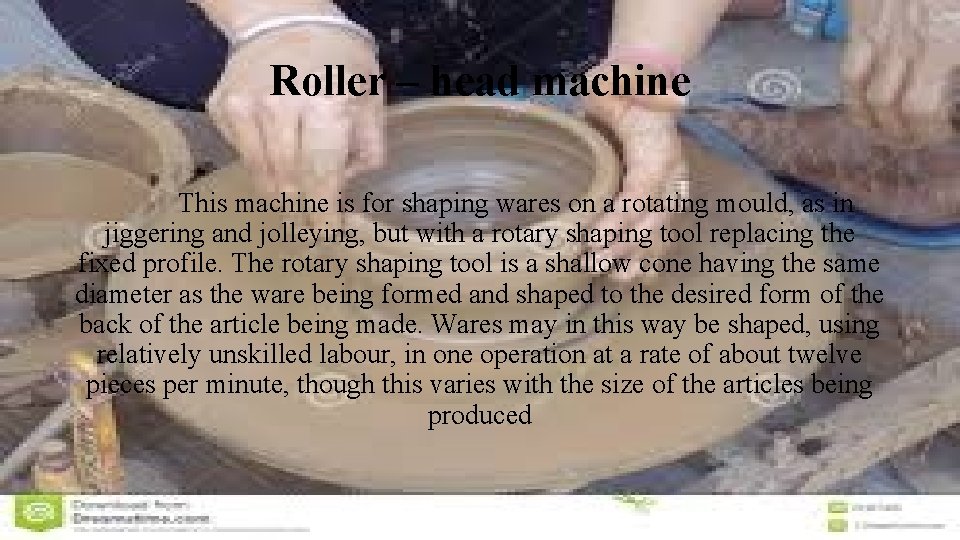
Roller – head machine This machine is for shaping wares on a rotating mould, as in jiggering and jolleying, but with a rotary shaping tool replacing the fixed profile. The rotary shaping tool is a shallow cone having the same diameter as the ware being formed and shaped to the desired form of the back of the article being made. Wares may in this way be shaped, using relatively unskilled labour, in one operation at a rate of about twelve pieces per minute, though this varies with the size of the articles being produced
Pressure casting specially developed polymeric materials allow a mould to be subject to application external pressures of up to 4. 0 MPa–so much higher than slip casting in plaster moulds where the capillary forces correspond to a pressure of around 0. 1 - 0. 2 MPa. The high pressure leads to much faster casting rates and, hence, faster production cycles. Furthermore, the application of high pressure air through the polymeric moulds upon demoulding the cast means a new casting cycle can be started immediately in the same mould, unlike plaster moulds which require lengthy drying times. The polymeric materials have much greater durability than plaster and, therefore, it is possible to achieve shaped products with better dimensional tolerances and much longer mould life.
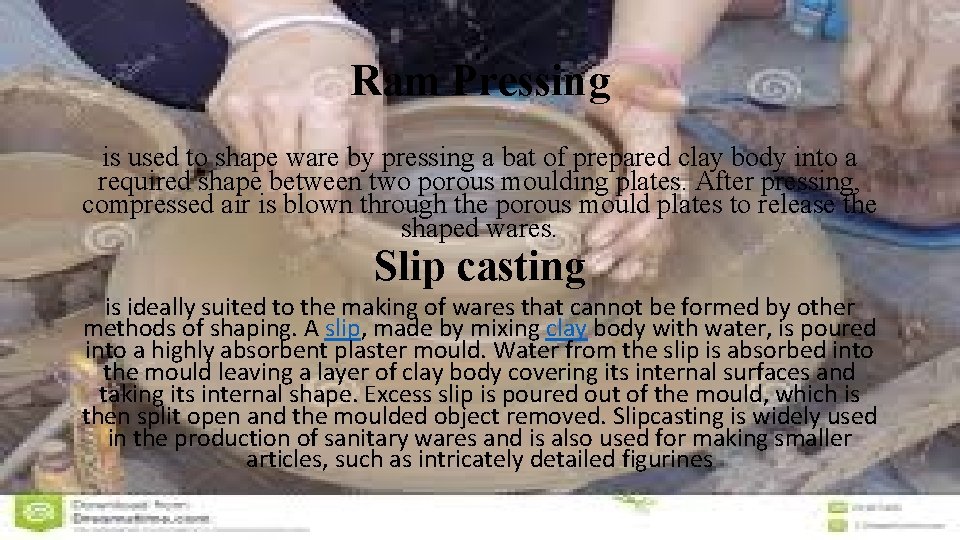
Ram Pressing is used to shape ware by pressing a bat of prepared clay body into a required shape between two porous moulding plates. After pressing, compressed air is blown through the porous mould plates to release the shaped wares. Slip casting is ideally suited to the making of wares that cannot be formed by other methods of shaping. A slip, made by mixing clay body with water, is poured into a highly absorbent plaster mould. Water from the slip is absorbed into the mould leaving a layer of clay body covering its internal surfaces and taking its internal shape. Excess slip is poured out of the mould, which is then split open and the moulded object removed. Slipcasting is widely used in the production of sanitary wares and is also used for making smaller articles, such as intricately detailed figurines
Five Essential tools in Pottery making Pottery tools are used for a variety of different purposes. Some tools are considered to be essential in the pottery and ceramic crafting arena. Some of these types of tools are used for sculpting the material, and others are used for moulding them. Some of the tools that are considered to be essential are used during the process of throwing pottery on a wheel or working without one. Still, others are considered essential in creating a finished project. How essential these tools are depends on the artists that are using them and how they work with their clay or ceramic material.
Some tools are essential to potters based solely on their individual preferences as well. One such example is the Potter's Needle, which is composed of a long needle-like body and has a handle that can be constructed out of various materials, such as plastic, wood, or metal. These heavy needles are considered to be versatile as it is also frequently used for trimming edges of clay creating while it spins on the pottery wheel. These are only a few of the uses that a tool like the Potter's Needles can be used for. Each person finds their own additional uses according to how the pottery is being formed and what outcome is eventually.
Five Essential tools in Pottery making • Ribbon cutter • Brushes • Moulds • Clay extruder • Potter’s Kiln
Ribbon cutter ribbon cutter is a commonly used sculpting tool. This type of tool is very lightweight and often has a wooden or plastic handle that has a thin metal loop or wire on the end. They come in a variety of lengths so that it is very easy to find one that is easy to hold and does not slip when in use. Uses: is one that is ideal for many general purposes uses, including trimming items that are crafted by hand. This type of tool is an essential one for many artists as the tool is able to make sharp, clean cuts. They are also great for making smooth, even grooves on soft materials. Although the ribbon cutter is a very versatile tool, it should not be used when throwing clay due to the fragile design.
Brushes are common tools that potters use in crafting pottery and other ceramics. Bamboo brushes, also known as sumi brushes, are a favourite among many people because they are soft enough to be pliable yet still strong. They are able to hold a lot of water and still have a pointed edge to work with. They come in a variety of brush widths, so it is easy to find one that is great for any project. Uses: One of the biggest reasons why brushes are essential for this type of craft is because of the many things that can be done using a brush. There are various types of brushes that can be used for working on pottery and ceramic items. Brushes are essential in smoothing out the surface of the clay or other ceramic material. They are also used for adding texture and are used in the painting and glazing process as well.
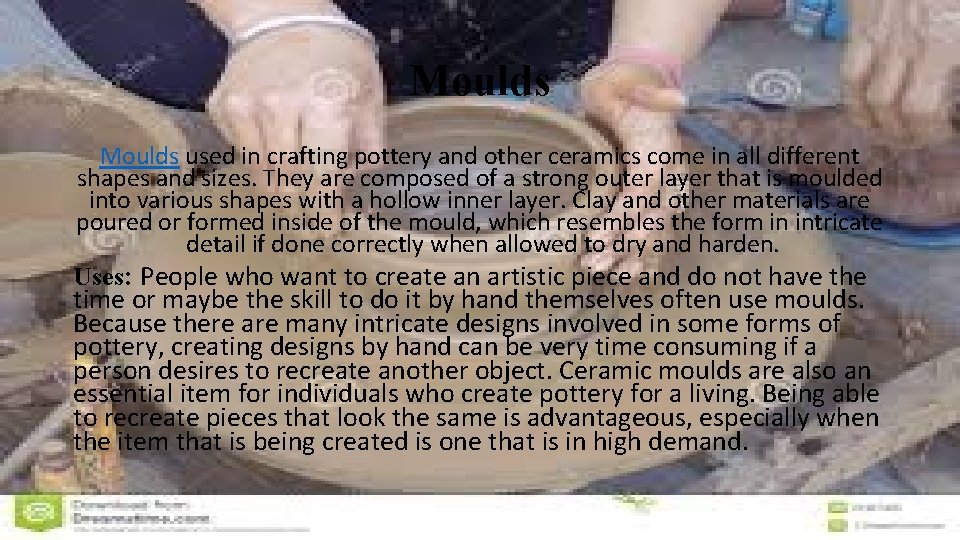
Moulds used in crafting pottery and other ceramics come in all different shapes and sizes. They are composed of a strong outer layer that is moulded into various shapes with a hollow inner layer. Clay and other materials are poured or formed inside of the mould, which resembles the form in intricate detail if done correctly when allowed to dry and harden. Uses: People who want to create an artistic piece and do not have the time or maybe the skill to do it by hand themselves often use moulds. Because there are many intricate designs involved in some forms of pottery, creating designs by hand can be very time consuming if a person desires to recreate another object. Ceramic moulds are also an essential item for individuals who create pottery for a living. Being able to recreate pieces that look the same is advantageous, especially when the item that is being created is one that is in high demand.
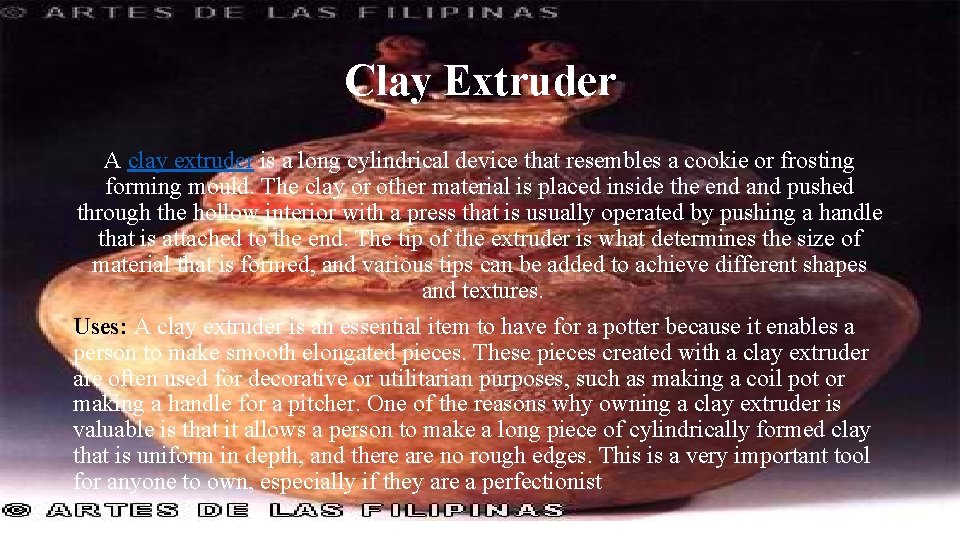
Clay Extruder A clay extruder is a long cylindrical device that resembles a cookie or frosting forming mould. The clay or other material is placed inside the end and pushed through the hollow interior with a press that is usually operated by pushing a handle that is attached to the end. The tip of the extruder is what determines the size of material that is formed, and various tips can be added to achieve different shapes and textures. Uses: A clay extruder is an essential item to have for a potter because it enables a person to make smooth elongated pieces. These pieces created with a clay extruder are often used for decorative or utilitarian purposes, such as making a coil pot or making a handle for a pitcher. One of the reasons why owning a clay extruder is valuable is that it allows a person to make a long piece of cylindrically formed clay that is uniform in depth, and there are no rough edges. This is a very important tool for anyone to own, especially if they are a perfectionist
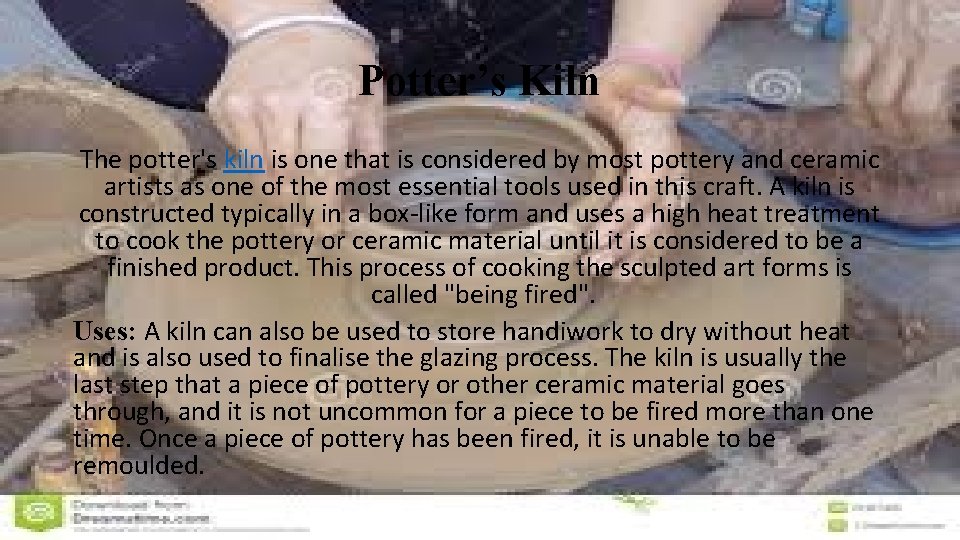
Potter’s Kiln The potter's kiln is one that is considered by most pottery and ceramic artists as one of the most essential tools used in this craft. A kiln is constructed typically in a box-like form and uses a high heat treatment to cook the pottery or ceramic material until it is considered to be a finished product. This process of cooking the sculpted art forms is called "being fired". Uses: A kiln can also be used to store handiwork to dry without heat and is also used to finalise the glazing process. The kiln is usually the last step that a piece of pottery or other ceramic material goes through, and it is not uncommon for a piece to be fired more than one time. Once a piece of pottery has been fired, it is unable to be remoulded.
THANK YOU FOR LISTENING ^_^ BYE…BYE. .