
potentiostat h detector Kyle A Grice Assistant Professor
- Slides: 5
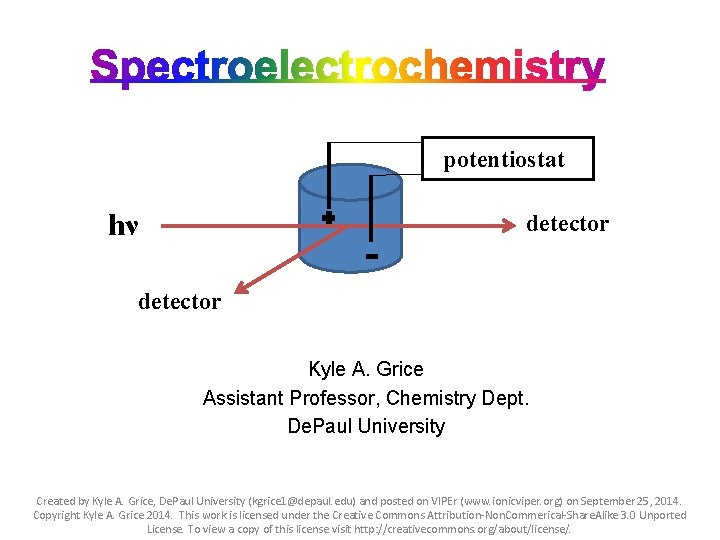
potentiostat hν detector Kyle A. Grice Assistant Professor, Chemistry Dept. De. Paul University Created by Kyle A. Grice, De. Paul University (kgrice 1@depaul. edu) and posted on VIPEr (www. ionicviper. org) on September 25, 2014. Copyright Kyle A. Grice 2014. This work is licensed under the Creative Commons Attribution-Non. Commerical-Share. Alike 3. 0 Unported License. To view a copy of this license visit http: //creativecommons. org/about/license/.
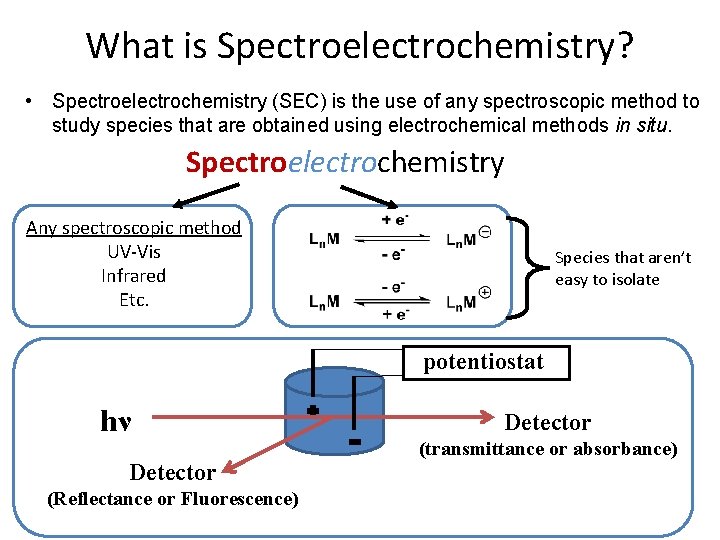
What is Spectroelectrochemistry? • Spectroelectrochemistry (SEC) is the use of any spectroscopic method to study species that are obtained using electrochemical methods in situ. Spectroelectrochemistry Any spectroscopic method UV-Vis Infrared Etc. Species that aren’t easy to isolate potentiostat hν Detector (Reflectance or Fluorescence) Detector (transmittance or absorbance)
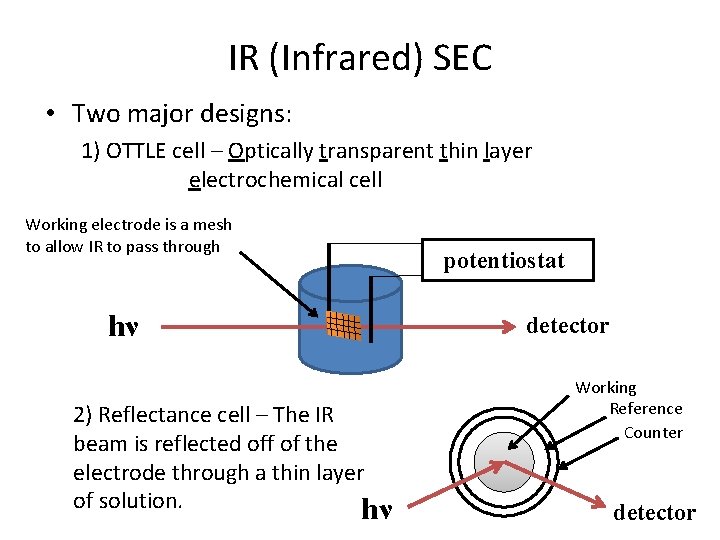
IR (Infrared) SEC • Two major designs: 1) OTTLE cell – Optically transparent thin layer electrochemical cell Working electrode is a mesh to allow IR to pass through hν 2) Reflectance cell – The IR beam is reflected off of the electrode through a thin layer of solution. hν potentiostat detector Working Reference Counter detector
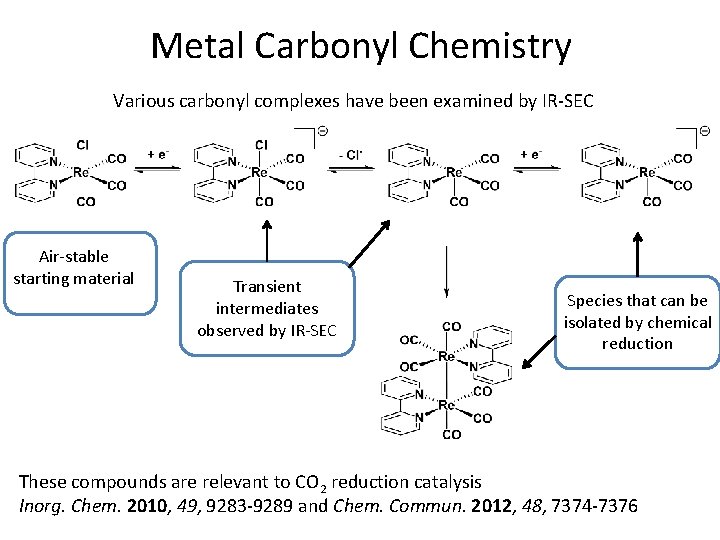
Metal Carbonyl Chemistry Various carbonyl complexes have been examined by IR-SEC Air-stable starting material Transient intermediates observed by IR-SEC Species that can be isolated by chemical reduction These compounds are relevant to CO 2 reduction catalysis Inorg. Chem. 2010, 49, 9283 -9289 and Chem. Commun. 2012, 48, 7374 -7376
Other Resources on SEC • Commercial Units are available – OTTLE IR-SEC – Specac and other companies – UV-Vis SEC – Pine and other companies Papers with Inorganic chemistry SEC examples: – IR-SEC: Organometallics 2014, 33, 4550 -4559 – X-ray SEC: J. Phys. Chem. C 2009, 113, 308 -315 – Raman SEC: Chem. Commun. 2014, 50, 5227 -5229