
POTENTIOMETRY Potentiometric Analysis Based on potential measurement of

POTENTIOMETRY

Potentiometric Analysis • Based on potential measurement of electrochemical cells without any appreciable current • The use of electrodes to measure voltages from chemical reactions

Applications of Potentiometric Analysis
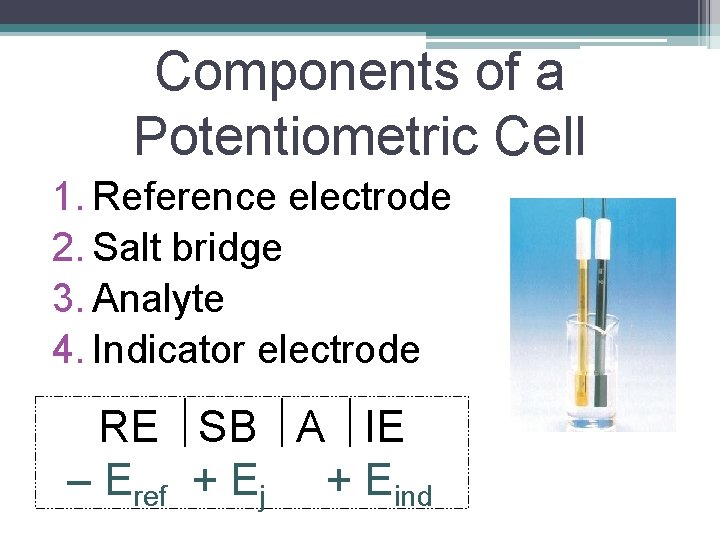
Components of a Potentiometric Cell 1. Reference electrode 2. Salt bridge 3. Analyte 4. Indicator electrode RE SB A IE – Eref + Ej + Eind
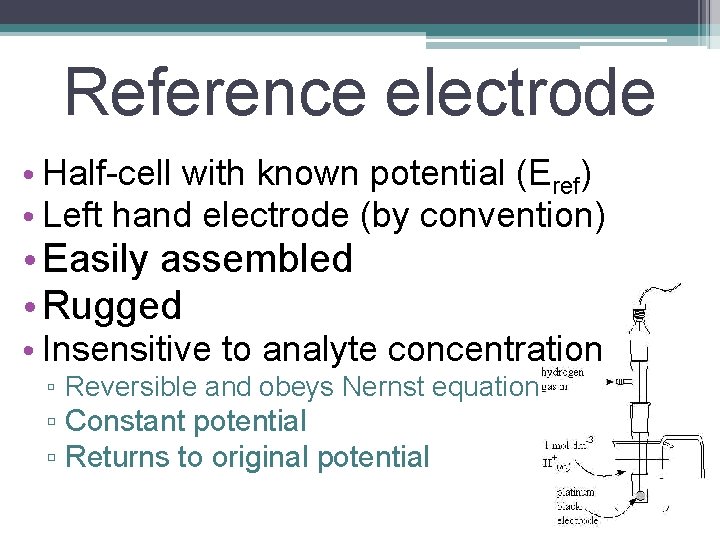
Reference electrode • Half-cell with known potential (Eref) • Left hand electrode (by convention) • Easily assembled • Rugged • Insensitive to analyte concentration ▫ Reversible and obeys Nernst equation ▫ Constant potential ▫ Returns to original potential
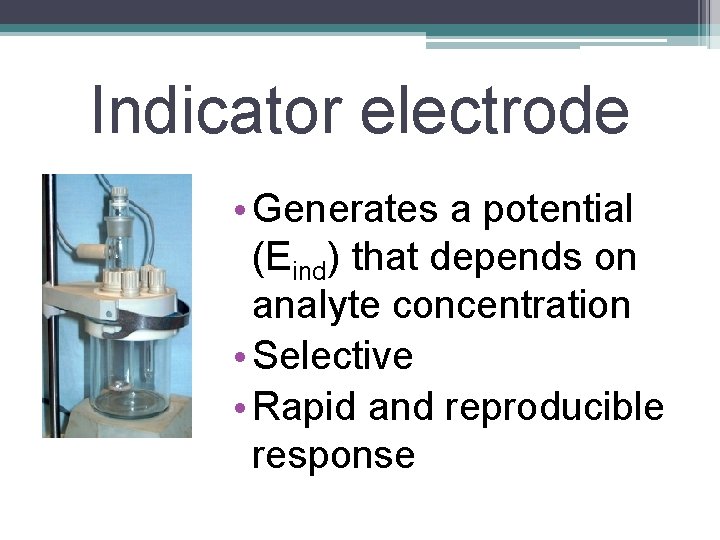
Indicator electrode • Generates a potential (Eind) that depends on analyte concentration • Selective • Rapid and reproducible response
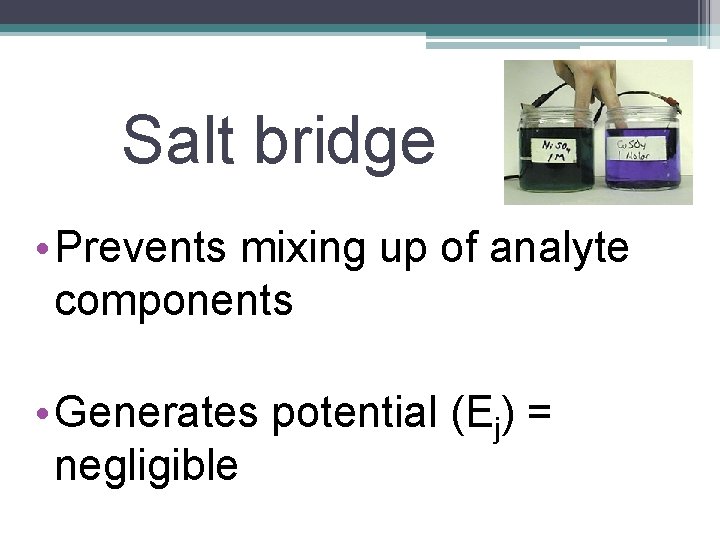
Salt bridge • Prevents mixing up of analyte components • Generates potential (Ej) = negligible

Reference Electrodes 1. Standard Hydrogen Electrode 2. Calomel Reference Electrode 3. Silver/Silver Chloride Reference Electrode
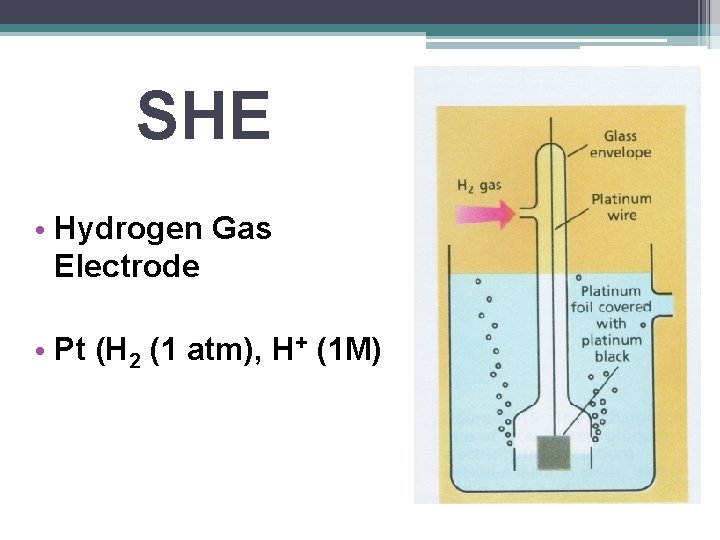
SHE • Hydrogen Gas Electrode • Pt (H 2 (1 atm), H+ (1 M)
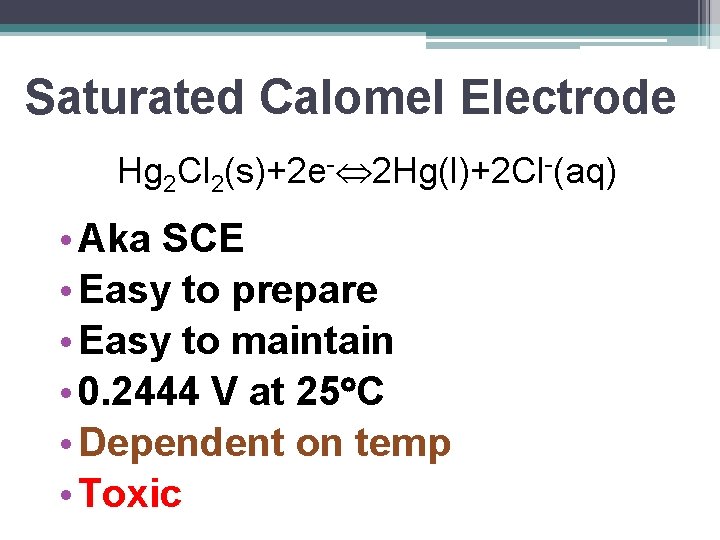
Saturated Calomel Electrode Hg 2 Cl 2(s)+2 e- 2 Hg(l)+2 Cl-(aq) • Aka SCE • Easy to prepare • Easy to maintain • 0. 2444 V at 25 C • Dependent on temp • Toxic
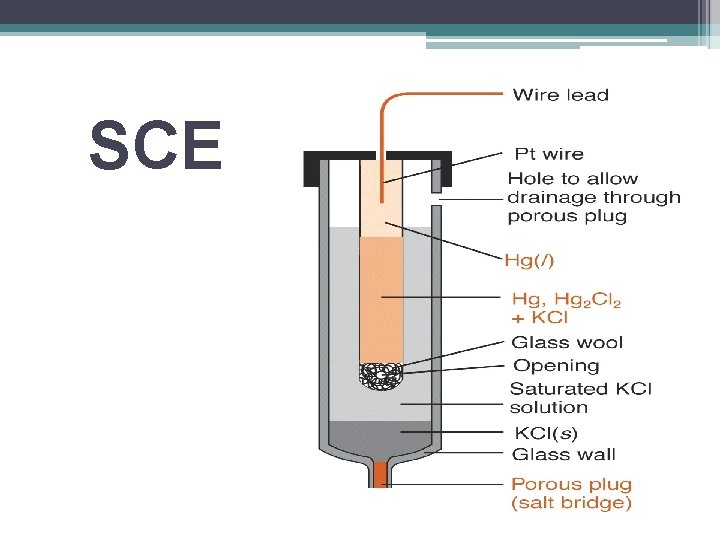
SCE
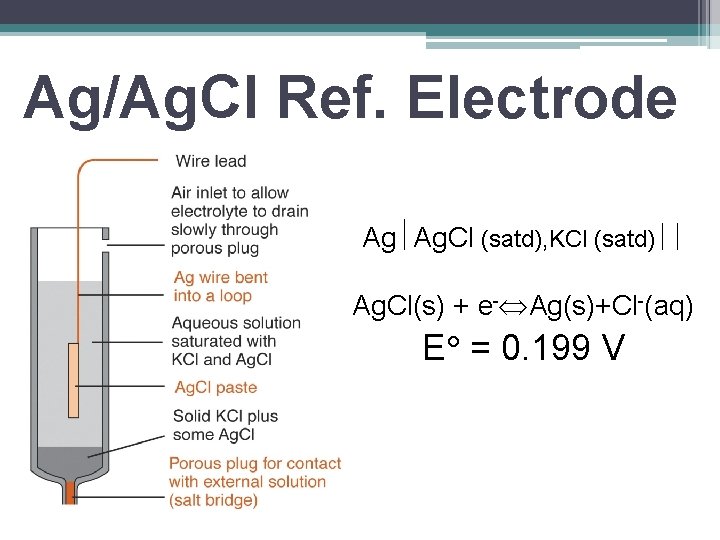
Ag/Ag. Cl Ref. Electrode Ag Ag. Cl (satd), KCl (satd) Ag. Cl(s) + e- Ag(s)+Cl-(aq) E = 0. 199 V

Liquid Junction Potential • Liquid junction - interface between two solutions containing different electrolytes or different concentrations of the same electrolyte • A junction potential occurs at every liquid junction. ▫ Caused by unequal mobilities of the + and - ions.
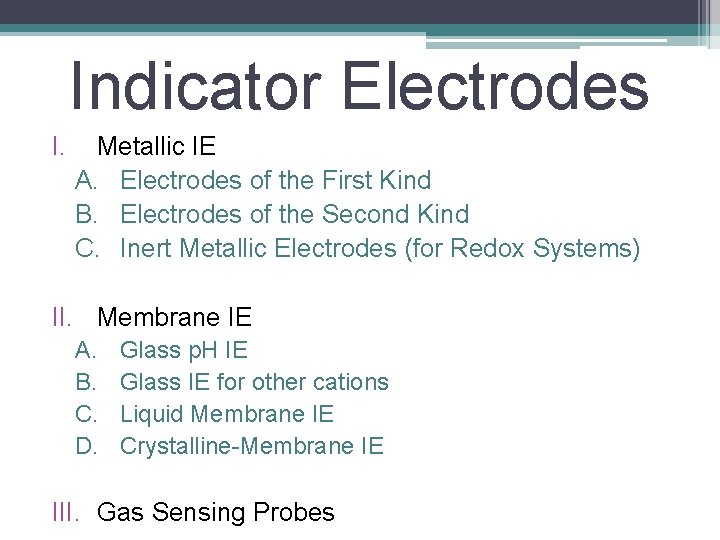
Indicator Electrodes I. Metallic IE A. Electrodes of the First Kind B. Electrodes of the Second Kind C. Inert Metallic Electrodes (for Redox Systems) II. Membrane IE A. B. C. D. Glass p. H IE Glass IE for other cations Liquid Membrane IE Crystalline-Membrane IE III. Gas Sensing Probes

METALLIC INDICATOR ELECTRODES
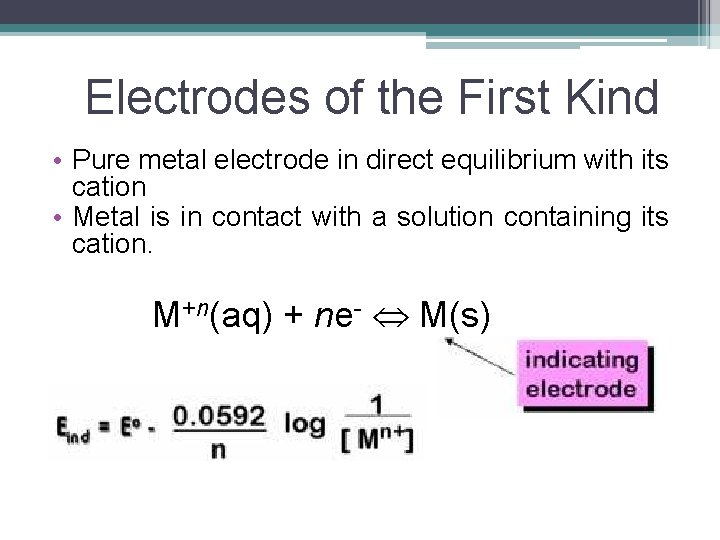
Electrodes of the First Kind • Pure metal electrode in direct equilibrium with its cation • Metal is in contact with a solution containing its cation. M+n(aq) + ne- M(s)
Disadvantages of First Kind Electrodes • Not very selective ▫ Ag+ interferes with Cu+2 • May be p. H dependent ▫ Zn and Cd dissolve in acidic solutions • Easily oxidized (deaeration required) • Non-reproducible response
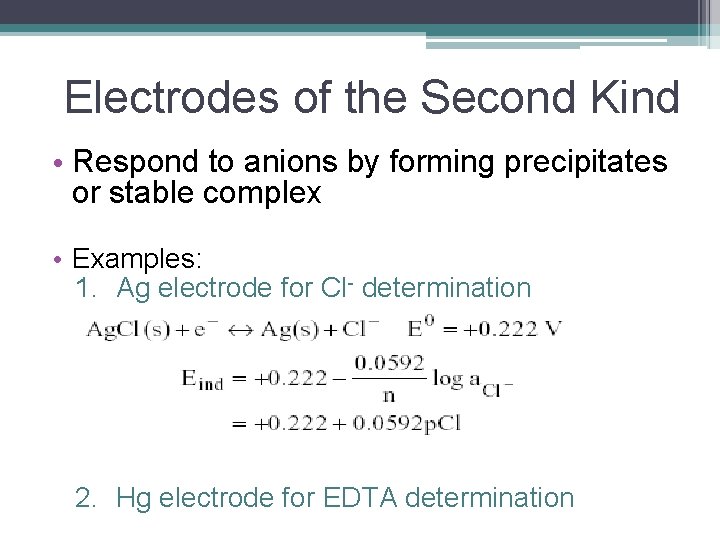
Electrodes of the Second Kind • Respond to anions by forming precipitates or stable complex • Examples: 1. Ag electrode for Cl- determination 2. Hg electrode for EDTA determination
Inert Metallic (Redox) Electrodes • Inert conductors that respond to redox systems • Electron source or sink • An inert metal in contact with a solution containing the soluble oxidized and reduced forms of the redox half-reaction. • May not be reversible • Examples: ▫ Pt, Au, Pd, C

MEMBRANE ELECTRODES • Aka p-ion electrodes • Consist of a thin membrane separating 2 solutions of different ion concentrations • Most common: p. H Glass electrode

Glass p. H Electrode
Properties of Glass p. H electrode • Potential not affected by the presence of oxidizing or reducing agents • Operates over a wide p. H range • Fast response • Functions well in physiological systems • Very selective • Long lifespan
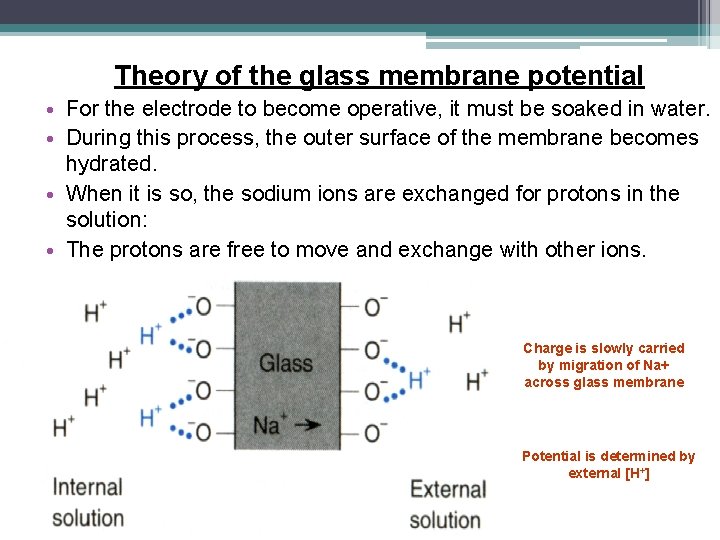
Theory of the glass membrane potential • For the electrode to become operative, it must be soaked in water. • During this process, the outer surface of the membrane becomes hydrated. • When it is so, the sodium ions are exchanged for protons in the solution: • The protons are free to move and exchange with other ions. Charge is slowly carried by migration of Na+ across glass membrane Potential is determined by external [H+]
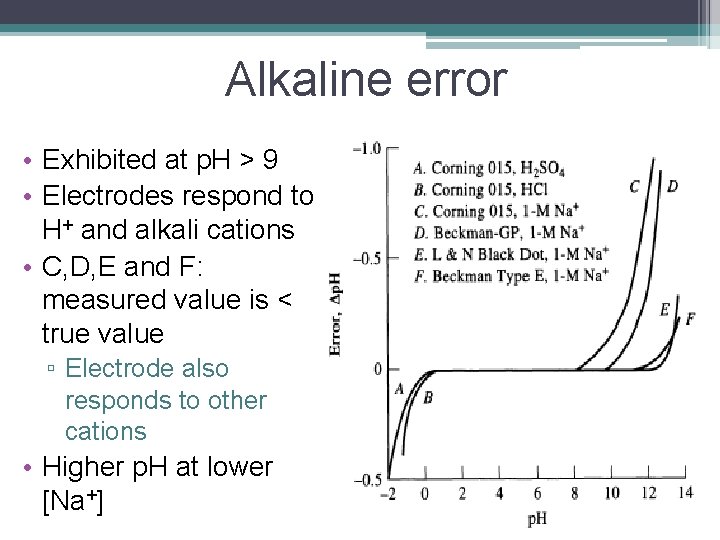
Alkaline error • Exhibited at p. H > 9 • Electrodes respond to H+ and alkali cations • C, D, E and F: measured value is < true value ▫ Electrode also responds to other cations • Higher p. H at lower [Na+]
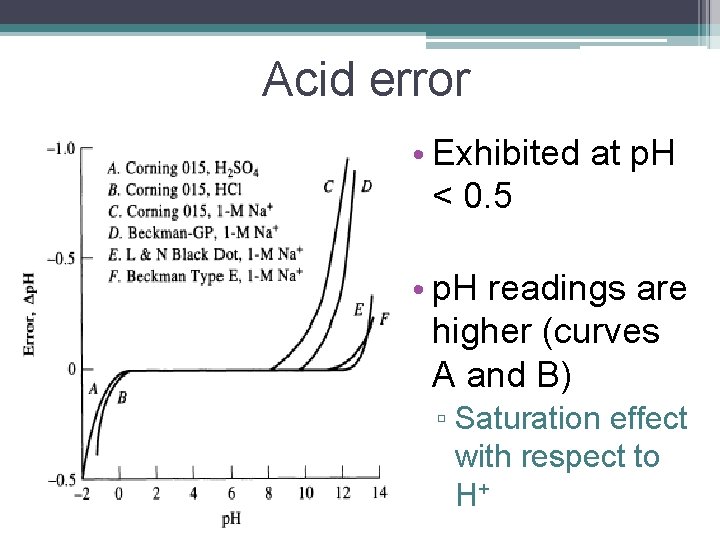
Acid error • Exhibited at p. H < 0. 5 • p. H readings are higher (curves A and B) ▫ Saturation effect with respect to H+

Selectivity Coefficient • No electrode responds exclusively to one kind of ion. ▫ The glass p. H electrode is among the most selective, but it also responds to high concentration of Na+. • When an electrode used to measure ion A, also responds to ion X, the selectivity coefficient gives the relative response of the electrode to the two different species. ▫ The smaller the selectivity coefficient, the less interference by X.
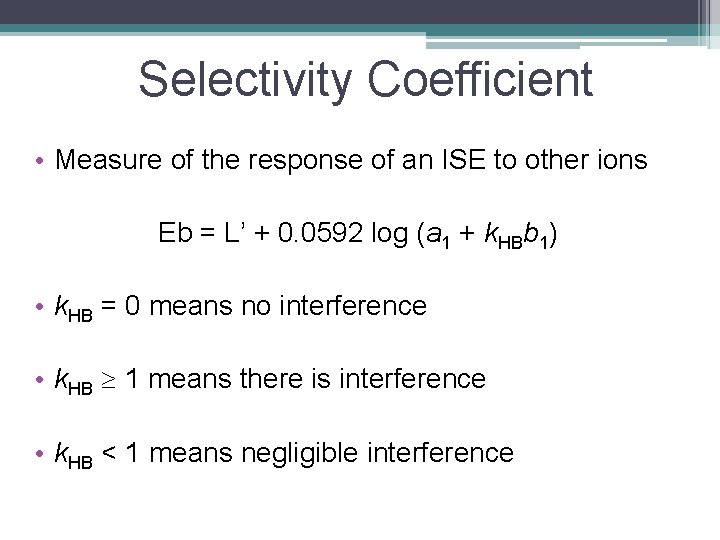
Selectivity Coefficient • Measure of the response of an ISE to other ions Eb = L’ + 0. 0592 log (a 1 + k. HBb 1) • k. HB = 0 means no interference • k. HB 1 means there is interference • k. HB < 1 means negligible interference

LIQUID MEMBRANE ELECTRODES
Liquid Membrane Electrodes • Potential develops across the interface between the analyte solution and a liquid ion exchanger (that bonds with analyte) • Similar to a p. H electrode except that the membrane is an organic polymer saturated with a liquid ion exchanger • Used for polyvalent ions as well as some anions • Example: • Calcium dialkyl phosphate insoluble in water, but binds Ca 2+ strongly
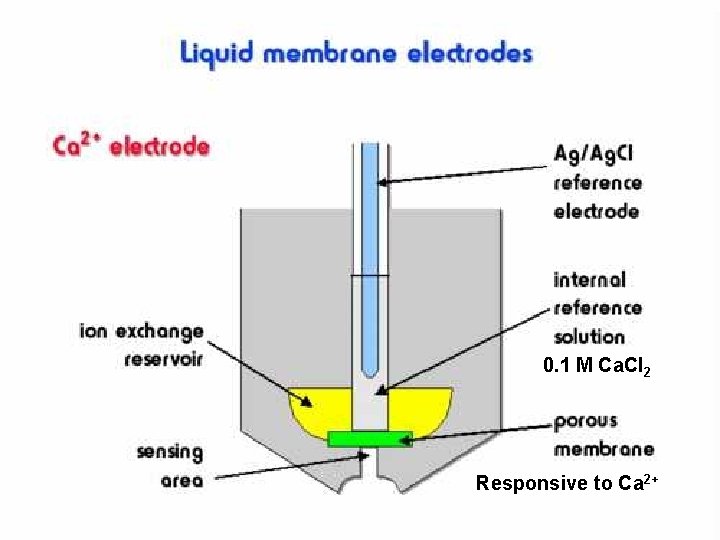
0. 1 M Ca. Cl 2 Responsive to Ca 2+
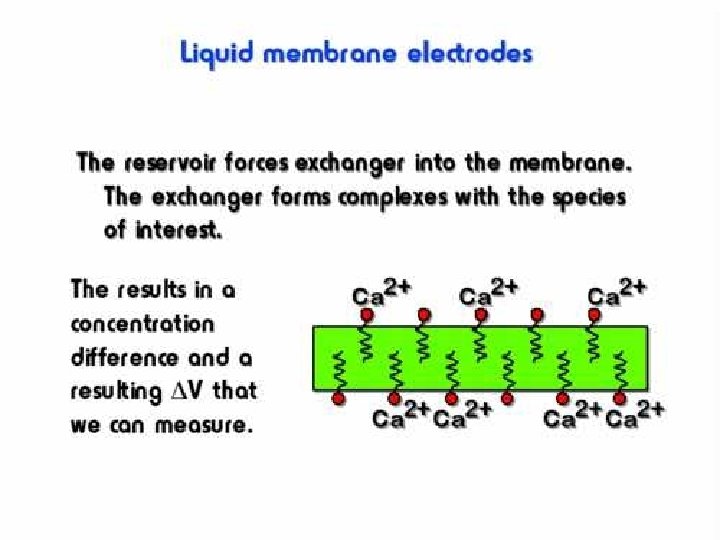

Characteristics of Ca+2 ISE • Relatively high sensitivity • Low LOD • Working p. H range: 5. 5 – 11 • Relevant in studying physiological processes
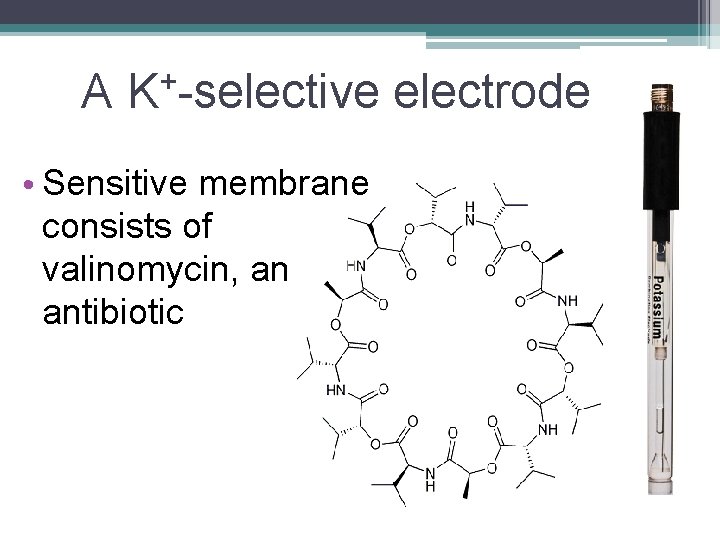
A K+-selective electrode • Sensitive membrane consists of valinomycin, an antibiotic

CRYSTALLINEMEMBRANE ELECTRODES
Crystalline-Membrane Electrodes • Solid state electrodes • Usually ionic compound • Crushed powder, melted and formed • Sometimes doped to increase conductivity • Operation similar to glass membrane

Crystalline-Membrane Electrodes • Ag. X membrane: Determination of X • Ag 2 S membrane: Determination of S-2 • La. F 3 membrane: Determination of F-

F Selective Electrode • A La. F 3 is doped with Eu. F 2. • Eu 2+ has less charge than the La 3+, so an anion vacancy occurs for every Eu 2+. • A neighboring F- can jump into the vacancy, thereby moving the vacancy to another site. • Repetition of this process moves F- through the lattice.
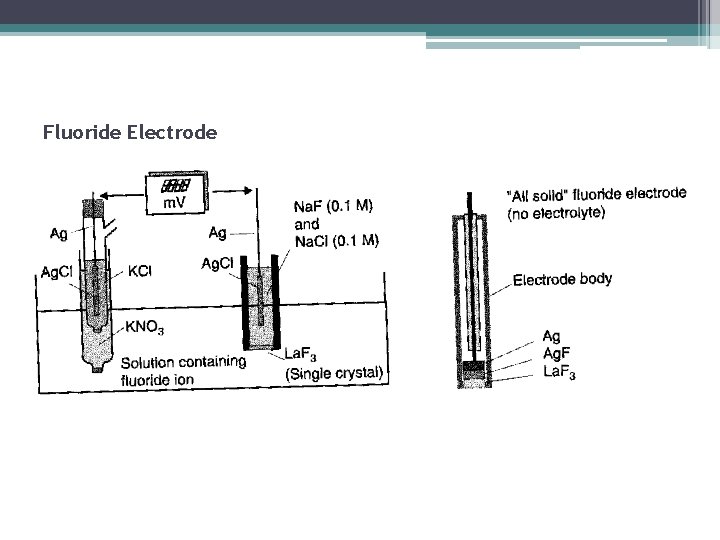
Fluoride Electrode

GAS SENSING PROBES

Gas Sensing Probes • A galvanic cell whose potential is related to the concentration of a gas in solution • Consist of RE, ISE and electrolyte solution • A thin gas-permeable membrane (PTFE) serves as a barrier between internal and analyte solutions • Allows small gas molecules to pass and dissolve into internal solution • O 2, NH 3/NH 4+, and CO 2/HCO 3 -/CO 32 -
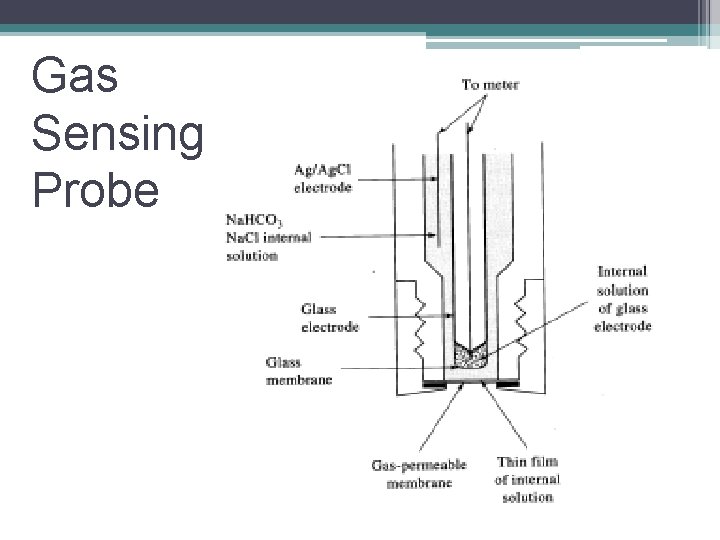
Gas Sensing Probe
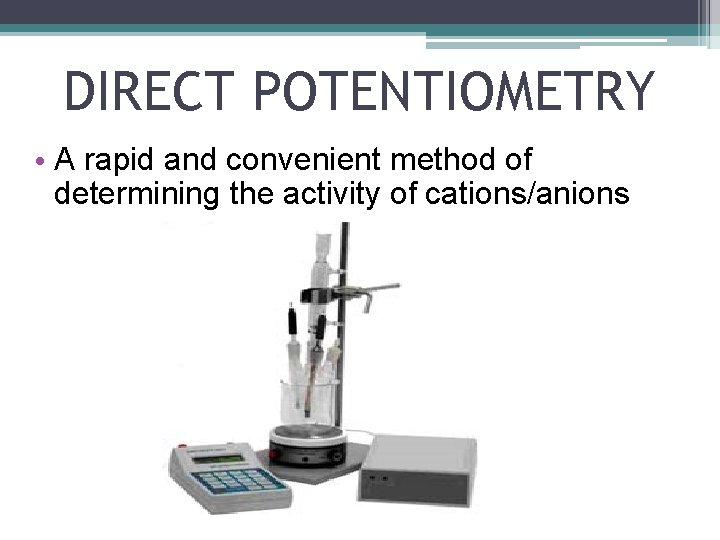
DIRECT POTENTIOMETRY • A rapid and convenient method of determining the activity of cations/anions

Potentiometric Measurement • Ionic composition of standards must be the same as that of analyte to avoid discrepancies • Swamp sample and standard with inert electrolyte to keep ionic strength constant • TISAB (Total Ionic Strength Adjustment Buffer) = controls ionic strength and p. H of samples and standards in ISE measurements

Potentiometric Measurement 1. Calibration Method 2. Standard Addition Method

Special Applications: Potentiometric p. H Measurement using Glass electrode • • • One drop of solution Tooth cavity Sweat on skin p. H inside a living cell Flowing liquid stream Acidity of stomach
Potentiometric Titration • Involves measurement of the potential of a suitable indicator electrode as a function of titrant volume • Provides MORE RELIABLE data than the usual titration method • Useful with colored/turbid solutions • May be automated • More time consuming
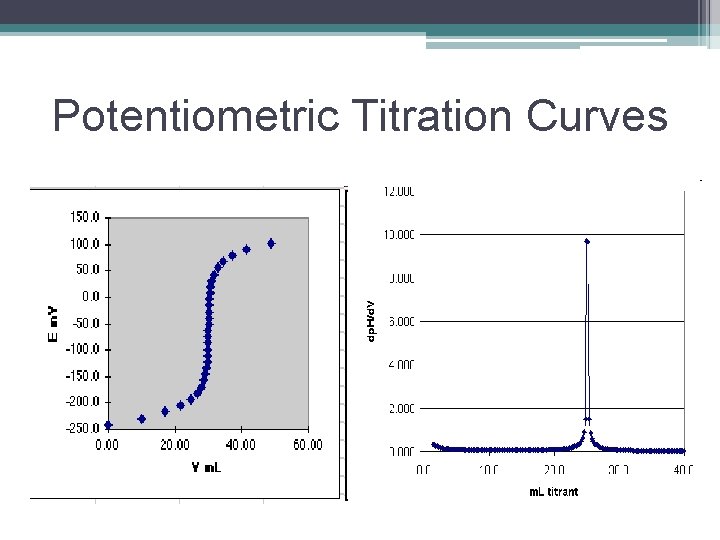
Potentiometric Titration Curves
- Slides: 48