
Potentiometric Methods A Introduction 1 Potentiometric Methods based

Potentiometric Methods A. ) Introduction: 1. ) Potentiometric Methods: based on measurements of the potential of electrochemical cells in the absence of appreciable currents (i. 0) 2. ) Basic Components: a) reference electrode: gives reference for potential measurement b) indicator electrode: where species of interest is measured c) potential measuring device
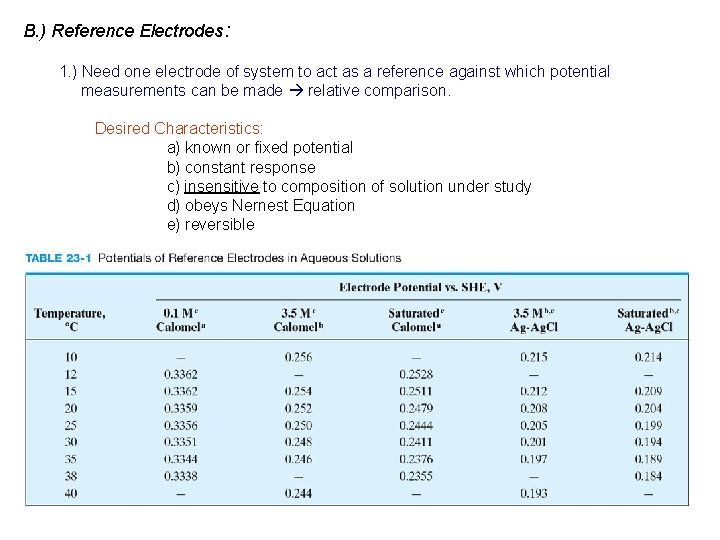
B. ) Reference Electrodes: 1. ) Need one electrode of system to act as a reference against which potential measurements can be made relative comparison. Desired Characteristics: a) known or fixed potential b) constant response c) insensitive to composition of solution under study d) obeys Nernest Equation e) reversible

B. ) Reference Electrodes: 2. ) Common Reference Electrodes used in Potentiometry a) Calomel Electrode (Hg in contact with Hg 2 Cl 2 & KCl) i. Saturated Calomel Electrode (SCE) very widely used ½ cell: Hg/Hg 2 Cl 2 (satd), KCl (x. M)|| ½ reaction: Hg 2 Cl 2 (s) + 2 e- » 2 Hg + 2 Cl- SCE Note: response is dependent on [Cl-]
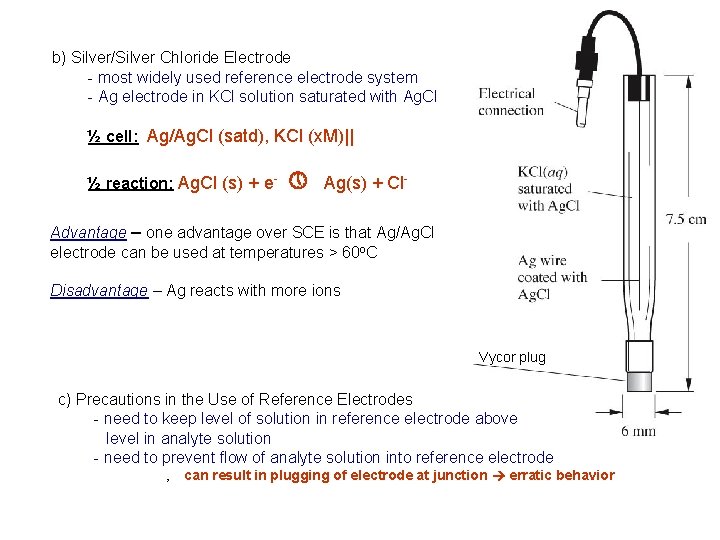
b) Silver/Silver Chloride Electrode - most widely used reference electrode system - Ag electrode in KCl solution saturated with Ag. Cl ½ cell: Ag/Ag. Cl (satd), KCl (x. M)|| ½ reaction: Ag. Cl (s) + e- » Ag(s) + Cl- Advantage – one advantage over SCE is that Ag/Ag. Cl electrode can be used at temperatures > 60 o. C Disadvantage – Ag reacts with more ions Vycor plug c) Precautions in the Use of Reference Electrodes - need to keep level of solution in reference electrode above level in analyte solution - need to prevent flow of analyte solution into reference electrode ‚ can result in plugging of electrode at junction erratic behavior
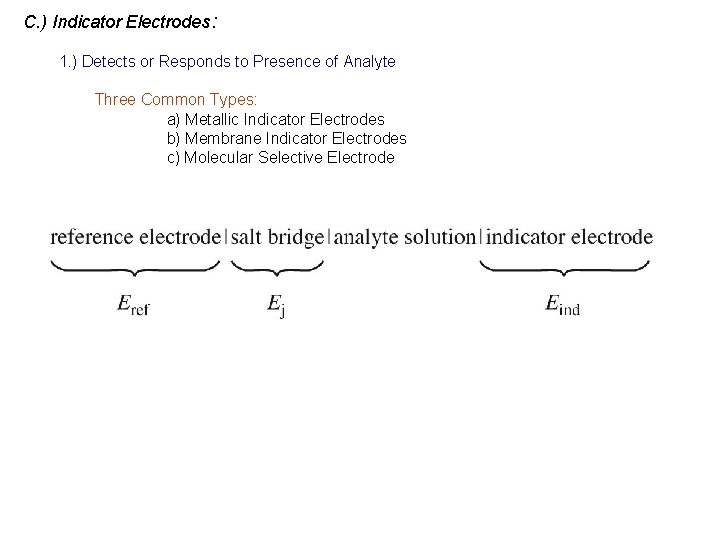
C. ) Indicator Electrodes: 1. ) Detects or Responds to Presence of Analyte Three Common Types: a) Metallic Indicator Electrodes b) Membrane Indicator Electrodes c) Molecular Selective Electrode

2. ) Metallic Indicator Electrode (Four Main Types) a) Metallic Electrodes of the First Kind i. Involves single reaction ii. Detection of cathode derived from the metal used in the electrode iii. Example: use of copper electrode to detect Cu 2+ in solution ½ reaction: Cu 2+ + 2 e. Eind gives direct measure of Cu 2+: since a. Cu(s) = 1: or using p. Cu = -log a. Cu 2+: » Cu (s) Eind = Eo. Cu – (0. 0592/2) log a. Cu(s)/a. Cu 2+ Eind = Eo. Cu – (0. 0592/2) log 1/a. Cu 2+ Eind = Eo. Cu – (0. 0592/2) p. Cu iv. Problems: - not very selective - many can only be used at neutral p. H metals dissolve in acids - some metals readily oxidize - certain hard metals (Fe, Cr, Co, Ni) do not yield reproducible results - p. X versus activity differ significantly and irregularly from theory

2. ) Metallic Indicator Electrode (Four Main Types) b) Metallic Electrodes of the Second Kind i. Detection of anion derived from the interaction with metal ion (Mn+) from the electrode ii. Anion forms precipitate or stable complex with metal ion (Mn+) iii. Example: Detection of Cl- with Ag electrode ½ reaction: Ag. Cl(s) + e. Eind gives direct measure of Cl-: since a. Ag(s) and a. Ag. Cl(s)= 1 & Eo = 0. 222 V: » Ag(s) + Cl- EO = 0. 222 V Eind = Eo – (0. 0592/1) log a. Ag(s) a. Cl-/a. Ag. Cl(s) Eind = 0. 222 – (0. 0592/1) log a. Cl- iv. Another Example: Detection of EDTA ion (Y 4 -) with Hg Electrode ½ reaction: Hg. Y 2 - + 2 e. Eind responds to a. Y 4 -: since a. Hg(l) = 1 and Eo = 0. 21 V: » Hg(l) + Y 4 - Eo = 0. 21 V Eind = Eo – (0. 0592/2) log a. Hg(l) a. Y 4 -/a. Hg. Y 2 Eind = 0. 21 – (0. 0592/1) log a. Y 4 -/a. Hg. Y 2 -

2. ) Metallic Indicator Electrode (Four Main Types) c) Metallic Electrodes of the Third Kind i. Metal electrodes responds to a different cation ii. Linked to cation by an intermediate reaction - Already saw detection of EDTA by Hg electrode (2 nd Kind) ii. Can be made to detect other cations that bind to EDTA affecting a. Y 4 iv. Example: Detect Ca by complex with EDTA equilibrium reaction: Ca. Y 2 Where: Kf = aca 2+. a. Y 4 a. Ca. Y 2 - ˆ » Ca 2+ + Y 4 - a. Ca. Y 2 ay 4 - = Kf. aca 2+ Eind = 0. 21 – (0. 0592/1) log a. Y 4 -/a. Hg. Y 2 Note: a. Y 4 - and Eind now also changes with a. Ca 2+
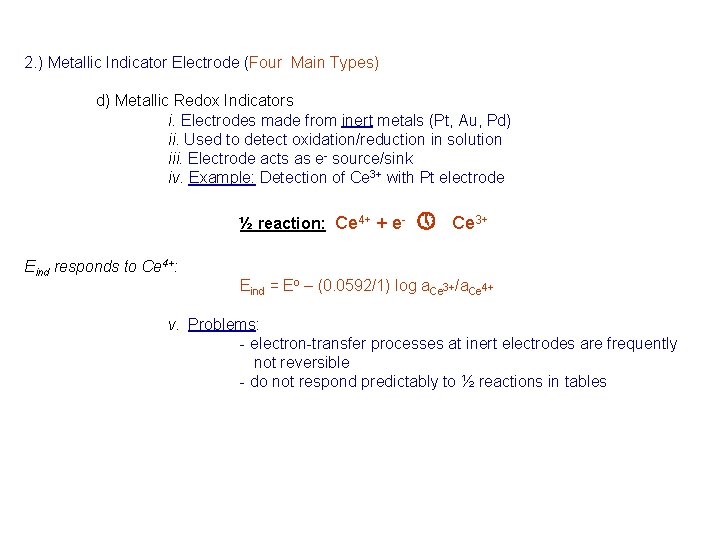
2. ) Metallic Indicator Electrode (Four Main Types) d) Metallic Redox Indicators i. Electrodes made from inert metals (Pt, Au, Pd) ii. Used to detect oxidation/reduction in solution iii. Electrode acts as e- source/sink iv. Example: Detection of Ce 3+ with Pt electrode ½ reaction: Ce 4+ + e. Eind responds to Ce 4+: » Ce 3+ Eind = Eo – (0. 0592/1) log a. Ce 3+/a. Ce 4+ v. Problems: - electron-transfer processes at inert electrodes are frequently not reversible - do not respond predictably to ½ reactions in tables

3. ) Membrane Indicator Electrodes a) General i. electrodes based on determination of cations or anions by the selective adsorption of these ions to a membrane surface. ii. Often called Ion Selective Electrodes (ISE) or p. Ion Electrodes iii. Desired properties of ISE’s ‚ minimal solubility – membrane will not dissolve in solution during measurement – silica, polymers, low solubility inorganic compounds (Ag. X) can be used ‚Need some electrical conductivity ‚Selectively binds ion of interest
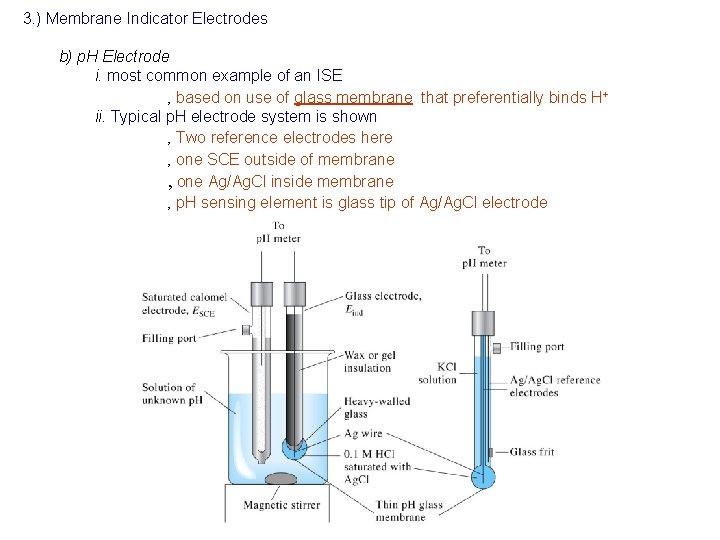
3. ) Membrane Indicator Electrodes b) p. H Electrode i. most common example of an ISE ‚ based on use of glass membrane that preferentially binds H+ ii. Typical p. H electrode system is shown ‚ Two reference electrodes here ‚ one SCE outside of membrane ‚ one Ag/Ag. Cl inside membrane ‚ p. H sensing element is glass tip of Ag/Ag. Cl electrode
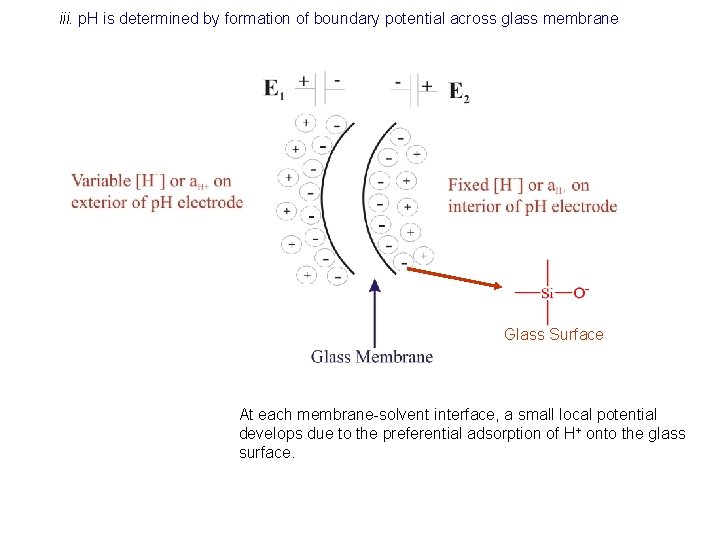
iii. p. H is determined by formation of boundary potential across glass membrane Glass Surface At each membrane-solvent interface, a small local potential develops due to the preferential adsorption of H+ onto the glass surface.
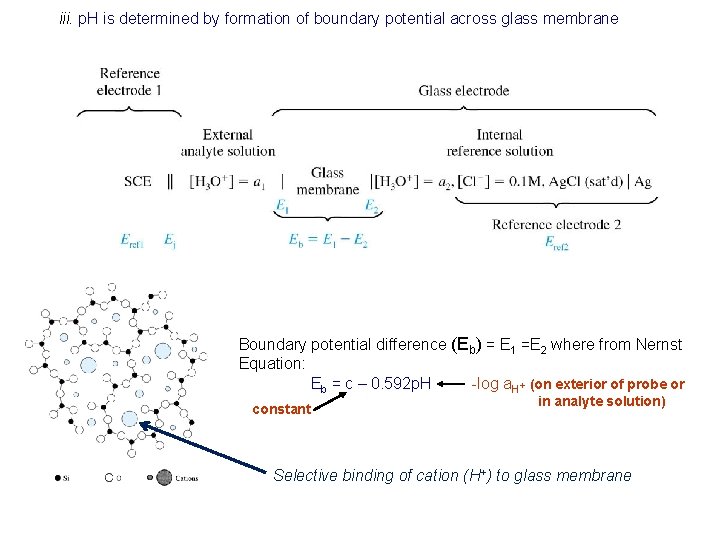
iii. p. H is determined by formation of boundary potential across glass membrane Boundary potential difference (Eb) = E 1 =E 2 where from Nernst Equation: Eb = c – 0. 592 p. H -log a. H+ (on exterior of probe or constant in analyte solution) Selective binding of cation (H+) to glass membrane
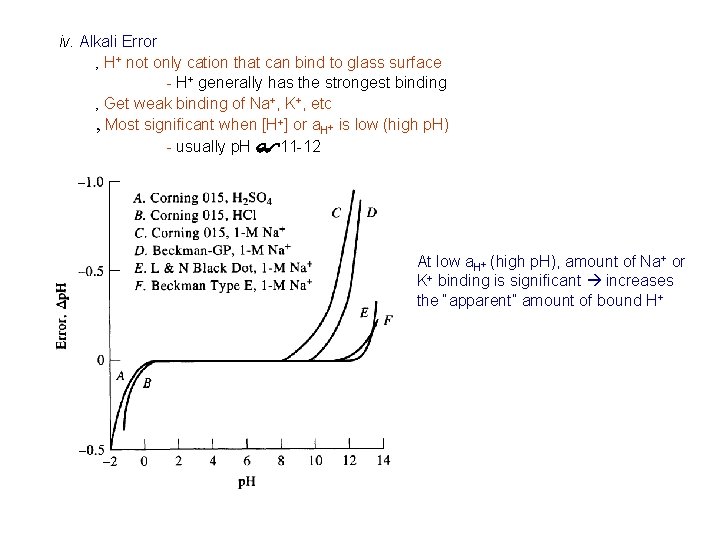
iv. Alkali Error ‚ H+ not only cation that can bind to glass surface - H+ generally has the strongest binding ‚ Get weak binding of Na+, K+, etc ‚ Most significant when [H+] or a. H+ is low (high p. H) - usually p. H $11 -12 At low a. H+ (high p. H), amount of Na+ or K+ binding is significant increases the “apparent” amount of bound H+
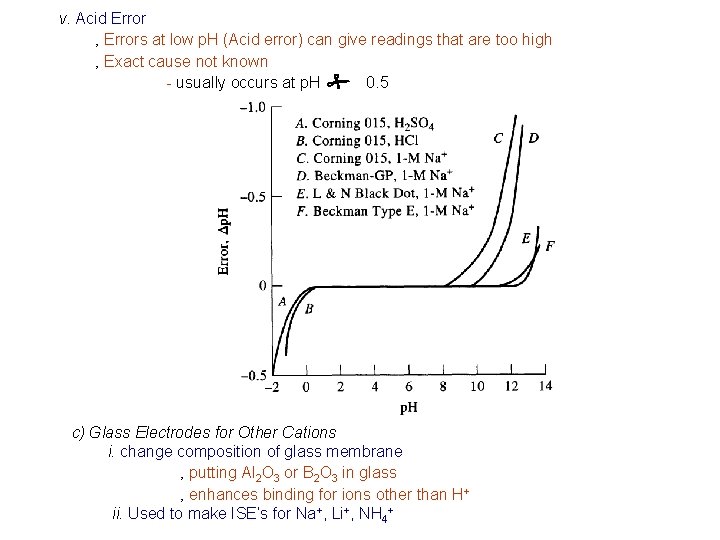
v. Acid Error ‚ Errors at low p. H (Acid error) can give readings that are too high ‚ Exact cause not known - usually occurs at p. H # 0. 5 c) Glass Electrodes for Other Cations i. change composition of glass membrane ‚ putting Al 2 O 3 or B 2 O 3 in glass ‚ enhances binding for ions other than H+ ii. Used to make ISE’s for Na+, Li+, NH 4+
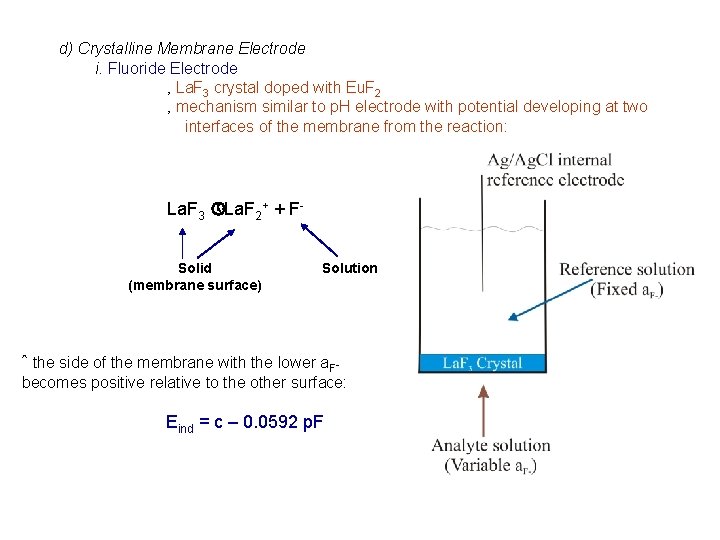
d) Crystalline Membrane Electrode i. Fluoride Electrode ‚ La. F 3 crystal doped with Eu. F 2 ‚ mechanism similar to p. H electrode with potential developing at two interfaces of the membrane from the reaction: La. F 3 » La. F 2+ + FSolid (membrane surface) Solution ˆ the side of the membrane with the lower a. F- becomes positive relative to the other surface: Eind = c – 0. 0592 p. F
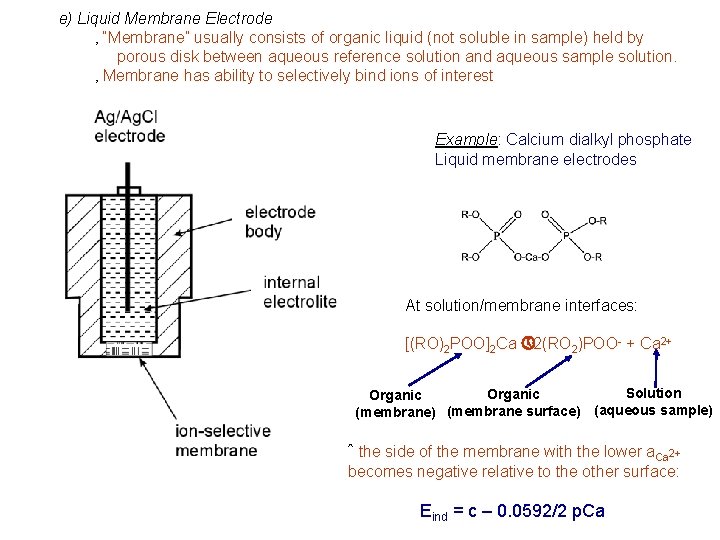
e) Liquid Membrane Electrode ‚ “Membrane” usually consists of organic liquid (not soluble in sample) held by porous disk between aqueous reference solution and aqueous sample solution. ‚ Membrane has ability to selectively bind ions of interest Example: Calcium dialkyl phosphate Liquid membrane electrodes At solution/membrane interfaces: [(RO)2 POO]2 Ca » 2(RO 2)POO- + Ca 2+ Solution Organic (membrane) (membrane surface) (aqueous sample) ˆ the side of the membrane with the lower a. Ca 2+ becomes negative relative to the other surface: Eind = c – 0. 0592/2 p. Ca
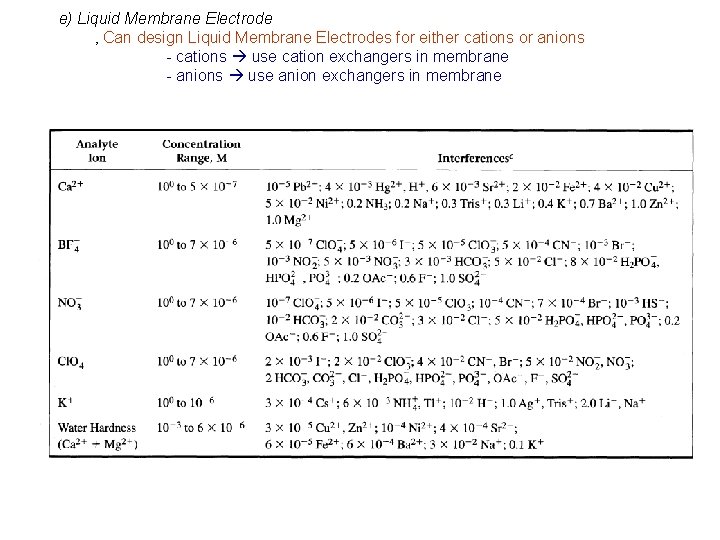
e) Liquid Membrane Electrode ‚ Can design Liquid Membrane Electrodes for either cations or anions - cations use cation exchangers in membrane - anions use anion exchangers in membrane
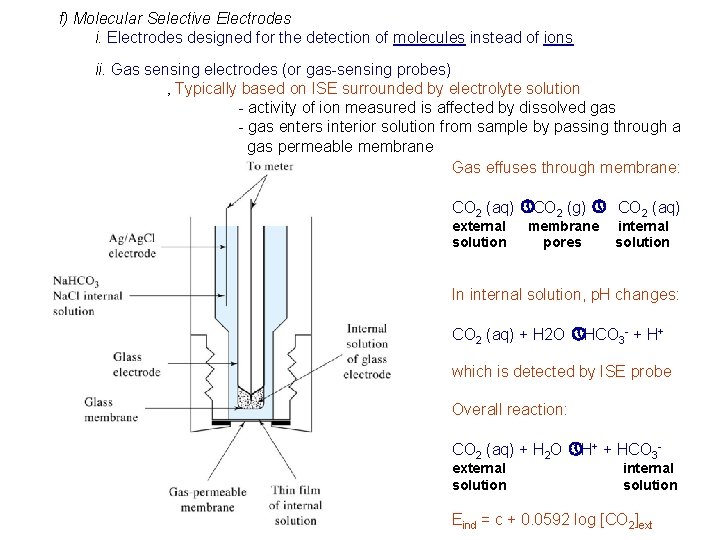
f) Molecular Selective Electrodes i. Electrodes designed for the detection of molecules instead of ions ii. Gas sensing electrodes (or gas-sensing probes) ‚ Typically based on ISE surrounded by electrolyte solution - activity of ion measured is affected by dissolved gas - gas enters interior solution from sample by passing through a gas permeable membrane Gas effuses through membrane: CO 2 (aq) » CO 2 (g) » CO 2 (aq) external solution membrane pores internal solution In internal solution, p. H changes: CO 2 (aq) + H 2 O » HCO 3 - + H+ which is detected by ISE probe Overall reaction: CO 2 (aq) + H 2 O » H+ + HCO 3 external solution internal solution Eind = c + 0. 0592 log [CO 2]ext

iii. Enzyme electrodes (or Biocatalytic Membrane Electrodes) ‚ General approach is to use an immobilized enzyme - enzyme converts a given molecular analyte into a species that can be measured electrochemically < enzyme substrate - Examples: H+ p. H electrode CO 2 gas sensing electrode NH 4+ ISE ‚ Example – Urea Enzyme Electrode - Principal: In presence of enzyme urease, urea (NH 4)2 CO is hydrolyzed to give NH 3 and H+ (NH 4)2 CO + 2 H 2 O + H+ » 2 NH 4+ + HCO 3» 2 NH 3 + 2 H+ Monitor amount of NH 3 produced using NH 3 gas sensing electrode
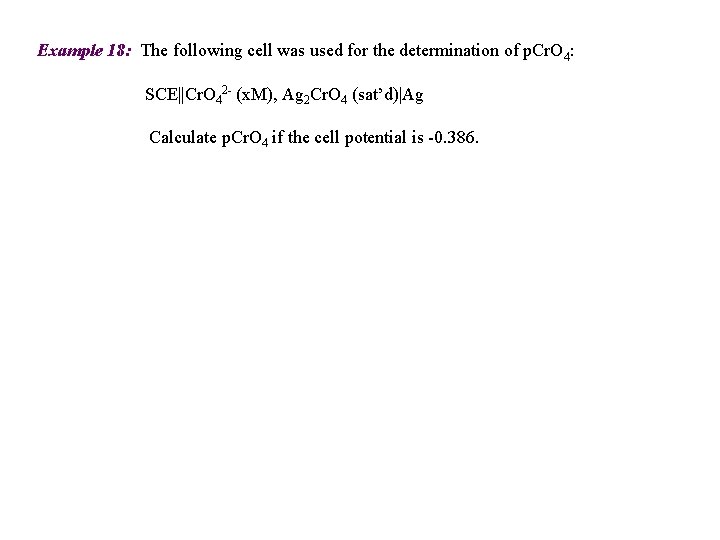
Example 18: The following cell was used for the determination of p. Cr. O 4: SCE||Cr. O 42 - (x. M), Ag 2 Cr. O 4 (sat’d)|Ag Calculate p. Cr. O 4 if the cell potential is -0. 386.
- Slides: 21