
Potential of ELV in Malaysia Bok Wee Gwee
Potential of ELV in Malaysia Bok Wee, Gwee President, MAARA 6 th September 2013

Background of ELV in Malaysia In 2009, the Malaysian government announced the National Automotive Policy as below: Gradual Phase-out of imported used parts and components Safety and environmental concerns rose from the practice of importing used parts and components without any restrictions or mandatory tests. The NAP Review is introducing a mechanism to prohibit imports of used parts and components, effective from June 2011

Action by MAARA Hire a professional team from local university to develop report known as A Comprehensive Study for Presentation as a Response on the National Automotive Policy to the Government Study concluded that: - . It will not improve safety and promote environmental-friendly opportunities but it will erode safety, increase environmental degradation and worsen the welfare of the industry, and consumers
Results of Actions The government announced to ban 4 items of used automotive parts Brake pads Brake Linings Tyres Batteries
Transformation plan MAARA planned to transform the industry to a governed industry to restore government and consumers’ confidences: MAARA launch a serial of transformation plan with the slogan: Transformations Pave Way for Better Opportunity 勇于转型, 发掘商机
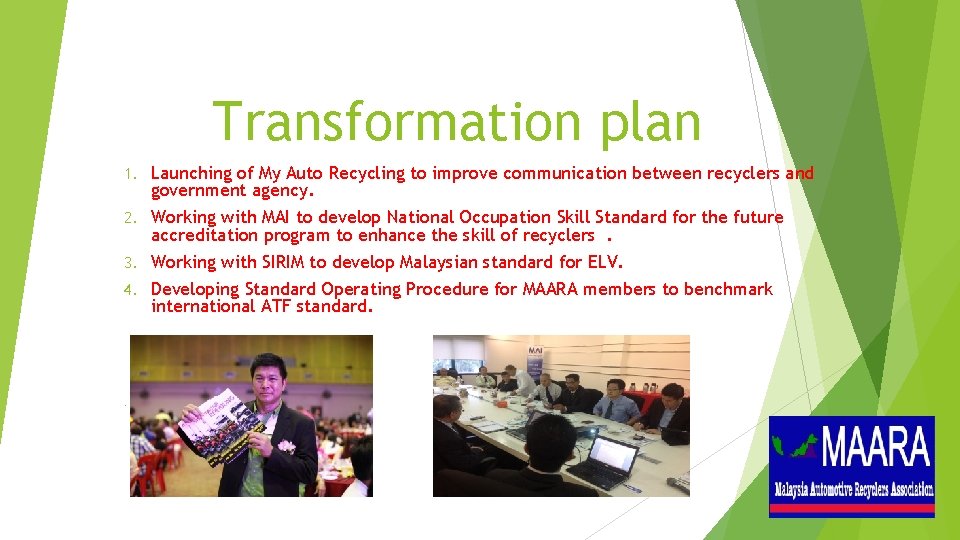
Transformation plan 1. Launching of My Auto Recycling to improve communication between recyclers and government agency. 2. Working with MAI to develop National Occupation Skill Standard for the future accreditation program to enhance the skill of recyclers. 3. Working with SIRIM to develop Malaysian standard for ELV. 4. Developing Standard Operating Procedure for MAARA members to benchmark international ATF standard. -
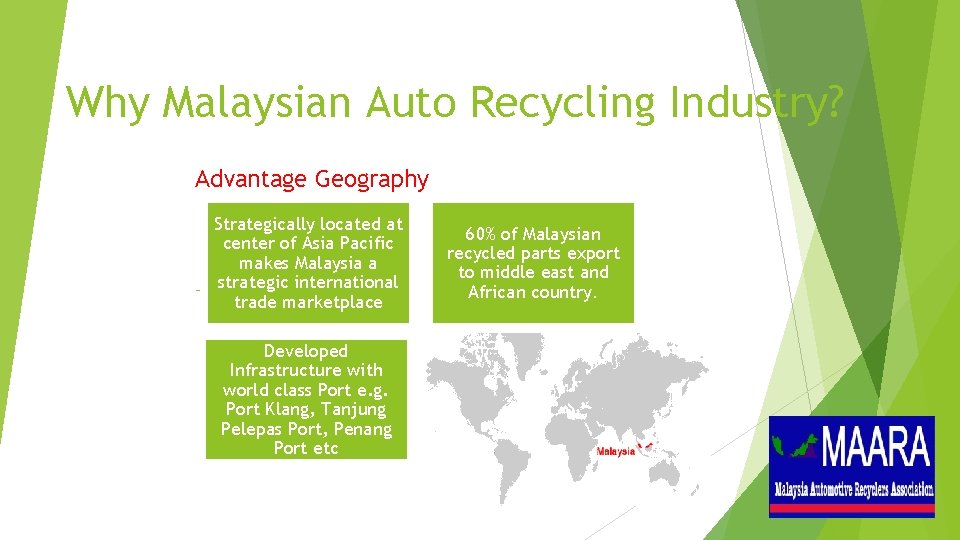
Why Malaysian Auto Recycling Industry? Advantage Geography Strategically located at center of Asia Pacific makes Malaysia a - strategic international trade marketplace Developed Infrastructure with world class Port e. g. Port Klang, Tanjung Pelepas Port, Penang Port etc 60% of Malaysian recycled parts export to middle east and African country.
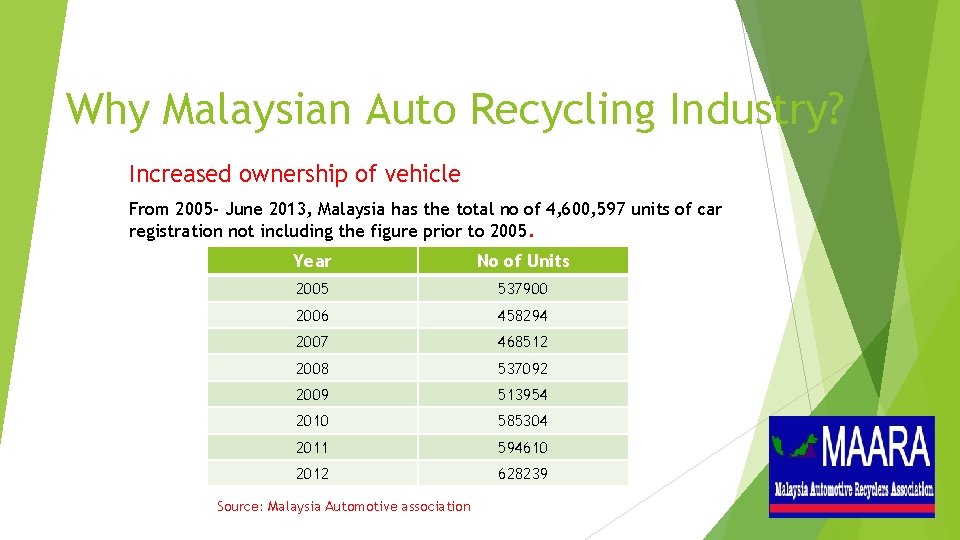
Why Malaysian Auto Recycling Industry? Increased ownership of vehicle From 2005 - June 2013, Malaysia has the total no of 4, 600, 597 units of car registration not including the figure prior to 2005. Year No of Units 2005 537900 2006 458294 2007 468512 2008 537092 2009 513954 2010 585304 2011 594610 2012 628239 Source: Malaysia Automotive association
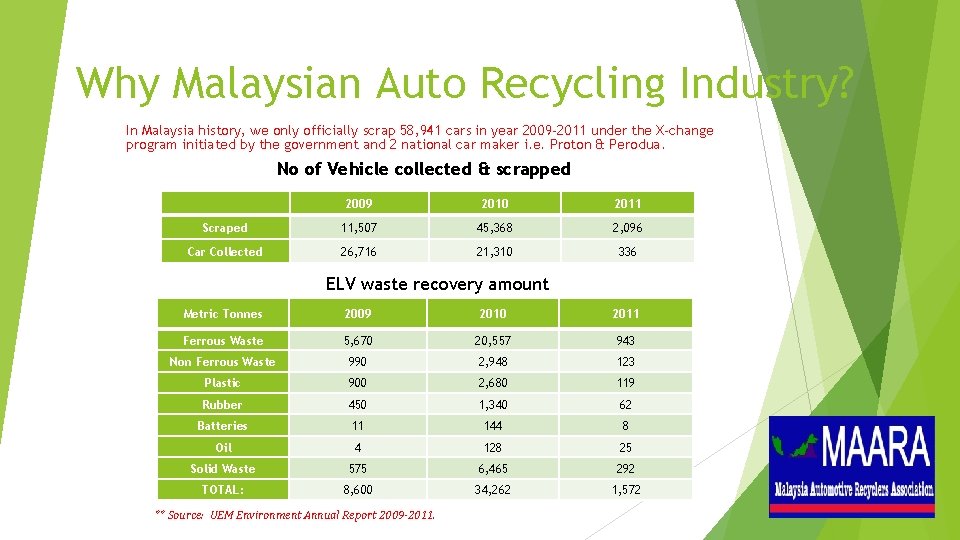
Why Malaysian Auto Recycling Industry? In Malaysia history, we only officially scrap 58, 941 cars in year 2009 -2011 under the X-change program initiated by the government and 2 national car maker i. e. Proton & Perodua. No of Vehicle collected & scrapped 2009 2010 2011 Scraped 11, 507 45, 368 2, 096 Car Collected 26, 716 21, 310 336 ELV waste recovery amount Metric Tonnes 2009 2010 2011 Ferrous Waste 5, 670 20, 557 943 Non Ferrous Waste 990 2, 948 123 Plastic 900 2, 680 119 Rubber 450 1, 340 62 Batteries 11 144 8 Oil 4 128 25 Solid Waste 575 6, 465 292 TOTAL: 8, 600 34, 262 1, 572 ** Source: UEM Environment Annual Report 2009 -2011.
Why Malaysian Auto Recycling Industry? Increased international car maker assembly plant - Malaysia government has actively attract foreign car maker to invest in assembly plant in Malaysia with the objective to increase job opportunity and lower the car price. - All these players will be the potential contributor of auto recycling under the producer extended responsibility (EPR).
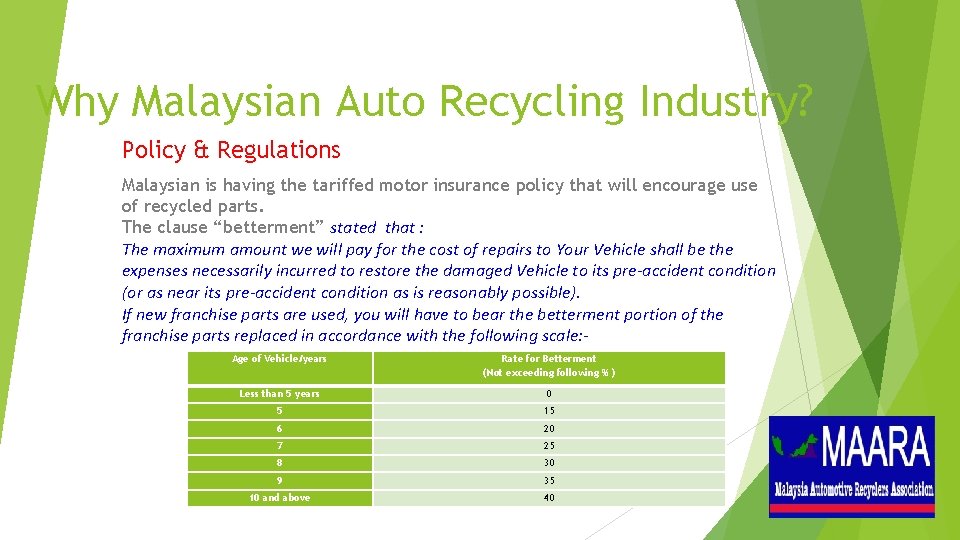
Why Malaysian Auto Recycling Industry? Policy & Regulations Malaysian is having the tariffed motor insurance policy that will encourage use of recycled parts. The clause “betterment” stated that : The maximum amount we will pay for the cost of repairs to Your Vehicle shall be the expenses necessarily incurred to restore the damaged Vehicle to its pre-accident condition (or as near its pre-accident condition as is reasonably possible). If new franchise parts are used, you will have to bear the betterment portion of the franchise parts replaced in accordance with the following scale: Age of Vehicle/years Rate for Betterment (Not exceeding following % ) Less than 5 years 0 5 15 6 20 7 25 8 30 9 35 10 and above 40
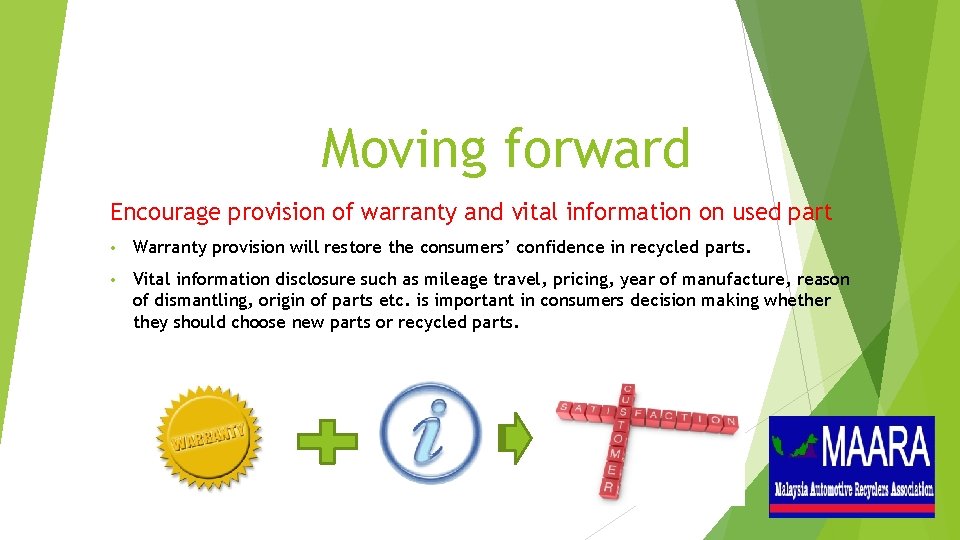
Moving forward Encourage provision of warranty and vital information on used part • Warranty provision will restore the consumers’ confidence in recycled parts. • Vital information disclosure such as mileage travel, pricing, year of manufacture, reason of dismantling, origin of parts etc. is important in consumers decision making whether they should choose new parts or recycled parts.
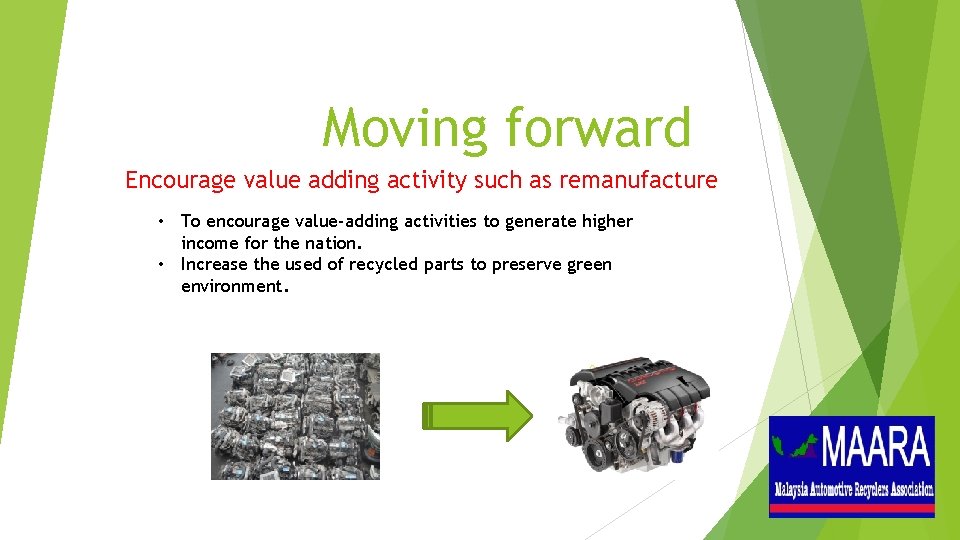
Moving forward Encourage value adding activity such as remanufacture • To encourage value-adding activities to generate higher income for the nation. • Increase the used of recycled parts to preserve green environment.
Moving forward Develop online virtual marketplace for recycled parts • Cost efficient ways to market recycled parts. • Time savings method for consumers to search for desired parts. • Gradual standardizing the pricing via market force. • Gradual increase the transparency of pricing throughout the nation.
Moving forward Tap on the advantage of motor insurance policy • Discuss with insurance company to use quality recycled parts for the repair of accident cars.
Conclusion As Malaysian have various competitive advantage within the country, so the industry players shall take initiative to upgrade themselves with quality recycled parts before they can penetrate the more international market. Beside aiming to be the regional automotive hub in ASEAN, the government shall include recycled parts in the roadmap so that Malaysia can become the recycled parts hub for the region too. Globalization has make the world flat, therefore setting up international standardization on recycled parts should be the priority task for all the players to ease the procurement when importing and exporting.
- Slides: 17