
Potential MRI Findings for Multiple Sclerosis Identify theme







- Slides: 30
Potential MRI Findings for Multiple Sclerosis
Identify theme and thesis for MRI findings Define and describe what Multiple Sclerosis is Explain the different types of Multiple Sclerosis Objectives Describe the various symptoms of Multiple Sclerosis Differentiate the Spinal lesions related to Multiple Sclerosis Explain the importance of MRI 3. 0 Tesla imaging Identify limitations for diagnosis of Multiple Sclerosis Compare PSIR and STIR in MRI imaging for Multiple Sclerosis Interactive Quiz Want to know more about these images? CLICK THE ICON
Thesis/Theme • The role of 3 D Phase-Sensitive Inversion Recovery (PSIR) and 3 D Short Tau Inversion Recovery (STIR) in detecting Spinal Cord Lesions in patients with Multiple Sclerosis. Want to know more about these images? CLICK THE ICON
• “Multiple sclerosis (MS) is an autoimmune What is Multiple Sclerosis? inflammatory central nervous system (CNS) disease, characterized by episodes of focal lymphocytic infiltration of the neural tissue that cause myelin and axonal destruction, followed by a remyelination phase. Persistence of the inflammatory process, widespread microglial activation, and progressive accumulation of lesions may convey to neurodegeneration and accumulation of neurological disability” (Arevalo, Riascos, Rabiei, Kamali, & Nelson, 2019, p. 1). Want to know more about these images? CLICK THE ICON
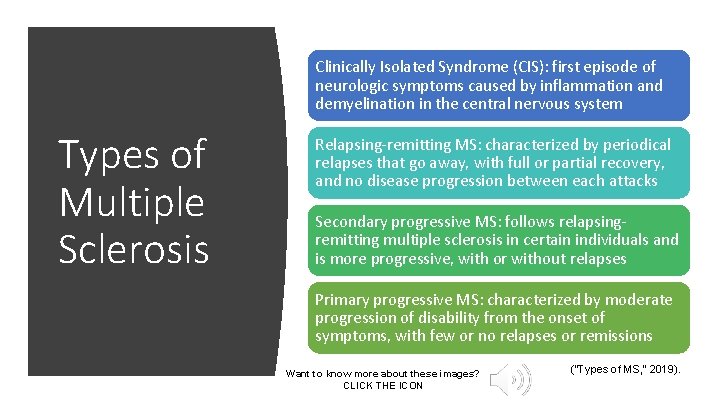
Clinically Isolated Syndrome (CIS): first episode of neurologic symptoms caused by inflammation and demyelination in the central nervous system Types of Multiple Sclerosis Relapsing-remitting MS: characterized by periodical relapses that go away, with full or partial recovery, and no disease progression between each attacks Secondary progressive MS: follows relapsingremitting multiple sclerosis in certain individuals and is more progressive, with or without relapses Primary progressive MS: characterized by moderate progression of disability from the onset of symptoms, with few or no relapses or remissions Want to know more about these images? CLICK THE ICON (“Types of MS, ” 2019).
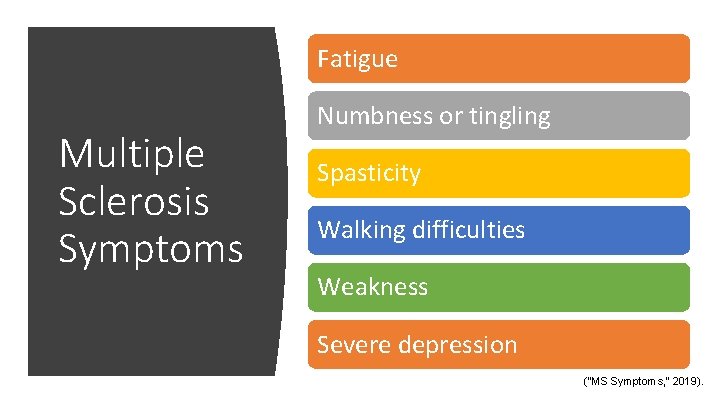
Fatigue Multiple Sclerosis Symptoms Numbness or tingling Spasticity Walking difficulties Weakness Severe depression (“MS Symptoms, ” 2019).
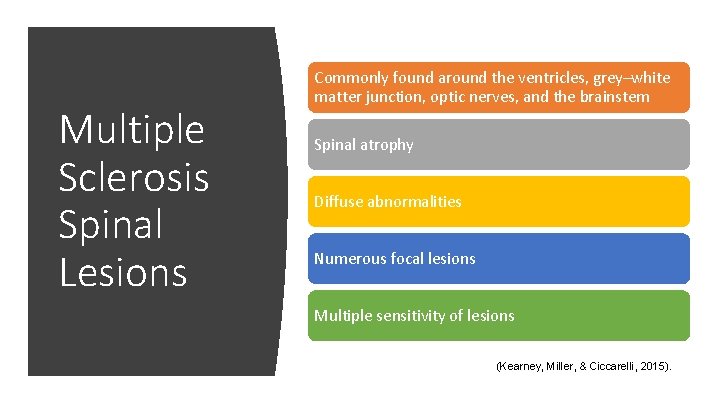
Multiple Sclerosis Spinal Lesions Commonly found around the ventricles, grey–white matter junction, optic nerves, and the brainstem Spinal atrophy Diffuse abnormalities Numerous focal lesions Multiple sensitivity of lesions (Kearney, Miller, & Ciccarelli, 2015).
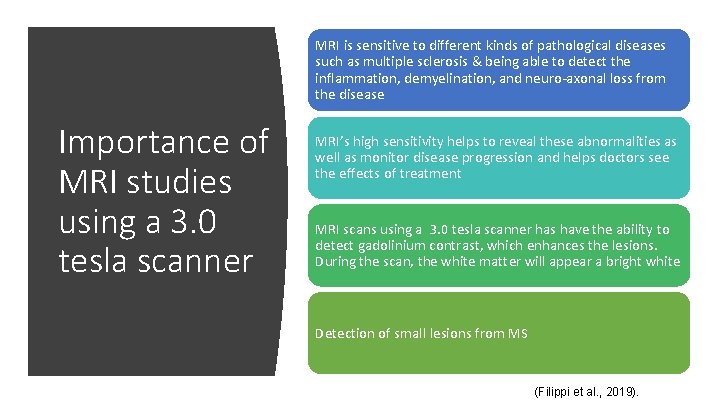
MRI is sensitive to different kinds of pathological diseases such as multiple sclerosis & being able to detect the inflammation, demyelination, and neuro-axonal loss from the disease Importance of MRI studies using a 3. 0 tesla scanner MRI’s high sensitivity helps to reveal these abnormalities as well as monitor disease progression and helps doctors see the effects of treatment MRI scans using a 3. 0 tesla scanner has have the ability to detect gadolinium contrast, which enhances the lesions. During the scan, the white matter will appear a bright white Detection of small lesions from MS (Filippi et al. , 2019).
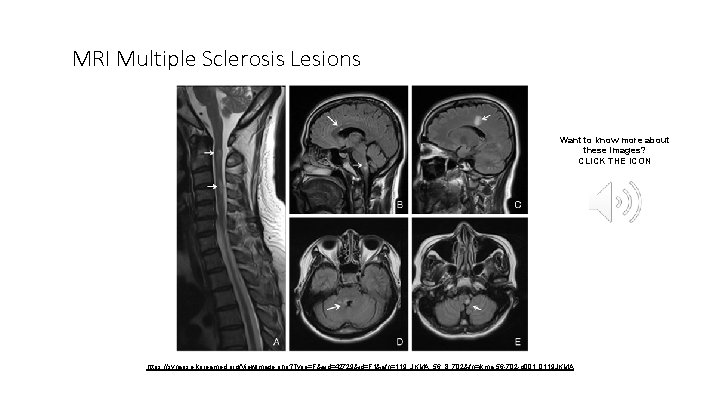
MRI Multiple Sclerosis Lesions Want to know more about these images? CLICK THE ICON https: //synapse. koreamed. org/View. Image. php? Type=F&aid=42729&id=F 1&afn=119_JKMA_56_8_702&fn=jkma-56 -702 -g 001_0119 JKMA
3 D Phase. Sensitive Inversion Recovery (PSIR) Uses two magnitude images at the same time, the first one with a low flip angle and the second one with a higher flip angle to increase the possible contrast range covering the lower brainstem through the mid-to-lower dorsal spine Better definition of lesion boundaries as compared to conventional imaging Ensures higher lesion conspicuity Accurate delineation and location of spinal cord lesions (Mirafzal et al. , 2019)
3 D Phase-Sensitive Inversion Recovery (PSIR) Imaging Fig 3. Follow-up MR imaging of a 40 -year-old woman with secondary-progressive MS. Sagittal T 2 WI (A) shows no spinal cord lesions. 3 D-PSIR reformatted in the sagittal plane (B) demonstrates 2 cervical spinal cord lesions (black arrows). 3 D-PSIR reformatted in the axial plane (C) provides accurate localization of the lesions (black arrow). Want to know more about these images? CLICK THE ICON https: //link. springer. com/content/pdf/10. 1007%2 Fs 00415 -019 -09591 -8. pdf
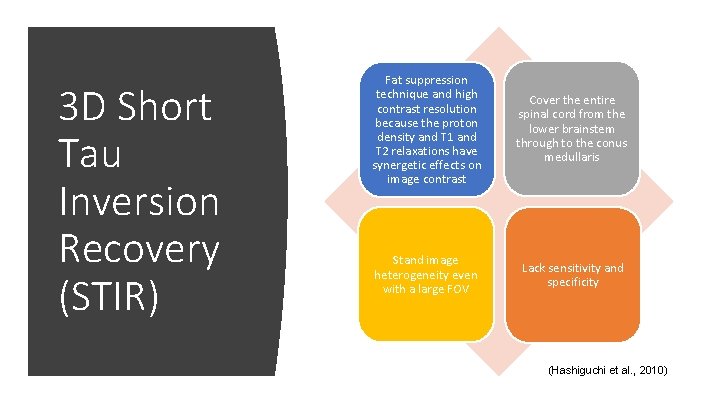
3 D Short Tau Inversion Recovery (STIR) Fat suppression technique and high contrast resolution because the proton density and T 1 and T 2 relaxations have synergetic effects on image contrast Cover the entire spinal cord from the lower brainstem through to the conus medullaris Stand image heterogeneity even with a large FOV Lack sensitivity and specificity (Hashiguchi et al. , 2010)
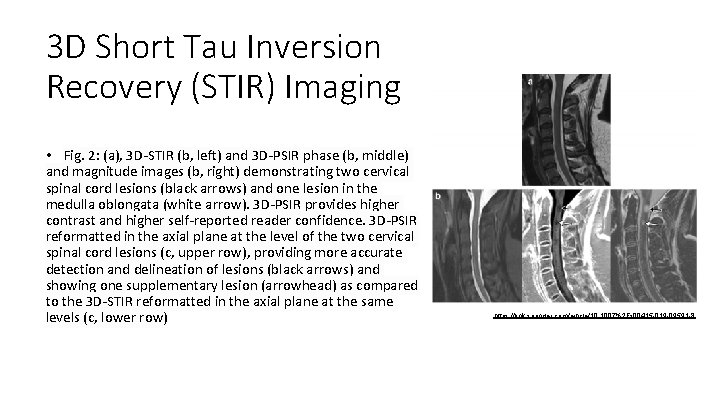
3 D Short Tau Inversion Recovery (STIR) Imaging • Fig. 2: (a), 3 D-STIR (b, left) and 3 D-PSIR phase (b, middle) and magnitude images (b, right) demonstrating two cervical spinal cord lesions (black arrows) and one lesion in the medulla oblongata (white arrow). 3 D-PSIR provides higher contrast and higher self-reported reader confidence. 3 D-PSIR reformatted in the axial plane at the level of the two cervical spinal cord lesions (c, upper row), providing more accurate detection and delineation of lesions (black arrows) and showing one supplementary lesion (arrowhead) as compared to the 3 D-STIR reformatted in the axial plane at the same levels (c, lower row) https: //link. springer. com/article/10. 1007%2 Fs 00415 -019 -09591 -8
3 D Phase-Sensitive Inversion Recovery (PSIR) compared to 3 D Short Tau Inversion Recovery (STIR) Imaging
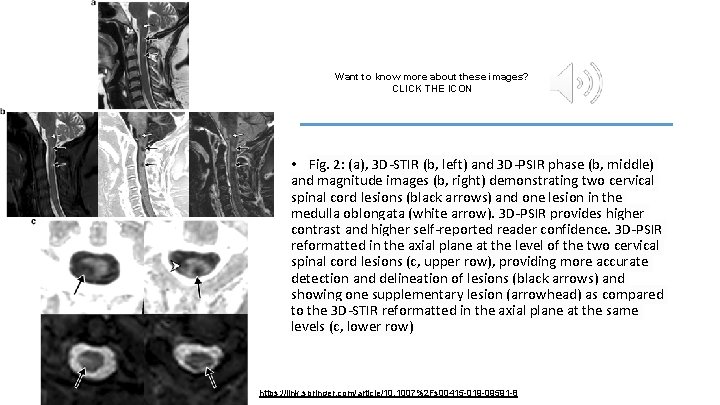
Want to know more about these images? CLICK THE ICON • Fig. 2: (a), 3 D-STIR (b, left) and 3 D-PSIR phase (b, middle) and magnitude images (b, right) demonstrating two cervical spinal cord lesions (black arrows) and one lesion in the medulla oblongata (white arrow). 3 D-PSIR provides higher contrast and higher self-reported reader confidence. 3 D-PSIR reformatted in the axial plane at the level of the two cervical spinal cord lesions (c, upper row), providing more accurate detection and delineation of lesions (black arrows) and showing one supplementary lesion (arrowhead) as compared to the 3 D-STIR reformatted in the axial plane at the same levels (c, lower row) https: //link. springer. com/article/10. 1007%2 Fs 00415 -019 -09591 -8
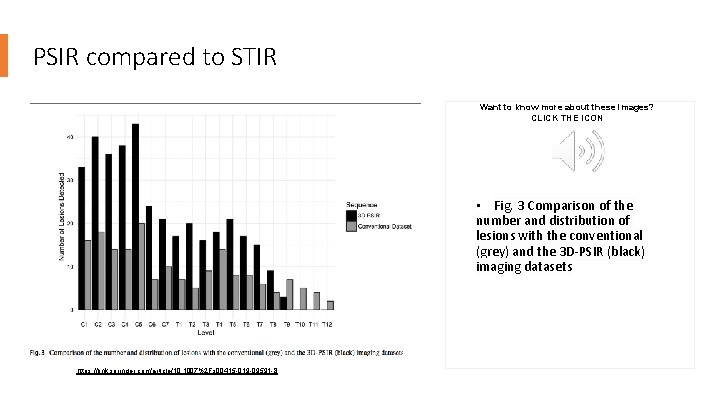
PSIR compared to STIR Want to know more about these images? CLICK THE ICON • Fig. 3 Comparison of the number and distribution of lesions with the conventional (grey) and the 3 D-PSIR (black) imaging datasets https: //link. springer. com/article/10. 1007%2 Fs 00415 -019 -09591 -8
GET READY TO PUT YOUR MIND TO WORK!
Ultrasound Which test is best to find spinal lesions in patients with Multiple Sclerosis? 3 D Phase- Sensitive Inversion Recovery 3 D Short Tau Inversion Recovery Computed Tomography with contrast
Which test is best to find spinal lesions in patients with Multiple Sclerosis? 3 D Phase- Sensitive Inversion Recovery (PSIR)
Which is the most common Multiple Sclerosis seen in patients? Clinically isolated syndrome Relapsing-remitting MS Secondary progressive MS Primary progressive MS
Which is the most common Multiple Sclerosis seen in patients? Clinically isolated syndrome Relapsing-remitting MS Secondary progressive MS Primary progressive MS
Where do lymphocytes attack in the body of a patient with Multiple Sclerosis? Muscle Tissue Cardiac Tissue Lymphatic Tissue Neural Tissue
Where do lymphocytes attack in the body of a patient with Multiple Sclerosis? Muscle Tissue Cardiac Tissue Nerve Tissue Neural Tissue
Short Stay in Radiation Unit What does STIR stand for? Short Tau Inversion Recovery Short Term Interest Rating Short Tau Inverse Recovery
What does STIR stand for? Short Stay in Radiation Unit Short Tau Inversion Recovery Short Term Interest Rating Short Tau Inverse Recovery
Which of the following are NOT benefits of 3. 0 Tesla? Higher patient dose Better contrast resolution Higher rate of detection Able to detect demyelination
Which of the following are NOT benefits of 3. 0 Tesla? Higher patient dose Better contrast resolution Higher rate of detection Able to detect demyelination
Conclusion Overall, PSIR is superior to STIR due to the accuracy of the detecting and locating small lesions that occur within a patient with MS. PSIR is best used in combination with a 3. 0 T MRI scanner. Overall, it’s the best option due to higher detection rates and the ability to reveal severe abnormalities.
Content Sources • • • Absinta, M. , Sati, P. , & Reich, D. S. (2016). Advanced MRI and staging of multiple sclerosis lesions. Nature Reviews Neurology, 12(6), 358– 368. doi: 10. 1038/nrneurol. 2016. 59 Arevalo, O. , Riascos, R. , Rabiei, P. , Kamali, A. , & Nelson, F. (2019). Standardizing Magnetic Resonance Imaging Protocols, Requisitions, and Reports in Multiple Sclerosis. Journal of Computer Assisted Tomography, 43(1), 1– 12. doi: 10. 1097/rct. 0000000767 Filippi, M. , Brück, W. , Chard, D. , Fazekas, F. , Geurts, J. J. G. , Enzinger, C. , … Rocca, M. A. (2019). Association between pathological and MRI findings in multiple sclerosis. The Lancet Neurology, 18(2), 198– 210. doi: 10. 1016/s 1474 -4422(18)30451 -4 Hashiguchi, K. , Morioka, T. , Murakami, N. , Suzuki, S. O. , Hiwatashi, A. , Yoshiura, T. , & Sasaki, T. (2010). Utility of 3 -T FLAIR and 3 D short tau inversion recovery MR imaging in the preoperative diagnosis of hippocampal sclerosis: Direct comparison with 1. 5 -T FLAIR MR imaging. Epilepsia, 51(9), 1820– 1828. doi: 10. 1111/j. 1528 -1167. 2010. 02685. x Mirafzal, S. , Goujon, A. , Deschamps, R. , Zuber, K. , Sadik, J. C. , Gout, O. , … Savatovsky, J. (2019). 3 D PSIR MRI at 3 Tesla improves detection of spinal cord lesions in multiple sclerosis. Journal of Neurology. doi: 10. 1007/s 00415 -019 -09591 -8 What Is MS? (n. d. ). Retrieved November 13, 2019, from https: //www. nationalmssociety. org/What-is-MS.
Image Sources (n. d. ). Retrieved November 13, 2019, from https: //synapse. koreamed. org/View. Image. php? Type=F&aid=42729&id=F 1&afn=119_J KMA_56_8_702&fn=jkma-56 -702 -g 001_0119 JKMA. • Fechner, A. , Savatovsky, J. , Methni, J. E. , Sadik, J. C. , Deschamps, R. , Gueguen, A. , & Lecler, A. (2019, January 24). A 3 T Phase-Sensitive Inversion Recovery MRI Sequence Improves Detection of Cervical Spinal Cord Lesions and Shows Active Lesions in Patients with Multiple Sclerosis. Retrieved December 4, 2019, from http: //www. ajnr. org/content/early/2019/01/24/ajnr. A 5941. • Mirafzal, S. , Goujon, A. , Deschamps, R. , Zuber, K. , Sadik, J. C. , Gout, O. , … Savatovsky, J. (2019). 3 D PSIR MRI at 3 Tesla improves detection of spinal cord lesions in multiple sclerosis. Journal of Neurology. doi: 10. 1007/s 00415 -019 -09591 -8 •