
Potential ILC contributions from Cornell Georg Hoffstaetter Ongoing
Potential ILC contributions from Cornell Georg Hoffstaetter Ongoing and potential Cornell for Cornell Laboratory for Accelerator contributions to the Based EIC Sciences and Education Cornell has experience in using CESR to study wiggler-dominated ILC damping rings; has verified electron beam simulations against experiments from source to high energy; and has developed and operated SRF components. Design – SRF – Damping rings polarization Georg. Hoffstaetter@Cornell. edu - October 19, 2020 – American Linear Collider Workshop – Positron 1
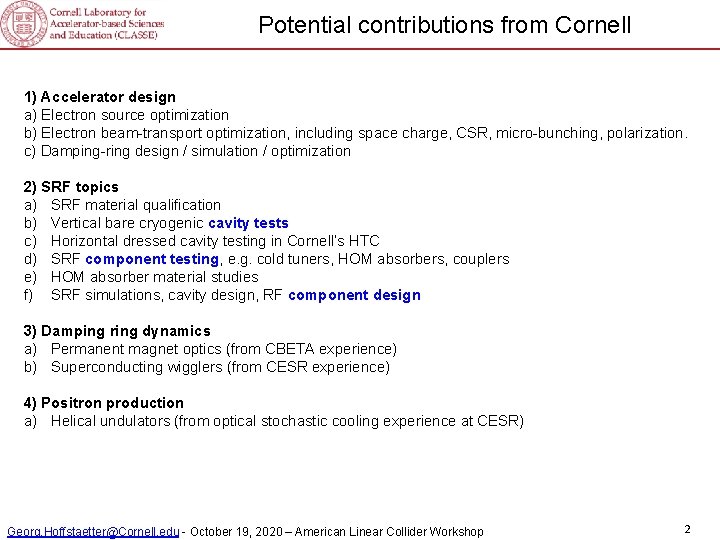
The CBETA CDRcontributions from Cornell Potential 1) Accelerator design a) Electron source optimization b) Electron beam-transport optimization, including space charge, CSR, micro-bunching, polarization. c) Damping-ring design / simulation / optimization 2) SRF topics a) SRF material qualification b) Vertical bare cryogenic cavity tests c) Horizontal dressed cavity testing in Cornell’s HTC d) SRF component testing, e. g. cold tuners, HOM absorbers, couplers e) HOM absorber material studies f) SRF simulations, cavity design, RF component design 3) Damping ring dynamics a) Permanent magnet optics (from CBETA experience) b) Superconducting wigglers (from CESR experience) 4) Positron production a) Helical undulators (from optical stochastic cooling experience at CESR) Georg. Hoffstaetter@Cornell. edu - October 19, 2020 – American Linear Collider Workshop 2
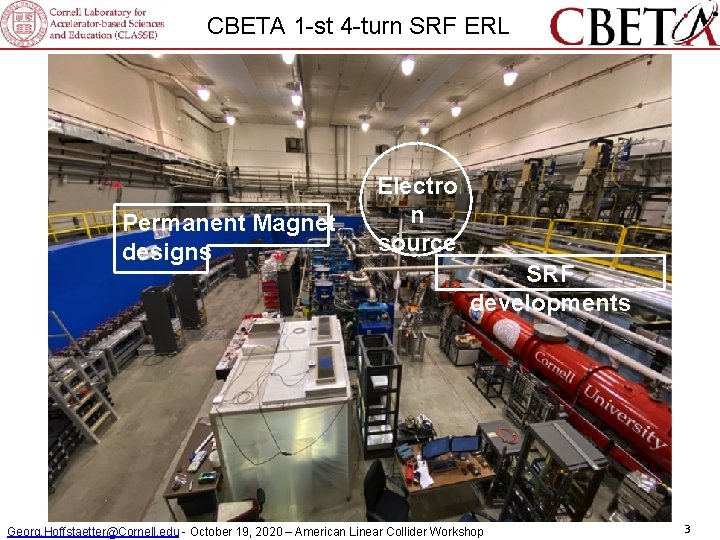
CBETA 1 -st 4 -turn SRF ERL Permanent Magnet designs Electro n source SRF developments Georg. Hoffstaetter@Cornell. edu - October 19, 2020 – American Linear Collider Workshop 3
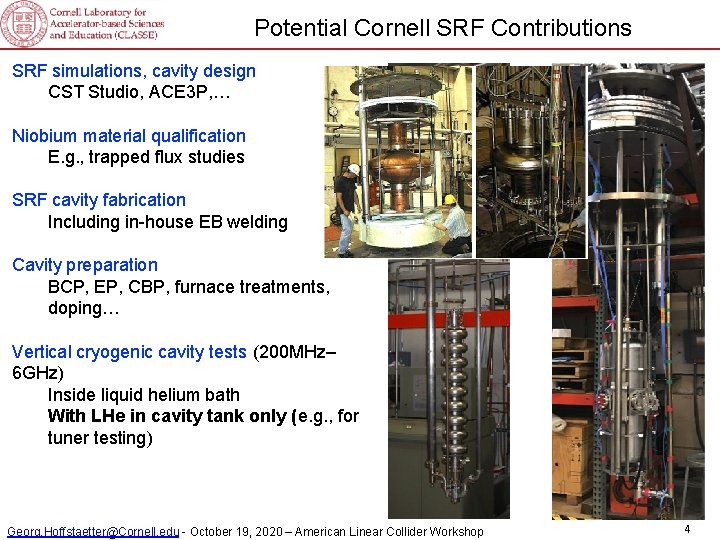
Potential Cornell SRF Contributions SRF simulations, cavity design CST Studio, ACE 3 P, … Niobium material qualification E. g. , trapped flux studies SRF cavity fabrication Including in-house EB welding Cavity preparation BCP, EP, CBP, furnace treatments, doping… Vertical cryogenic cavity tests (200 MHz– 6 GHz) Inside liquid helium bath With LHe in cavity tank only (e. g. , for tuner testing) Georg. Hoffstaetter@Cornell. edu - October 19, 2020 – American Linear Collider Workshop 4
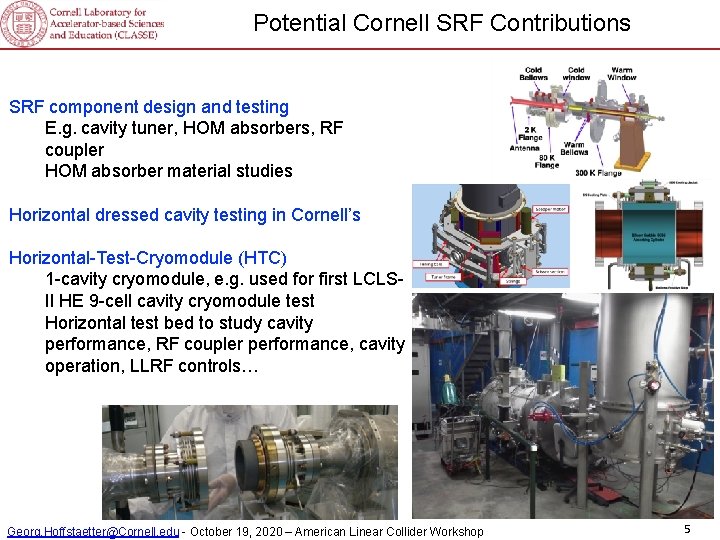
Potential Cornell SRF Contributions SRF component design and testing E. g. cavity tuner, HOM absorbers, RF coupler HOM absorber material studies Horizontal dressed cavity testing in Cornell’s Horizontal-Test-Cryomodule (HTC) 1 -cavity cryomodule, e. g. used for first LCLSII HE 9 -cell cavity cryomodule test Horizontal test bed to study cavity performance, RF coupler performance, cavity operation, LLRF controls… Georg. Hoffstaetter@Cornell. edu - October 19, 2020 – American Linear Collider Workshop 5
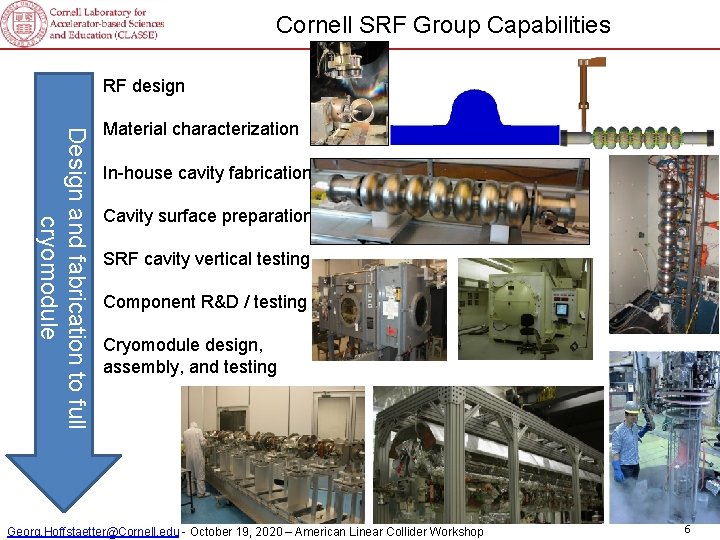
Cornell SRF Group Capabilities RF design Design and fabrication to full cryomodule Material characterization In-house cavity fabrication Cavity surface preparation SRF cavity vertical testing Component R&D / testing Cryomodule design, assembly, and testing Georg. Hoffstaetter@Cornell. edu - October 19, 2020 – American Linear Collider Workshop 6
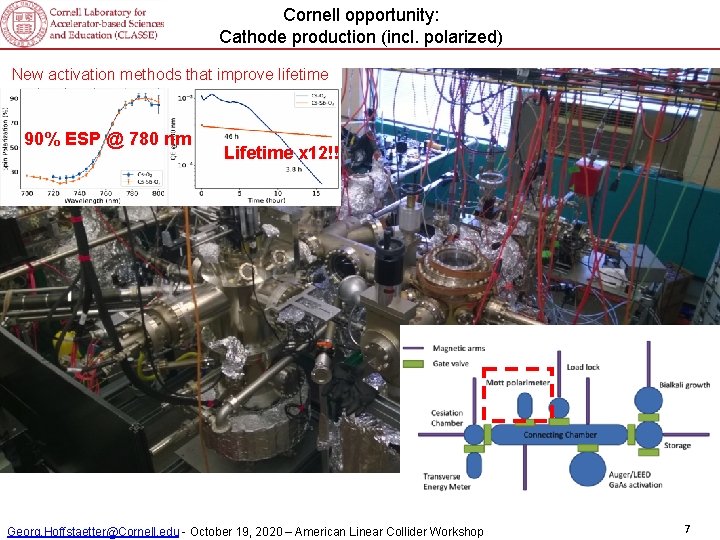
Cornellphotocathode opportunity: Spin polarized Cathode production (incl. polarized) New activation methods that improve lifetime 90% ESP @ 780 nm Lifetime x 12!! Georg. Hoffstaetter@Cornell. edu - October 19, 2020 – American Linear Collider Workshop 7
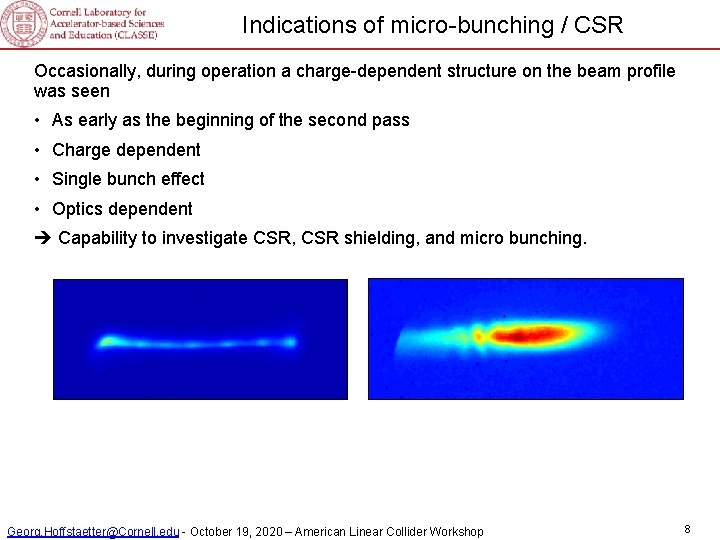
Indications of micro-bunching / CSR Occasionally, during operation a charge-dependent structure on the beam profile was seen • As early as the beginning of the second pass • Charge dependent • Single bunch effect • Optics dependent Capability to investigate CSR, CSR shielding, and micro bunching. Georg. Hoffstaetter@Cornell. edu - October 19, 2020 – American Linear Collider Workshop 8
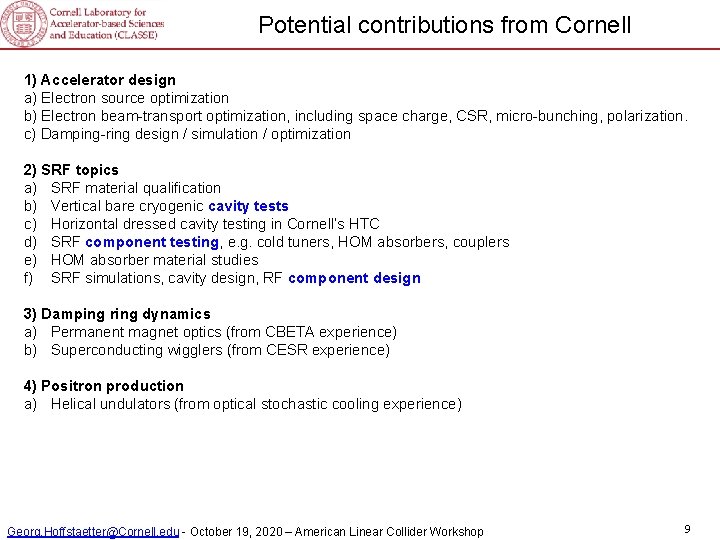
The CBETA CDRcontributions from Cornell Potential 1) Accelerator design a) Electron source optimization b) Electron beam-transport optimization, including space charge, CSR, micro-bunching, polarization. c) Damping-ring design / simulation / optimization 2) SRF topics a) SRF material qualification b) Vertical bare cryogenic cavity tests c) Horizontal dressed cavity testing in Cornell’s HTC d) SRF component testing, e. g. cold tuners, HOM absorbers, couplers e) HOM absorber material studies f) SRF simulations, cavity design, RF component design 3) Damping ring dynamics a) Permanent magnet optics (from CBETA experience) b) Superconducting wigglers (from CESR experience) 4) Positron production a) Helical undulators (from optical stochastic cooling experience) Georg. Hoffstaetter@Cornell. edu - October 19, 2020 – American Linear Collider Workshop 9
Questions ? Georg. Hoffstaetter@Cornell. edu - October 19, 2020 – American Linear Collider Workshop 10
- Slides: 10