
Potential Environmental and Social Impacts of Solar Energy
- Slides: 13
Potential Environmental and Social Impacts of Solar Energy Solar Industry Practices for Environmental Stewardship on Utility-Scale Ground Mounted Projects by Miriam Makyhoun Solar & Renewable Energy Industry Specialist NC Sustainable Energy Association miriam@energync. org
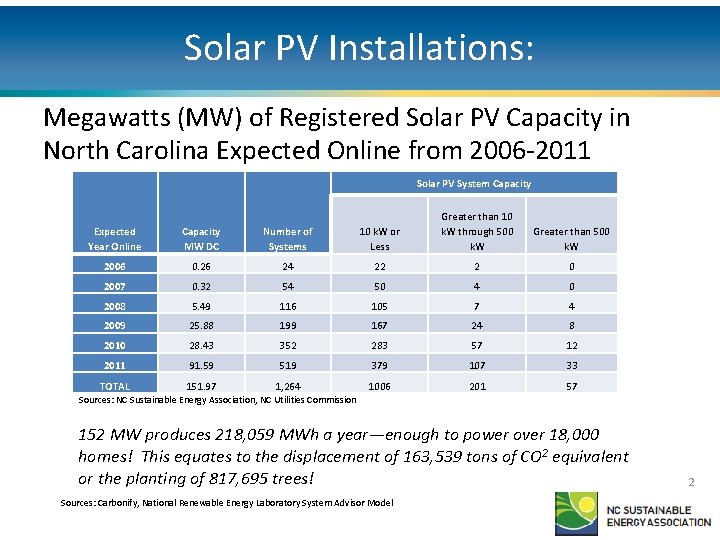
Solar PV Installations: Megawatts (MW) of Registered Solar PV Capacity in North Carolina Expected Online from 2006 -2011 Solar PV System Capacity Expected Year Online Capacity MW DC Number of Systems 10 k. W or Less Greater than 10 k. W through 500 k. W 2006 0. 26 24 22 2 0 2007 0. 32 54 50 4 0 2008 5. 49 116 105 7 4 2009 25. 88 199 167 24 8 2010 28. 43 352 283 57 12 2011 91. 59 519 379 107 33 TOTAL 151. 97 1, 264 1006 201 57 Greater than 500 k. W Sources: NC Sustainable Energy Association, NC Utilities Commission 152 MW produces 218, 059 MWh a year—enough to power over 18, 000 homes! This equates to the displacement of 163, 539 tons of CO 2 equivalent or the planting of 817, 695 trees! Sources: Carbonify, National Renewable Energy Laboratory System Advisor Model 2
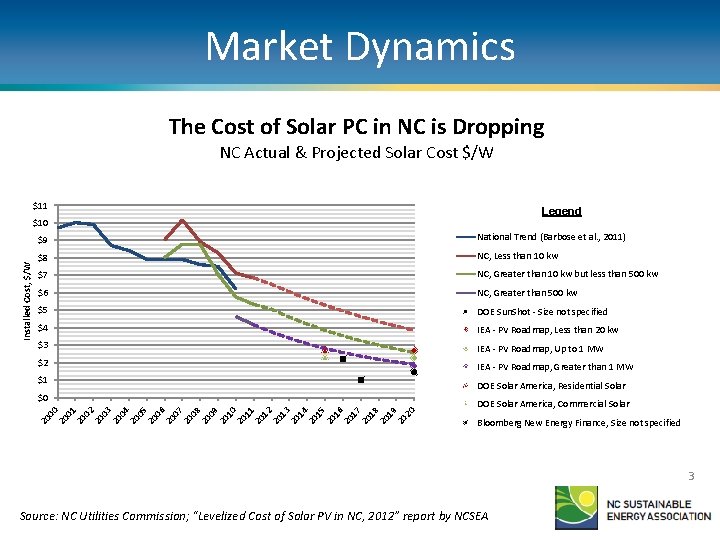
Market Dynamics The Cost of Solar PC in NC is Dropping NC Actual & Projected Solar Cost $/W $11 Legend Installed Cost, $/W $10 $9 National Trend (Barbose et al. , 2011) $8 NC, Less than 10 kw $7 NC, Greater than 10 kw but less than 500 kw $6 NC, Greater than 500 kw $5 DOE Sun. Shot - Size not specified $4 IEA - PV Roadmap, Less than 20 kw $3 IEA - PV Roadmap, Up to 1 MW $2 IEA - PV Roadmap, Greater than 1 MW $1 20 00 20 01 20 02 20 03 20 04 20 05 20 06 20 07 20 08 20 09 20 10 20 11 20 12 20 13 20 14 20 15 20 16 20 17 20 18 20 19 20 20 $0 DOE Solar America, Residential Solar DOE Solar America, Commercial Solar Bloomberg New Energy Finance, Size not specified 3 Source: NC Utilities Commission; “Levelized Cost of Solar PV in NC, 2012” report by NCSEA
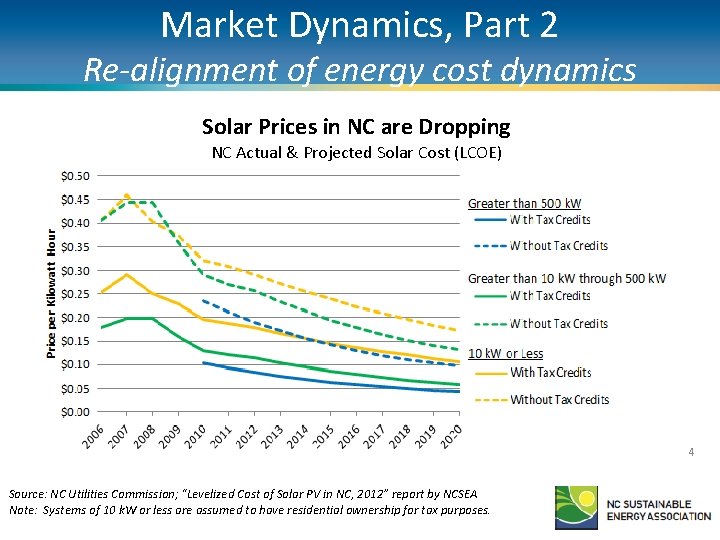
Market Dynamics, Part 2 Re-alignment of energy cost dynamics Solar Prices in NC are Dropping NC Actual & Projected Solar Cost (LCOE) 4 Source: NC Utilities Commission; “Levelized Cost of Solar PV in NC, 2012” report by NCSEA Note: Systems of 10 k. W or less are assumed to have residential ownership for tax purposes.
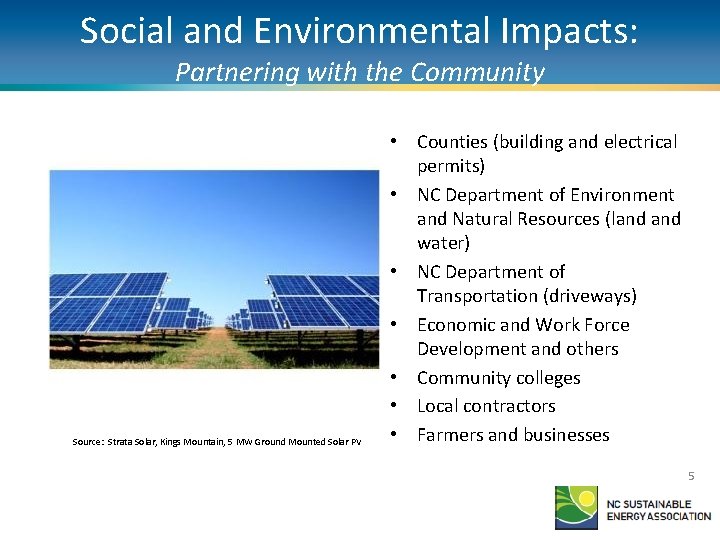
Social and Environmental Impacts: Partnering with the Community Source: Strata Solar, Kings Mountain, 5 MW Ground Mounted Solar PV • Counties (building and electrical permits) • NC Department of Environment and Natural Resources (land water) • NC Department of Transportation (driveways) • Economic and Work Force Development and others • Community colleges • Local contractors • Farmers and businesses 5
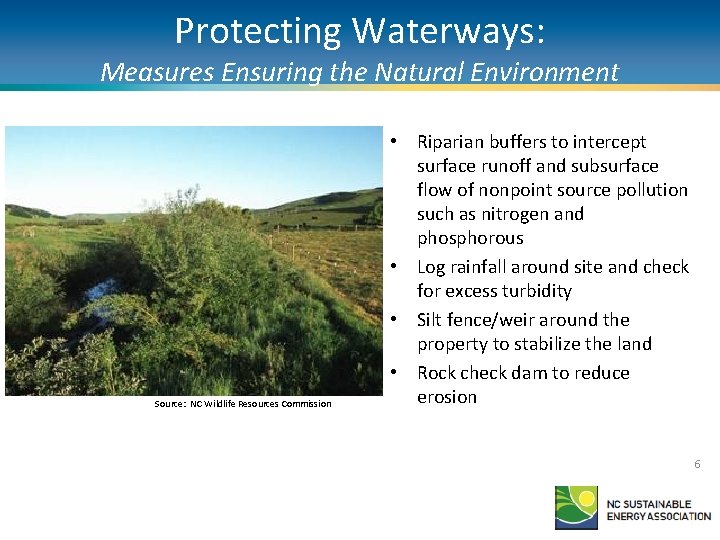
Protecting Waterways: Measures Ensuring the Natural Environment Source: NC Wildlife Resources Commission • Riparian buffers to intercept surface runoff and subsurface flow of nonpoint source pollution such as nitrogen and phosphorous • Log rainfall around site and check for excess turbidity • Silt fence/weir around the property to stabilize the land • Rock check dam to reduce erosion 6
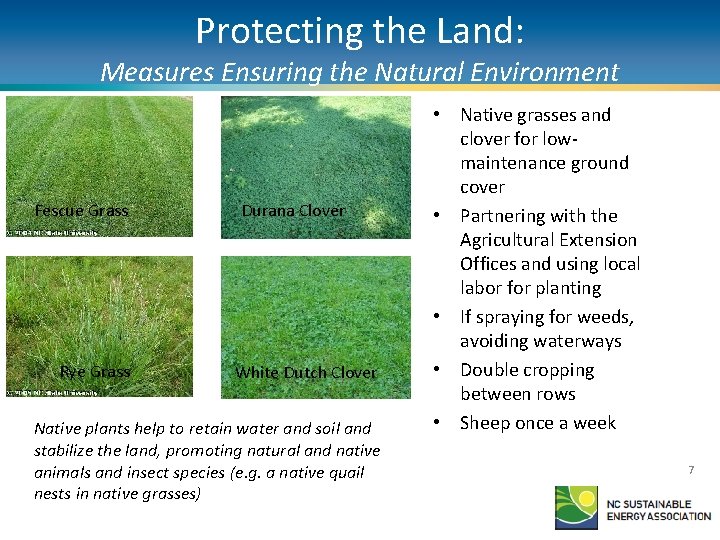
Protecting the Land: Measures Ensuring the Natural Environment Fescue Grass Rye Grass Durana Clover White Dutch Clover Native plants help to retain water and soil and stabilize the land, promoting natural and native animals and insect species (e. g. a native quail nests in native grasses) • Native grasses and clover for lowmaintenance ground cover • Partnering with the Agricultural Extension Offices and using local labor for planting • If spraying for weeds, avoiding waterways • Double cropping between rows • Sheep once a week 7
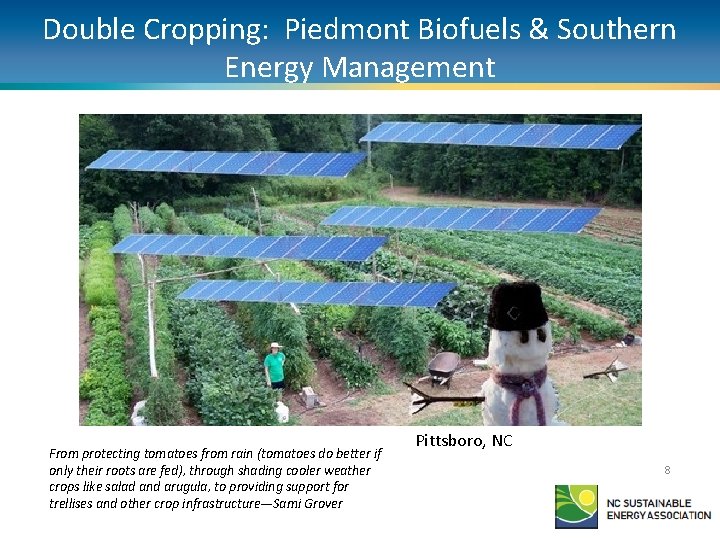
Double Cropping: Piedmont Biofuels & Southern Energy Management From protecting tomatoes from rain (tomatoes do better if only their roots are fed), through shading cooler weather crops like salad and arugula, to providing support for trellises and other crop infrastructure—Sami Grover Pittsboro, NC 8
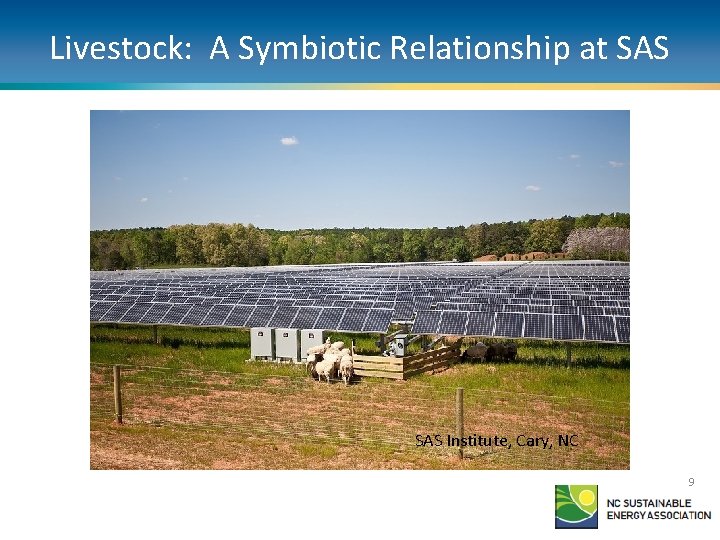
Livestock: A Symbiotic Relationship at SAS Institute, Cary, NC 9
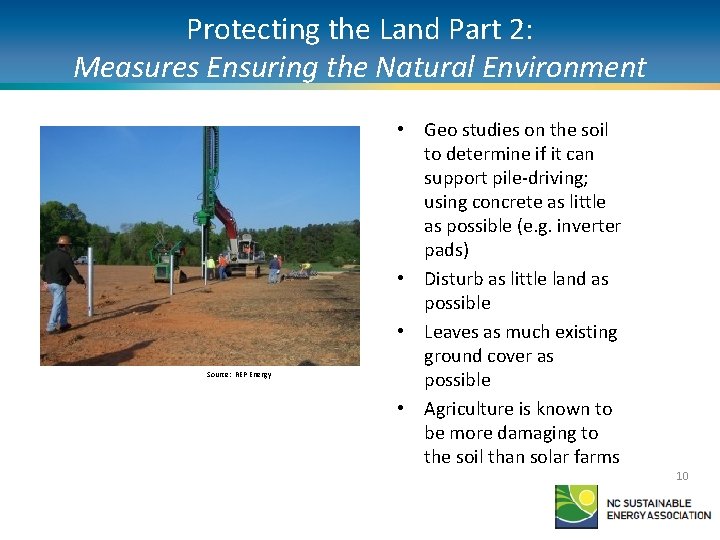
Protecting the Land Part 2: Measures Ensuring the Natural Environment Source: REP Energy • Geo studies on the soil to determine if it can support pile-driving; using concrete as little as possible (e. g. inverter pads) • Disturb as little land as possible • Leaves as much existing ground cover as possible • Agriculture is known to be more damaging to the soil than solar farms 10
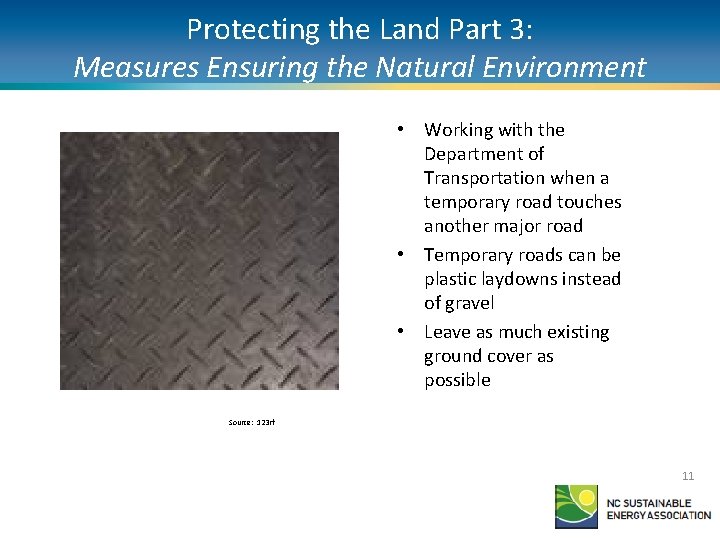
Protecting the Land Part 3: Measures Ensuring the Natural Environment • Working with the Department of Transportation when a temporary road touches another major road • Temporary roads can be plastic laydowns instead of gravel • Leave as much existing ground cover as possible Source: 123 rf 11
Social Benefits of Solar PV • A use for underused or no longer arable land • A net tax benefit through taxable infrastructure that does not burden existing infrastructure • Job-creation and training/certification in often rural areas • It helps farmers: Out of over 7, 000 U. S. farms who responded to the 2009 USDA On-Farm Census stating they utilize solar energy, North Carolina had 104 farms with solar, 67 with PV panels; 55 with solar thermal panels • It saves businesses and residents money: Over the last decade, utility electricity prices have risen by 3% per year, while the cost of solar PV continues to decrease (30% in North Carolina from 2007— 2011, according to the North Carolina Utilities Commission Docket Filings) 12
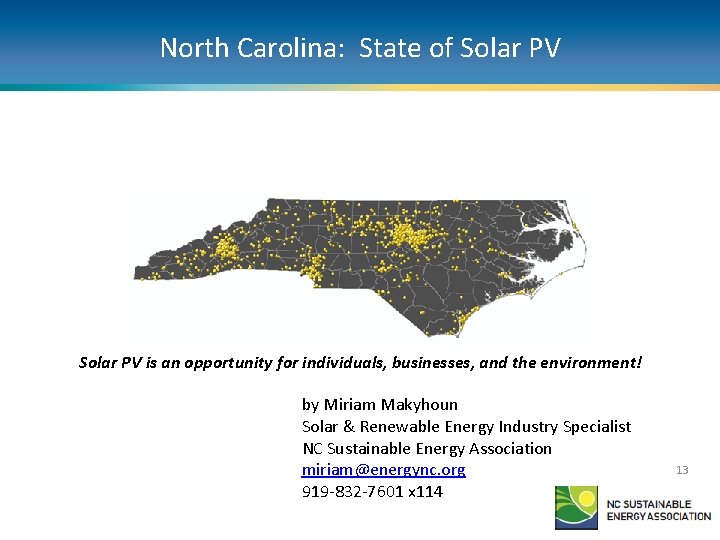
North Carolina: State of Solar PV is an opportunity for individuals, businesses, and the environment! by Miriam Makyhoun Solar & Renewable Energy Industry Specialist NC Sustainable Energy Association miriam@energync. org 919 -832 -7601 x 114 13