
Potential energy surfaces and Berry phases beyond the
Potential energy surfaces and Berry phases beyond the Born-Oppenheimer approximation
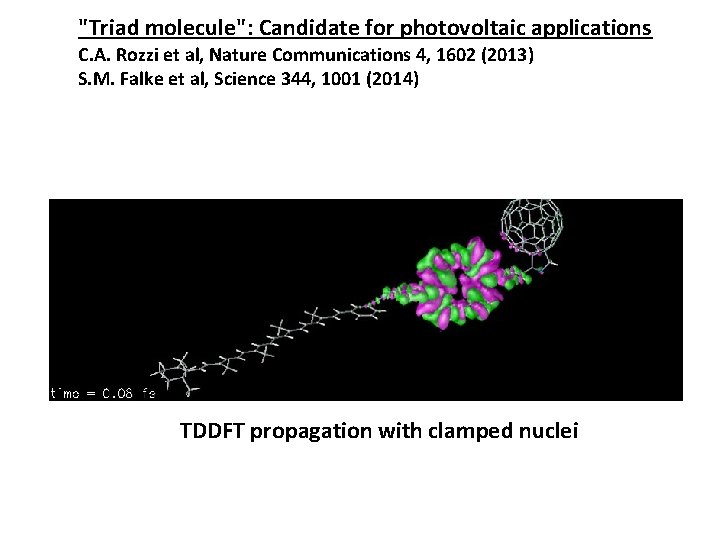
"Triad molecule": Candidate for photovoltaic applications C. A. Rozzi et al, Nature Communications 4, 1602 (2013) S. M. Falke et al, Science 344, 1001 (2014) TDDFT propagation with clamped nuclei
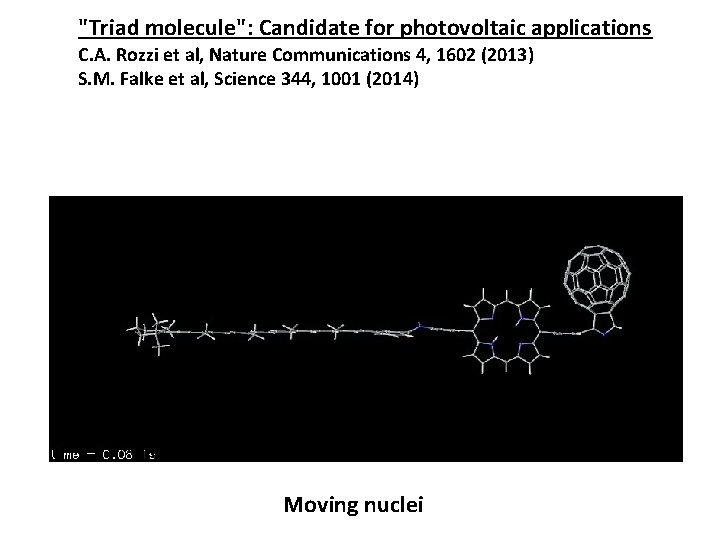
"Triad molecule": Candidate for photovoltaic applications C. A. Rozzi et al, Nature Communications 4, 1602 (2013) S. M. Falke et al, Science 344, 1001 (2014) Moving nuclei
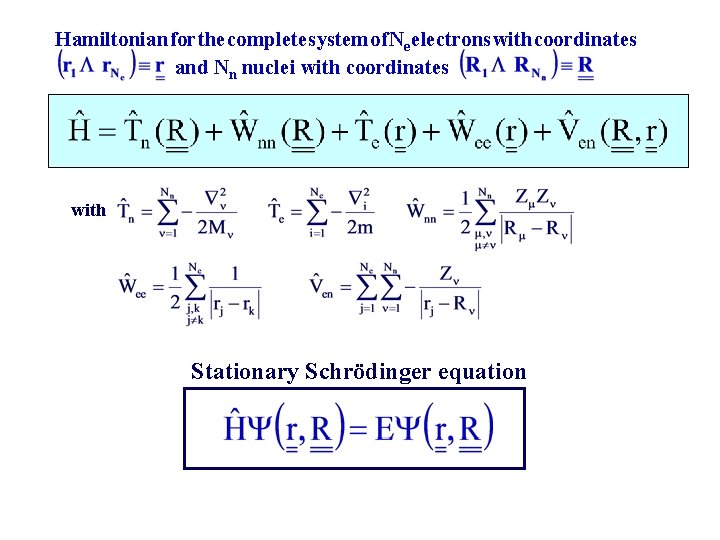
Hamiltonian for the complete system of Ne electrons with coordinates and Nn nuclei with coordinates with Stationary Schrödinger equation
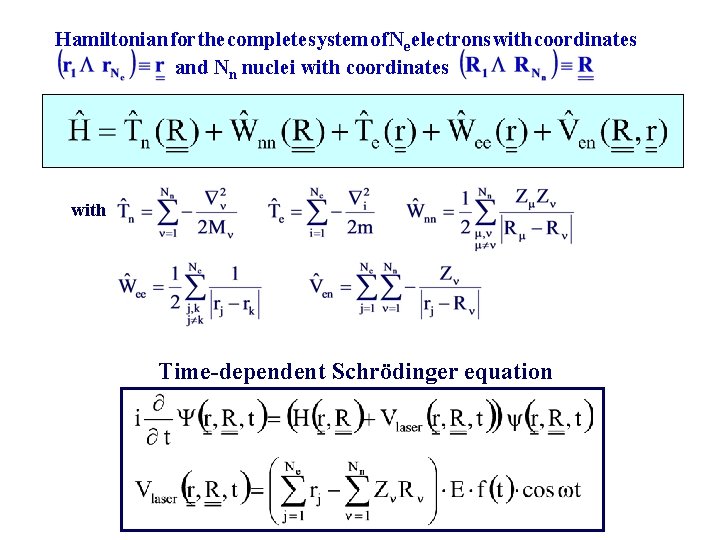
Hamiltonian for the complete system of Ne electrons with coordinates and Nn nuclei with coordinates with Time-dependent Schrödinger equation

Born-Oppenheimer approximation J=1 J=0 solve for each fixed nuclear configuration Make adiabatic ansatz for the complete wave function: and find best χBO by minimizing <ΨBO | H | ΨBO > w. r. t. χBO :
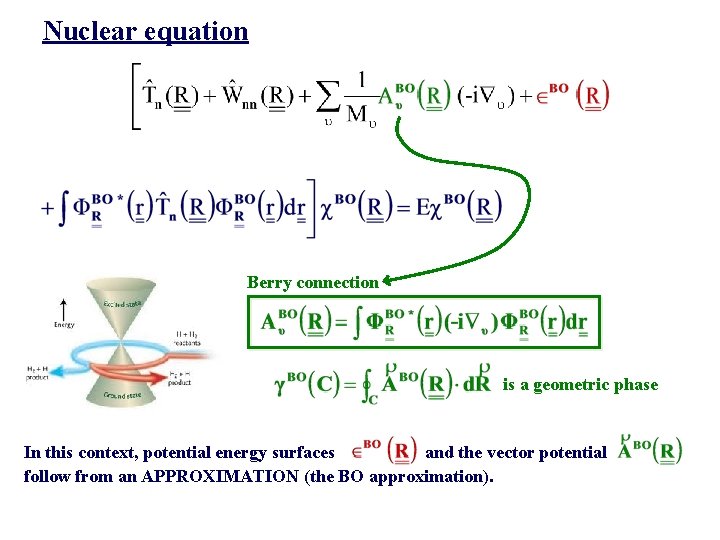
Nuclear equation Berry connection is a geometric phase In this context, potential energy surfaces and the vector potential follow from an APPROXIMATION (the BO approximation).
Can one find a quantity –similar to the molecular Berry phase- but without making the Born. Oppenheimer approximation?
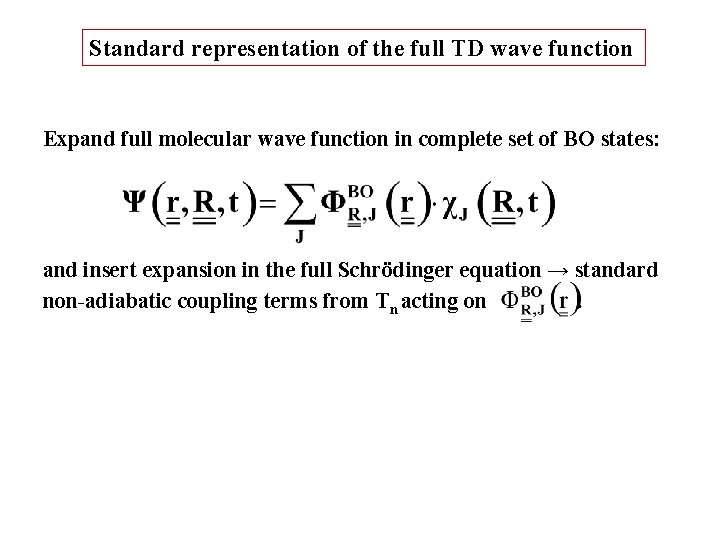
Standard representation of the full TD wave function Expand full molecular wave function in complete set of BO states: and insert expansion in the full Schrödinger equation → standard non-adiabatic coupling terms from Tn acting on
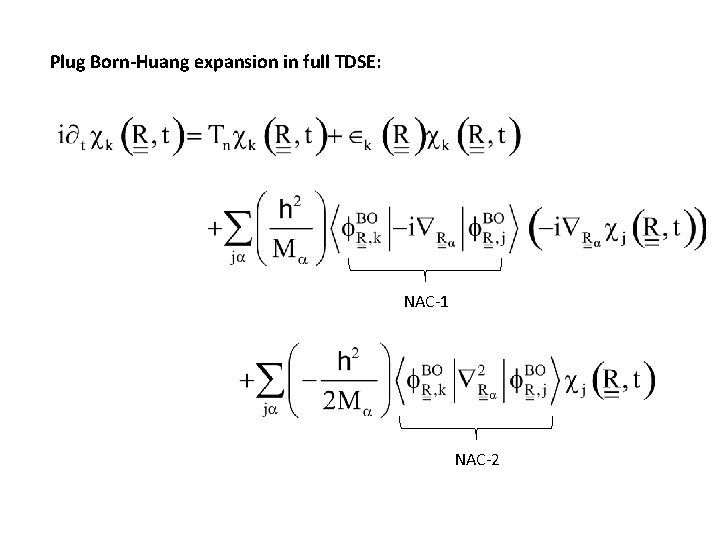
Plug Born-Huang expansion in full TDSE: NAC-1 NAC-2
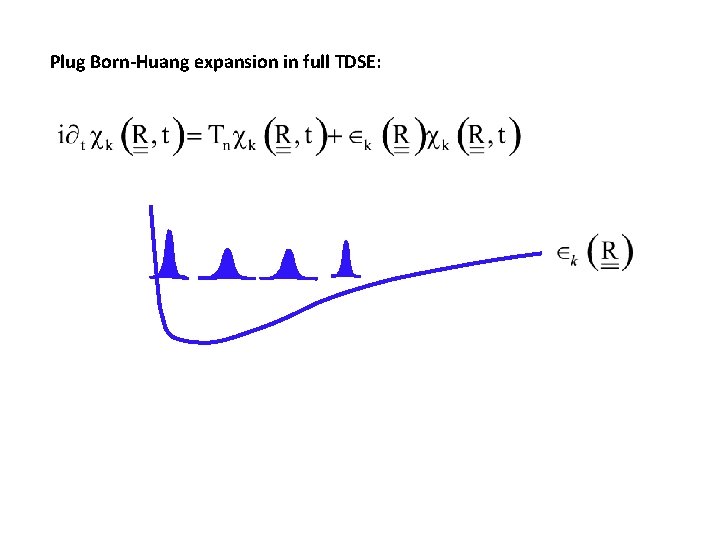
Plug Born-Huang expansion in full TDSE:
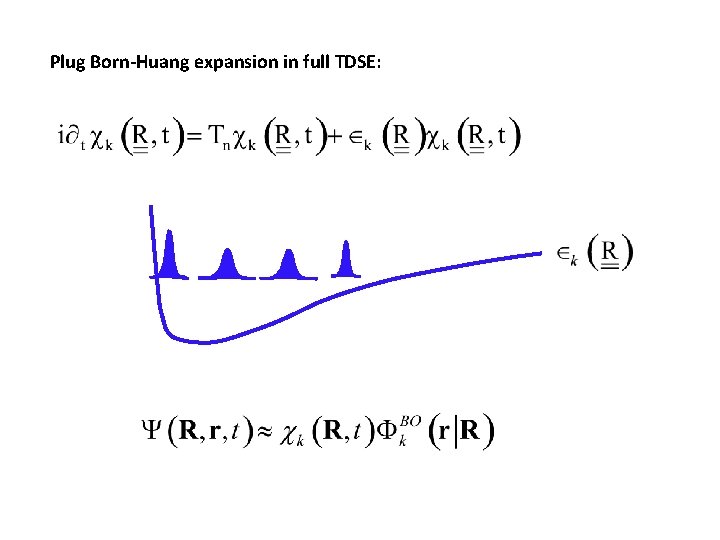
Plug Born-Huang expansion in full TDSE:
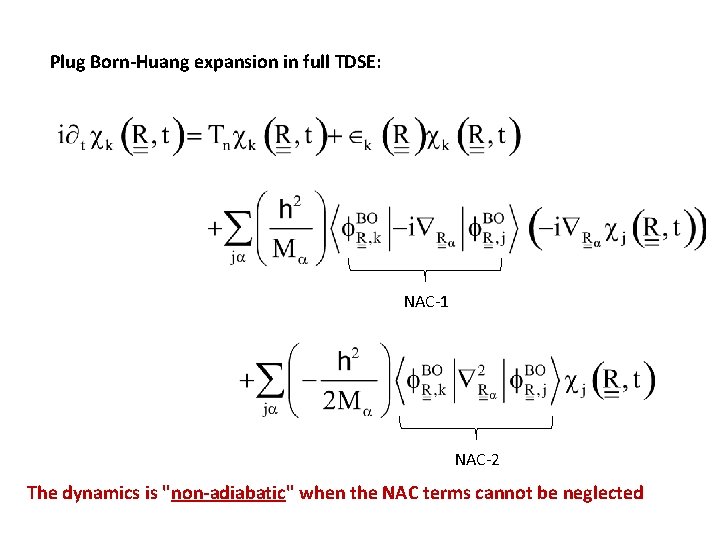
Plug Born-Huang expansion in full TDSE: NAC-1 NAC-2 The dynamics is "non-adiabatic" when the NAC terms cannot be neglected
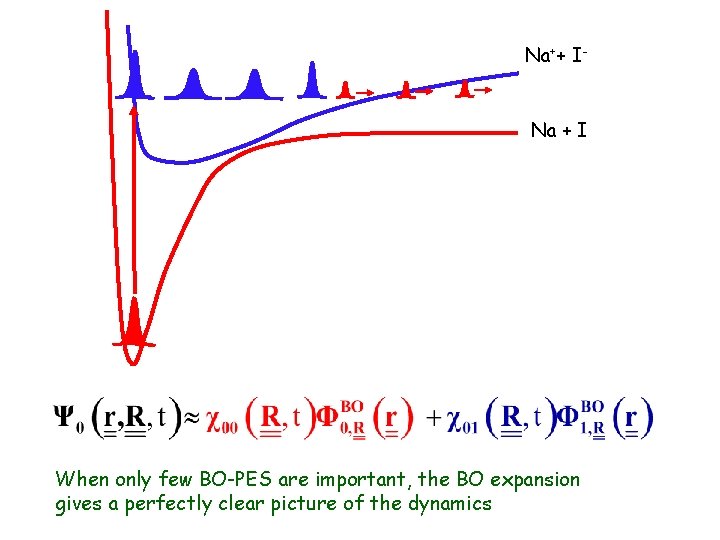
Na++ INa + I When only few BO-PES are important, the BO expansion gives a perfectly clear picture of the dynamics
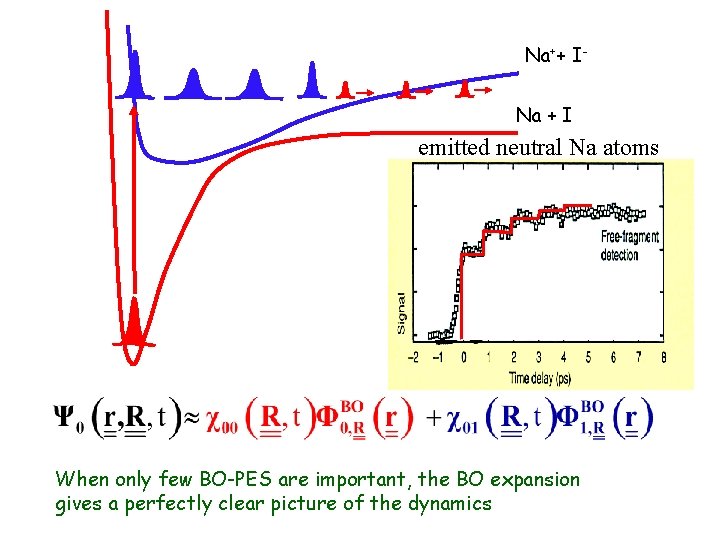
Na++ INa + I emitted neutral Na atoms When only few BO-PES are important, the BO expansion gives a perfectly clear picture of the dynamics
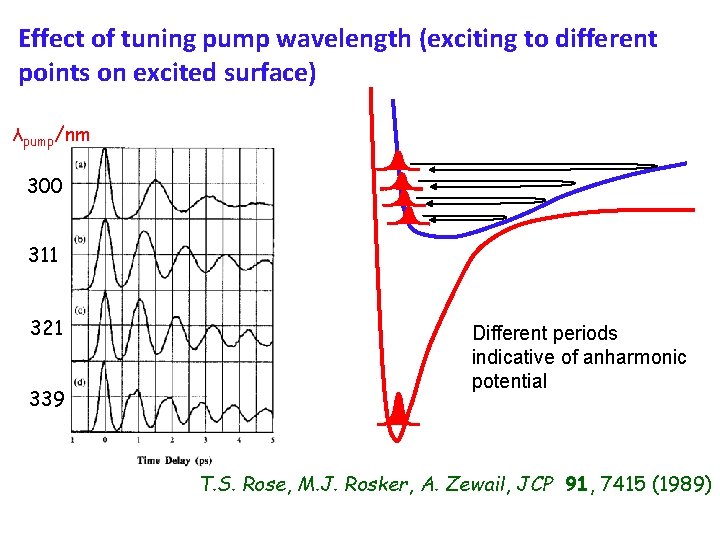
Effect of tuning pump wavelength (exciting to different points on excited surface) λpump/nm 300 311 321 339 Different periods indicative of anharmonic potential T. S. Rose, M. J. Rosker, A. Zewail, JCP 91, 7415 (1989)
For larger systems one would like to (one has to) treat the nuclear motion with cassical trajectories.
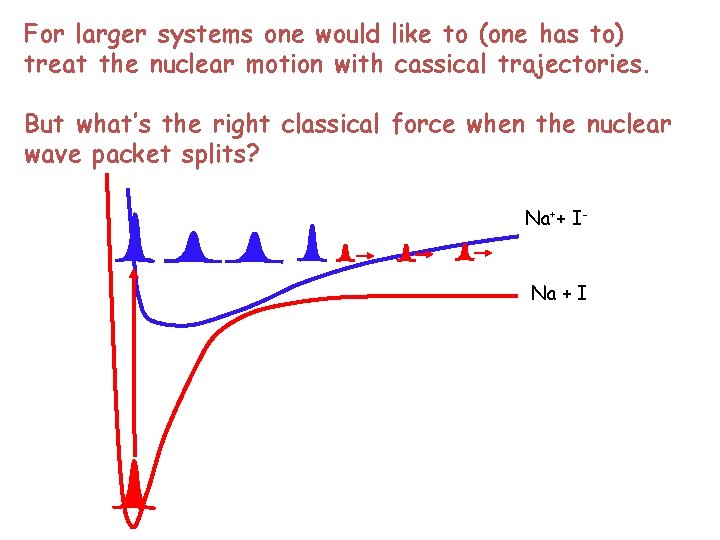
For larger systems one would like to (one has to) treat the nuclear motion with cassical trajectories. But what’s the right classical force when the nuclear wave packet splits? Na++ INa + I
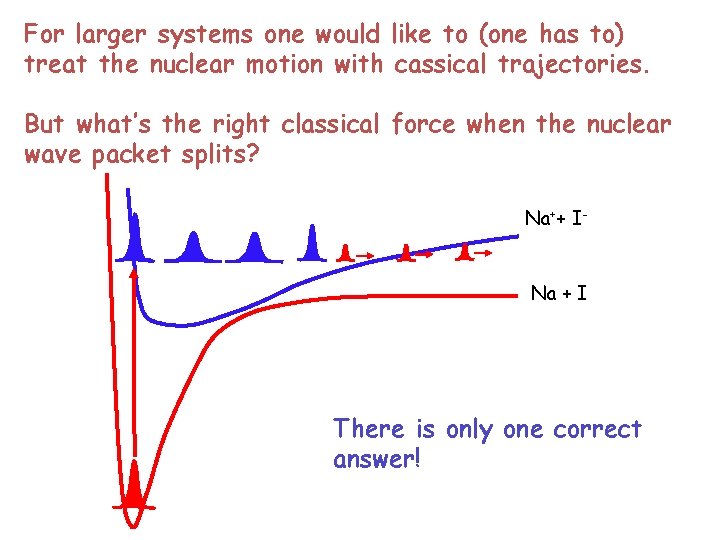
For larger systems one would like to (one has to) treat the nuclear motion with cassical trajectories. But what’s the right classical force when the nuclear wave packet splits? Na++ INa + I There is only one correct answer!
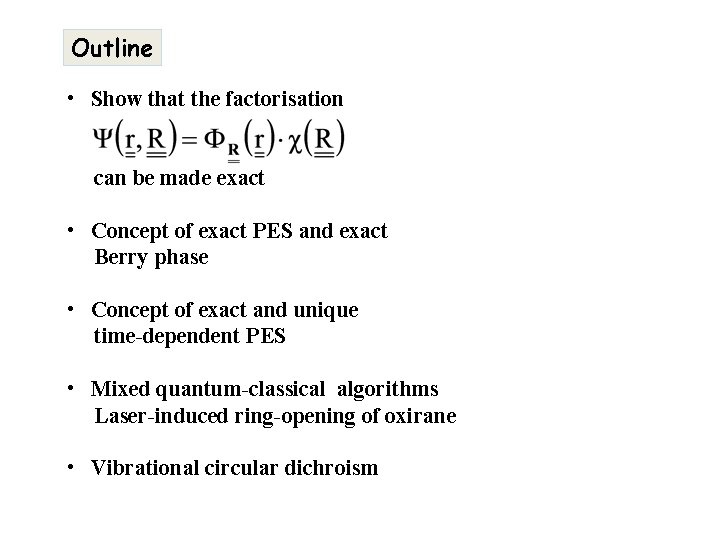
Outline • Show that the factorisation can be made exact • Concept of exact PES and exact Berry phase • Concept of exact and unique time-dependent PES • Mixed quantum-classical algorithms Laser-induced ring-opening of oxirane • Vibrational circular dichroism
THANKS! Ali Abedi Federica Agostini Axel Schild Yasumitsu Suzuki Basile Curchod b Cesar Proetto Seung Kyu Min Neepa Maitra Ivano Tavernelli Rodolphe Vuilleumier Ryan Requist Nikitas Gidopoulos
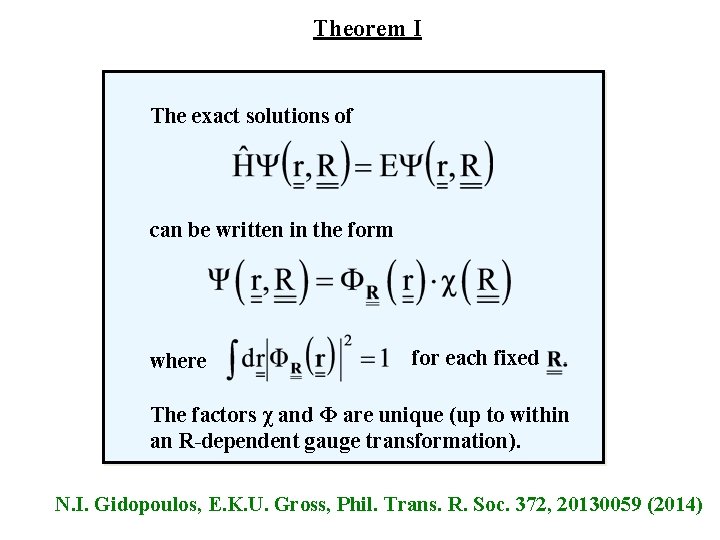
Theorem I The exact solutions of can be written in the form where for each fixed The factors χ and Φ are unique (up to within an R-dependent gauge transformation). N. I. Gidopoulos, E. K. U. Gross, Phil. Trans. R. Soc. 372, 20130059 (2014)
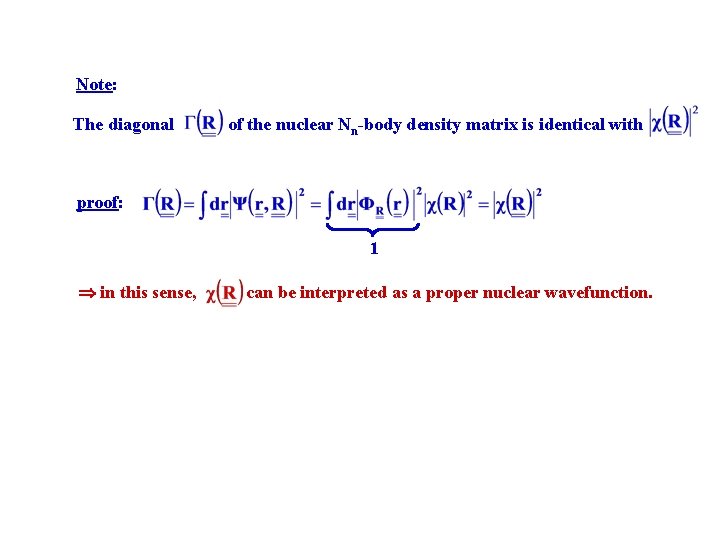
Note: The diagonal of the nuclear Nn-body density matrix is identical with proof: 1 in this sense, can be interpreted as a proper nuclear wavefunction.
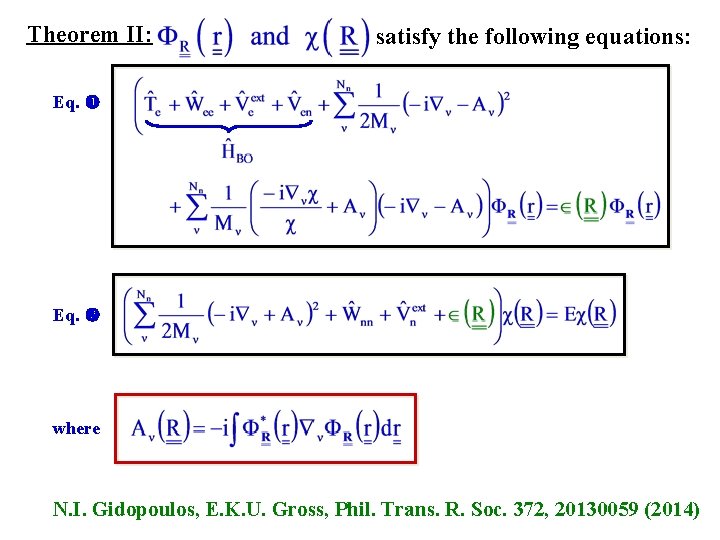
Theorem II: satisfy the following equations: Eq. where N. I. Gidopoulos, E. K. U. Gross, Phil. Trans. R. Soc. 372, 20130059 (2014)
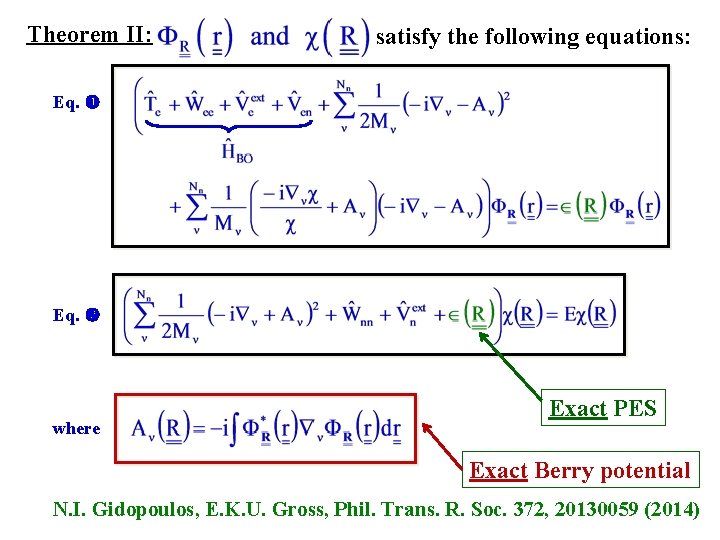
Theorem II: satisfy the following equations: Eq. where Exact PES Exact Berry potential N. I. Gidopoulos, E. K. U. Gross, Phil. Trans. R. Soc. 372, 20130059 (2014)
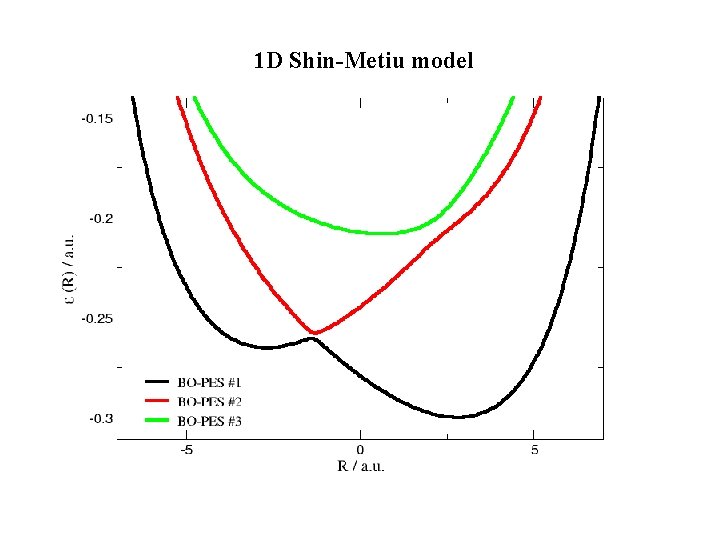
How do the exact PES look like?
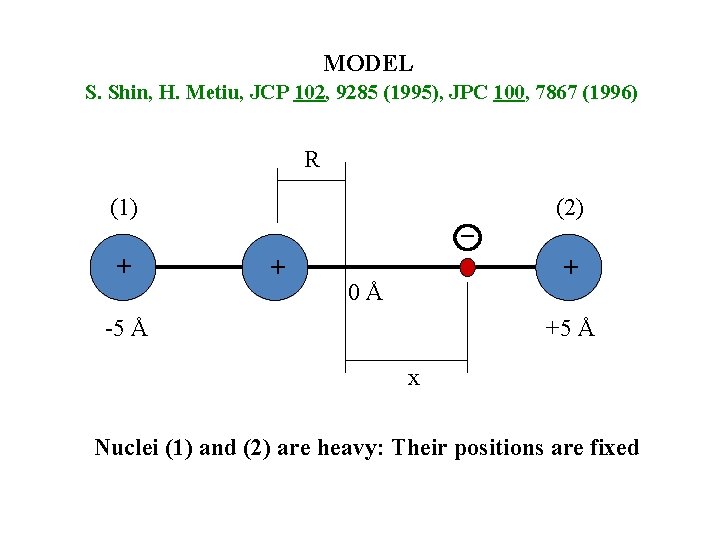
MODEL S. Shin, H. Metiu, JCP 102, 9285 (1995), JPC 100, 7867 (1996) R (1) (2) – + + + 0 Å -5 Å +5 Å x Nuclei (1) and (2) are heavy: Their positions are fixed
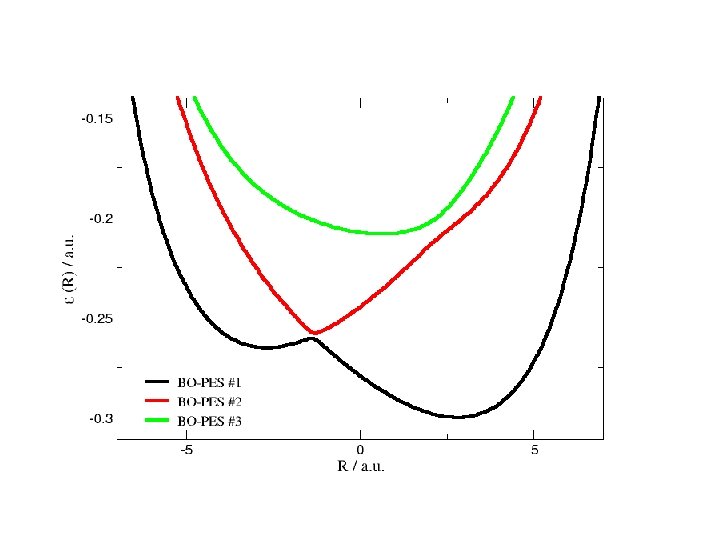
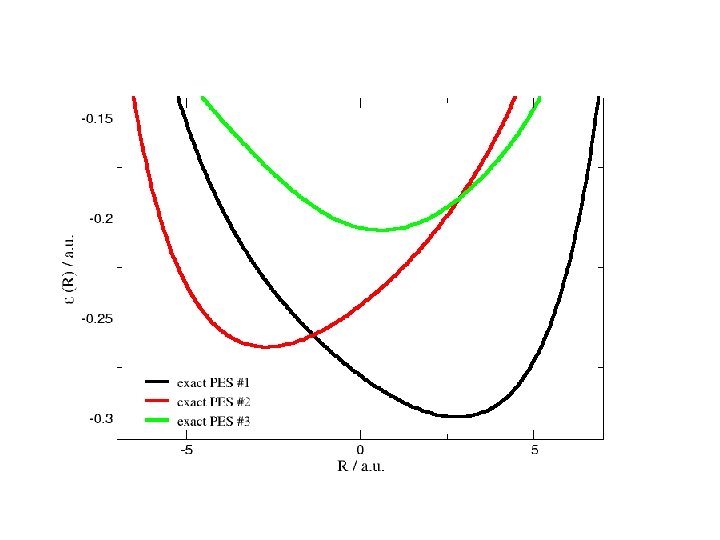
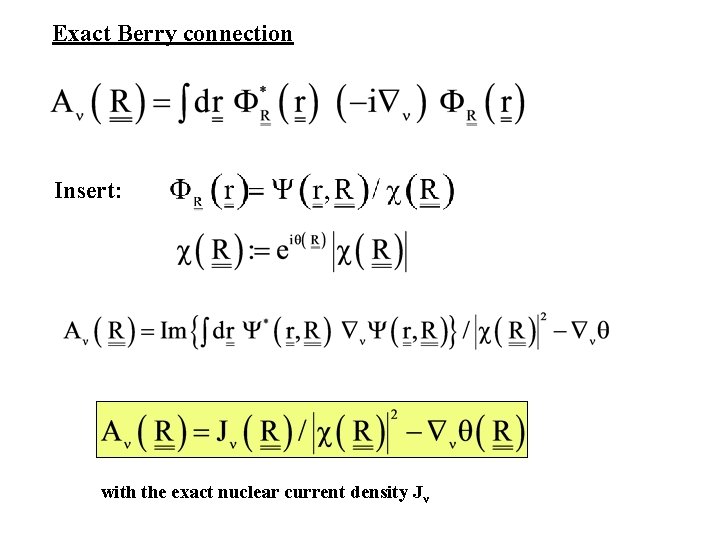
Exact Berry connection Insert: with the exact nuclear current density Jν
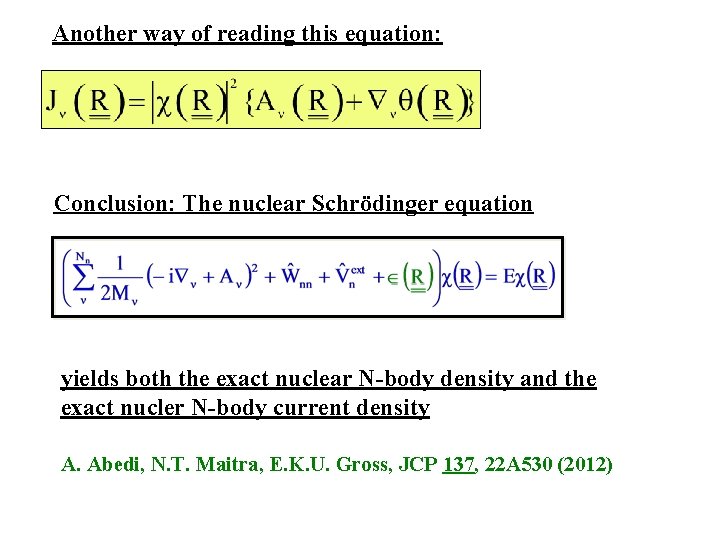
Another way of reading this equation: Conclusion: The nuclear Schrödinger equation yields both the exact nuclear N-body density and the exact nucler N-body current density A. Abedi, N. T. Maitra, E. K. U. Gross, JCP 137, 22 A 530 (2012)
Question: Can the exact vector potential be gauged away, i. e. is the associated (exact) Berry phase zero?
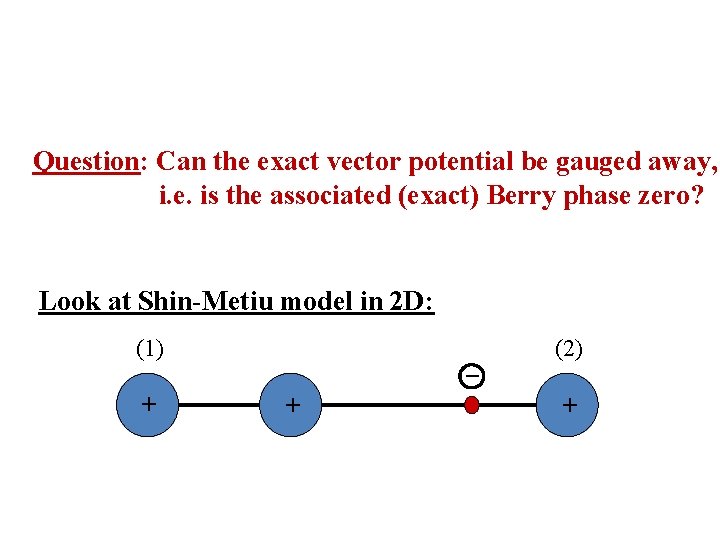
Question: Can the exact vector potential be gauged away, i. e. is the associated (exact) Berry phase zero? Look at Shin-Metiu model in 2 D: (1) + – + (2) +
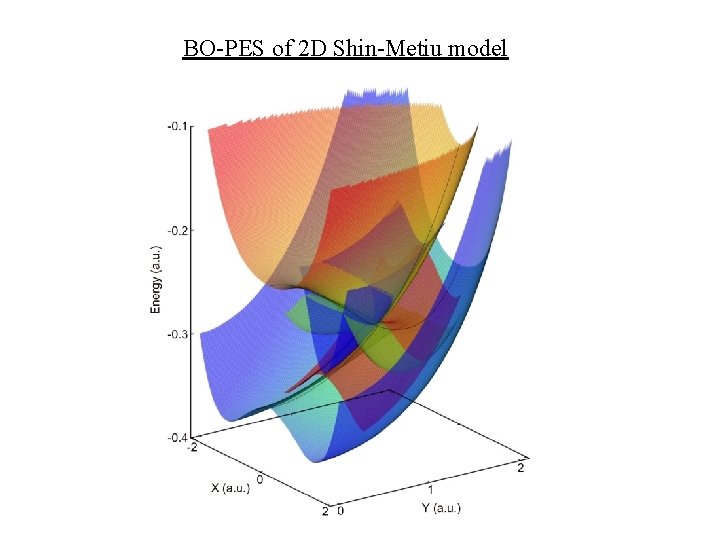
BO-PES of 2 D Shin-Metiu model
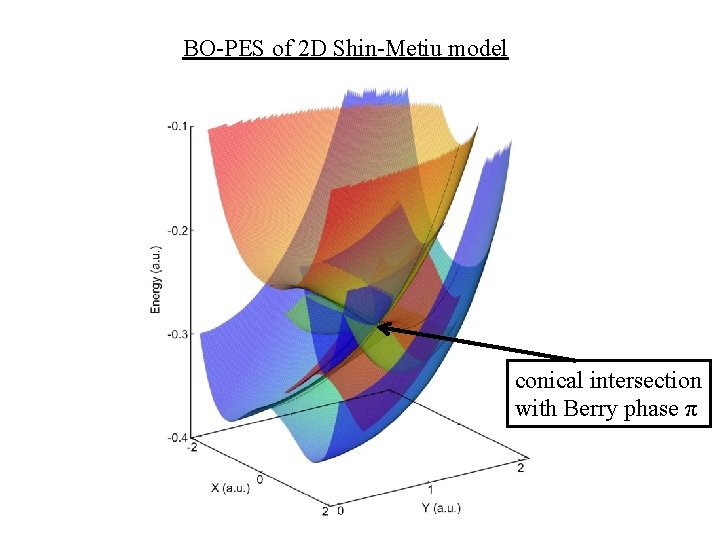
BO-PES of 2 D Shin-Metiu model conical intersection with Berry phase π
In this system, the exact vector potential can be gauged away, i. e. the true Berry phase is zero!!
In this system, the exact vector potential can be gauged away, i. e. the true Berry phase is zero!! (although there is a proper Berry phase in BO)
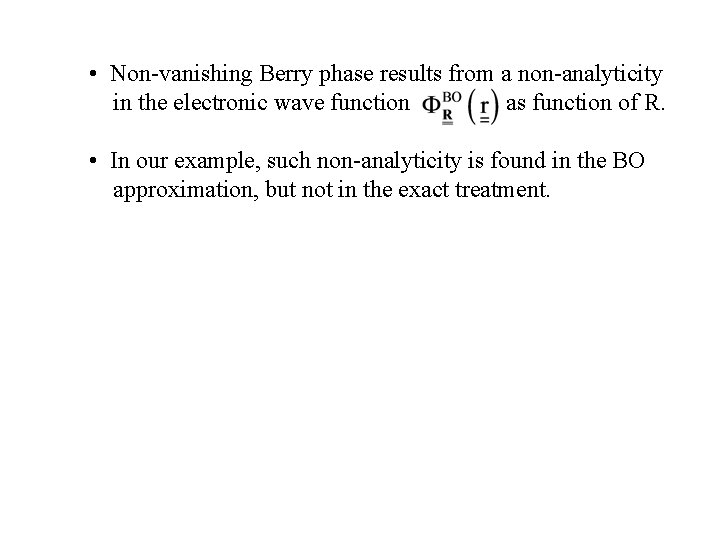
• Non-vanishing Berry phase results from a non-analyticity in the electronic wave function as function of R. • In our example, such non-analyticity is found in the BO approximation, but not in the exact treatment.
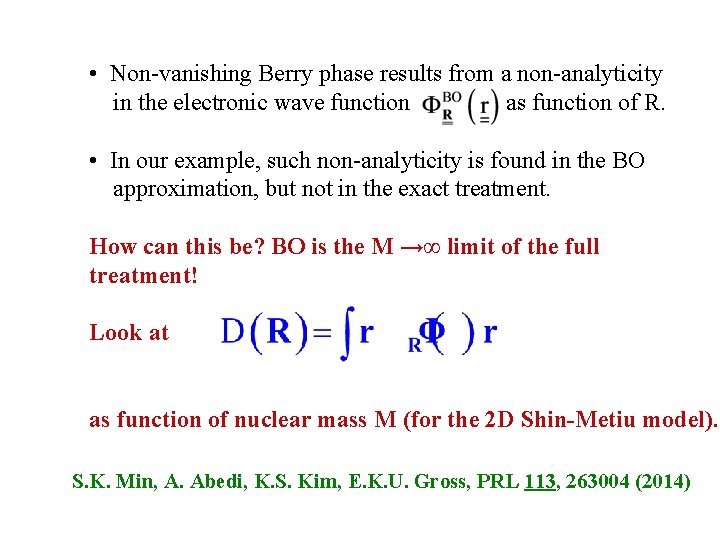
• Non-vanishing Berry phase results from a non-analyticity in the electronic wave function as function of R. • In our example, such non-analyticity is found in the BO approximation, but not in the exact treatment. How can this be? BO is the M →∞ limit of the full treatment! Look at as function of nuclear mass M (for the 2 D Shin-Metiu model). S. K. Min, A. Abedi, K. S. Kim, E. K. U. Gross, PRL 113, 263004 (2014)
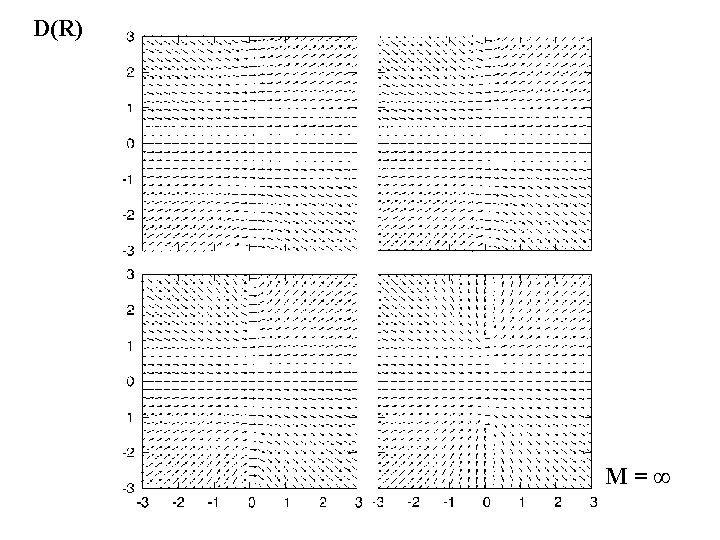
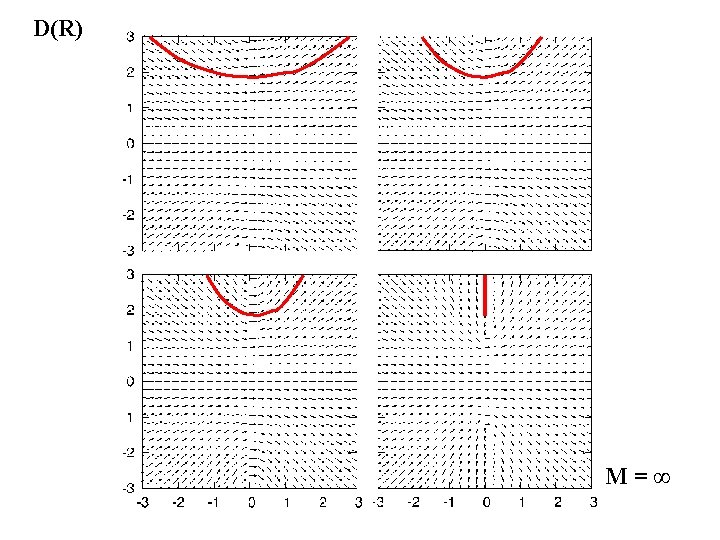
Question: Can one prove in general that the exact molecular Berry phase (at finite nuclear mass) vanishes?
Question: Can one prove in general that the exact molecular Berry phase (at finite nuclear mass) vanishes? Answer: No! There are cases where a nontrivial Berry phase appears in the exact treatment. See lecture by Ryan Requist later this week
Time-dependent case
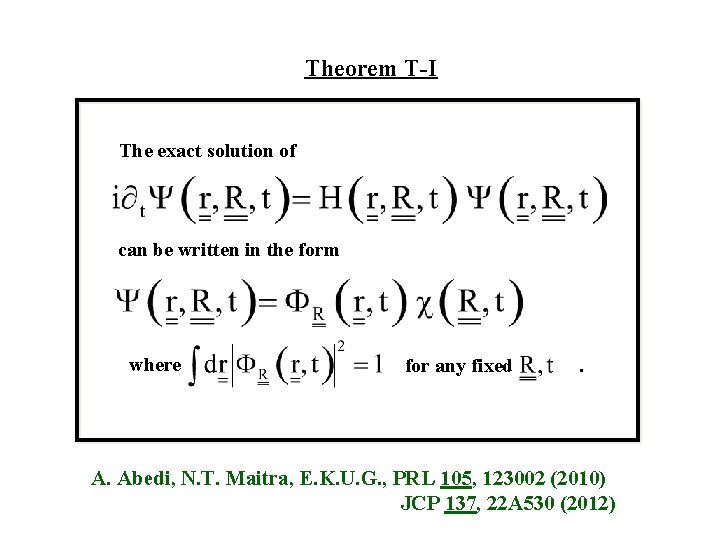
Theorem T-I The exact solution of can be written in the form where for any fixed . A. Abedi, N. T. Maitra, E. K. U. G. , PRL 105, 123002 (2010) JCP 137, 22 A 530 (2012)
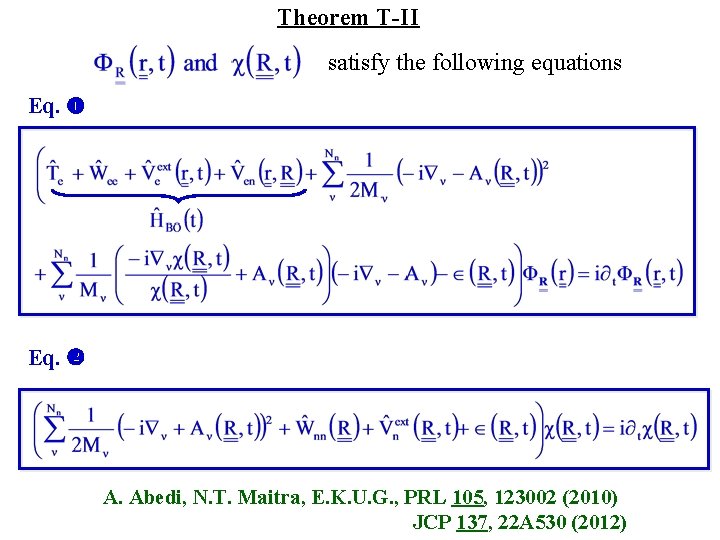
Theorem T-II satisfy the following equations Eq. A. Abedi, N. T. Maitra, E. K. U. G. , PRL 105, 123002 (2010) JCP 137, 22 A 530 (2012)
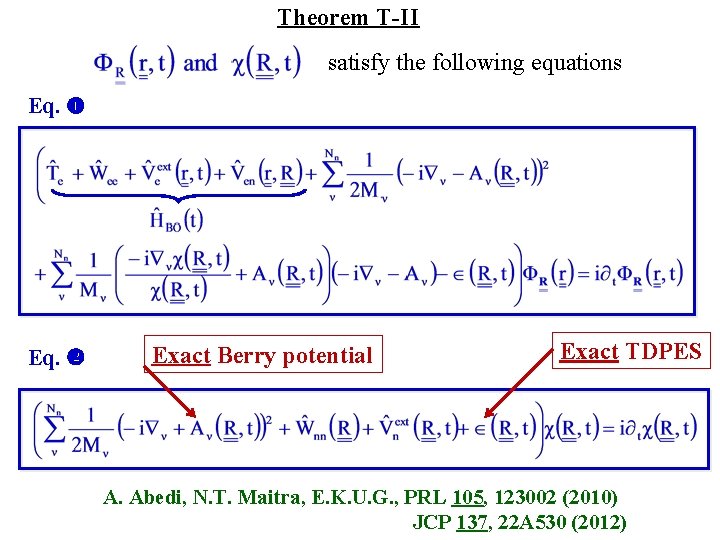
Theorem T-II satisfy the following equations Eq. Exact Berry potential Exact TDPES A. Abedi, N. T. Maitra, E. K. U. G. , PRL 105, 123002 (2010) JCP 137, 22 A 530 (2012)
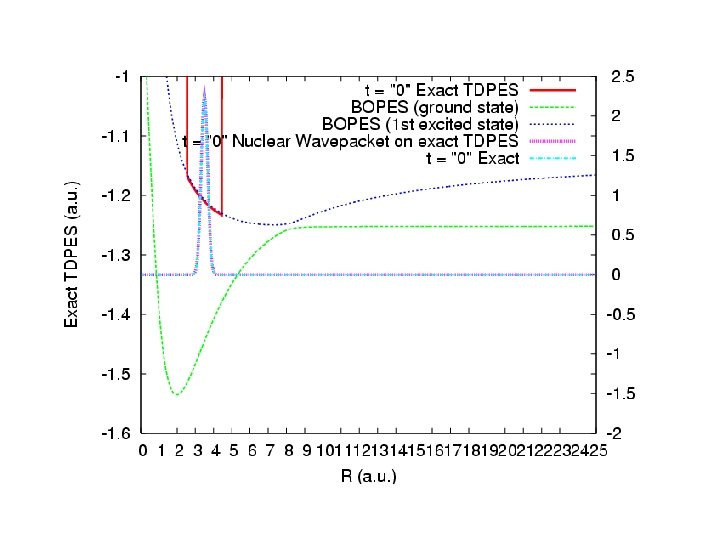
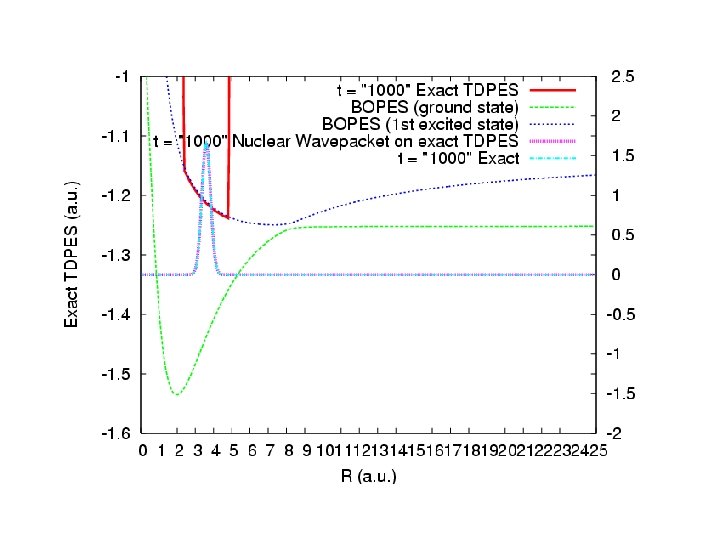
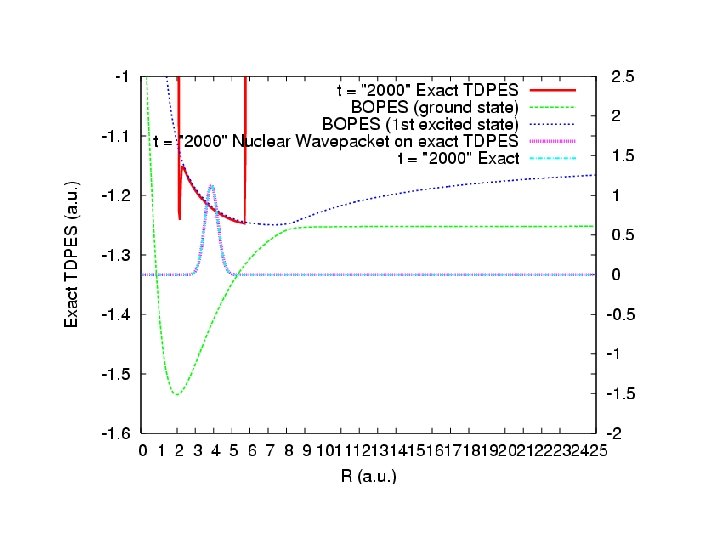
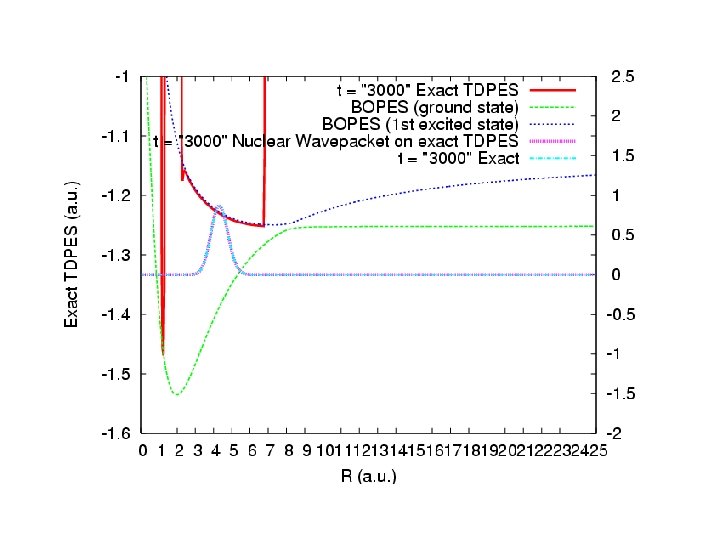
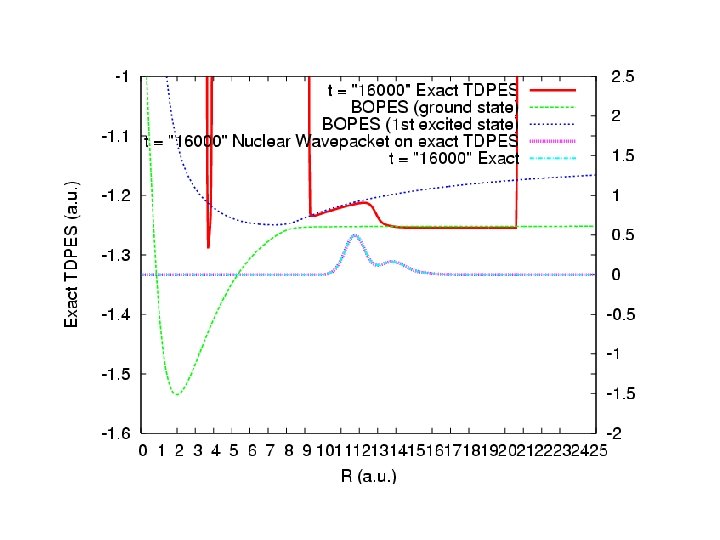
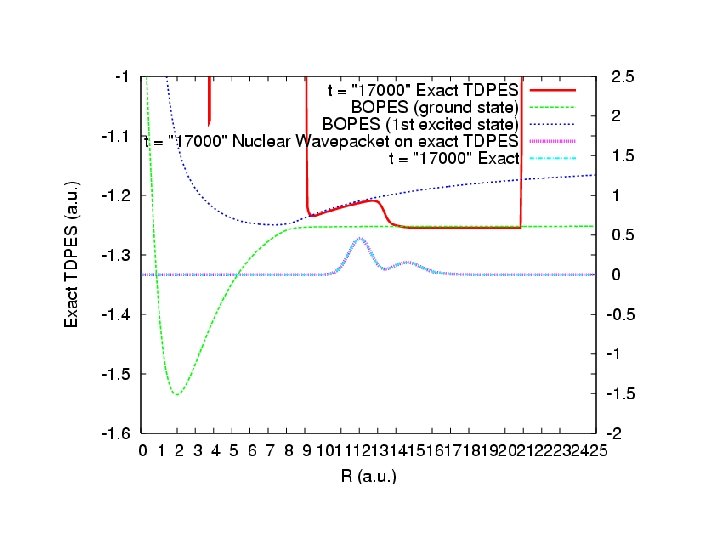
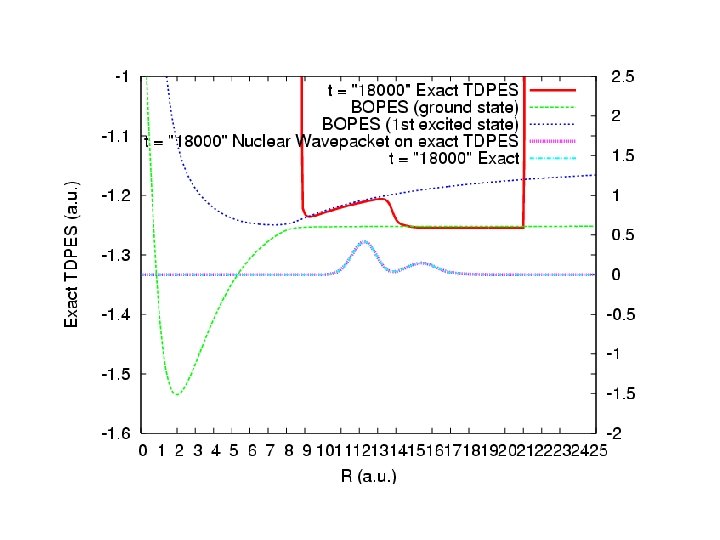
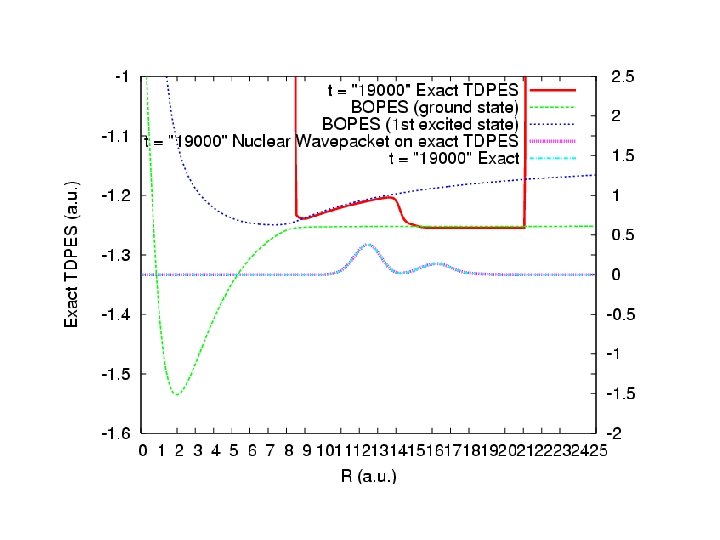
How does the exact time-dependent PES look like?
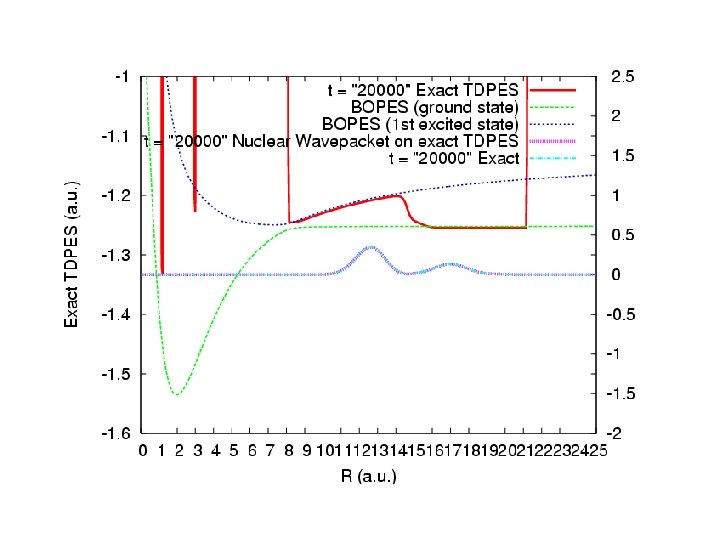
Example: Nuclear wave packet going through an avoided crossing (Zewail experiment) A. Abedi, F. Agostini, Y. Suzuki, E. K. U. Gross, PRL 110, 263001 (2013) F. Agostini, A. Abedi, Y. Suzuki, E. K. U. Gross, Mol. Phys. 111, 3625 (2013)
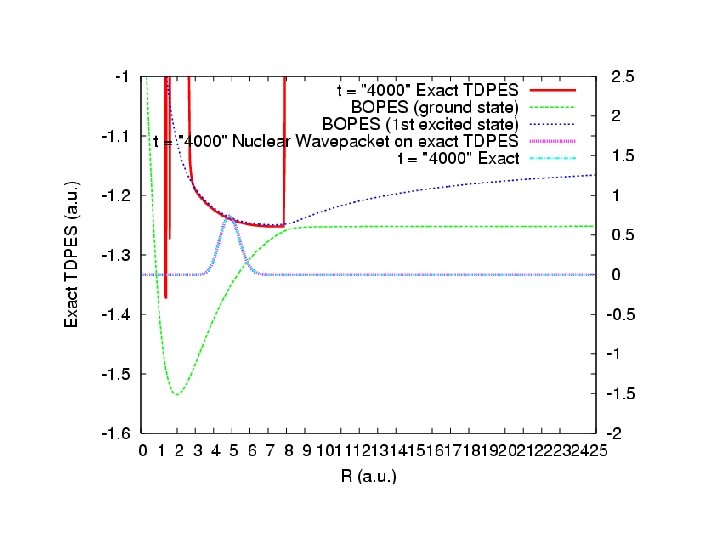
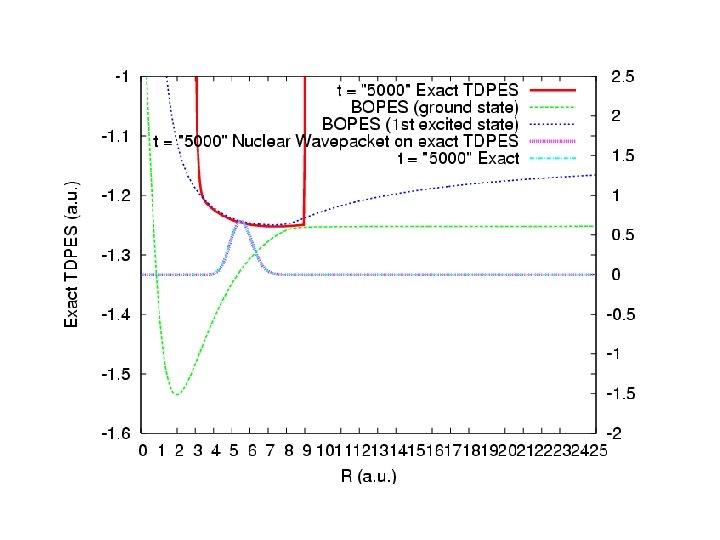
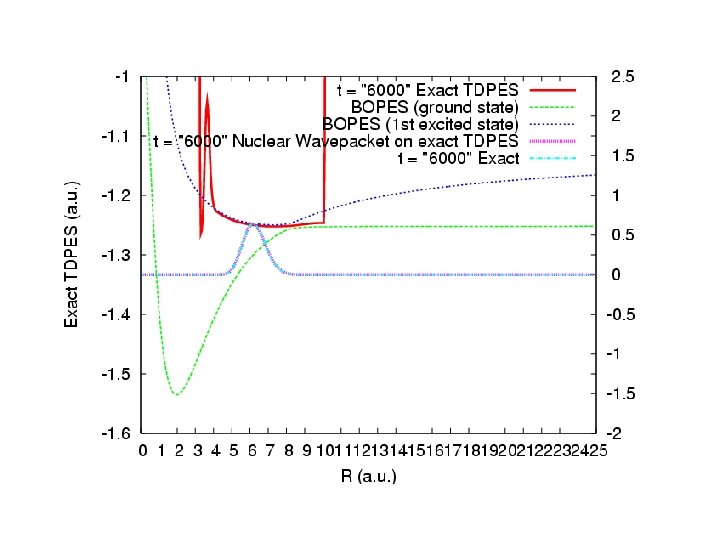
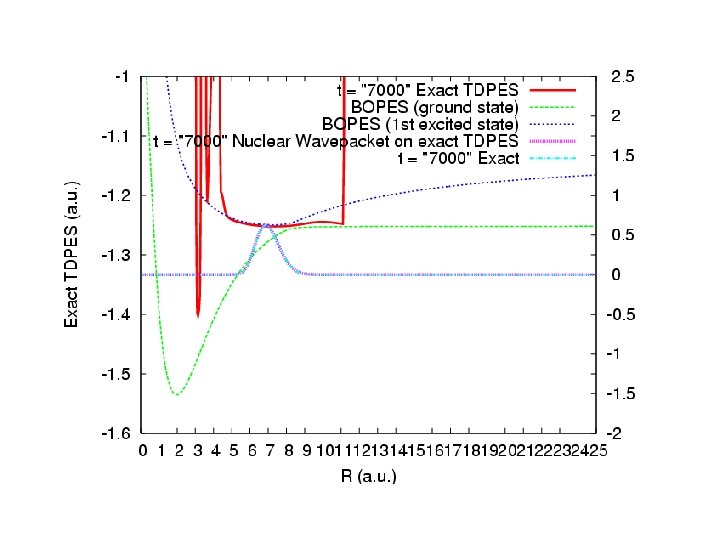
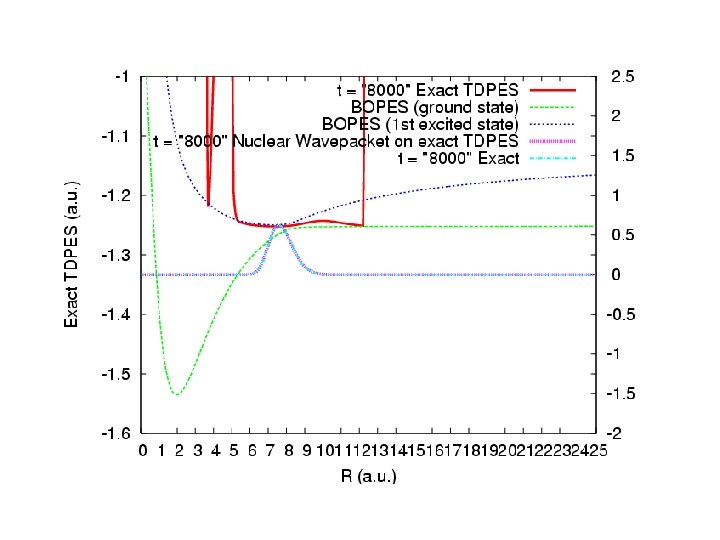
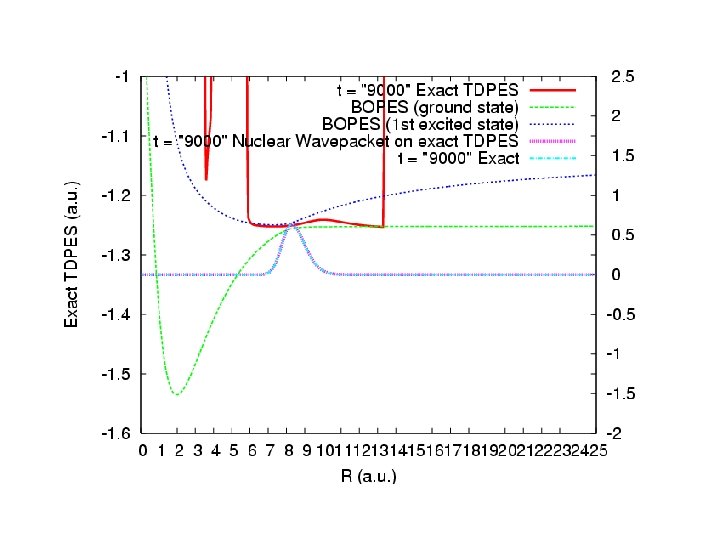
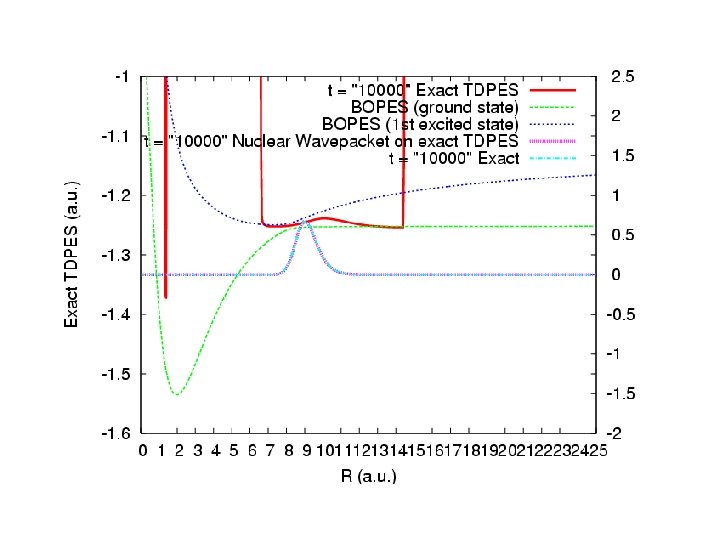
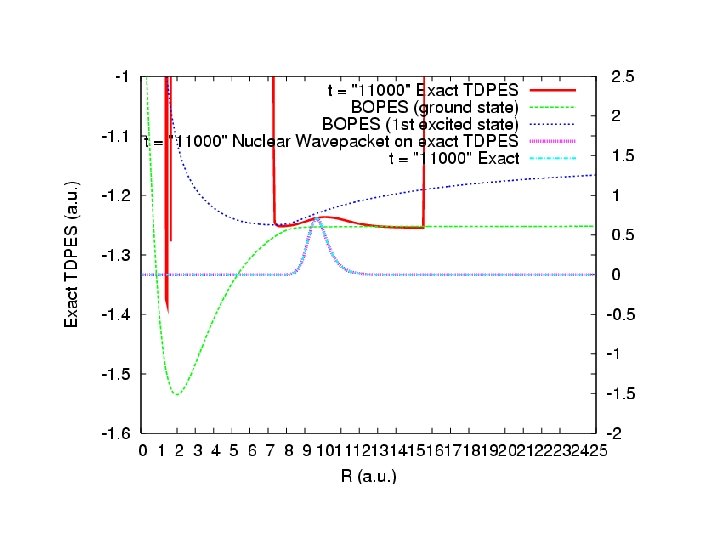
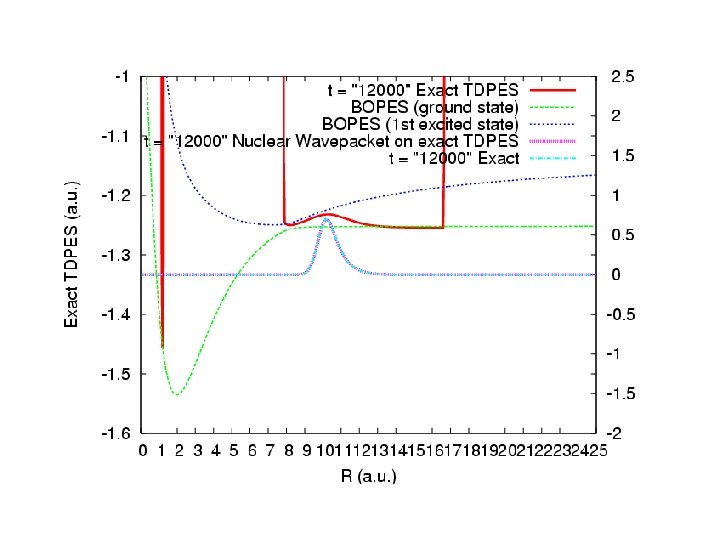
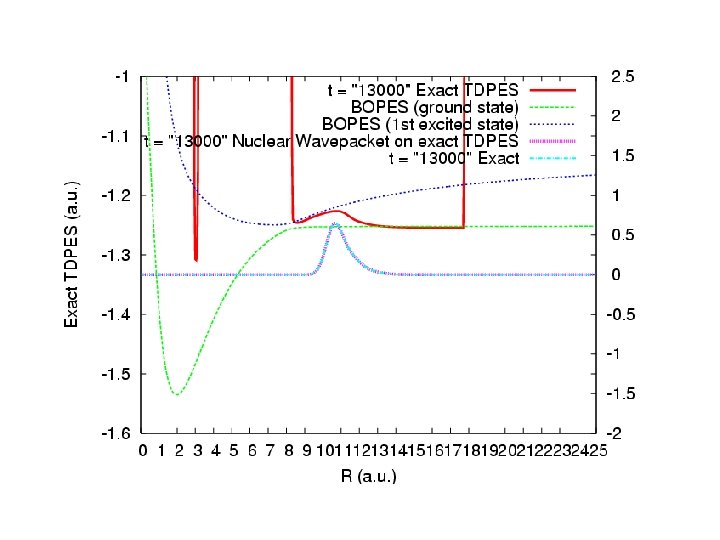
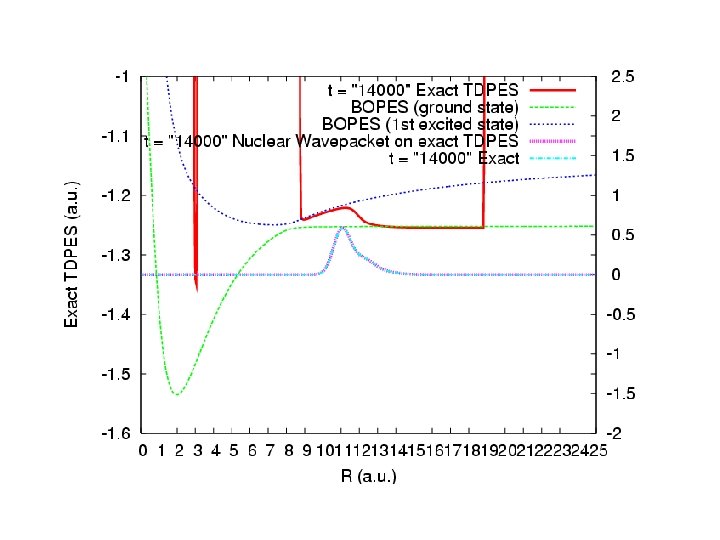
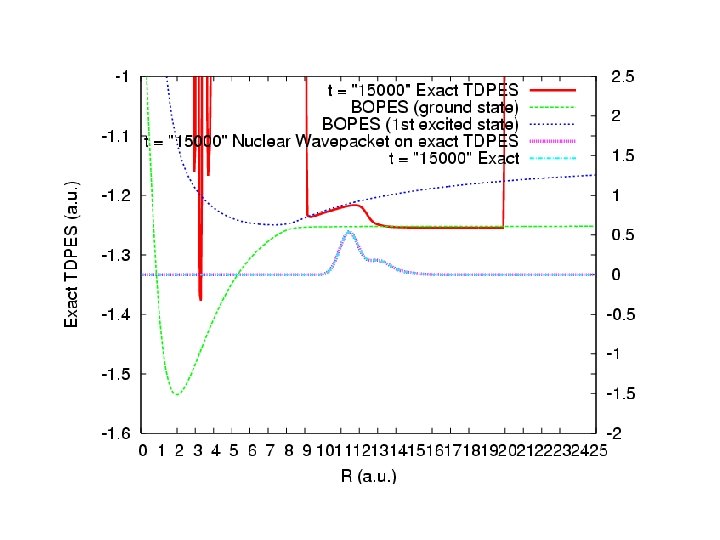
New MD schemes: Treat the nuclear motion with classical trajectories, but retain the quantum treatment of the electronic degrees of freedom.
New MD schemes: Treat the nuclear motion with classical trajectories, but retain the quantum treatment of the electronic degrees of freedom. S. K. Min, F. Agostini, E. K. U. Gross, Phys. Rev. Lett. 115, 073001 (2015) F. Agostini, S. K. Min, A. Abedi, E. K. U. Gross, JCTC 12, 2127 (2016) F. Agostini, S. K. Min, I. Tavernelli, E. K. U. Gross, JPCL 8, 3048 (2017)
New MD schemes: Treat the nuclear motion with classical trajectories, but retain the quantum treatment of the electronic degrees of freedom. S. K. Min, F. Agostini, E. K. U. Gross, Phys. Rev. Lett. 115, 073001 (2015) F. Agostini, S. K. Min, A. Abedi, E. K. U. Gross, JCTC 12, 2127 (2016) F. Agostini, S. K. Min, I. Tavernelli, E. K. U. Gross, JPCL 8, 3048 (2017) Further step: "Density-functionalization": to make the many-electron equation of motion tractable Ryan Requist, E. K. U. Gross, PRL 117, 193001 (2016)
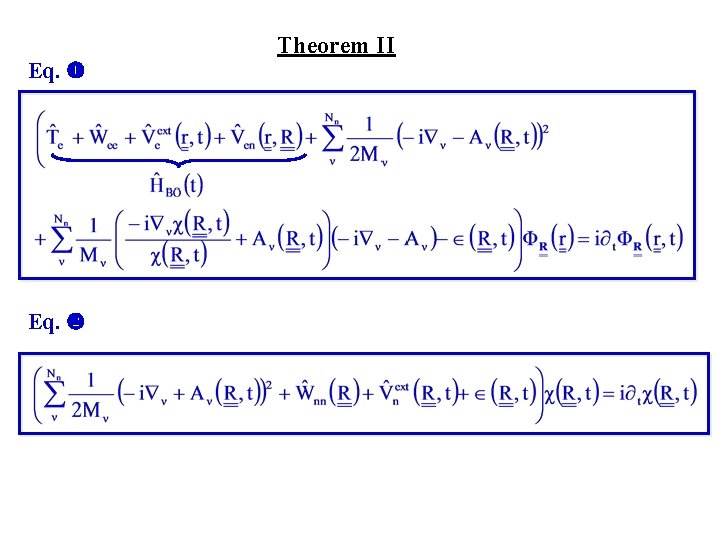
Theorem II Eq.
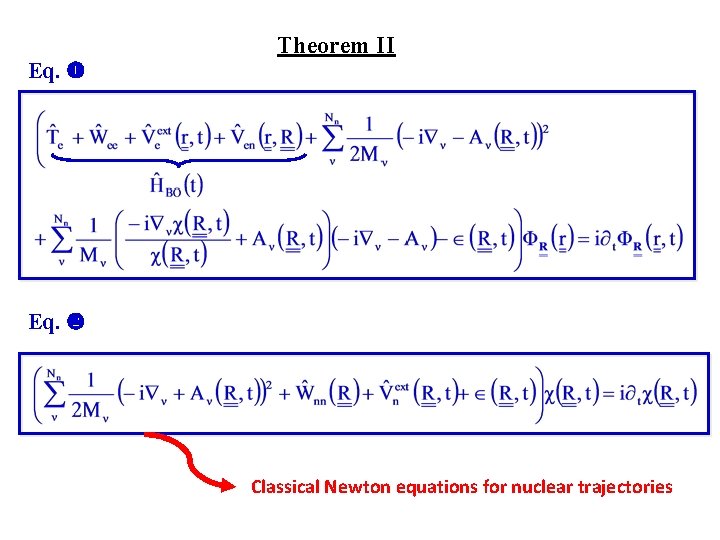
Theorem II Eq. Classical Newton equations for nuclear trajectories
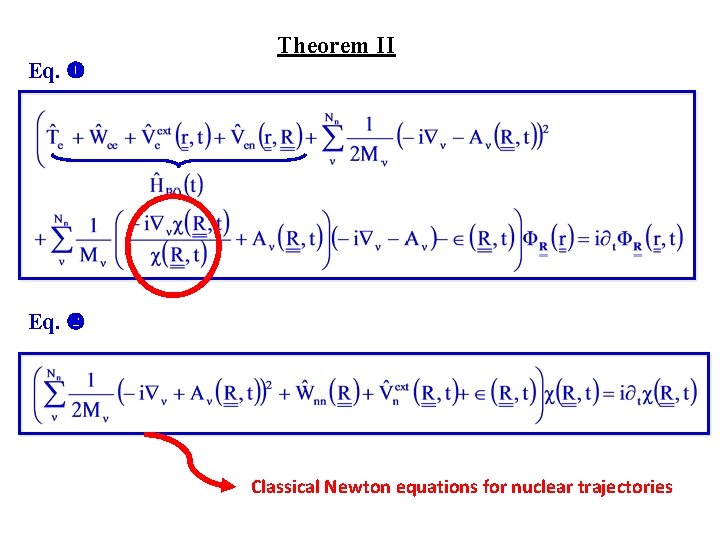
Theorem II Eq. Classical Newton equations for nuclear trajectories
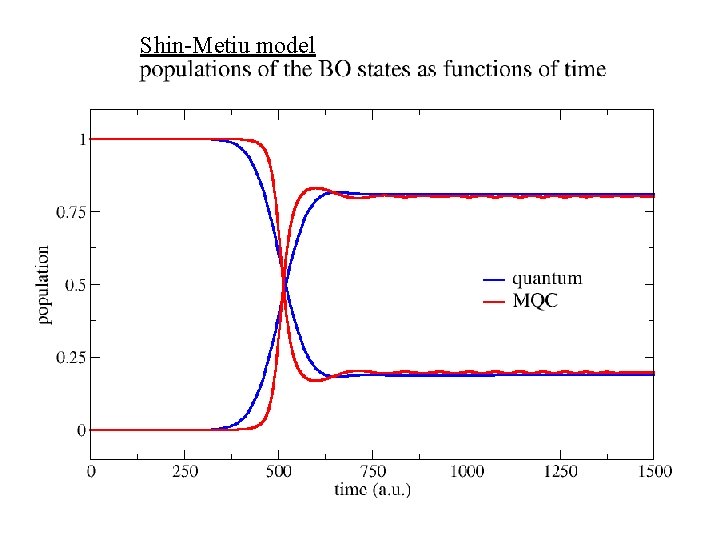
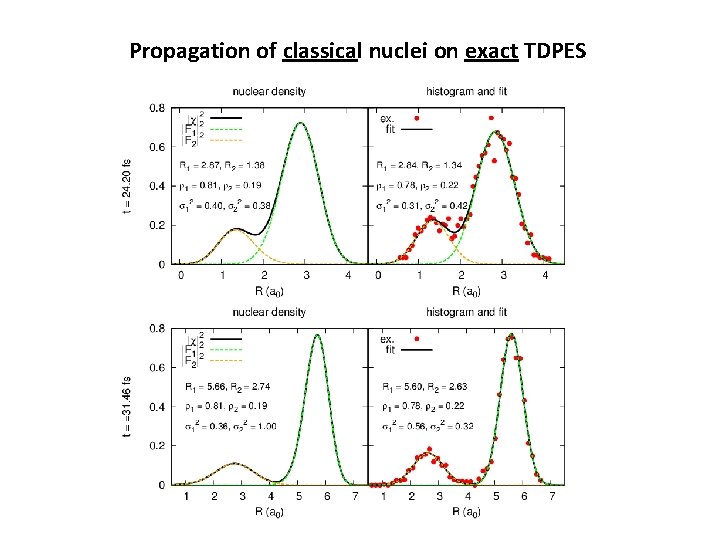
First test: Propagate classical nuclei on the exact TDPES for an exactly solvable model
1 D Shin-Metiu model
Shin-Metiu model
Propagation of classical nuclei on exact TDPES
Measure of decoherence: Quantum: Trajectories
Photo-induced ring opening in Oxirane
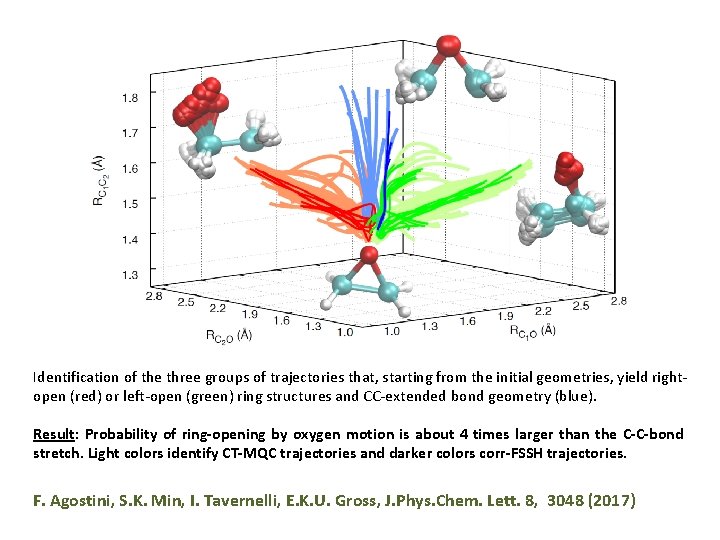
Identification of the three groups of trajectories that, starting from the initial geometries, yield rightopen (red) or left-open (green) ring structures and CC-extended bond geometry (blue). Result: Probability of ring-opening by oxygen motion is about 4 times larger than the C-C-bond stretch. Light colors identify CT-MQC trajectories and darker colors corr-FSSH trajectories. F. Agostini, S. K. Min, I. Tavernelli, E. K. U. Gross, J. Phys. Chem. Lett. 8, 3048 (2017)
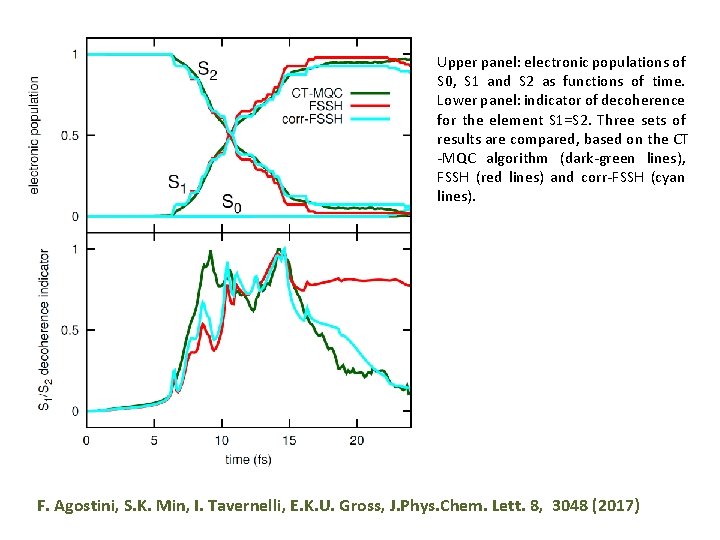
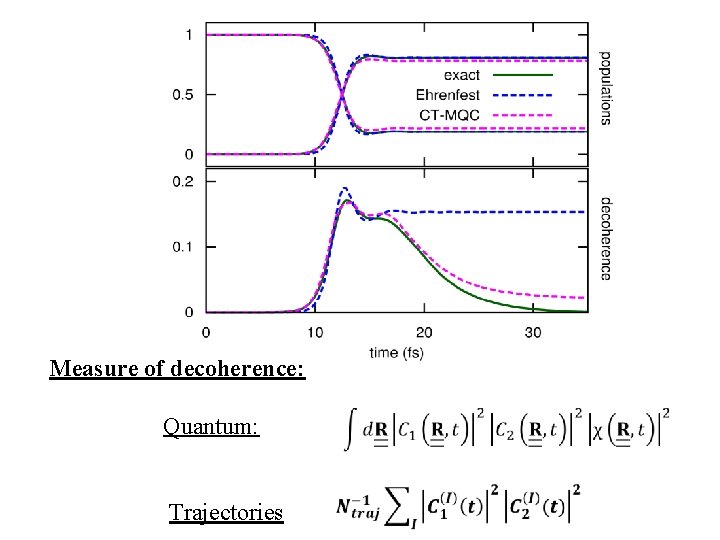
Upper panel: electronic populations of S 0, S 1 and S 2 as functions of time. Lower panel: indicator of decoherence for the element S 1=S 2. Three sets of results are compared, based on the CT -MQC algorithm (dark-green lines), FSSH (red lines) and corr-FSSH (cyan lines). F. Agostini, S. K. Min, I. Tavernelli, E. K. U. Gross, J. Phys. Chem. Lett. 8, 3048 (2017)
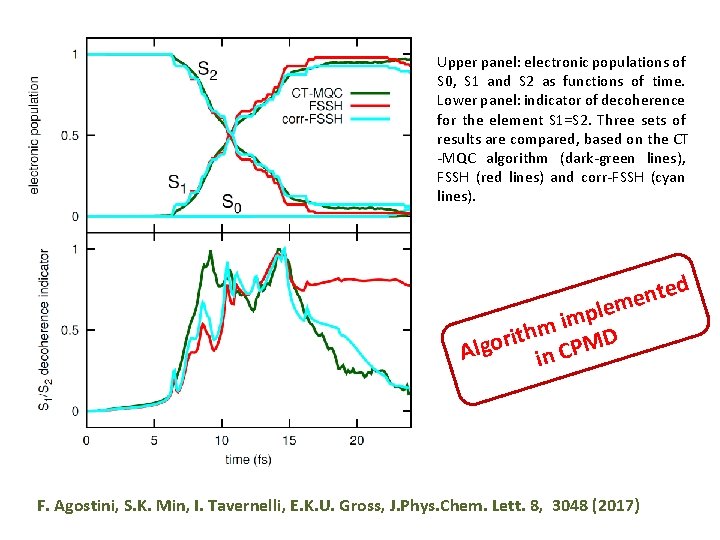
Upper panel: electronic populations of S 0, S 1 and S 2 as functions of time. Lower panel: indicator of decoherence for the element S 1=S 2. Three sets of results are compared, based on the CT -MQC algorithm (dark-green lines), FSSH (red lines) and corr-FSSH (cyan lines). ted n e lem p m i hm MD t i r o Alg in CP F. Agostini, S. K. Min, I. Tavernelli, E. K. U. Gross, J. Phys. Chem. Lett. 8, 3048 (2017)
Vibrational circular dichroism
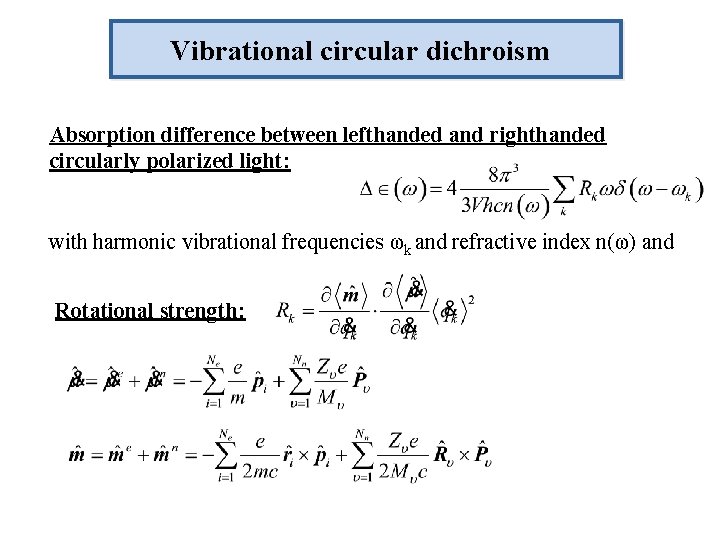
Vibrational circular dichroism Absorption difference between lefthanded and righthanded circularly polarized light: with harmonic vibrational frequencies ωk and refractive index n(ω) and Rotational strength:
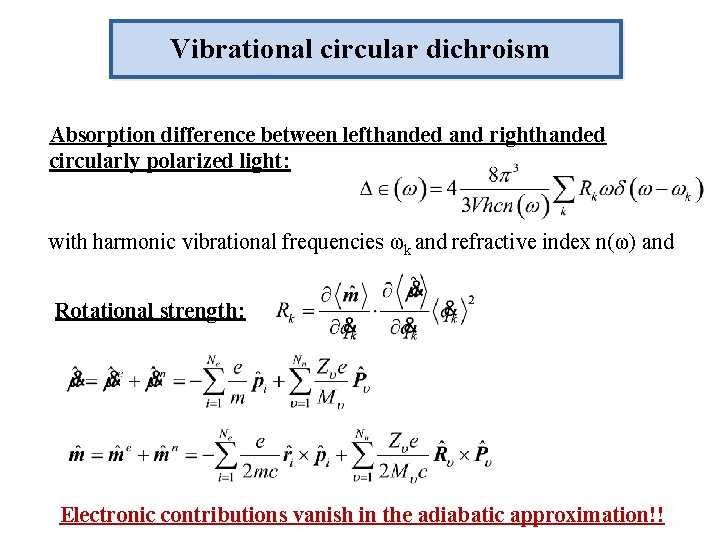
Vibrational circular dichroism Absorption difference between lefthanded and righthanded circularly polarized light: with harmonic vibrational frequencies ωk and refractive index n(ω) and Rotational strength: Electronic contributions vanish in the adiabatic approximation!!
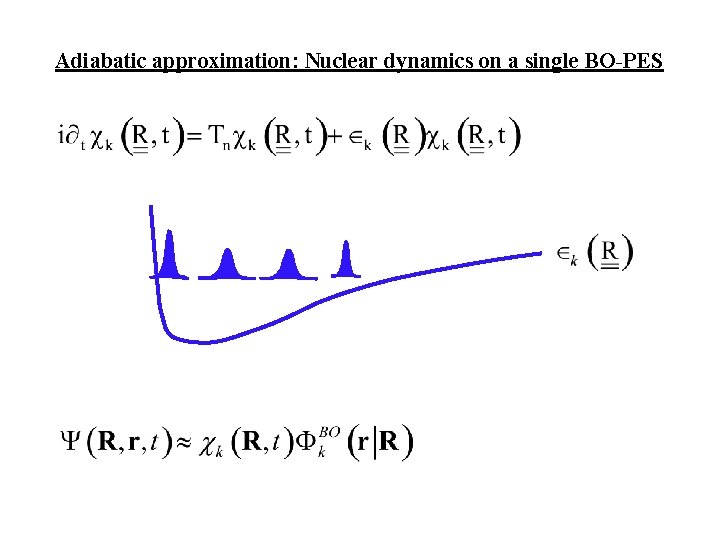
Adiabatic approximation: Nuclear dynamics on a single BO-PES
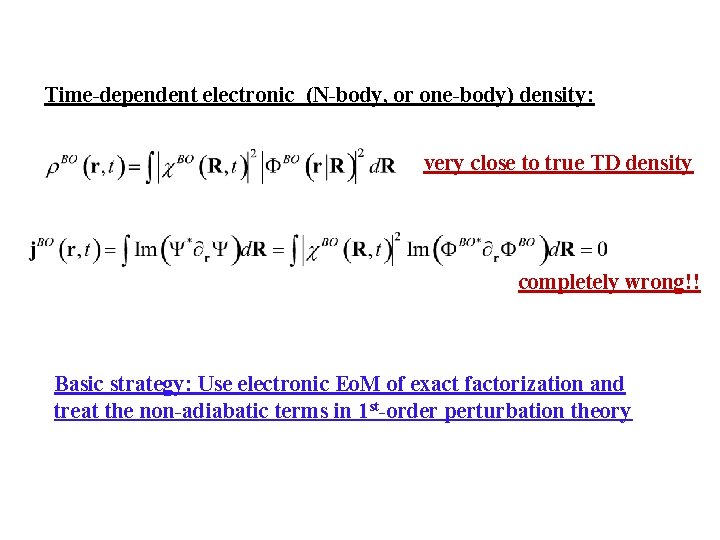
Time-dependent electronic (N-body, or one-body) density: very close to true TD density completely wrong!! Basic strategy: Use electronic Eo. M of exact factorization and treat the non-adiabatic terms in 1 st-order perturbation theory
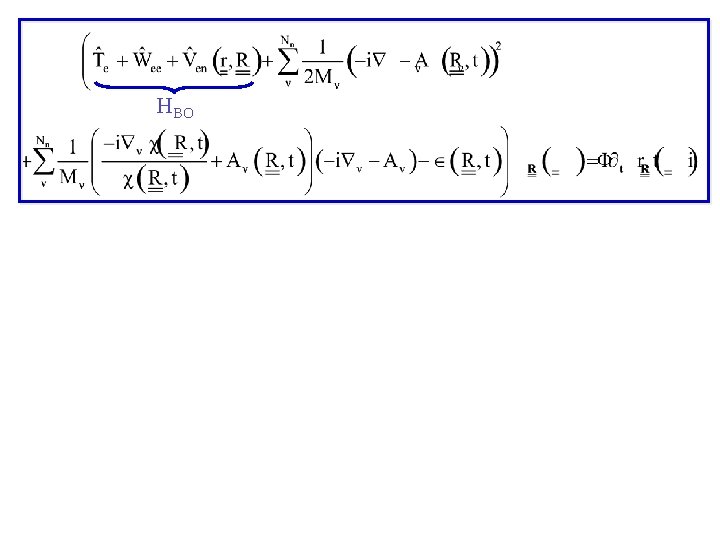
HBO
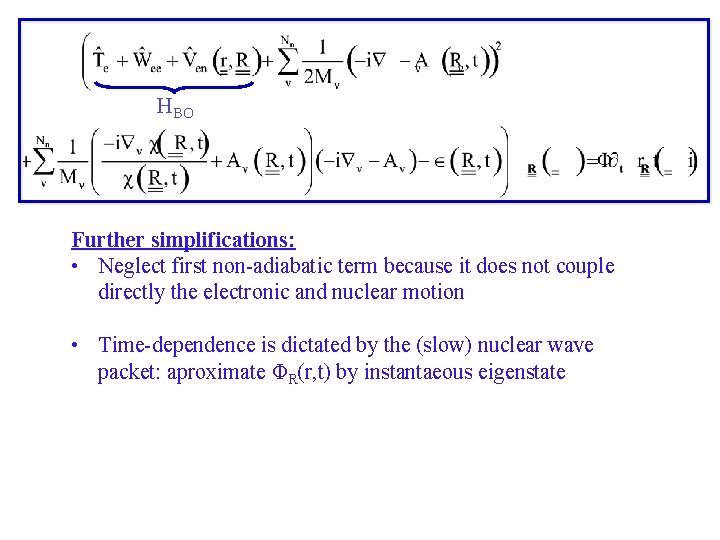
HBO Further simplifications: • Neglect first non-adiabatic term because it does not couple directly the electronic and nuclear motion • Time-dependence is dictated by the (slow) nuclear wave packet: aproximate ΦR(r, t) by instantaeous eigenstate
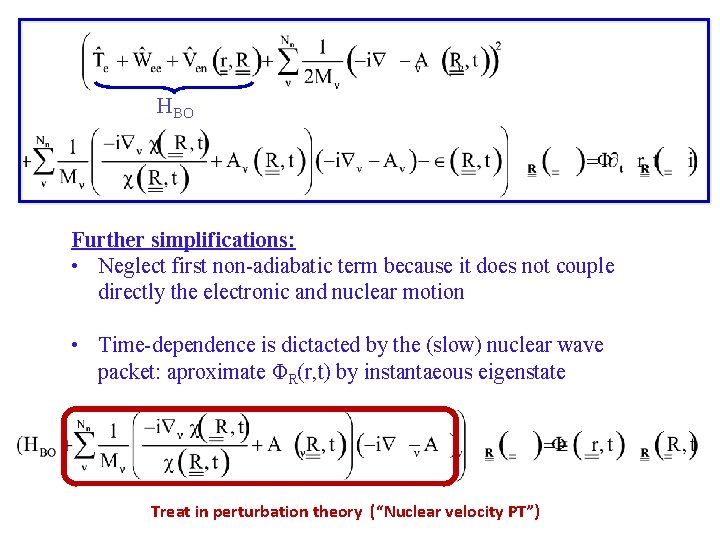
HBO Further simplifications: • Neglect first non-adiabatic term because it does not couple directly the electronic and nuclear motion • Time-dependence is dictacted by the (slow) nuclear wave packet: aproximate ΦR(r, t) by instantaeous eigenstate Treat in perturbation theory (“Nuclear velocity PT”)
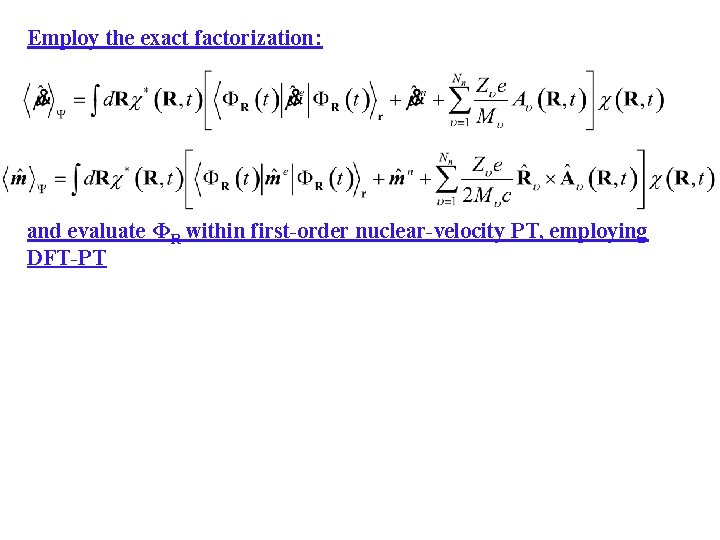
Employ the exact factorization: and evaluate ΦR within first-order nuclear-velocity PT, employing DFT-PT
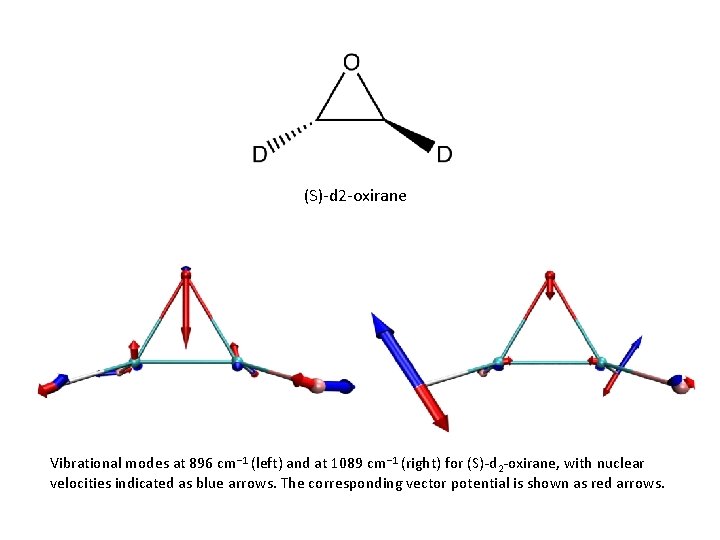
(S)-d 2 -oxirane Vibrational modes at 896 cm− 1 (left) and at 1089 cm− 1 (right) for (S)-d 2 -oxirane, with nuclear velocities indicated as blue arrows. The corresponding vector potential is shown as red arrows.
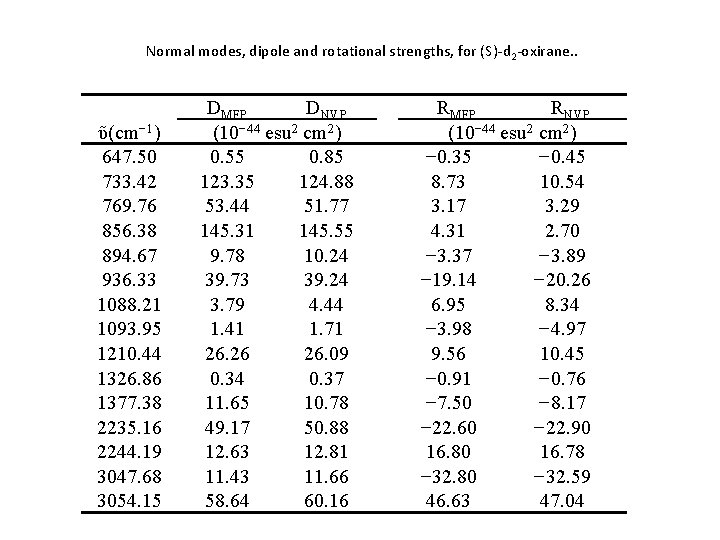
Normal modes, dipole and rotational strengths, for (S)-d 2 -oxirane. . ῦ(cm− 1) 647. 50 733. 42 769. 76 856. 38 894. 67 936. 33 1088. 21 1093. 95 1210. 44 1326. 86 1377. 38 2235. 16 2244. 19 3047. 68 3054. 15 DMFP DNVP (10− 44 esu 2 cm 2) 0. 55 0. 85 123. 35 124. 88 53. 44 51. 77 145. 31 145. 55 9. 78 10. 24 39. 73 39. 24 3. 79 4. 44 1. 41 1. 71 26. 26 26. 09 0. 34 0. 37 11. 65 10. 78 49. 17 50. 88 12. 63 12. 81 11. 43 11. 66 58. 64 60. 16 RMFP RNVP (10− 44 esu 2 cm 2) − 0. 35 − 0. 45 8. 73 10. 54 3. 17 3. 29 4. 31 2. 70 − 3. 37 − 3. 89 − 19. 14 − 20. 26 6. 95 8. 34 − 3. 98 − 4. 97 9. 56 10. 45 − 0. 91 − 0. 76 − 7. 50 − 8. 17 − 22. 60 − 22. 90 16. 80 16. 78 − 32. 80 − 32. 59 46. 63 47. 04
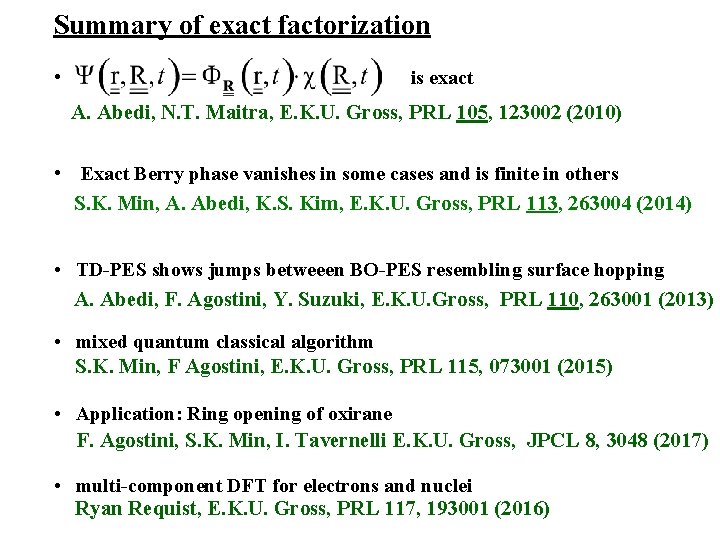
Summary of exact factorization • is exact A. Abedi, N. T. Maitra, E. K. U. Gross, PRL 105, 123002 (2010) • Exact Berry phase vanishes in some cases and is finite in others S. K. Min, A. Abedi, K. S. Kim, E. K. U. Gross, PRL 113, 263004 (2014) • TD-PES shows jumps betweeen BO-PES resembling surface hopping A. Abedi, F. Agostini, Y. Suzuki, E. K. U. Gross, PRL 110, 263001 (2013) • mixed quantum classical algorithm S. K. Min, F Agostini, E. K. U. Gross, PRL 115, 073001 (2015) • Application: Ring opening of oxirane F. Agostini, S. K. Min, I. Tavernelli E. K. U. Gross, JPCL 8, 3048 (2017) • multi-component DFT for electrons and nuclei Ryan Requist, E. K. U. Gross, PRL 117, 193001 (2016)
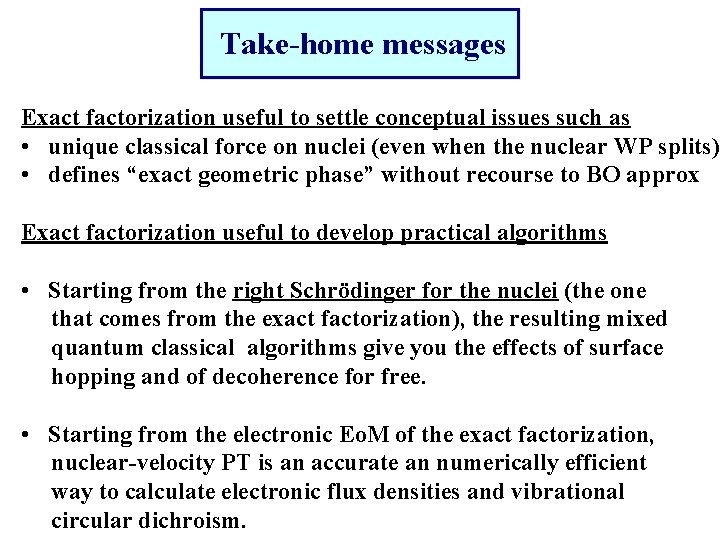
Take-home messages Exact factorization useful to settle conceptual issues such as • unique classical force on nuclei (even when the nuclear WP splits) • defines “exact geometric phase” without recourse to BO approx Exact factorization useful to develop practical algorithms • Starting from the right Schrödinger for the nuclei (the one that comes from the exact factorization), the resulting mixed quantum classical algorithms give you the effects of surface hopping and of decoherence for free. • Starting from the electronic Eo. M of the exact factorization, nuclear-velocity PT is an accurate an numerically efficient way to calculate electronic flux densities and vibrational circular dichroism.
- Slides: 98