
Potential Energy Reaction Dynamics Paul Percival Modified by
Potential Energy Reaction Dynamics © Paul Percival Modified by Jed Macosko 10/7/2020
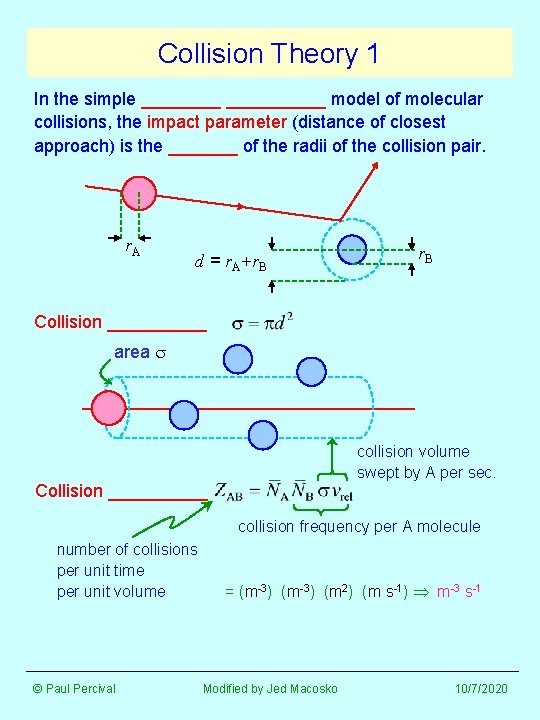
Collision Theory 1 In the simple __________ model of molecular collisions, the impact parameter (distance of closest approach) is the _______ of the radii of the collision pair. r. A d = r. A+r. B Collision _____ area s collision volume swept by A per sec. Collision _____ collision frequency per A molecule number of collisions per unit time per unit volume © Paul Percival = (m-3) (m 2) (m s-1) m-3 s-1 Modified by Jed Macosko 10/7/2020
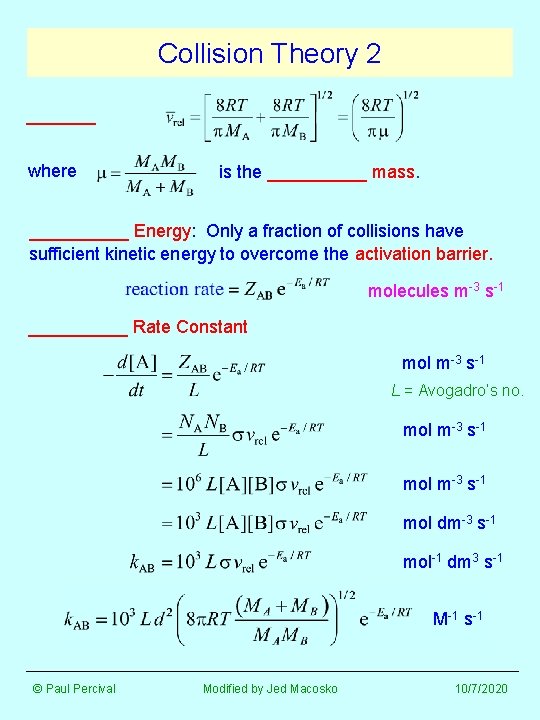
Collision Theory 2 _______ where is the _____ mass. _____ Energy: Only a fraction of collisions have sufficient kinetic energy to overcome the activation barrier. molecules m-3 s-1 _____ Rate Constant mol m-3 s-1 L = Avogadro’s no. mol m-3 s-1 mol dm-3 s-1 mol-1 dm 3 s-1 M-1 s-1 © Paul Percival Modified by Jed Macosko 10/7/2020
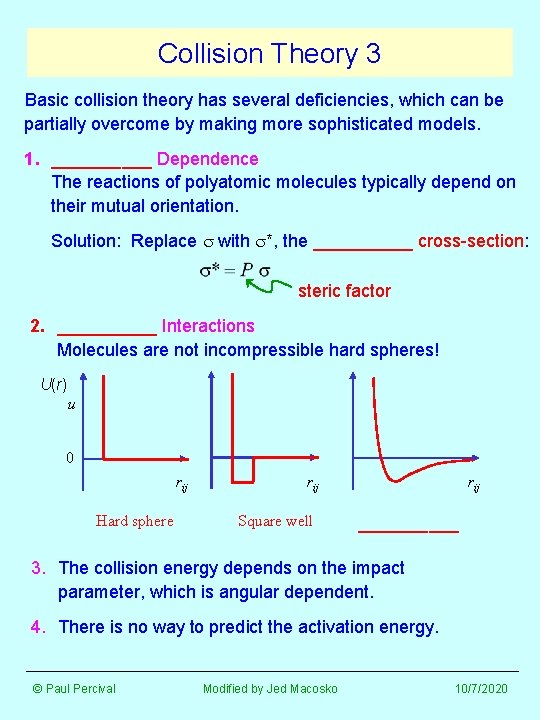
Collision Theory 3 Basic collision theory has several deficiencies, which can be partially overcome by making more sophisticated models. 1. _____ Dependence The reactions of polyatomic molecules typically depend on their mutual orientation. Solution: Replace s with s*, the _____ cross-section: steric factor 2. _____ Interactions Molecules are not incompressible hard spheres! U(r) u 0 rij Hard sphere rij Square well rij _____ 3. The collision energy depends on the impact parameter, which is angular dependent. 4. There is no way to predict the activation energy. © Paul Percival Modified by Jed Macosko 10/7/2020
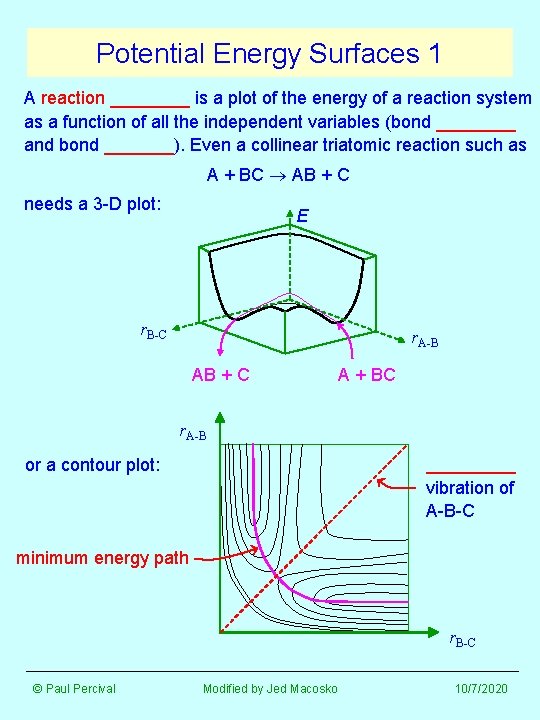
Potential Energy Surfaces 1 A reaction ____ is a plot of the energy of a reaction system as a function of all the independent variables (bond ____ and bond _______). Even a collinear triatomic reaction such as A + BC AB + C needs a 3 -D plot: E r. B-C r. A-B AB + C A + BC r. A-B _____ vibration of A-B-C or a contour plot: minimum energy path r. B-C © Paul Percival Modified by Jed Macosko 10/7/2020

Potential Energy Surfaces 2 © Paul Percival Modified by Jed Macosko 10/7/2020
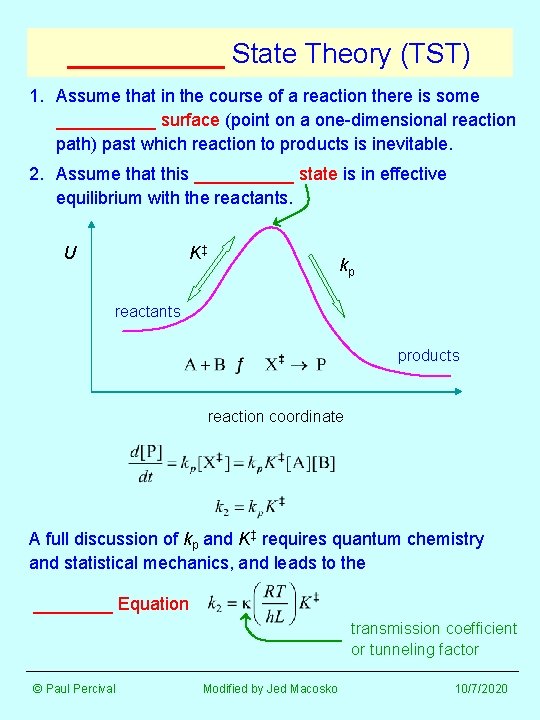
_____ State Theory (TST) 1. Assume that in the course of a reaction there is some _____ surface (point on a one-dimensional reaction path) past which reaction to products is inevitable. 2. Assume that this _____ state is in effective equilibrium with the reactants. U K‡ kp reactants products reaction coordinate A full discussion of kp and K‡ requires quantum chemistry and statistical mechanics, and leads to the ____ Equation transmission coefficient or tunneling factor © Paul Percival Modified by Jed Macosko 10/7/2020
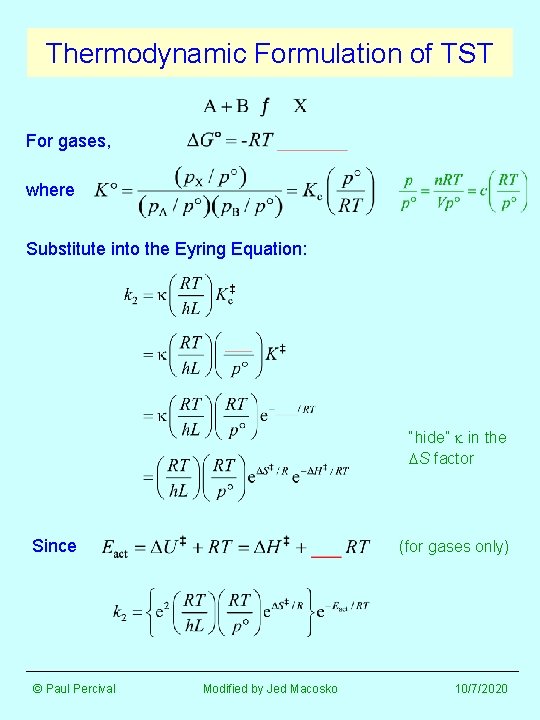
Thermodynamic Formulation of TST For gases, where Substitute into the Eyring Equation: “hide” k in the DS factor Since © Paul Percival (for gases only) Modified by Jed Macosko 10/7/2020
- Slides: 8