
Potential Difference Batteries Three parts l l l

Potential Difference
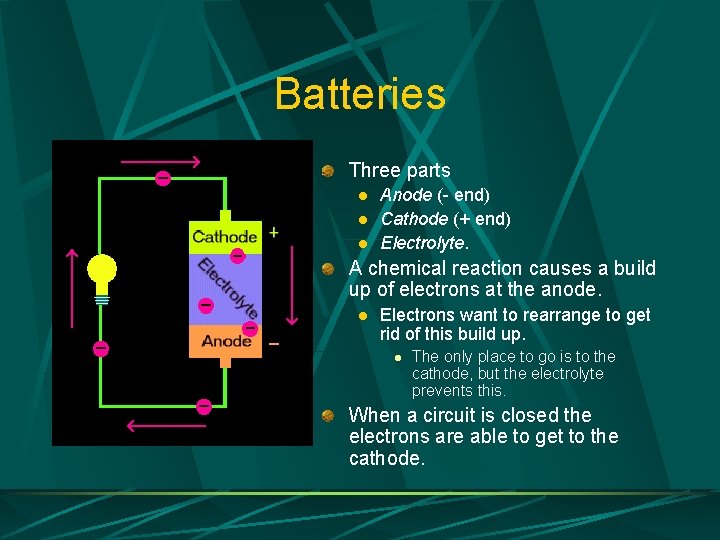
Batteries Three parts l l l Anode (- end) Cathode (+ end) Electrolyte. A chemical reaction causes a build up of electrons at the anode. l Electrons want to rearrange to get rid of this build up. l The only place to go is to the cathode, but the electrolyte prevents this. When a circuit is closed the electrons are able to get to the cathode.
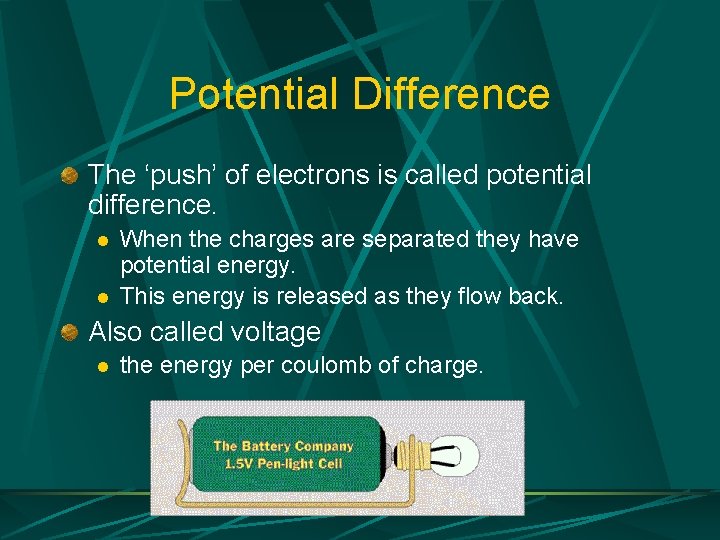
Potential Difference The ‘push’ of electrons is called potential difference. l l When the charges are separated they have potential energy. This energy is released as they flow back. Also called voltage l the energy per coulomb of charge.
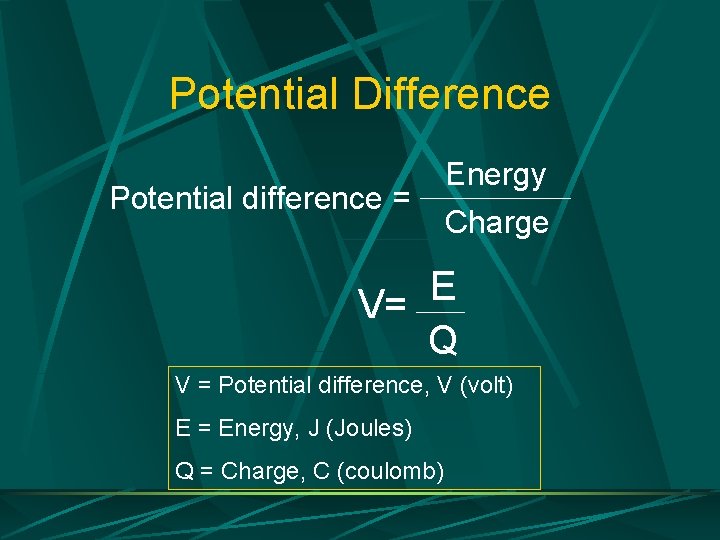
Potential Difference Potential difference = Energy Charge E V= Q V = Potential difference, V (volt) E = Energy, J (Joules) Q = Charge, C (coulomb)
Example l If 42 Joules of chemical energy in a battery places 7. 0 C of –ve charge at the –ve terminal, leaving a deficit at the +ve terminal, what is the potential difference between the terminals of the battery?

Answer E V= Q V= 42. 0 J 7. 0 C V= 6. 0 J/C V= 6. 0 V The chemical energy in the battery results in 6. 0 V of potential difference between the positive and negative terminals.
Voltmeter Measures potential difference between two points in a circuit. The negative end of the voltmeter must be connected to the part of the circuit nearest the –ve terminal of the battery. The +ve end must be connected in likewise manner

Assignment Read text pages 330 – 336 Questions #1 -5, Current and Potential Difference: Practicing Calculations worksheet.
- Slides: 8