
POTENTIAL BARRIERS OF COMMUNICATION Abbie Llewellyn GENERAL COMMUNICATION
POTENTIAL BARRIERS OF COMMUNICATION Abbie Llewellyn
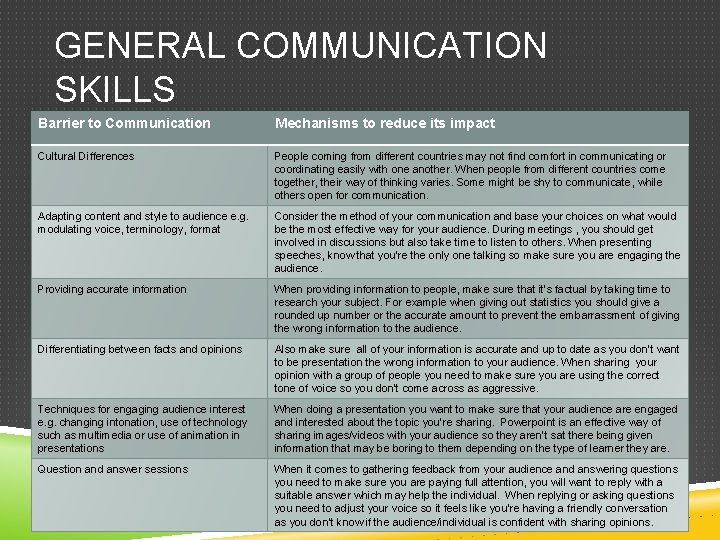
GENERAL COMMUNICATION SKILLS Barrier to Communication Mechanisms to reduce its impact Cultural Differences People coming from different countries may not find comfort in communicating or coordinating easily with one another. When people from different countries come together, their way of thinking varies. Some might be shy to communicate, while others open for communication. Adapting content and style to audience e. g. modulating voice, terminology, format Consider the method of your communication and base your choices on what would be the most effective way for your audience. During meetings , you should get involved in discussions but also take time to listen to others. When presenting speeches, know that you’re the only one talking so make sure you are engaging the audience. Providing accurate information When providing information to people, make sure that it’s factual by taking time to research your subject. For example when giving out statistics you should give a rounded up number or the accurate amount to prevent the embarrassment of giving the wrong information to the audience. Differentiating between facts and opinions Also make sure all of your information is accurate and up to date as you don’t want to be presentation the wrong information to your audience. When sharing your opinion with a group of people you need to make sure you are using the correct tone of voice so you don’t come across as aggressive. Techniques for engaging audience interest e. g. changing intonation, use of technology such as multimedia or use of animation in presentations When doing a presentation you want to make sure that your audience are engaged and interested about the topic you’re sharing. Powerpoint is an effective way of sharing images/videos with your audience so they aren’t sat there being given information that may be boring to them depending on the type of learner they are. Question and answer sessions When it comes to gathering feedback from your audience and answering questions you need to make sure you are paying full attention, you will want to reply with a suitable answer which may help the individual. When replying or asking questions you need to adjust your voice so it feels like you’re having a friendly conversation as you don’t know if the audience/individual is confident with sharing opinions.
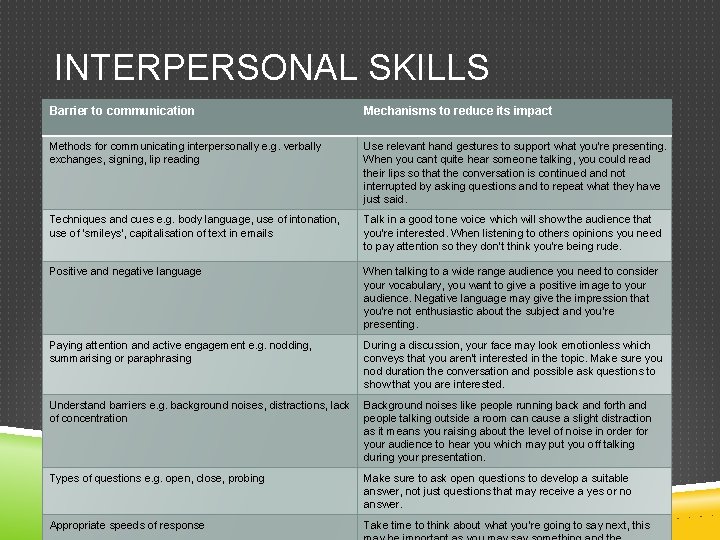
INTERPERSONAL SKILLS Barrier to communication Mechanisms to reduce its impact Methods for communicating interpersonally e. g. verbally exchanges, signing, lip reading Use relevant hand gestures to support what you’re presenting. When you cant quite hear someone talking, you could read their lips so that the conversation is continued and not interrupted by asking questions and to repeat what they have just said. Techniques and cues e. g. body language, use of intonation, use of ‘smileys’, capitalisation of text in emails Talk in a good tone voice which will show the audience that you’re interested. When listening to others opinions you need to pay attention so they don’t think you’re being rude. Positive and negative language When talking to a wide range audience you need to consider your vocabulary, you want to give a positive image to your audience. Negative language may give the impression that you’re not enthusiastic about the subject and you’re presenting. Paying attention and active engagement e. g. nodding, summarising or paraphrasing During a discussion, your face may look emotionless which conveys that you aren’t interested in the topic. Make sure you nod duration the conversation and possible ask questions to show that you are interested. Understand barriers e. g. background noises, distractions, lack of concentration Background noises like people running back and forth and people talking outside a room can cause a slight distraction as it means you raising about the level of noise in order for your audience to hear you which may put you off talking during your presentation. Types of questions e. g. open, close, probing Make sure to ask open questions to develop a suitable answer, not just questions that may receive a yes or no answer. Appropriate speeds of response Take time to think about what you’re going to say next, this
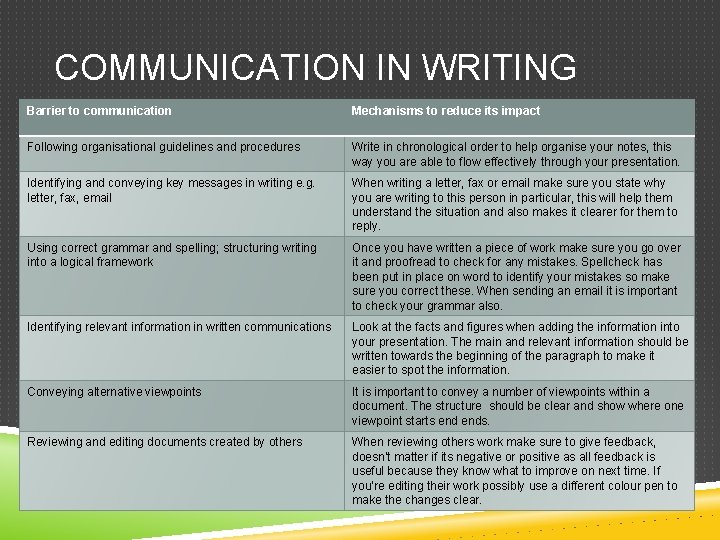
COMMUNICATION IN WRITING Barrier to communication Mechanisms to reduce its impact Following organisational guidelines and procedures Write in chronological order to help organise your notes, this way you are able to flow effectively through your presentation. Identifying and conveying key messages in writing e. g. letter, fax, email When writing a letter, fax or email make sure you state why you are writing to this person in particular, this will help them understand the situation and also makes it clearer for them to reply. Using correct grammar and spelling; structuring writing into a logical framework Once you have written a piece of work make sure you go over it and proofread to check for any mistakes. Spellcheck has been put in place on word to identify your mistakes so make sure you correct these. When sending an email it is important to check your grammar also. Identifying relevant information in written communications Look at the facts and figures when adding the information into your presentation. The main and relevant information should be written towards the beginning of the paragraph to make it easier to spot the information. Conveying alternative viewpoints It is important to convey a number of viewpoints within a document. The structure should be clear and show where one viewpoint starts ends. Reviewing and editing documents created by others When reviewing others work make sure to give feedback, doesn’t matter if its negative or positive as all feedback is useful because they know what to improve on next time. If you’re editing their work possibly use a different colour pen to make the changes clear.
- Slides: 4