
Potassium Replacement Protocol Revised Christina Mc Donald Senior
- Slides: 1
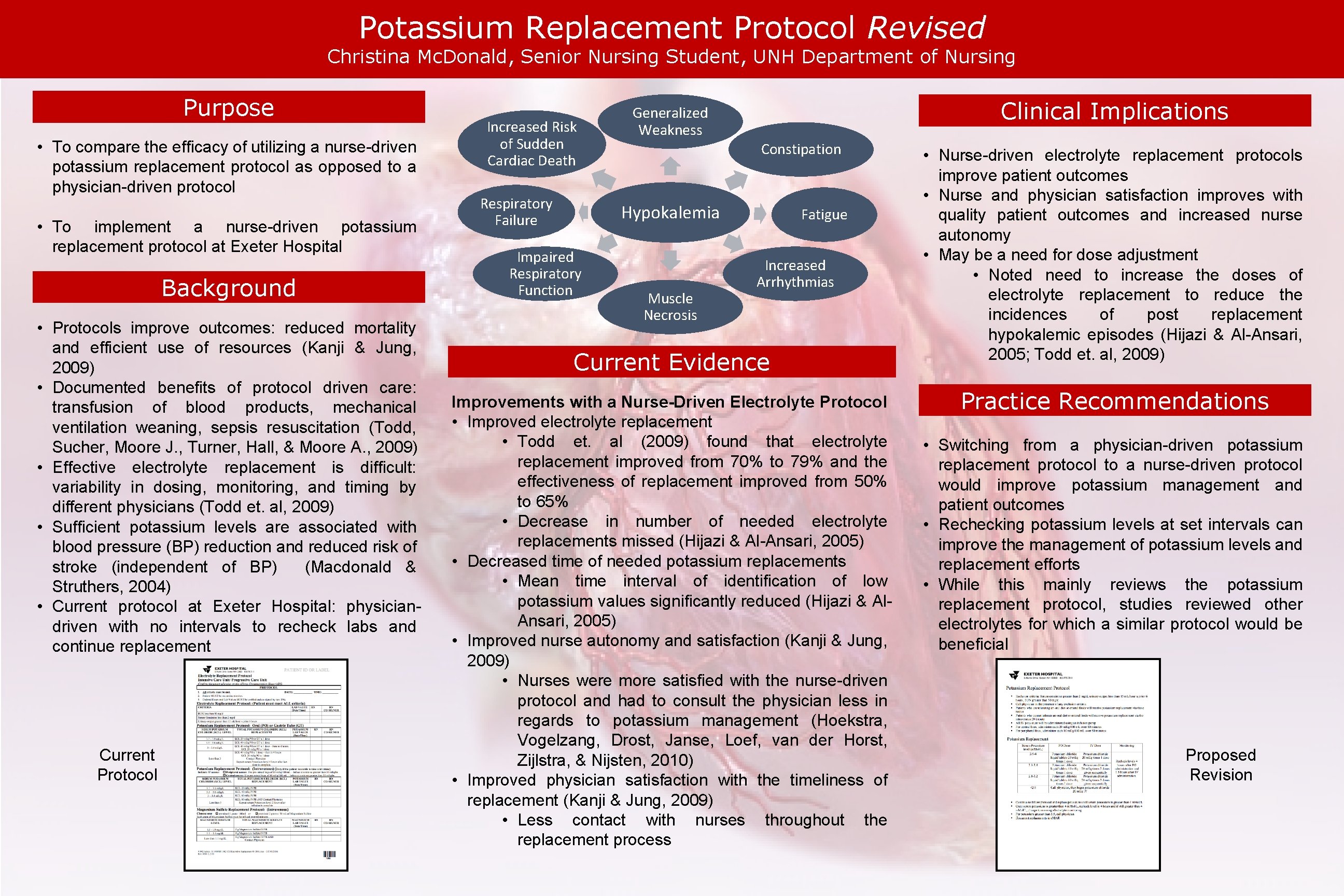
Potassium Replacement Protocol Revised Christina Mc. Donald, Senior Nursing Student, UNH Department of Nursing Purpose • To compare the efficacy of utilizing a nurse-driven potassium replacement protocol as opposed to a physician-driven protocol • To implement a nurse-driven potassium replacement protocol at Exeter Hospital Background • Protocols improve outcomes: reduced mortality and efficient use of resources (Kanji & Jung, 2009) • Documented benefits of protocol driven care: transfusion of blood products, mechanical ventilation weaning, sepsis resuscitation (Todd, Sucher, Moore J. , Turner, Hall, & Moore A. , 2009) • Effective electrolyte replacement is difficult: variability in dosing, monitoring, and timing by different physicians (Todd et. al, 2009) • Sufficient potassium levels are associated with blood pressure (BP) reduction and reduced risk of stroke (independent of BP) (Macdonald & Struthers, 2004) • Current protocol at Exeter Hospital: physiciandriven with no intervals to recheck labs and continue replacement Current Protocol Increased Risk of Sudden Cardiac Death Respiratory Failure Clinical Implications Generalized Weakness Constipation Hypokalemia Impaired Respiratory Function Muscle Necrosis Fatigue Increased Arrhythmias Current Evidence Improvements with a Nurse-Driven Electrolyte Protocol • Improved electrolyte replacement • Todd et. al (2009) found that electrolyte replacement improved from 70% to 79% and the effectiveness of replacement improved from 50% to 65% • Decrease in number of needed electrolyte replacements missed (Hijazi & Al-Ansari, 2005) • Decreased time of needed potassium replacements • Mean time interval of identification of low potassium values significantly reduced (Hijazi & Al. Ansari, 2005) • Improved nurse autonomy and satisfaction (Kanji & Jung, 2009) • Nurses were more satisfied with the nurse-driven protocol and had to consult the physician less in regards to potassium management (Hoekstra, Vogelzang, Drost, Janse, Loef, van der Horst, Zijlstra, & Nijsten, 2010) • Improved physician satisfaction with the timeliness of replacement (Kanji & Jung, 2009) • Less contact with nurses throughout the replacement process • Nurse-driven electrolyte replacement protocols improve patient outcomes • Nurse and physician satisfaction improves with quality patient outcomes and increased nurse autonomy • May be a need for dose adjustment • Noted need to increase the doses of electrolyte replacement to reduce the incidences of post replacement hypokalemic episodes (Hijazi & Al-Ansari, 2005; Todd et. al, 2009) Practice Recommendations • Switching from a physician-driven potassium replacement protocol to a nurse-driven protocol would improve potassium management and patient outcomes • Rechecking potassium levels at set intervals can improve the management of potassium levels and replacement efforts • While this mainly reviews the potassium replacement protocol, studies reviewed other electrolytes for which a similar protocol would be beneficial Proposed Revision