
PostWWII Decolonization Get out your gold decolonization worksheet


- Slides: 28
Post-WWII De-colonization • Get out your gold de-colonization worksheet from yesterday. • With a partner, brainstorm three similarities and three differences between the decolonization movements in South Africa vs. India. • Be ready to discuss! • This worksheet is a classwork assignment I will check for points soon!
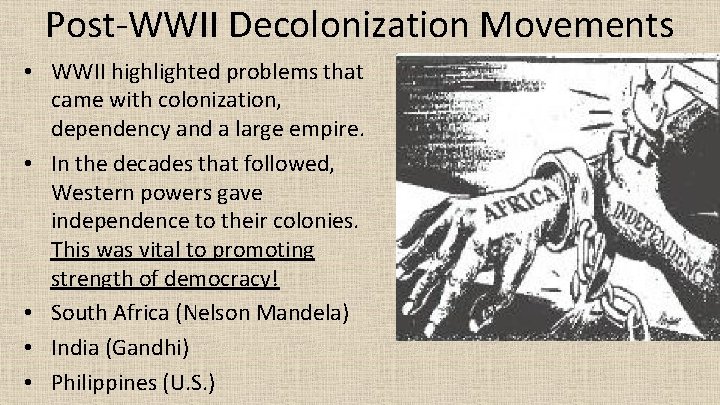
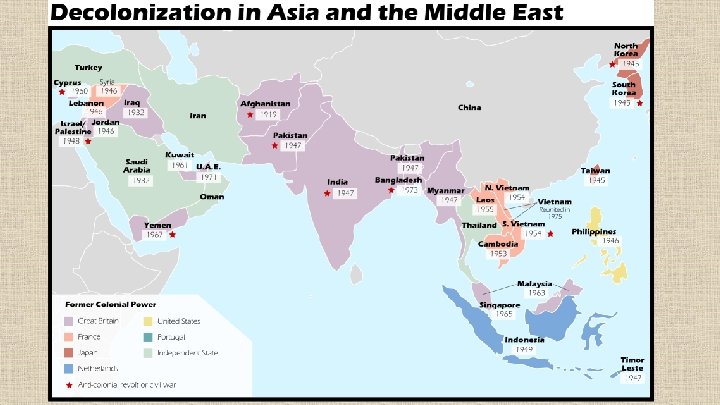
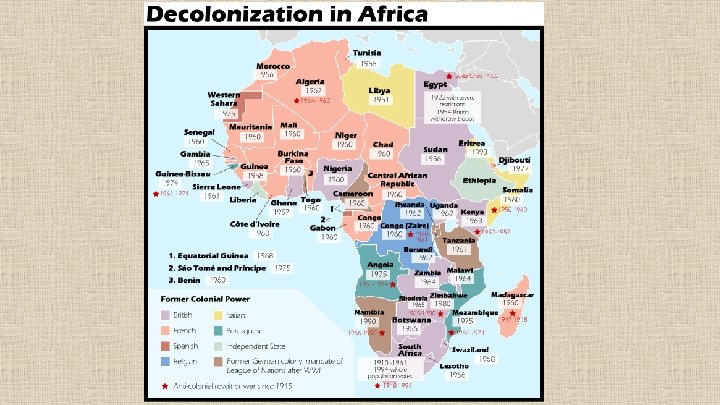
Post-WWII Decolonization Movements • WWII highlighted problems that came with colonization, dependency and a large empire. • In the decades that followed, Western powers gave independence to their colonies. This was vital to promoting strength of democracy! • South Africa (Nelson Mandela) • India (Gandhi) • Philippines (U. S. )
Reminders • Today/tomorrow: Cold War Overview • Friday: Spring Final Essay – Compare/Contrast • Monday: Review (All late/missing work due!) – I will also be collecting bathroom passes! • Wednesday 5/22: Spring Final Multiple Choice – Study guide due!
Exceeds Expectations (4) Spring Final Essay Rubric Meets Expectations (3) Below Expectations (2) Far Below Expectations (1) Thesis The introduction includes a clear and acceptable thesis. The thesis statement names the topic of the essay and outlines the main points to be discussed. The introduction includes a relatively clear thesis. The thesis statement names the topic, but may not address all points of the prompt. The introduction includes a thesis that either names the topic or outlines some of the points to be discussed. The thesis statement is unclear and does not preview what will be discussed. Compare The student makes three clear comparisons between topics with correct use of examples and evidence. The student makes two clear comparisons between topics with little evidence or few examples. The student makes one or no comparisons between topics and offers no evidence or examples. Contrast The student makes three clear contrasting arguments between topics with correct use of examples and evidence. The student makes three clear comparisons between topics, with some evidence or examples. The student makes three clear contrasting arguments between topics, with some evidence or examples. The student makes two clear contrasting arguments between topics with little evidence or few examples. The student makes one or no contrasting arguments between topics and offers no evidence or examples. Content Analysis The student makes clear and effective analysis of all parts of the question. Mechanics The student makes mostly clear and effective analysis of all parts of the question. Student makes virtually no Author makes few errors in grammar, spelling or punctuation that distract the punctuation that distract reader from the content. The the reader from the paper moves smoothly from content. The student uses one idea to the next. some transitions to show relationship between ideas. The student partially addresses No analysis of the question, leaving parts of question is present. the analysis out. Author makes some errors in grammar, spelling or punctuation that distract the reader from the content. The paper moves from one idea to the next, but may lack or misuse transition words to show relationships between ideas. Author makes excessive errors in grammar, spelling or punctuation that distract the reader from the content. Transitions may be missing; connections between ideas are unclear or illogical.
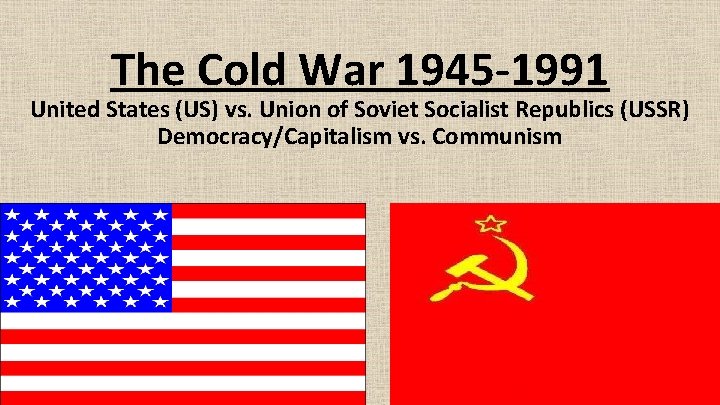
The Cold War 1945 -1991 United States (US) vs. Union of Soviet Socialist Republics (USSR) Democracy/Capitalism vs. Communism
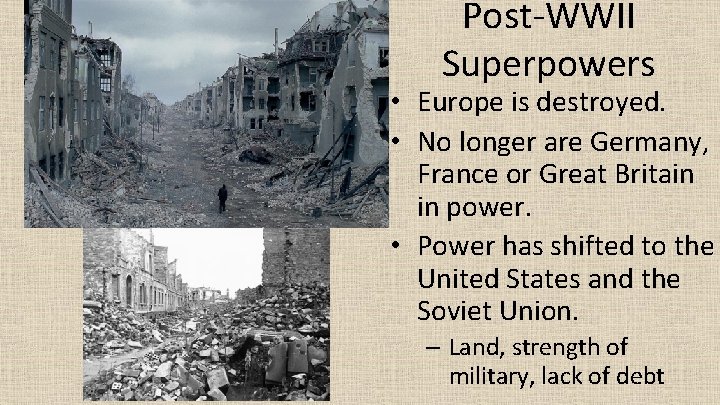
Post-WWII Superpowers • Europe is destroyed. • No longer are Germany, France or Great Britain in power. • Power has shifted to the United States and the Soviet Union. – Land, strength of military, lack of debt
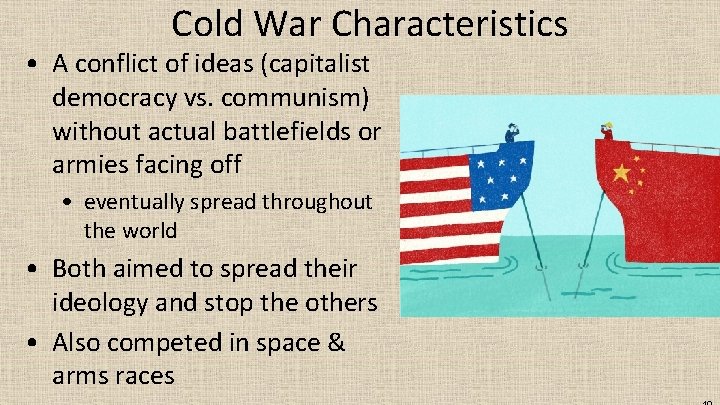
Cold War Characteristics • A conflict of ideas (capitalist democracy vs. communism) without actual battlefields or armies facing off • eventually spread throughout the world • Both aimed to spread their ideology and stop the others • Also competed in space & arms races
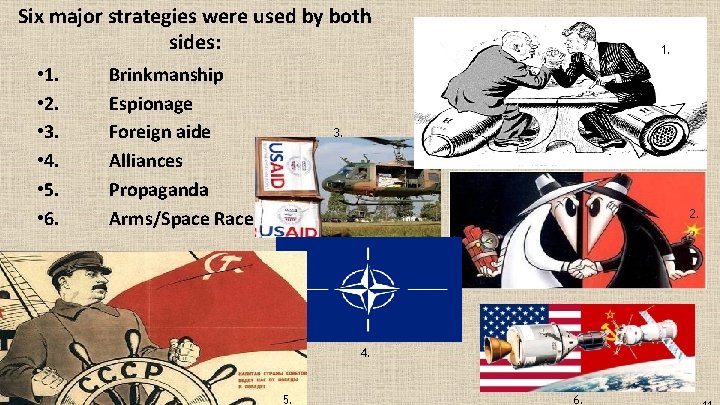
Six major strategies were used by both sides: • 1. • 2. • 3. • 4. • 5. • 6. Brinkmanship Espionage Foreign aide Alliances Propaganda Arms/Space Race 1. 3. 2. 4. 5. 6.
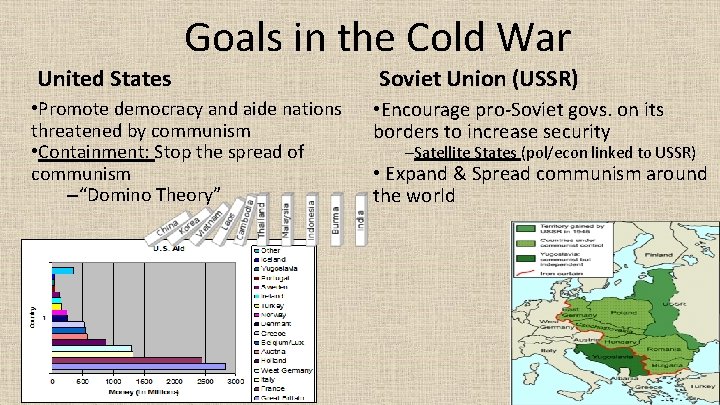
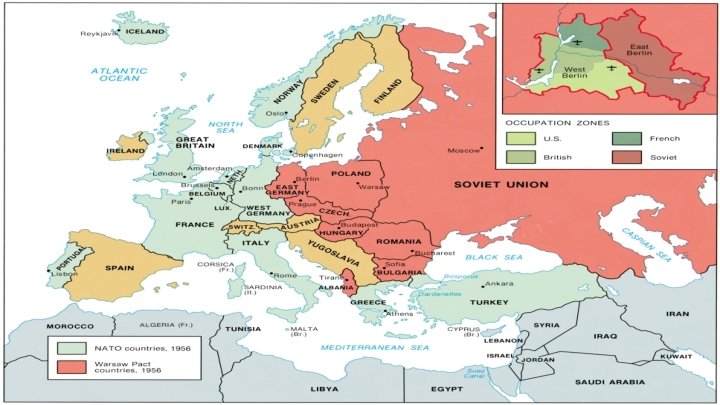
Goals in the Cold War United States Soviet Union (USSR) • Promote democracy and aide nations threatened by communism • Containment: Stop the spread of communism –“Domino Theory” • Encourage pro-Soviet govs. on its borders to increase security –Satellite States (pol/econ linked to USSR) • Expand & Spread communism around the world
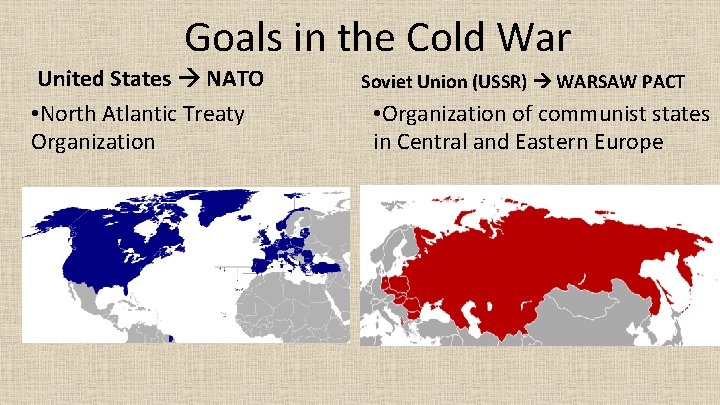
Goals in the Cold War United States NATO • North Atlantic Treaty Organization Soviet Union (USSR) WARSAW PACT • Organization of communist states in Central and Eastern Europe
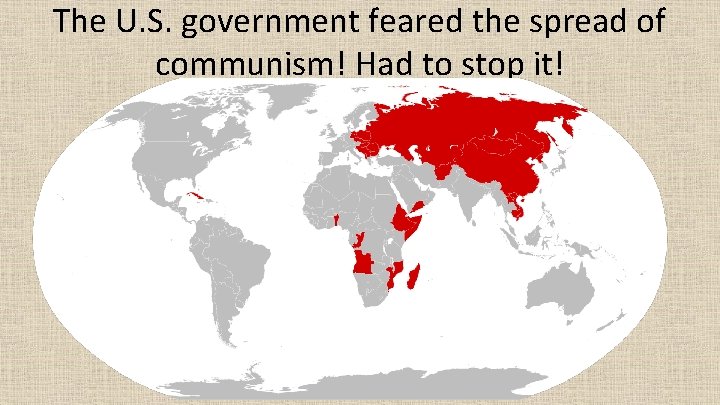
The U. S. government feared the spread of communism! Had to stop it!
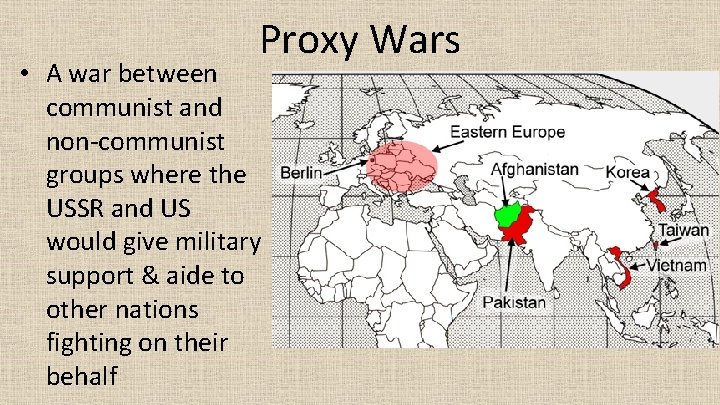
Proxy Wars • A war between communist and non-communist groups where the USSR and US would give military support & aide to other nations fighting on their behalf
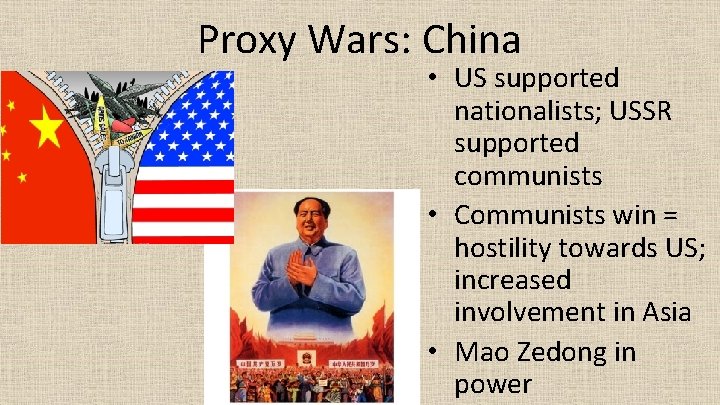
Proxy Wars: China • US supported nationalists; USSR supported communists • Communists win = hostility towards US; increased involvement in Asia • Mao Zedong in power
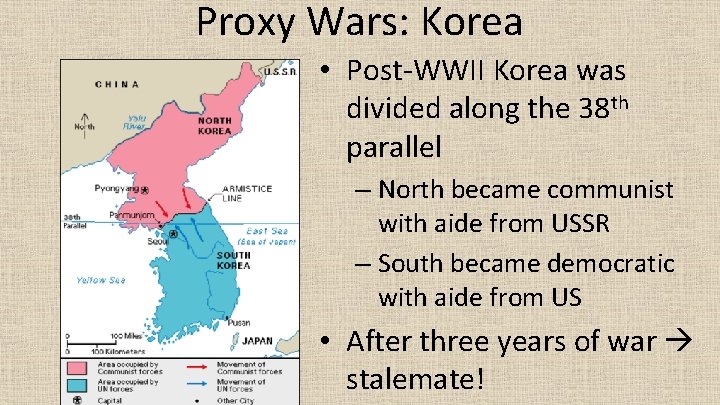
Proxy Wars: Korea • Post-WWII Korea was divided along the 38 th parallel – North became communist with aide from USSR – South became democratic with aide from US • After three years of war stalemate!
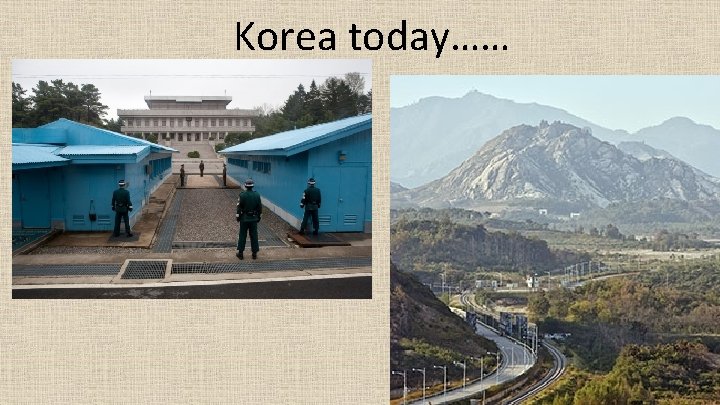
Korea today……
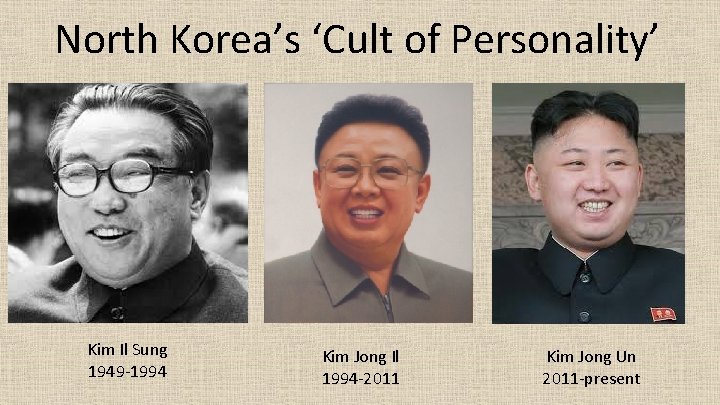
North Korea’s ‘Cult of Personality’ Kim Il Sung 1949 -1994 Kim Jong Il 1994 -2011 Kim Jong Un 2011 -present
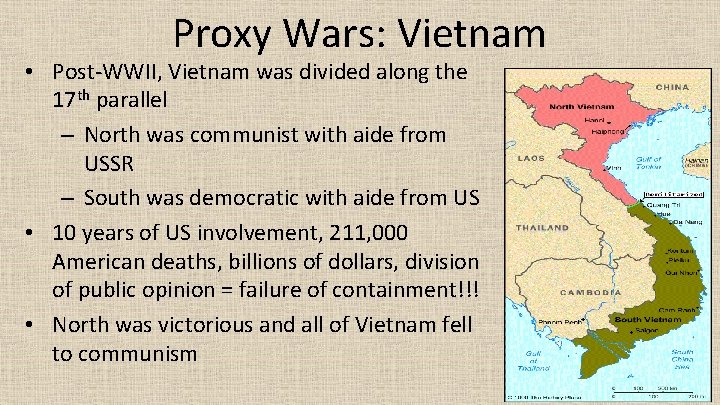
Proxy Wars: Vietnam • Post-WWII, Vietnam was divided along the 17 th parallel – North was communist with aide from USSR – South was democratic with aide from US • 10 years of US involvement, 211, 000 American deaths, billions of dollars, division of public opinion = failure of containment!!! • North was victorious and all of Vietnam fell to communism
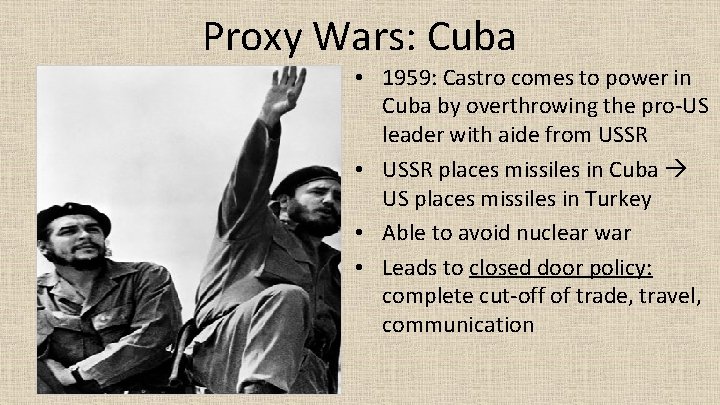
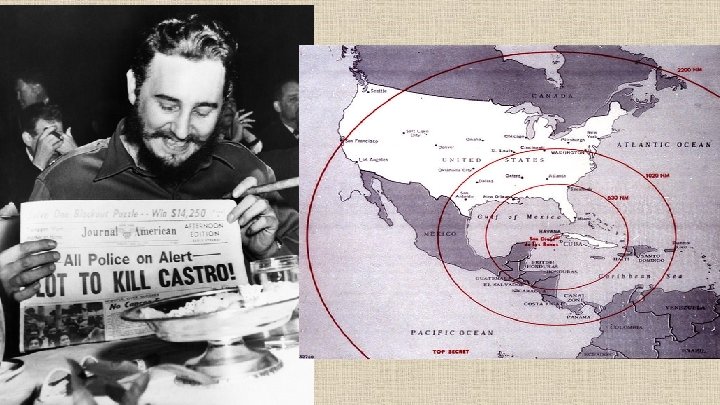
Proxy Wars: Cuba • 1959: Castro comes to power in Cuba by overthrowing the pro-US leader with aide from USSR • USSR places missiles in Cuba US places missiles in Turkey • Able to avoid nuclear war • Leads to closed door policy: complete cut-off of trade, travel, communication
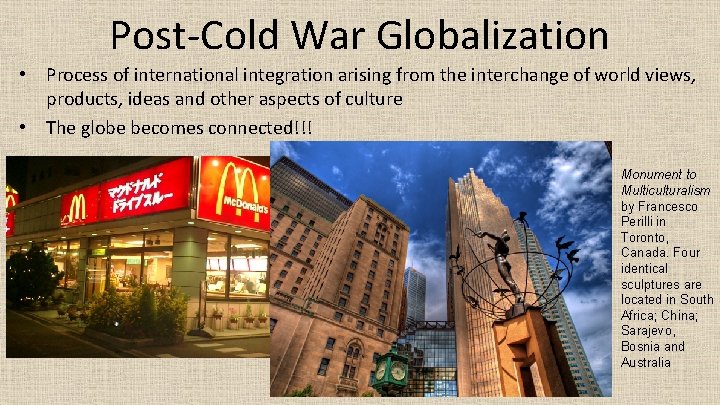
Post-Cold War Globalization • Process of international integration arising from the interchange of world views, products, ideas and other aspects of culture • The globe becomes connected!!! Monument to Multiculturalism by Francesco Perilli in Toronto, Canada. Four identical sculptures are located in South Africa; China; Sarajevo, Bosnia and Australia
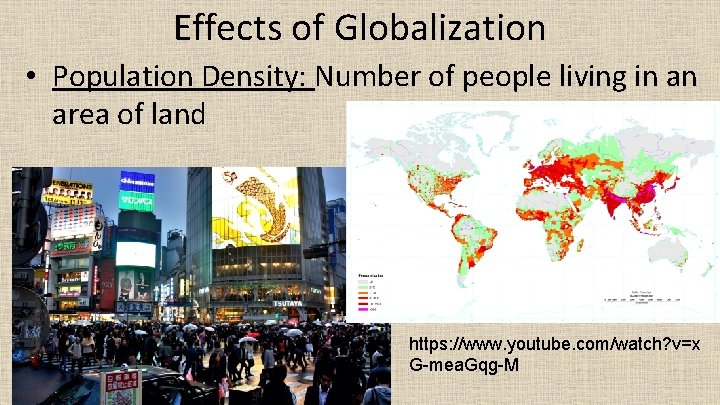
Effects of Globalization • Population Density: Number of people living in an area of land https: //www. youtube. com/watch? v=x G-mea. Gqg-M
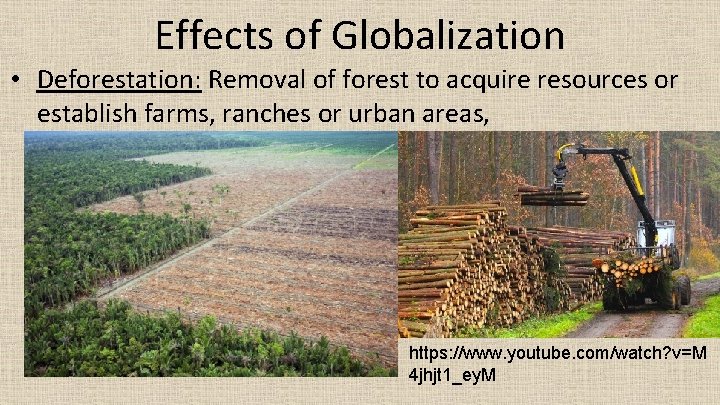
Effects of Globalization • Deforestation: Removal of forest to acquire resources or establish farms, ranches or urban areas, https: //www. youtube. com/watch? v=M 4 jhjt 1_ey. M
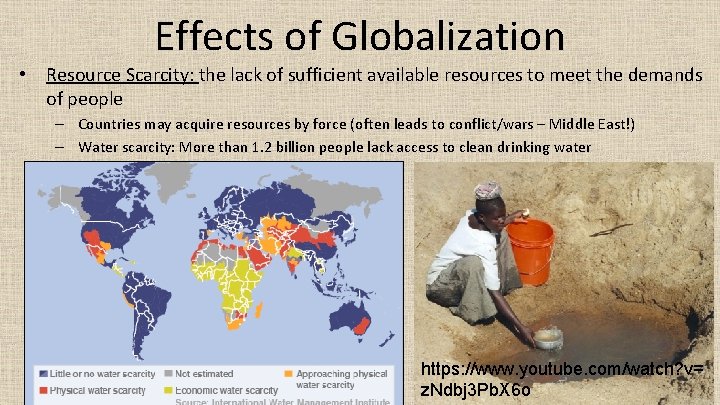
Effects of Globalization • Resource Scarcity: the lack of sufficient available resources to meet the demands of people – Countries may acquire resources by force (often leads to conflict/wars – Middle East!) – Water scarcity: More than 1. 2 billion people lack access to clean drinking water https: //www. youtube. com/watch? v= z. Ndbj 3 Pb. X 6 o
Spring Final Review & Study Time!