
Postwildfire erosion Soil hydrophobicity in Colorado soils Meredith
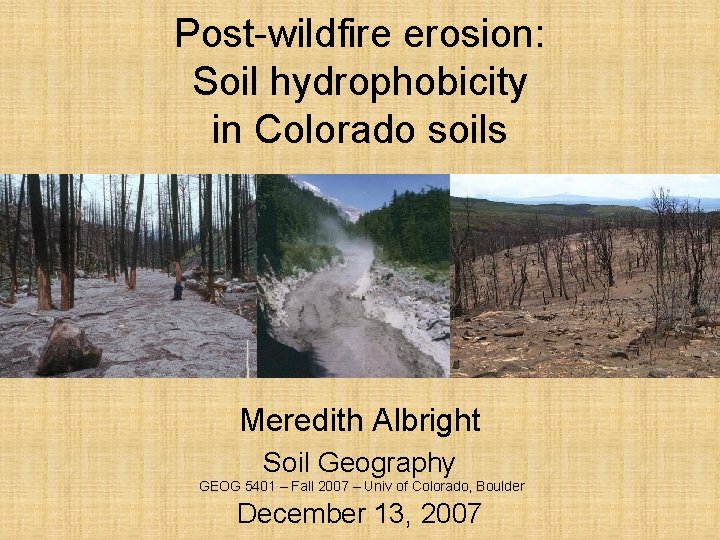
Post-wildfire erosion: Soil hydrophobicity in Colorado soils Meredith Albright Soil Geography GEOG 5401 – Fall 2007 – Univ of Colorado, Boulder December 13, 2007
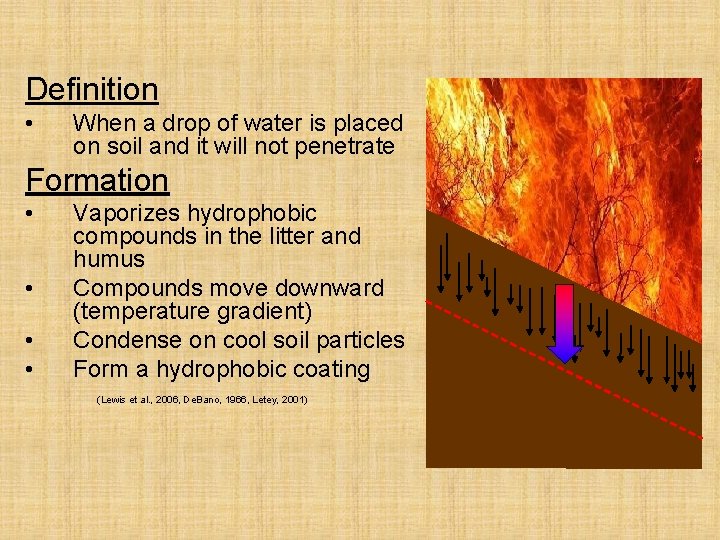
Definition • When a drop of water is placed on soil and it will not penetrate Formation • • Vaporizes hydrophobic compounds in the litter and humus Compounds move downward (temperature gradient) Condense on cool soil particles Form a hydrophobic coating (Lewis et al. , 2006, De. Bano, 1966, Letey, 2001)
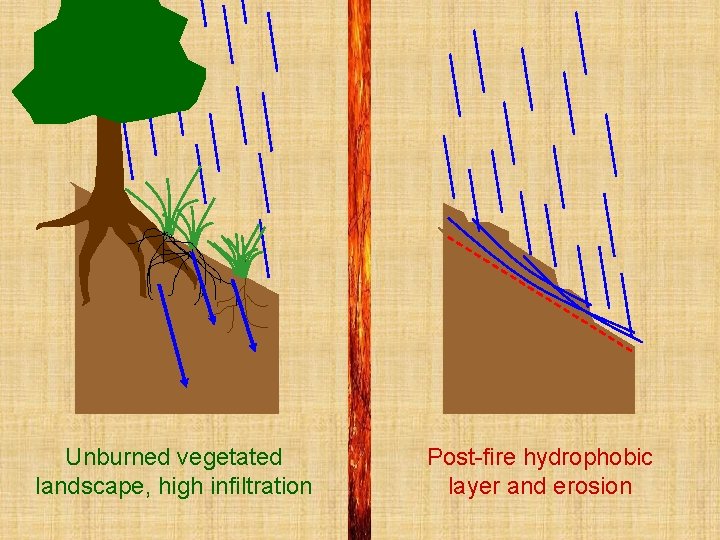
Unburned vegetated djdjsjfdksdskjkjdslkljdskjfl landscape, high infiltration Post-fire hydrophobic layer and erosion
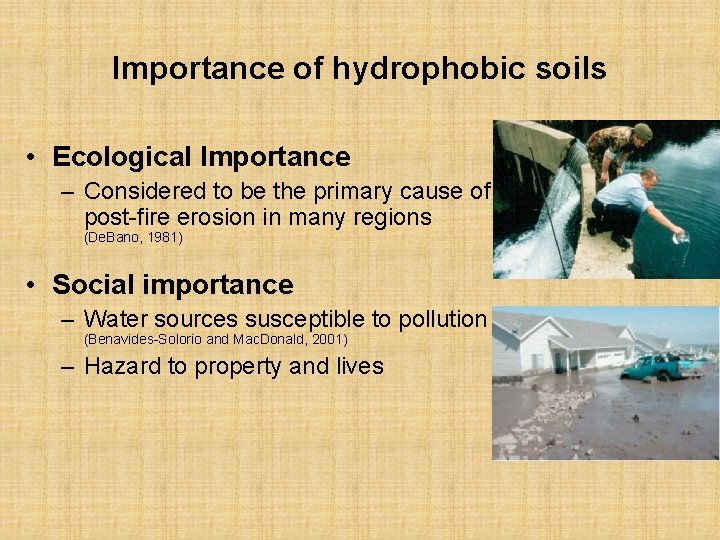
Importance of hydrophobic soils • Ecological Importance – Considered to be the primary cause of post-fire erosion in many regions (De. Bano, 1981) • Social importance – Water sources susceptible to pollution (Benavides-Solorio and Mac. Donald, 2001) – Hazard to property and lives

Specific questions about Colorado: • What determines hydrophobic soil formation? • Do hydrophobic soils increase post-fire erosion?
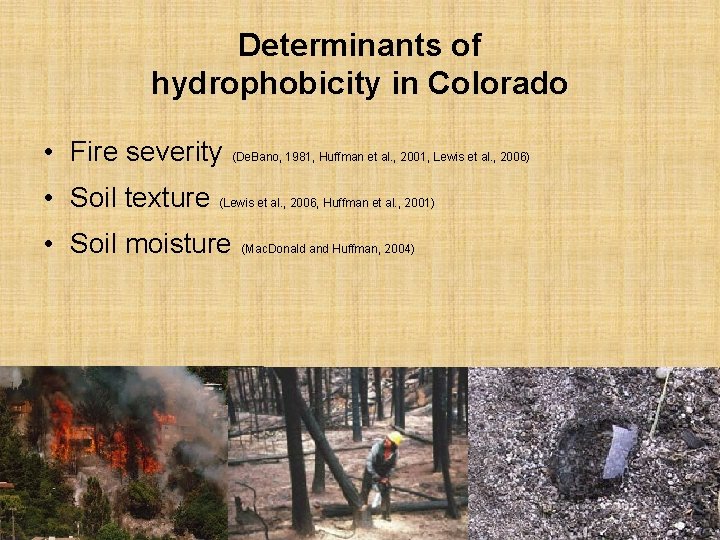
Determinants of hydrophobicity in Colorado • Fire severity • Soil texture (De. Bano, 1981, Huffman et al. , 2001, Lewis et al. , 2006) (Lewis et al. , 2006, Huffman et al. , 2001) • Soil moisture (Mac. Donald and Huffman, 2004)
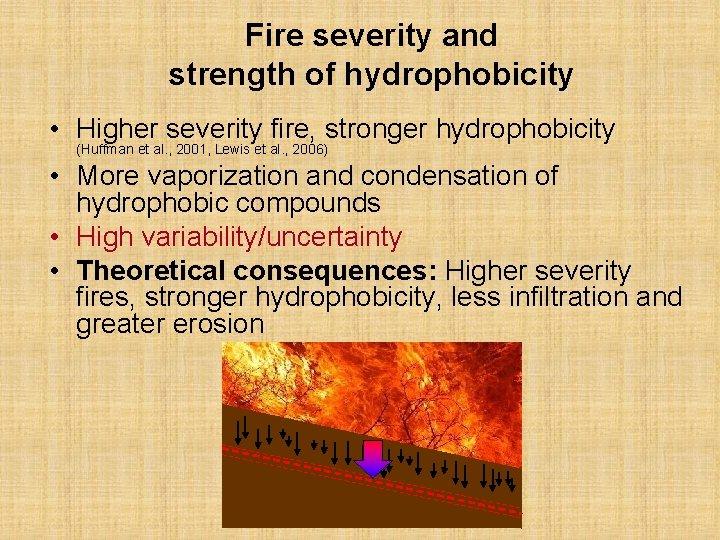
Fire severity and strength of hydrophobicity • Higher severity fire, stronger hydrophobicity (Huffman et al. , 2001, Lewis et al. , 2006) • More vaporization and condensation of hydrophobic compounds • High variability/uncertainty • Theoretical consequences: Higher severity fires, stronger hydrophobicity, less infiltration and greater erosion
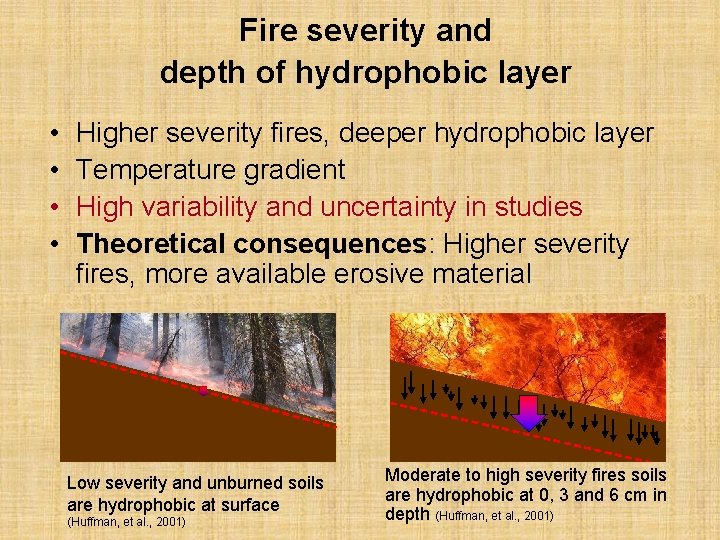
Fire severity and depth of hydrophobic layer • • Higher severity fires, deeper hydrophobic layer Temperature gradient High variability and uncertainty in studies Theoretical consequences: Higher severity fires, more available erosive material Low severity and unburned soils are hydrophobic at surface (Huffman, et al. , 2001) Moderate to high severity fires soils are hydrophobic at 0, 3 and 6 cm in depth (Huffman, et al. , 2001)
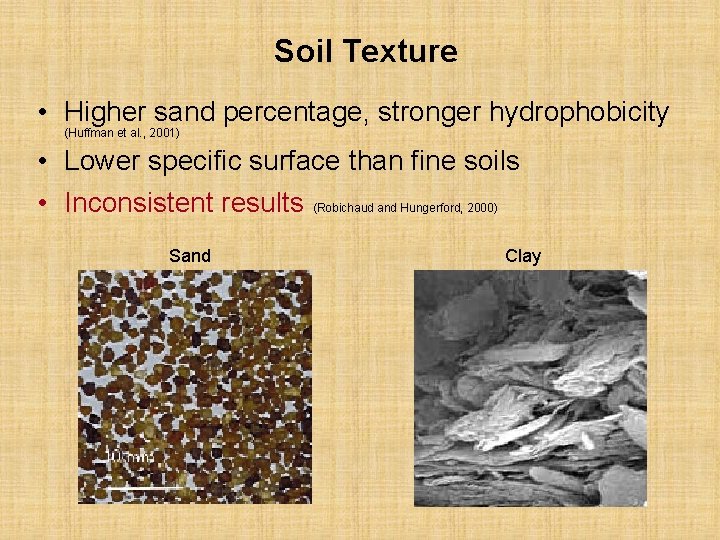
Soil Texture • Higher sand percentage, stronger hydrophobicity (Huffman et al. , 2001) • Lower specific surface than fine soils • Inconsistent results (Robichaud and Hungerford, 2000) Sand Clay
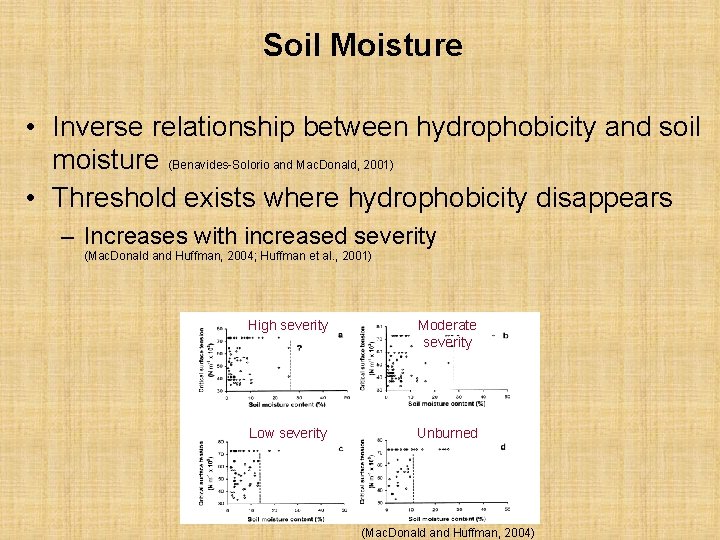
Soil Moisture • Inverse relationship between hydrophobicity and soil moisture (Benavides-Solorio and Mac. Donald, 2001) • Threshold exists where hydrophobicity disappears – Increases with increased severity (Mac. Donald and Huffman, 2004; Huffman et al. , 2001) High severity Moderate severity Low severity Unburned (Mac. Donald and Huffman, 2004)
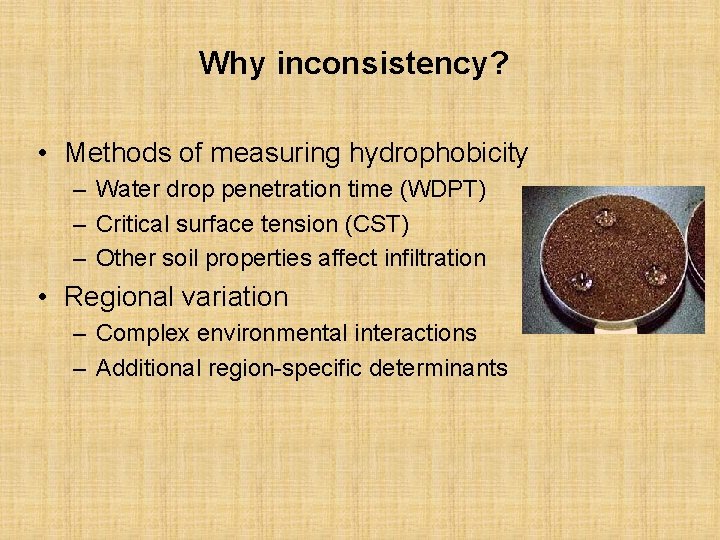
Why inconsistency? • Methods of measuring hydrophobicity – Water drop penetration time (WDPT) – Critical surface tension (CST) – Other soil properties affect infiltration • Regional variation – Complex environmental interactions – Additional region-specific determinants
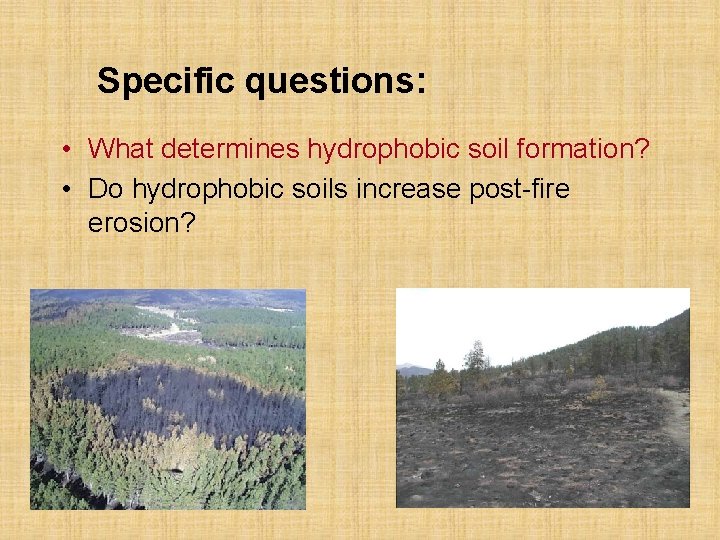
Specific questions: • What determines hydrophobic soil formation? • Do hydrophobic soils increase post-fire erosion?
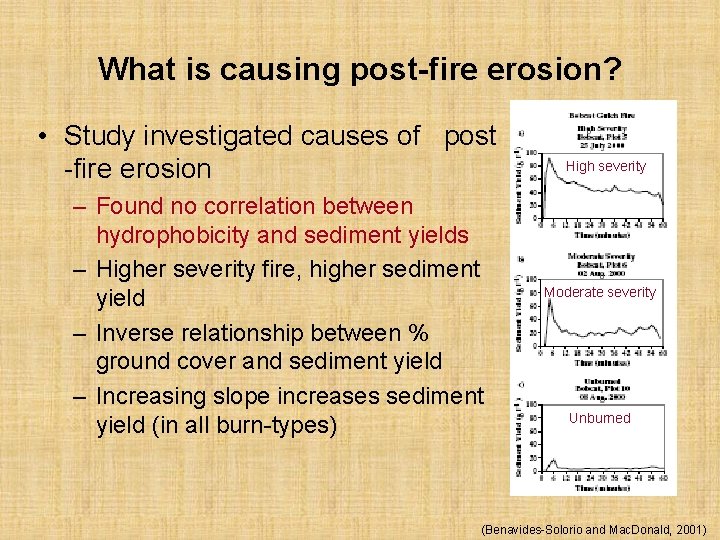
What is causing post-fire erosion? • Study investigated causes of post -fire erosion – Found no correlation between hydrophobicity and sediment yields – Higher severity fire, higher sediment yield – Inverse relationship between % ground cover and sediment yield – Increasing slope increases sediment yield (in all burn-types) High severity Moderate severity Unburned (Benavides-Solorio and Mac. Donald, 2001)
What is causing the post-fire erosion? Vegetation loss or hydrophobic soil? • High severity fires result in higher erosion rates (Benavides-Solorio and Mac. Donald, 2001) – Clear pattern between ground cover and erosion (R 2 = 0. 81) • Need for studies determining the effects of hydrophobicity on erosion – Hydrophobic soils present in unburned and burned soils (Martin and Moody, 2001)
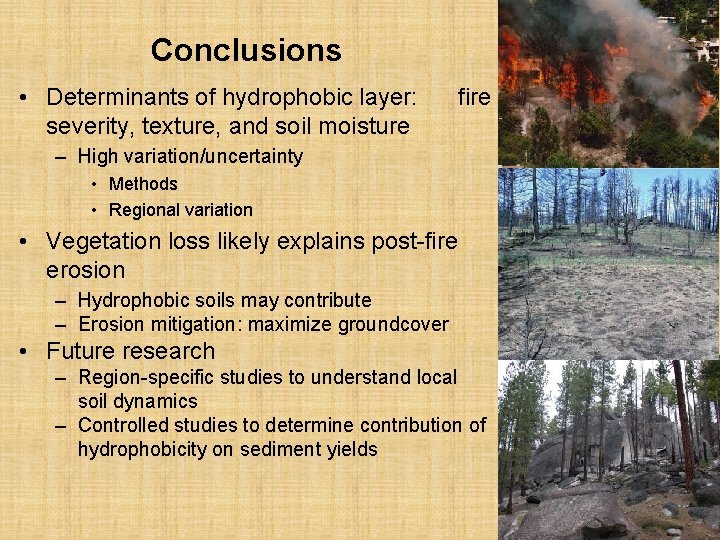
Conclusions • Determinants of hydrophobic layer: severity, texture, and soil moisture fire – High variation/uncertainty • Methods • Regional variation • Vegetation loss likely explains post-fire erosion – Hydrophobic soils may contribute – Erosion mitigation: maximize groundcover • Future research – Region-specific studies to understand local soil dynamics – Controlled studies to determine contribution of hydrophobicity on sediment yields
References • • • Benavides-Solorio, J. , L. H. Mac. Donald, 2001. Post-fire runoff and erosion from simulated rainfall on small plots, Colorado Front Range. Hydrological Processes 15: 2931 -2952. De. Bano L. F. , 1981. Water repellent soils: a state-of-the-art. Gen. Tech. Rep. PSW-46, Pacific Southwest Forest and Range Experiment Station, Forest Service, US Department of Agriculture, Berkeley, CA. Huffman, E. L. , L. H. Mac. Donald, and J. D. Stednick, 2001. Strength and persistence of fireinduced soil hydrophobicity under ponderosa and lodgepole pine, Colorado Front Range. Hydrological Processes 15: 2877 -2892. Letey, J. , 2001. Causes and consequences of fire-induced soil water repellency. Hydrological Processes 15: 2867 -2875. Lewis, S. A. J. Q Wu, P. R. Robichaud, 2006. Assessing burn severity and comparing soil water repellency, Hayman Fire, Colorado. Hydrological Processes 20: 1 -16. Mac. Donald, L. H. , E. L. Huffman, 2004. Post-fire soil water repellency: persistence and soil moisture thresholds. Soil Science Society of America Journal 68: 1729 -1734. Martin, D. , J. Moody 2001. Comparison of soil infiltration rates in burned and unburned mountainous watersheds. Hydrological Processes 15: 2893 -2903. Moody, J and D. Martin 2001. Initial hydrologic and geomorphic response following a wildfire in the Colorado Front Range. Earth Surf Processes landforms 26: 1049 -1070 Robichaud, P. R. , Hungerford, P. D. , 2000. Water repellency by laboratory burning of four northern Rocky Mountain forest soils. Journal of Hydrology 231 -232: 207 -219.
- Slides: 16