
Postwar America 1945 1960 III The Cold War
- Slides: 10
Postwar America (1945 -1960) III. The Cold War Intensifies
Postwar America (1945 -1960) III. The Cold War Intensifies Learning Objectives • • Describe how Cold War tensions were intensified by the arms race between the United States and the Soviet Union. Explain how Eisenhower’s response to communism differed from that of Truman. Analyze the impact on the United States of significant international Cold War conflicts. Describe how Cold War tensions were intensified by the space race.
Postwar America (1945 -1960) III. The Cold War Intensifies A. The Arms Race Intensifies Tensions 1. On Sept. 2 nd, 1949, the Soviets tested their first atomic bomb. This triggered an arms race between the USA and USSR. 2. Truman then ok’d plans for a fusion/hydrogen bomb because it was vastly more powerful than earlier atomic weapons. The Soviets tested an H-bomb a year later. Eventually, both sides would have ICBM’s, capable of hitting anywhere in the world in a matter of minutes. 3. Both sides tested hundreds of weapons, raising pollution in the atmosphere. The general strategy was mutually assured destruction. We have these weapons so that we don’t have to use them.
B. Eisenhower’s Response to Soviet Aggression 1. Eisenhower’s foreign policy was mainly guided by John Foster Dulles advocated massive retaliation and brinkmanship, respond with overwhelming force, including nuclear weapons and you have to be serious about war as a possibility. These ideas were meant to prevent another world war. 2. Stalin died in 1953 and was eventually replaced by Nikita Khrushchev renounced most of Stalin’s cruel policies and while he was hostile to the west, he and Eisenhower met up multiple times. The leaders at least appeared to be willing to work with each other.
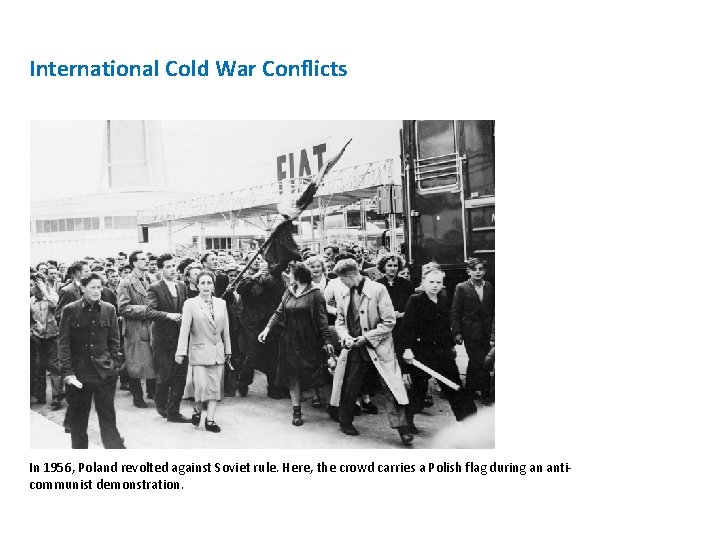
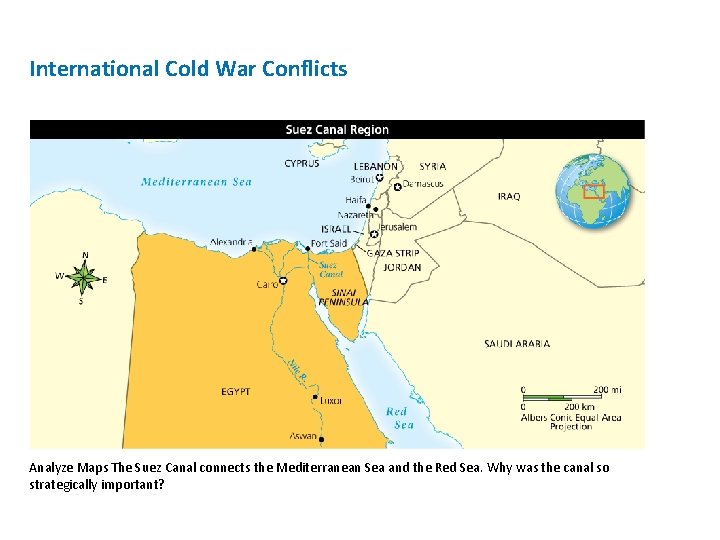
C. International Cold War Conflicts 1. Eastern bloc countries attempted to test Khrushchev’s resolve. Polish workers won concessions but Hungary’s revolution was violently put down. Egypt tried to exploit tensions. Nasser seized the Suez Canal and when British and French troops tried to take it back, Eisenhower rebuked them. 2. Eisenhower’s doctrine had to do with the Middle East. He would “help” any Middle Eastern nation trying to stop communism. He used the CIA to conduct covert operations, overthrowing governments in Iran and Guatemala. 3. The Soviets launched Sputnik 1 in 1957, raising fears that the Soviets were winning the arms race. The next year, NASA was created and the United States soon regained the technological advantage.
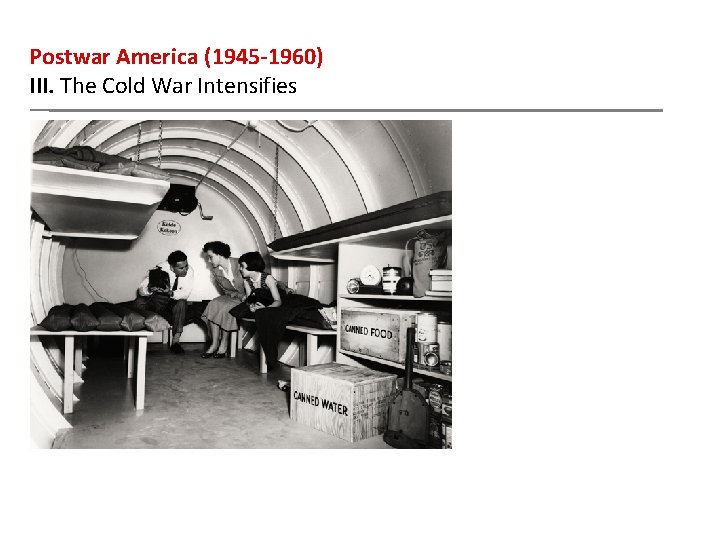
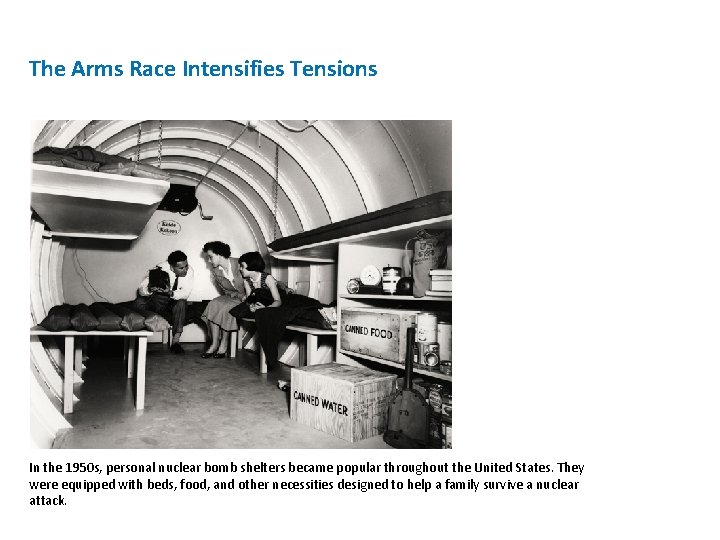
The Arms Race Intensifies Tensions In the 1950 s, personal nuclear bomb shelters became popular throughout the United States. They were equipped with beds, food, and other necessities designed to help a family survive a nuclear attack.
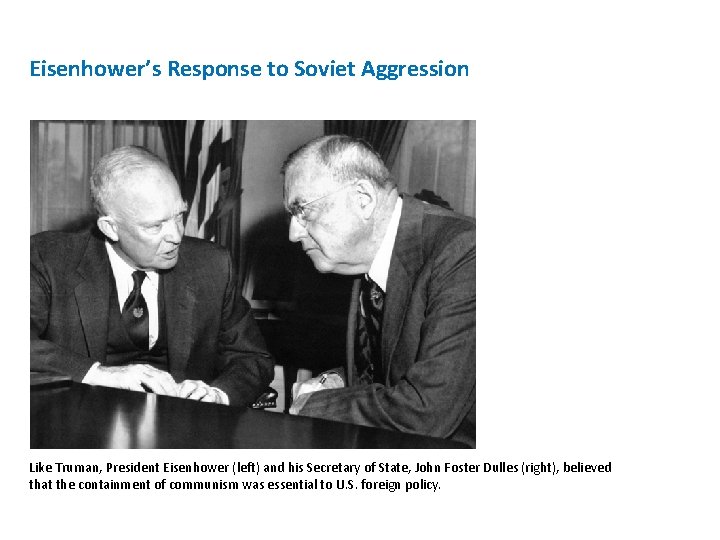
Eisenhower’s Response to Soviet Aggression Like Truman, President Eisenhower (left) and his Secretary of State, John Foster Dulles (right), believed that the containment of communism was essential to U. S. foreign policy.
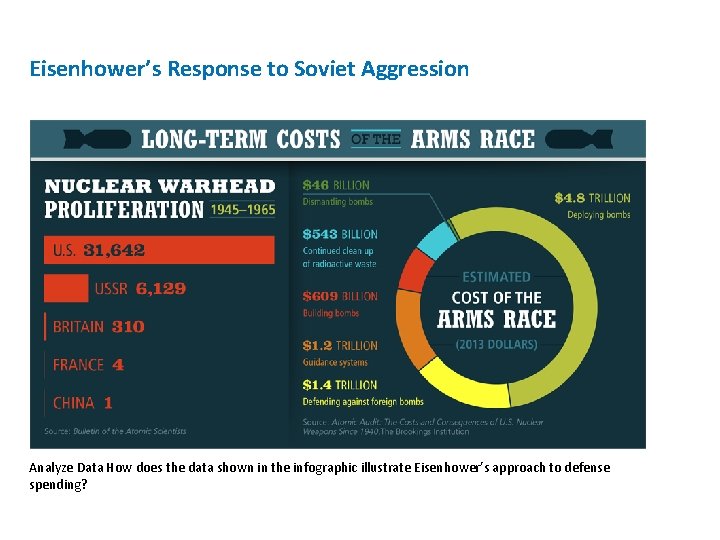
Eisenhower’s Response to Soviet Aggression Analyze Data How does the data shown in the infographic illustrate Eisenhower’s approach to defense spending?
International Cold War Conflicts In 1956, Poland revolted against Soviet rule. Here, the crowd carries a Polish flag during an anticommunist demonstration.
International Cold War Conflicts Analyze Maps The Suez Canal connects the Mediterranean Sea and the Red Sea. Why was the canal so strategically important?