
Posture and Seating What is posture The way
- Slides: 8
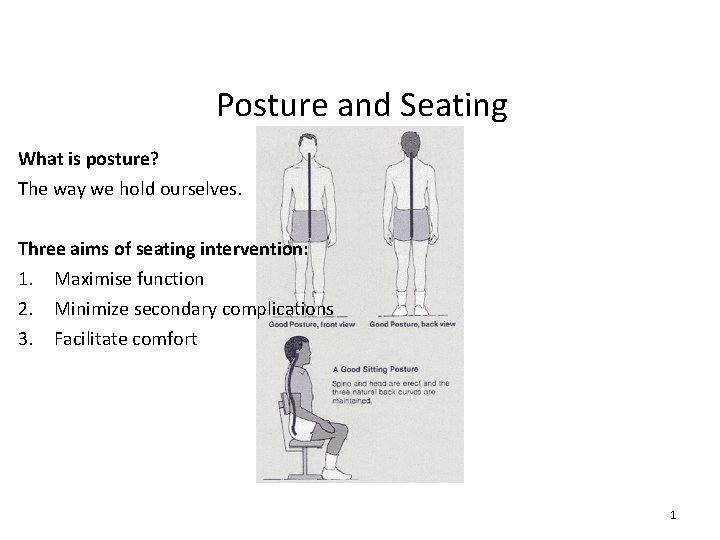
Posture and Seating What is posture? The way we hold ourselves. Three aims of seating intervention: 1. Maximise function 2. Minimize secondary complications 3. Facilitate comfort 1
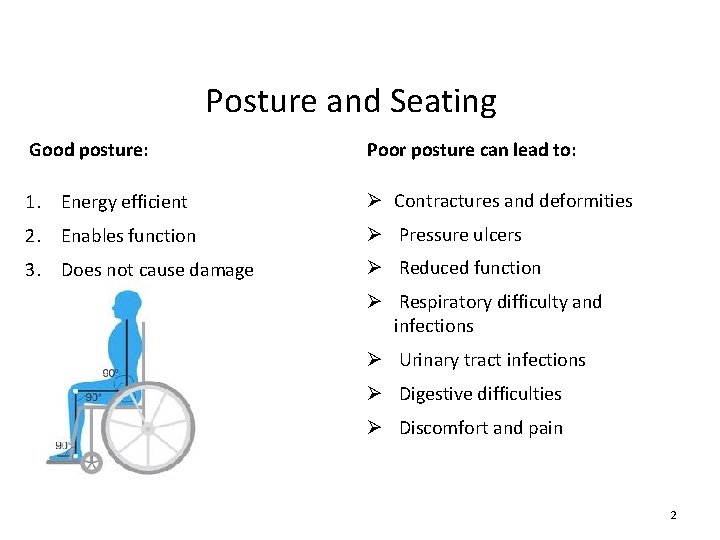
Posture and Seating Good posture: Poor posture can lead to: 1. Energy efficient Ø Contractures and deformities 2. Enables function Ø Pressure ulcers 3. Does not cause damage Ø Reduced function Ø Respiratory difficulty and infections Ø Urinary tract infections Ø Digestive difficulties Ø Discomfort and pain 2
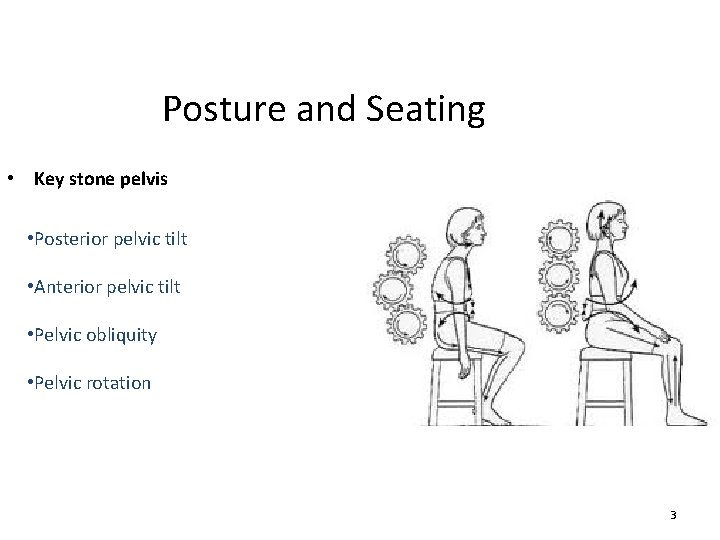
Posture and Seating • Key stone pelvis • Posterior pelvic tilt • Anterior pelvic tilt • Pelvic obliquity • Pelvic rotation 3
Wheelchair dimensions - width Seat width is usually close to the hip width or the widest part of the body. Seat width too wide: 1. Pelvic obliquity and scoliosis 2. Impede access to wheels or joystick 3. Impact upon accessibility (i. e. doors) Seat width too narrow: 1. Create rotational deformities 2. Cause discomfort 3. Increased risk of pressure areas 4
Wheelchair dimensions - depth The seat depth should be slightly shorter than the upper leg length. Seat depth too long: 1. Posterior pelvic tilt, slumping in the seat, sliding out of seat, pressure and shear 2. Increases overall frame length 3. Impede transfers Seat depth too short: 1. Increased pressure on buttocks 2. Anterior pelvic tilt, drag on legs 3. Postural adaptation to have more base of support 5
Basic Wheelchair Training Tips Manual Wheelchair – Moving forward on a flat surface 1. Grasp the hand-rims and push evenly with both hands. 2. Position hands at 11 o’clock for starting the stroke. 3. Release hands at 2 o’clock for finishing the stroke. 4. Use smooth strokes matching the speed of the moving wheel. 5. Avoid jerky accelerations that could cause the wheelchair to tip over backwards. 6. Lean forward to avoid lifting the front wheels off the ground. 7. Push with longer, less frequent strokes, allowing coasting where possible. 8. Touch middle fingers onto the axles during recovery phase to reinforce a circular propulsion pattern. • 6
Wheelchair Training Tips Manual Wheelchair – Stopping The rate of slowing can be controlled by how hard the hand-rims are gripped. The hand-rims should run through the wheelchair user’s hands. If the wheelchair user stops too quickly, they may tip over forwards. To prevent this, the wheelchair user should lean back whenever they are required to stop quickly. Manual Wheelchair – Turning whilst moving forward 1. The turn should not begin until the axles rear wheels have reached the object (e. g. corner / wall) 2. Slow down the inside wheel. 3. Push harder on the outside wheel. 7
Wheelchair Training Tips Power Wheelchair – Moving and stopping 1. One person only taking charge and giving instructions. 2. The first instruction that a first time power chair user should understand is ‘stop’. 3. Driving the wheelchair in circles is an acceptable first time movement. 4. It is acceptable for the child to bump into things initially. 5. Consider greater rewards for following instructions. 6. Power wheelchairs may be rear-, front- or mid-wheel- drive. This affects the drive path and ease of moving wheelchair forward. 7. If the user is over-correcting when driving, changing the contact point with the joystick may improve the fluidity of the driving. 8. If the user’s hand control is limited, then alternative access can be considered. 8