
PostTranscriptional Gene Silencing PTGS Also called RNA interference
- Slides: 19
Post-Transcriptional Gene Silencing (PTGS) • Also called RNA interference or RNAi • Process results in down-regulation of a gene at the RNA level (i. e. , after transcription) • There is also gene silencing at the transcriptional level (TGS) – Examples: transposons, retroviral genes, heterochromatin
• PTGS is heritable, although it can be modified in subsequent cell divisions or generations – Ergo, it is an epigenetic phenomenon Epigenetics - refers to heritable changes in phenotype or gene expression caused by mechanisms other than changes in the underlying DNA sequence.
Antisense Technology • Used from ~1980 on, to repress specific genes – Alternative to gene knock-outs, which were/are very difficult to do in higher plants and animals • Theory: by introducing an antisense gene (or as. RNA) into cells, the as. RNA would “zip up” the complementary m. RNA into a ds. RNA that would not be translated • The “antisense effect” was highly variable, and in light of the discovery of RNAi, as. RNA probably inhibited its target by inducing RNAi rather than inhibiting translation.
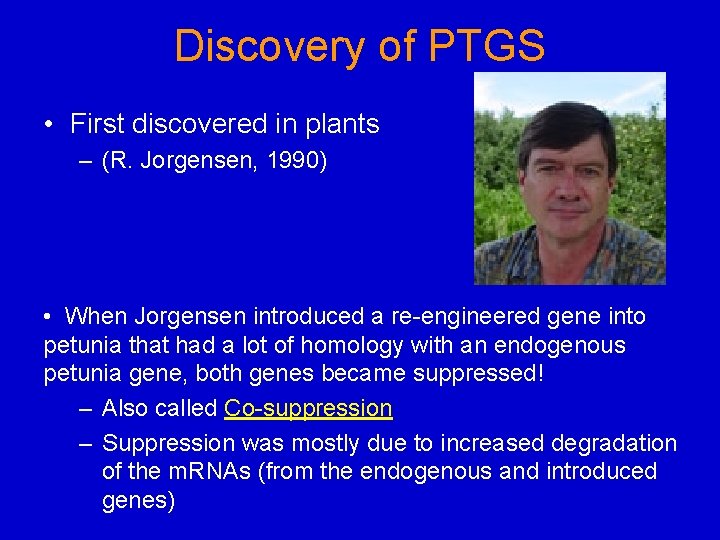
Discovery of PTGS • First discovered in plants – (R. Jorgensen, 1990) • When Jorgensen introduced a re-engineered gene into petunia that had a lot of homology with an endogenous petunia gene, both genes became suppressed! – Also called Co-suppression – Suppression was mostly due to increased degradation of the m. RNAs (from the endogenous and introduced genes)
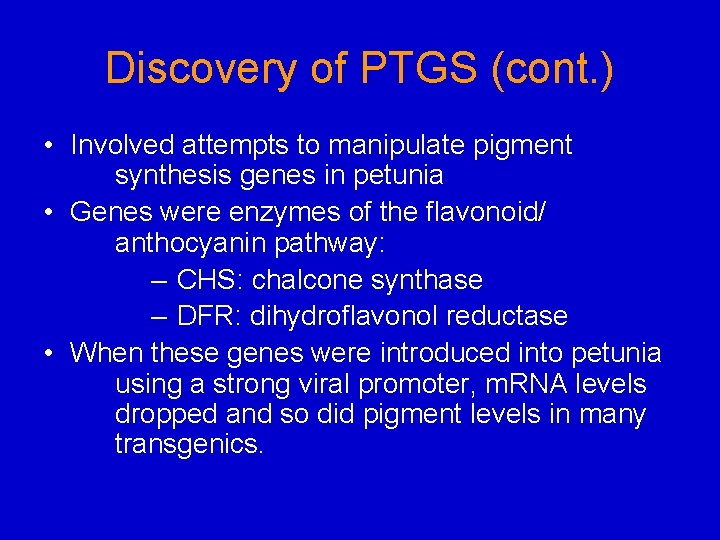
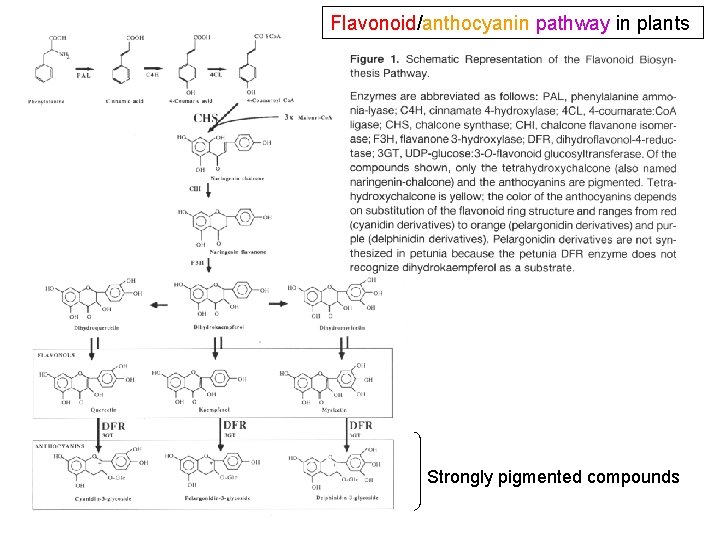
Discovery of PTGS (cont. ) • Involved attempts to manipulate pigment synthesis genes in petunia • Genes were enzymes of the flavonoid/ anthocyanin pathway: – CHS: chalcone synthase – DFR: dihydroflavonol reductase • When these genes were introduced into petunia using a strong viral promoter, m. RNA levels dropped and so did pigment levels in many transgenics.
Flavonoid/anthocyanin pathway in plants Strongly pigmented compounds
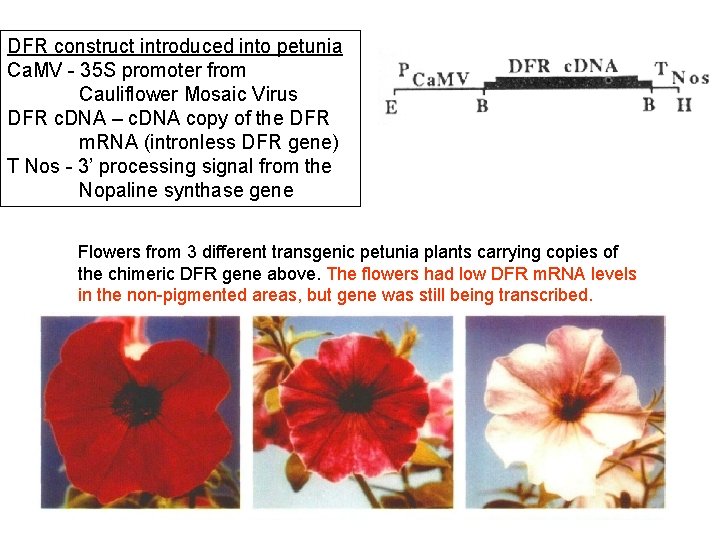
DFR construct introduced into petunia Ca. MV - 35 S promoter from Cauliflower Mosaic Virus DFR c. DNA – c. DNA copy of the DFR m. RNA (intronless DFR gene) T Nos - 3’ processing signal from the Nopaline synthase gene Flowers from 3 different transgenic petunia plants carrying copies of the chimeric DFR gene above. The flowers had low DFR m. RNA levels in the non-pigmented areas, but gene was still being transcribed.
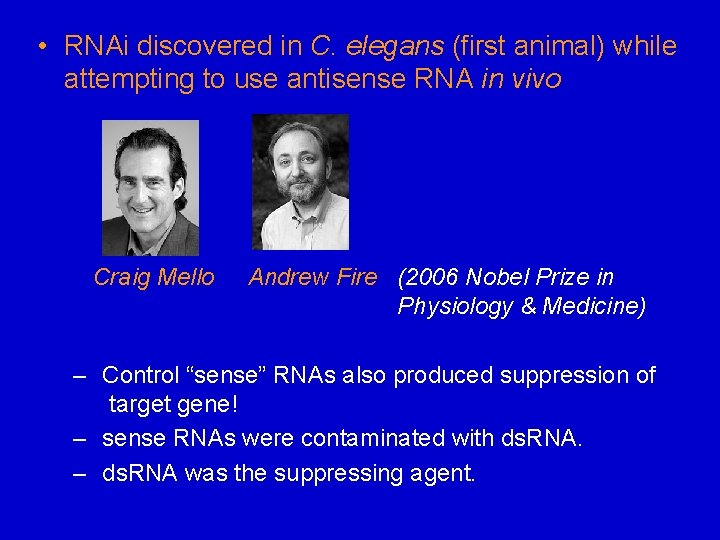
• RNAi discovered in C. elegans (first animal) while attempting to use antisense RNA in vivo Craig Mello Andrew Fire (2006 Nobel Prize in Physiology & Medicine) – Control “sense” RNAs also produced suppression of target gene! – sense RNAs were contaminated with ds. RNA. – ds. RNA was the suppressing agent.
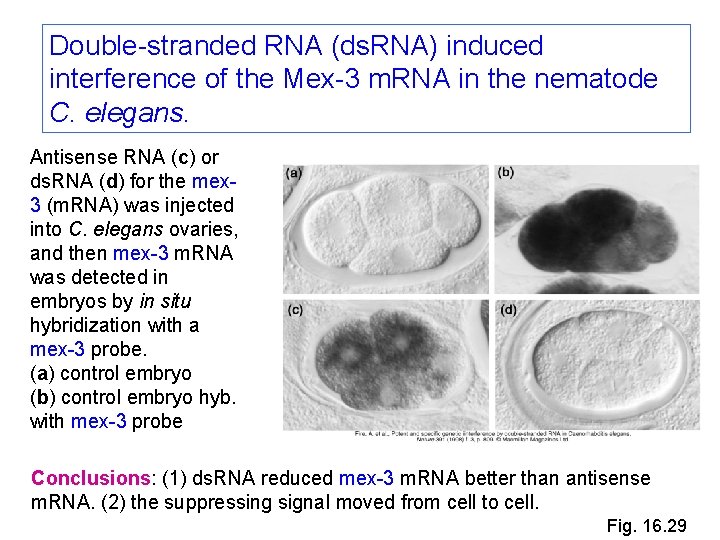
Double-stranded RNA (ds. RNA) induced interference of the Mex-3 m. RNA in the nematode C. elegans. Antisense RNA (c) or ds. RNA (d) for the mex 3 (m. RNA) was injected into C. elegans ovaries, and then mex-3 m. RNA was detected in embryos by in situ hybridization with a mex-3 probe. (a) control embryo (b) control embryo hyb. with mex-3 probe Conclusions: (1) ds. RNA reduced mex-3 m. RNA better than antisense m. RNA. (2) the suppressing signal moved from cell to cell. Fig. 16. 29
PTGS (RNAi) occurs in wide variety of Eukaryotes: – Angiosperms – C. elegans (nematode) – Drosophila – Mammalian cells – Chlamydomonas (unicellular – Neurospora, but not in Yeast!
Mechanism of RNAi: Role of Dicer 1. 2. 3. Cells (plants and animals) undergoing RNAi contained small fragments (~25 nt) of the RNA being suppressed. A nuclease (Dicer) was purified from Drosophila embryos that still had small RNA fragments associated with it, both sense and antisense. The Dicer gene is found in all organisms that exhibit RNAi, and mutating it inhibits the RNAi effect. Conclusion: Dicer is the endonuclease that degrades ds. RNA into 21 -24 nt fragments, and in higher eukaryotes also pulls the strands apart via intrinsic helicase activity.
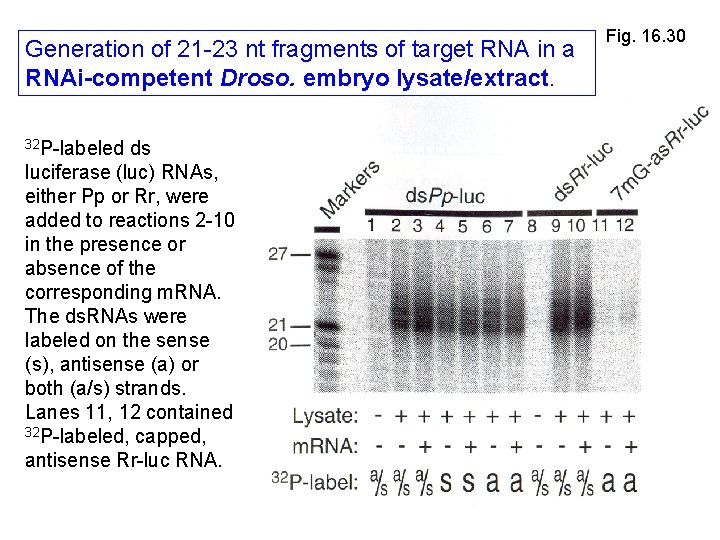
Generation of 21 -23 nt fragments of target RNA in a RNAi-competent Droso. embryo lysate/extract. 32 P-labeled ds luciferase (luc) RNAs, either Pp or Rr, were added to reactions 2 -10 in the presence or absence of the corresponding m. RNA. The ds. RNAs were labeled on the sense (s), antisense (a) or both (a/s) strands. Lanes 11, 12 contained 32 P-labeled, capped, antisense Rr-luc RNA. Fig. 16. 30
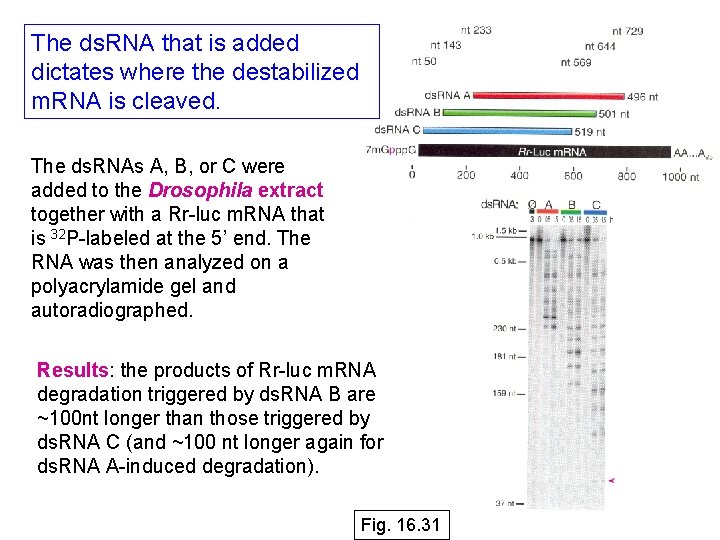
The ds. RNA that is added dictates where the destabilized m. RNA is cleaved. The ds. RNAs A, B, or C were added to the Drosophila extract together with a Rr-luc m. RNA that is 32 P-labeled at the 5’ end. The RNA was then analyzed on a polyacrylamide gel and autoradiographed. Results: the products of Rr-luc m. RNA degradation triggered by ds. RNA B are ~100 nt longer than those triggered by ds. RNA C (and ~100 nt longer again for ds. RNA A-induced degradation). Fig. 16. 31
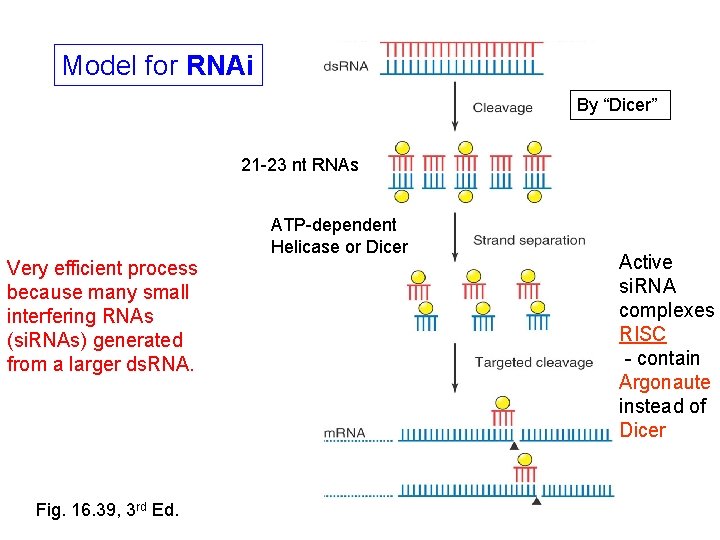
Model for RNAi By “Dicer” 21 -23 nt RNAs ATP-dependent Helicase or Dicer Very efficient process because many small interfering RNAs (si. RNAs) generated from a larger ds. RNA. Fig. 16. 39, 3 rd Ed. Active si. RNA complexes RISC - contain Argonaute instead of Dicer
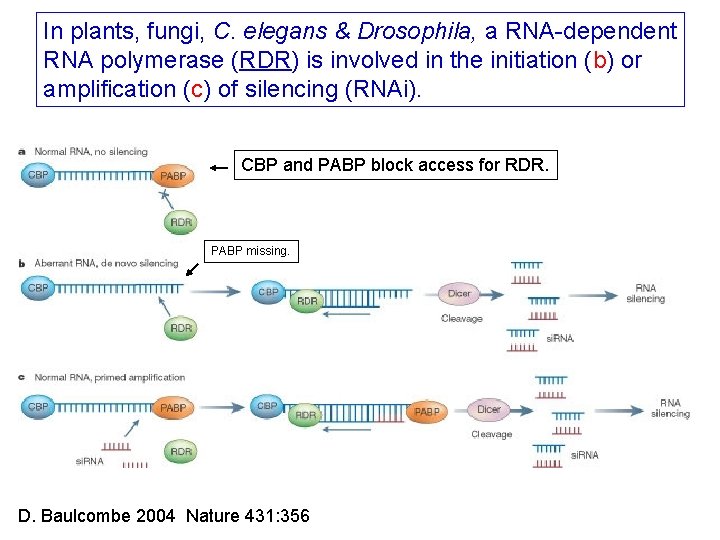
In plants, fungi, C. elegans & Drosophila, a RNA-dependent RNA polymerase (RDR) is involved in the initiation (b) or amplification (c) of silencing (RNAi). CBP and PABP block access for RDR. PABP missing. D. Baulcombe 2004 Nature 431: 356
Why RNAi silencing? • Most widely held view is that RNAi evolved to protect the genome from viruses (and perhaps transposons or mobile DNAs). • Some viruses have proteins that suppress silencing: 1. HCPro - first one identified, found in plant potyviruses (V. Vance) 2. P 19 - tomato bushy stunt virus, binds to si. RNAs and prevents RISC formation (D. Baulcombe). 3. Tat - RNA-binding protein from HIV
Micro RNAs (Mi. RNAs) • Recently, very small (micro) Mi. RNAs have been discovered in plants and animals. • They resemble si. RNAs, and they regulate specific m. RNAs by promoting their degradation or repressing their translation. • New use for the RNAi mechanism besides defense.
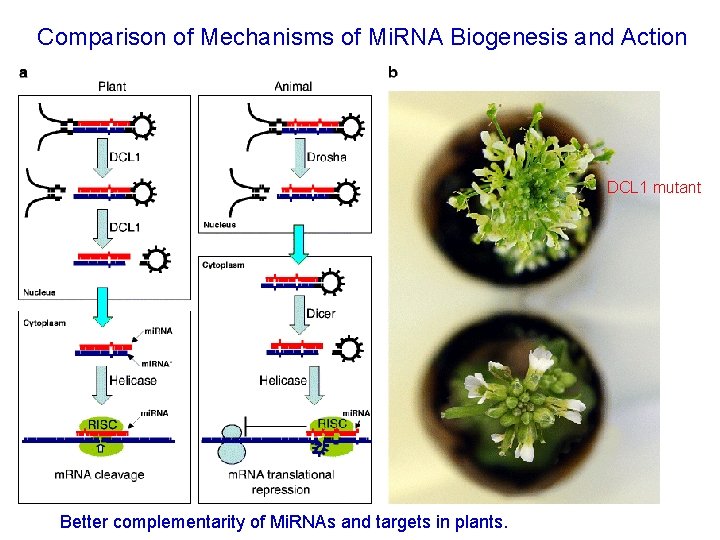
Comparison of Mechanisms of Mi. RNA Biogenesis and Action DCL 1 mutant Better complementarity of Mi. RNAs and targets in plants.
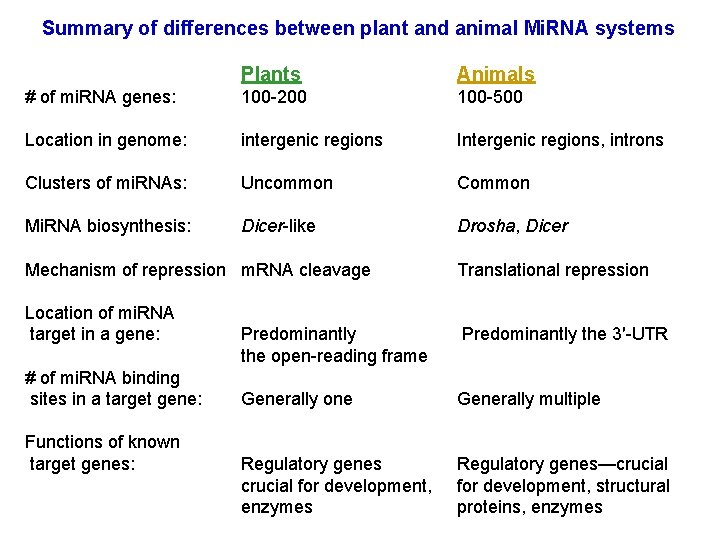
Summary of differences between plant and animal Mi. RNA systems Plants Animals # of mi. RNA genes: 100 -200 100 -500 Location in genome: intergenic regions Intergenic regions, introns Clusters of mi. RNAs: Uncommon Common Mi. RNA biosynthesis: Dicer-like Drosha, Dicer Mechanism of repression m. RNA cleavage Translational repression Location of mi. RNA target in a gene: Predominantly the open-reading frame Predominantly the 3′-UTR Generally one Generally multiple Regulatory genes crucial for development, enzymes Regulatory genes—crucial for development, structural proteins, enzymes # of mi. RNA binding sites in a target gene: Functions of known target genes: