
Posttraining Preparations Dorothee Spuhler Leonellha BarretoDillon Martin Wafler
Post-training Preparations Dorothee Spuhler, Leonellha Barreto-Dillon, Martin Wafler, Naomi Radke (seecon international gmbh) Sreevidya Satish (Ecosan Service Foundation) Bipin Dangol (Environmental and Public Health Organization) Post-training Preparations 1
Find this presentation and more on: www. ssswm. info. Copyright & Disclaimer Copy it, adapt it, use it – but acknowledge the source! Copyright Included in the SSWM Toolbox are materials from various organisations and sources. Those materials are open source. Following the opensource concept for capacity building and non-profit use, copying and adapting is allowed provided proper acknowledgement of the source is made (see below). The publication of these materials in the SSWM Toolbox does not alter any existing copyrights. Material published in the SSWM Toolbox for the first time follows the same open-source concept, with all rights remaining with the original authors or producing organisations. To view an official copy of the Creative Commons Attribution Works 3. 0 Unported License we build upon, visit http: //creativecommons. org/licenses/by/3. 0. This agreement officially states that: You are free to: • Share - to copy, distribute and transmit this document • Remix - to adapt this document. We would appreciate receiving a copy of any changes that you have made to improve this document. Under the following conditions: • Attribution: You must always give the original authors or publishing agencies credit for the document or picture you are using. Disclaimer The contents of the SSWM Toolbox reflect the opinions of the respective authors and not necessarily the official opinion of the funding or supporting partner organisations. Depending on the initial situations and respective local circumstances, there is no guarantee that single measures described in the toolbox will make the local water and sanitation system more sustainable. The main aim of the SSWM Toolbox is to be a reference tool to provide ideas for improving the local water and sanitation situation in a sustainable manner. Results depend largely on the respective situation and the implementation and combination of the measures described. An in-depth analysis of respective advantages and disadvantages and the suitability of the measure is necessary in every single case. We do not assume any responsibility for and make no warranty with respect to the results that may be obtained from the use of the information provided. Post-training Preparations
Find this presentation and more on: www. ssswm. info. Contents 1) Certification 2) Evaluation 3) Follow-Up 4) Evaluation versus Follow-up 5) Report Post-training Preparations 3
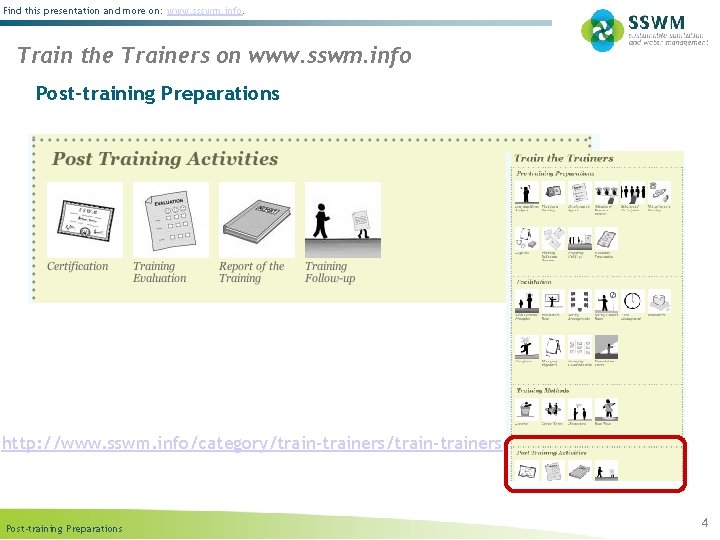
Find this presentation and more on: www. ssswm. info. Train the Trainers on www. sswm. info Post-training Preparations http: //www. sswm. info/category/train-trainers Post-training Preparations 4
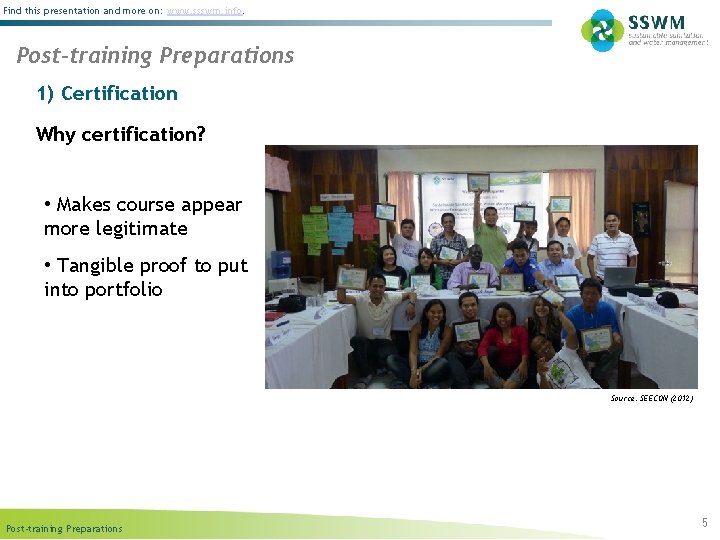
Find this presentation and more on: www. ssswm. info. Post-training Preparations 1) Certification Why certification? • Makes course appear more legitimate • Tangible proof to put into portfolio Source: SEECON (2012) Post-training Preparations 5
Find this presentation and more on: www. ssswm. info. Post-training Preparations 1) Certification Creating a Good Certificate • Look for templates (free templates online) • Use a text programme (Word/Open Office) OR • Use a presentation programme (e. g. Power. Point) makes composing easier • Add borders looks more formal • Use the right font readable, font size 20 -50 • Print certificates with laser printer • Include the right information full name, date and name of training, organisation’s name, water mark/stamp, signature Post-training Preparations 6
Find this presentation and more on: www. ssswm. info. Contents 1) Certification 2) Evaluation 3) Follow-Up 4) Evaluation versus Follow-up 5) Report Post-training Preparations 7
Find this presentation and more on: www. ssswm. info. Post-training Preparations 2) Evaluation WHY should we perform Evaluation? Monitor the training approach • Which elements have contributed to successfully achieve the training aim, objectives, key learning? • Which have failed their purpose ? Post-training Preparations Judging: • Effectiveness • Efficiency • Any other outcome? IMPROVE TRAINING APPROACH 8
Find this presentation and more on: www. ssswm. info. Post-training Preparations 2) Evaluation Questions to ask yourself: Have the participants achieved the course objectives? Have the participants learned what they are supposed to learn? (are key learning successfully transferred? ) What unexpected positive outcomes have occurred that can be incorporated in the future courses? What are the courses strengths and weaknesses? Has the performance of the participants improved after training? How are they integrating the gained knowledge in their day-today job? Post-training Preparations 9
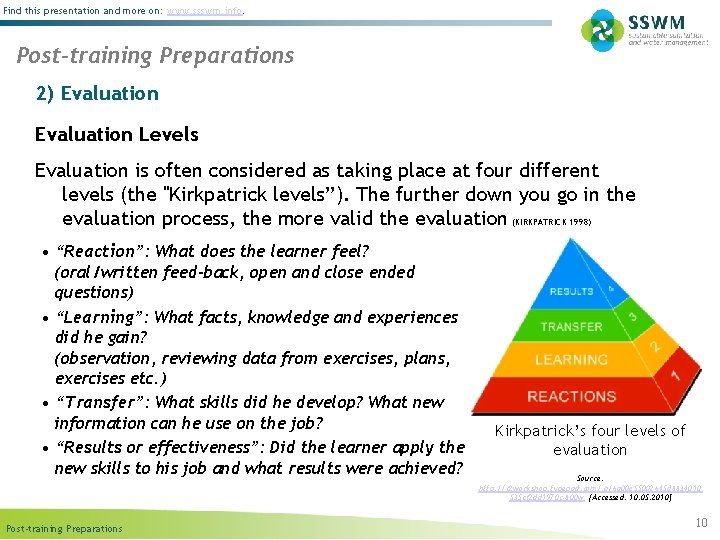
Find this presentation and more on: www. ssswm. info. Post-training Preparations 2) Evaluation Levels Evaluation is often considered as taking place at four different levels (the "Kirkpatrick levels”). The further down you go in the evaluation process, the more valid the evaluation (KIRKPATRICK 1998) • “Reaction”: What does the learner feel? (oral/written feed-back, open and close ended questions) • “Learning”: What facts, knowledge and experiences did he gain? (observation, reviewing data from exercises, plans, exercises etc. ) • “Transfer”: What skills did he develop? What new information can he use on the job? • “Results or effectiveness”: Did the learner apply the new skills to his job and what results were achieved? Post-training Preparations Kirkpatrick’s four levels of evaluation Source: http: //c 2 workshop. typepad. com/. a/6 a 00 e 55002645 d 8834010 535 cf 2 dd 1970 c-800 w [Accessed: 10. 05. 2010] 10
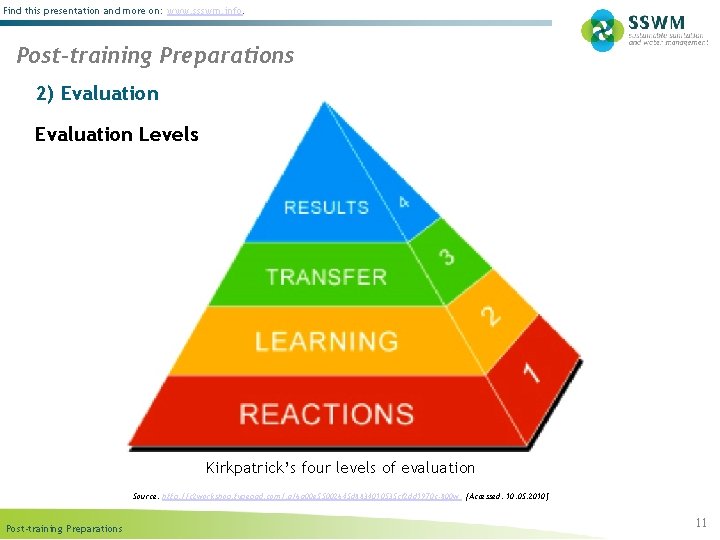
Find this presentation and more on: www. ssswm. info. Post-training Preparations 2) Evaluation Levels Kirkpatrick’s four levels of evaluation Source: http: //c 2 workshop. typepad. com/. a/6 a 00 e 55002645 d 8834010535 cf 2 dd 1970 c-800 w [Accessed: 10. 05. 2010] Post-training Preparations 11
Find this presentation and more on: www. ssswm. info. Post-training Preparations 2) Evaluation How should we perform Evaluation? Brainstorming Time: up to 5 minutes Post-training Preparations 12
Find this presentation and more on: www. ssswm. info. Post-training Preparations 2) Evaluation How should we perform Evaluation? • Evaluation forms • Qualitative feedback • Rating Post-training Preparations 13
Find this presentation and more on: www. ssswm. info. Post-training Preparations 2) Evaluation Be selective! Do not hand out a huge list of questions. What do you really want to know and what is the best way of finding this out? Be realistic! Form-filling is never fun. Do not expect people to conscientiously work through a long and complex evaluation form. Be creative! Create evaluative processes that will engage participants and provide you at the same time with a valid feedback (e. g. an activity that is itself engaging and enjoyable!) Be balanced! Combine standardised element that allows you to make comparisons over time (add changing elements, which shows you a new perspective). Be holistic! Paper exercises can be very useful but should be part of a wider evaluation process that includes dimensions of learning that are less easy to capture on paper. (adapted from GREENAWAY (1999)) Post-training Preparations 14
Find this presentation and more on: www. ssswm. info. Contents 1) Certification 2) Evaluation 3) Follow-Up 4) Evaluation versus Follow-up 5) Report Post-training Preparations 15
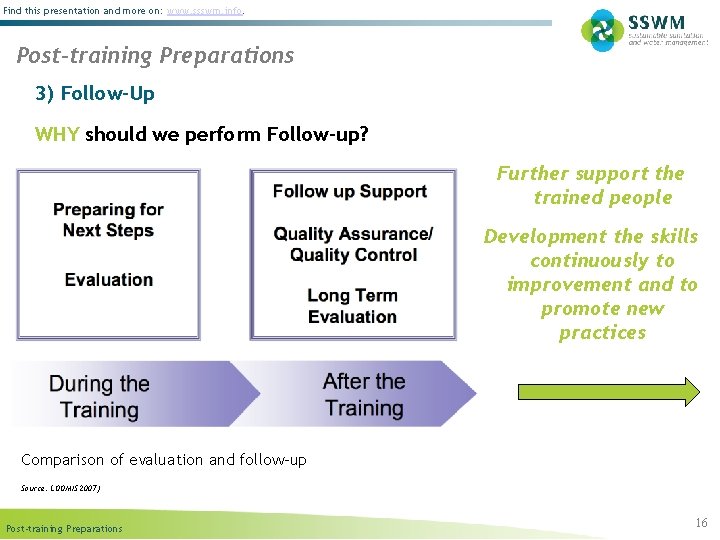
Find this presentation and more on: www. ssswm. info. Post-training Preparations 3) Follow-Up WHY should we perform Follow-up? Further support the trained people Development the skills continuously to improvement and to promote new practices Comparison of evaluation and follow-up Source: LOOMIS 2007) Post-training Preparations 16
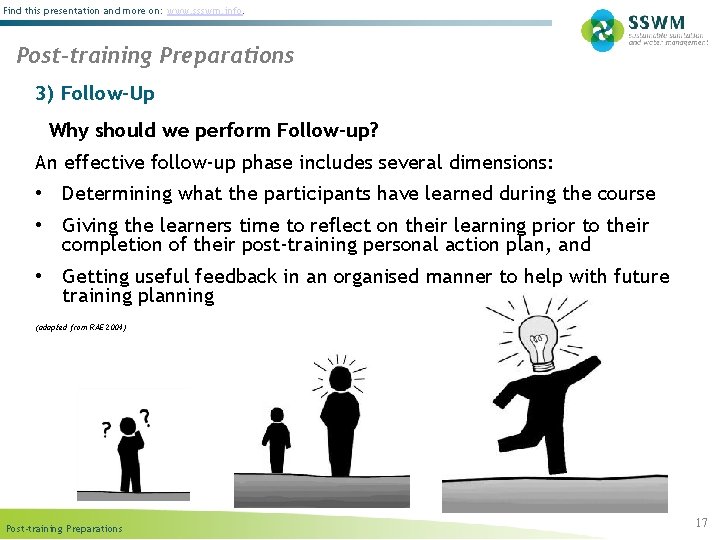
Find this presentation and more on: www. ssswm. info. Post-training Preparations 3) Follow-Up Why should we perform Follow-up? An effective follow-up phase includes several dimensions: • Determining what the participants have learned during the course • Giving the learners time to reflect on their learning prior to their completion of their post-training personal action plan, and • Getting useful feedback in an organised manner to help with future training planning (adapted from RAE 2004) Post-training Preparations 17
Find this presentation and more on: www. ssswm. info. Post-training Preparations 3) Follow-Up How can we perform Follow-up? – some ideas At the close of training, ask each attendee to commit to trying 1 -3 new skills from the program. Let them know that the group will get back together to follow up and discuss techniques tried. Schedule a follow-up session. Ask each attendee to email you a brief summary of the two most important points they took away from the training. Gather the feedback together and post the responses in a central location. Take the list down after two weeks. Let a few weeks go by and then mail or email the responses to the group, along with any additional feedback that has occurred in the meantime. Send out a quiz related to the training’s content several weeks after the initial session. Post the responses and award a prize for the “best” answers. (adapted from BUSINESS TRAINING WORKS n. y. ; http: //www. businesstrainingworks. com/Onsite Training Web/-Free Articles/PDFs/Five Ways to Follow Up. pdf [Accessed: 21. 05. 2010]) Post-training Preparations 18
Find this presentation and more on: www. ssswm. info. Contents 1) Certification 2) Evaluation 3) Follow-Up 4) Evaluation versus Follow-up 5) Report Post-training Preparations 19
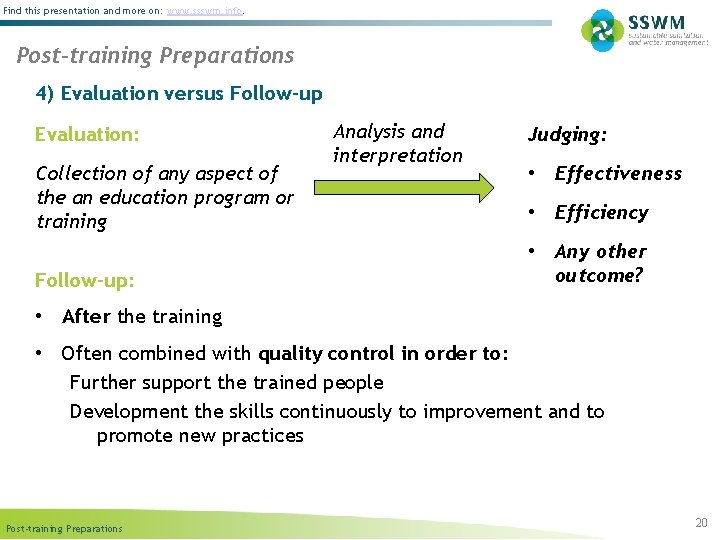
Find this presentation and more on: www. ssswm. info. Post-training Preparations 4) Evaluation versus Follow-up Evaluation: Collection of any aspect of the an education program or training Follow-up: Analysis and interpretation Judging: • Effectiveness • Efficiency • Any other outcome? • After the training • Often combined with quality control in order to: Further support the trained people Development the skills continuously to improvement and to promote new practices Post-training Preparations 20
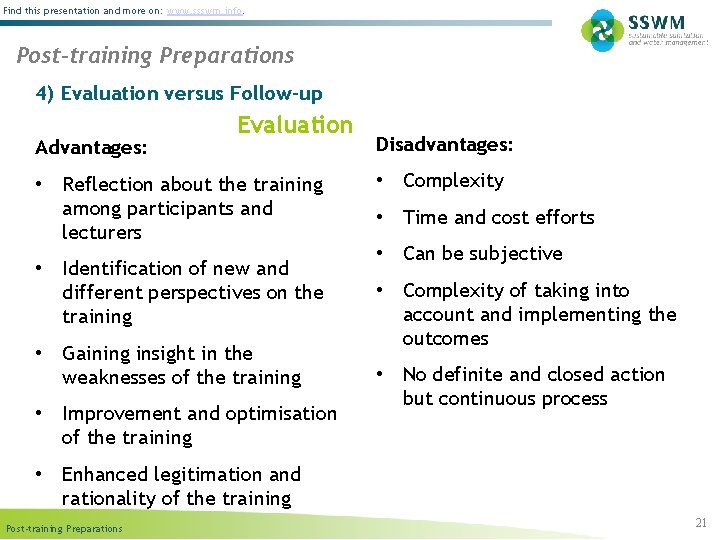
Find this presentation and more on: www. ssswm. info. Post-training Preparations 4) Evaluation versus Follow-up Advantages: Evaluation • Reflection about the training among participants and lecturers • Identification of new and different perspectives on the training • Gaining insight in the weaknesses of the training • Improvement and optimisation of the training Disadvantages: • Complexity • Time and cost efforts • Can be subjective • Complexity of taking into account and implementing the outcomes • No definite and closed action but continuous process • Enhanced legitimation and rationality of the training Post-training Preparations 21
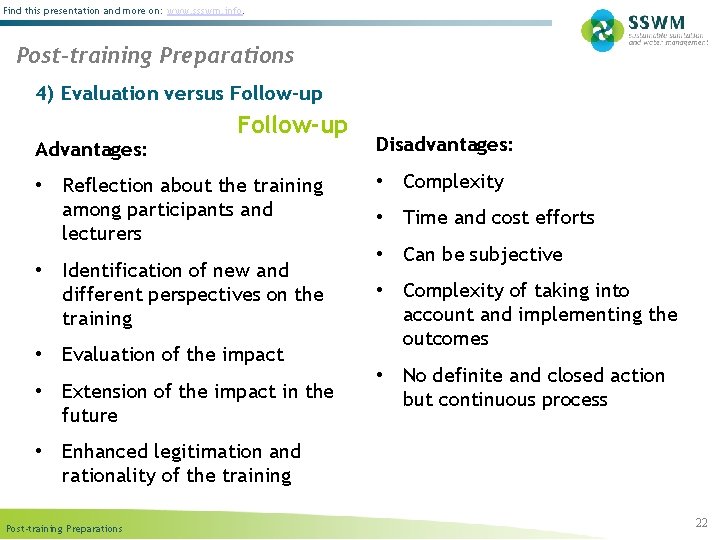
Find this presentation and more on: www. ssswm. info. Post-training Preparations 4) Evaluation versus Follow-up Advantages: Follow-up • Reflection about the training among participants and lecturers • Identification of new and different perspectives on the training • Evaluation of the impact • Extension of the impact in the future Disadvantages: • Complexity • Time and cost efforts • Can be subjective • Complexity of taking into account and implementing the outcomes • No definite and closed action but continuous process • Enhanced legitimation and rationality of the training Post-training Preparations 22
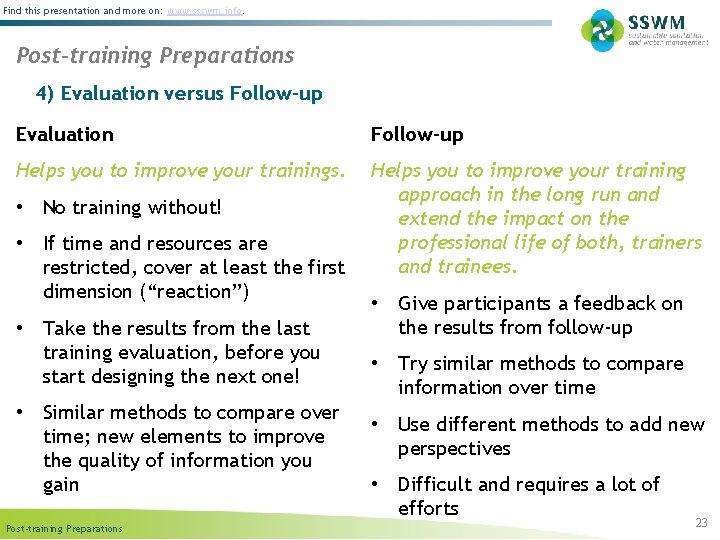
Find this presentation and more on: www. ssswm. info. Post-training Preparations 4) Evaluation versus Follow-up Evaluation Follow-up Helps you to improve your trainings. Helps you to improve your training approach in the long run and extend the impact on the professional life of both, trainers and trainees. • No training without! • If time and resources are restricted, cover at least the first dimension (“reaction”) • Take the results from the last training evaluation, before you start designing the next one! • Similar methods to compare over time; new elements to improve the quality of information you gain Post-training Preparations • Give participants a feedback on the results from follow-up • Try similar methods to compare information over time • Use different methods to add new perspectives • Difficult and requires a lot of efforts 23
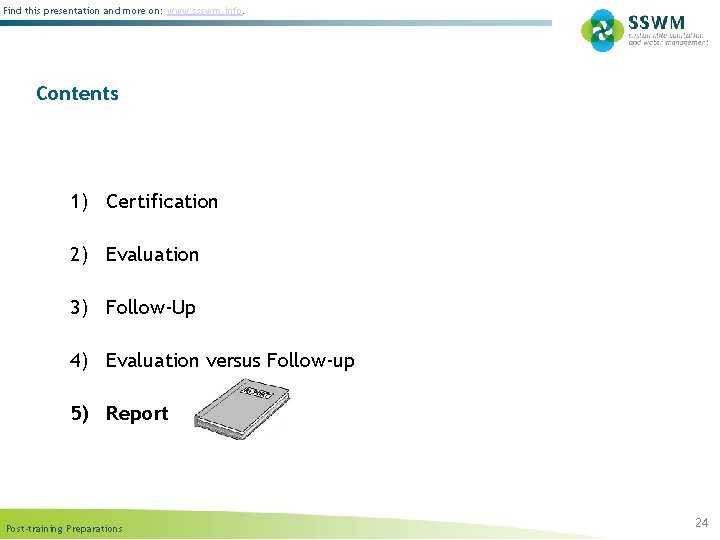
Find this presentation and more on: www. ssswm. info. Contents 1) Certification 2) Evaluation 3) Follow-Up 4) Evaluation versus Follow-up 5) Report Post-training Preparations 24
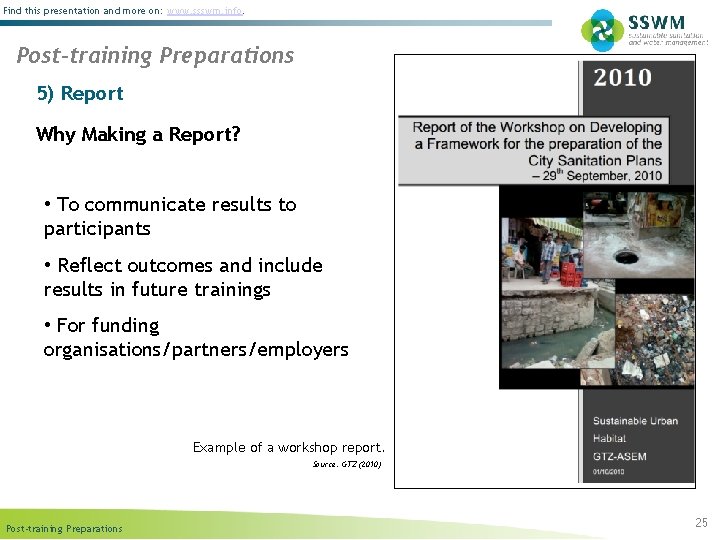
Find this presentation and more on: www. ssswm. info. Post-training Preparations 5) Report Why Making a Report? • To communicate results to participants • Reflect outcomes and include results in future trainings • For funding organisations/partners/employers Example of a workshop report. Source: GTZ (2010) Post-training Preparations 25
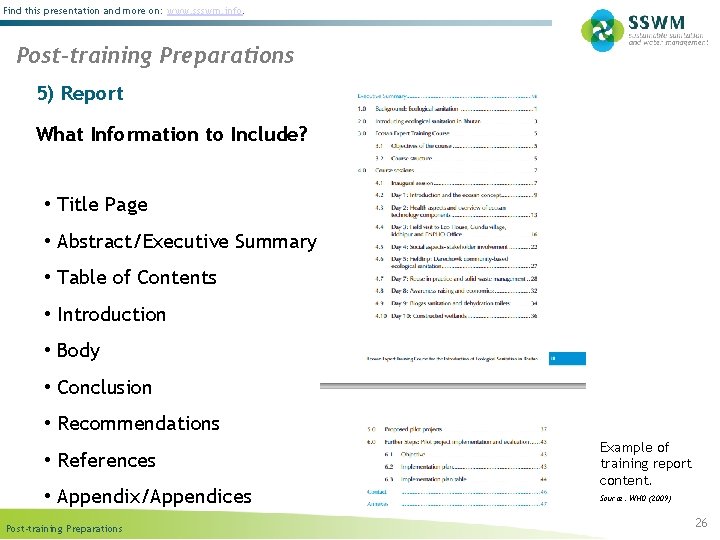
Find this presentation and more on: www. ssswm. info. Post-training Preparations 5) Report What Information to Include? • Title Page • Abstract/Executive Summary • Table of Contents • Introduction • Body • Conclusion • Recommendations • References • Appendix/Appendices Post-training Preparations Example of training report content. Source: WHO (2009) 26
Find this presentation and more on: www. ssswm. info. References GTZ (Editor) (2010): Report of the Workshop on Developing a Framework for the preparation of the City Sanitation Plans. 29 th September 2010 in New Delhi. Eschborn: Deutsche Gesellschaft für Technische Zusammenarbeit (GTZ). GREENAWAY, R. (2010): Course Evaluation Methods. Stirling: Greenaway. URL: http: //reviewing. co. uk/evaluation/methods 1. htm [Accessed 14. 04. 2010] LOOMIS, M. (2007): Making your trainings more effective. Durham: Family Health International. URL: http: //siteresources. worldbank. org/DEVMARKETPLACE/-Resources/Presentation 2_Next. Steps. pdf [Accessed 21. 05. 2010] RAE, L (2004): Evaluation of training and learning. Leicester: Business Balls. URL: http: //www. businessballs. com/trainingevaluationtools. pdf [Accessed 21. 05. 2010] WHO (Editor) (2009): Ecosan Expert Training Course for the Introduction of Ecological Sanitation in Bhutan. Geneva: World Health Organisation. Post-training Preparations 27
“Linking up Sustainable Sanitation, Water Management & Agriculture” SSWM is an initiative supported by: Created by: Pre-training Preparations 28
- Slides: 28