
Postpartum IUD Insertion Training Lisa Goldthwaite MD MPH

- Slides: 13
Postpartum IUD Insertion Training Lisa Goldthwaite, MD, MPH Paul Blumenthal, MD, MPH Stanford University Division of Family Planning Services and Research Kristina Tocce, MD, MPH The University of Colorado Division of Family Planning
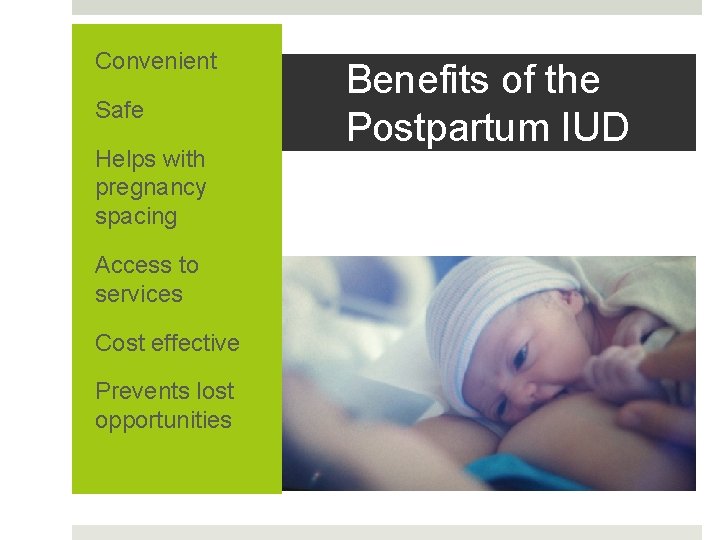
Convenient Safe Helps with pregnancy spacing Access to services Cost effective Prevents lost opportunities Benefits of the Postpartum IUD
PPIUD: Definitions Postplacental insertion (“Delivery Room Insertion”) When the IUD is inserted within 10 minutes after the expulsion of the placenta following a vaginal delivery Immediate postpartum insertion (“Morning After Delivery Insertion”) When the IUD is inserted after the postplacental period but within 48 -72 hours of a vaginal delivery Trans-cesarean insertion When the insertion takes place following a cesarean delivery, before the uterine incision is closed Interval insertion Insertion of the IUD at ≥ 4 weeks postpartum
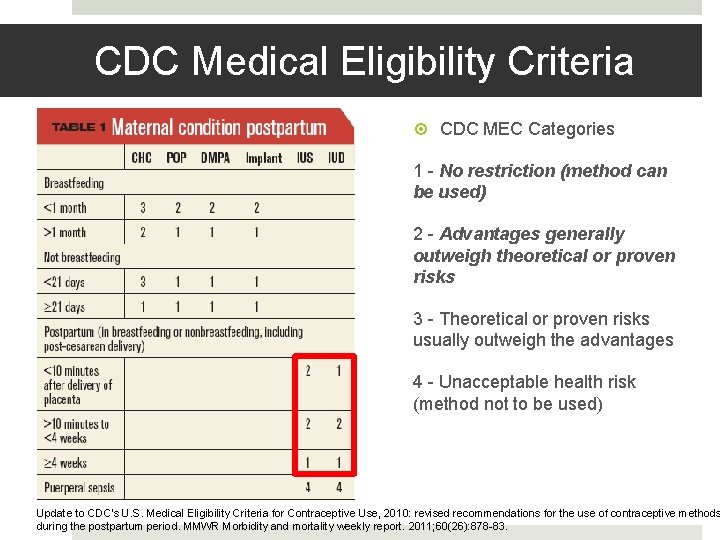
CDC Medical Eligibility Criteria CDC MEC Categories 1 - No restriction (method can be used) 2 - Advantages generally outweigh theoretical or proven risks 3 - Theoretical or proven risks usually outweigh the advantages 4 - Unacceptable health risk (method not to be used) Update to CDC's U. S. Medical Eligibility Criteria for Contraceptive Use, 2010: revised recommendations for the use of contraceptive methods during the postpartum period. MMWR Morbidity and mortality weekly report. 2011; 60(26): 878 -83.
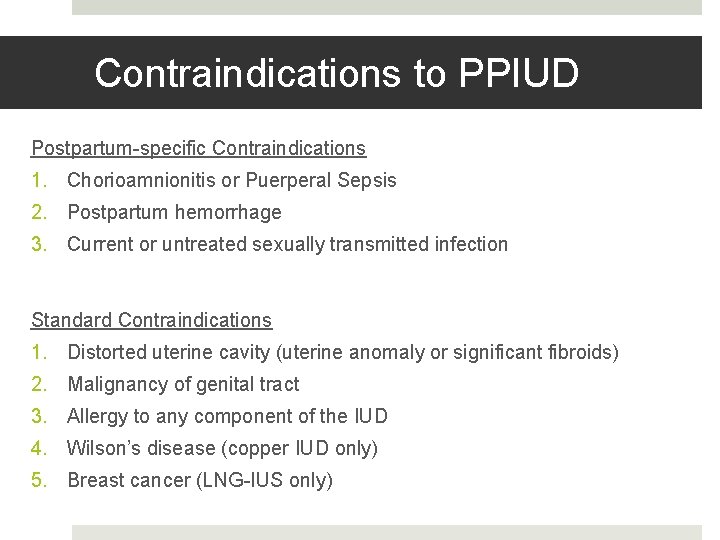
Contraindications to PPIUD Postpartum-specific Contraindications 1. Chorioamnionitis or Puerperal Sepsis 2. Postpartum hemorrhage 3. Current or untreated sexually transmitted infection Standard Contraindications 1. Distorted uterine cavity (uterine anomaly or significant fibroids) 2. Malignancy of genital tract 3. Allergy to any component of the IUD 4. Wilson’s disease (copper IUD only) 5. Breast cancer (LNG-IUS only)
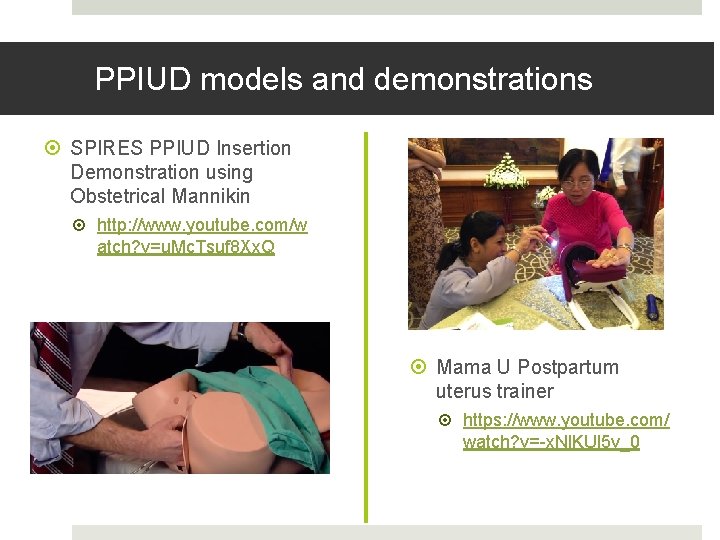
PPIUD models and demonstrations SPIRES PPIUD Insertion Demonstration using Obstetrical Mannikin http: //www. youtube. com/w atch? v=u. Mc. Tsuf 8 Xx. Q Mama U Postpartum uterus trainer https: //www. youtube. com/ watch? v=-x. Nl. KUl 5 v_0
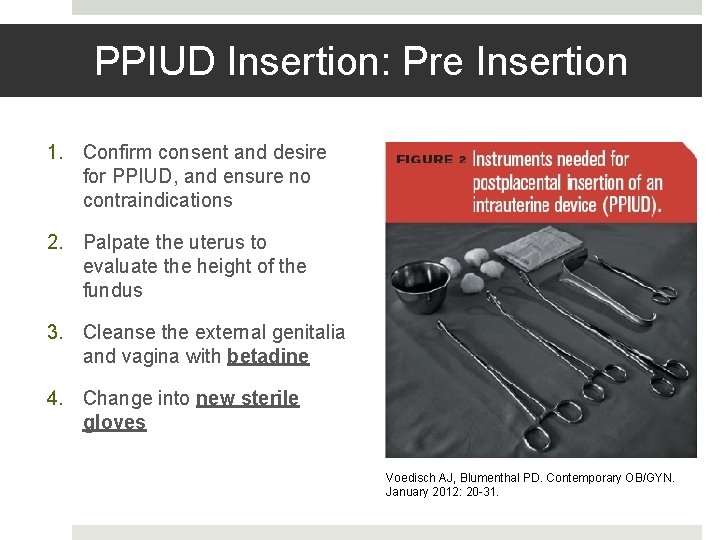
PPIUD Insertion: Pre Insertion 1. Confirm consent and desire for PPIUD, and ensure no contraindications 2. Palpate the uterus to evaluate the height of the fundus 3. Cleanse the external genitalia and vagina with betadine 4. Change into new sterile gloves Voedisch AJ, Blumenthal PD. Contemporary OB/GYN. January 2012: 20 -31.
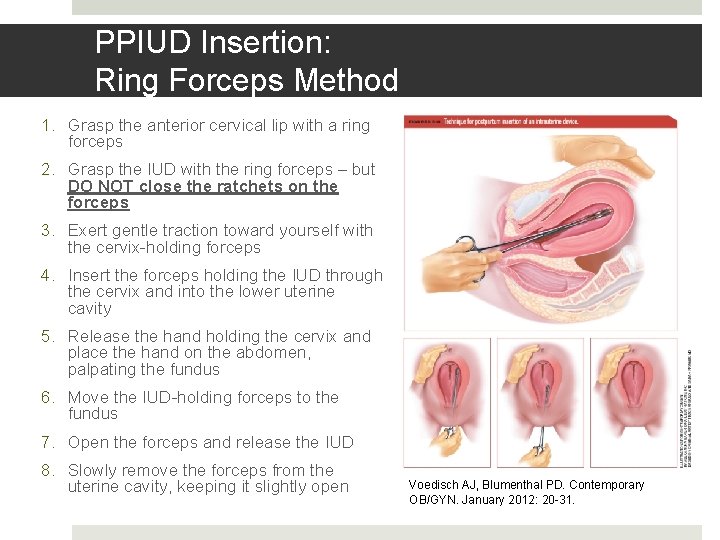
PPIUD Insertion: Ring Forceps Method 1. Grasp the anterior cervical lip with a ring forceps 2. Grasp the IUD with the ring forceps – but DO NOT close the ratchets on the forceps 3. Exert gentle traction toward yourself with the cervix-holding forceps 4. Insert the forceps holding the IUD through the cervix and into the lower uterine cavity 5. Release the hand holding the cervix and place the hand on the abdomen, palpating the fundus 6. Move the IUD-holding forceps to the fundus 7. Open the forceps and release the IUD 8. Slowly remove the forceps from the uterine cavity, keeping it slightly open Voedisch AJ, Blumenthal PD. Contemporary OB/GYN. January 2012: 20 -31.
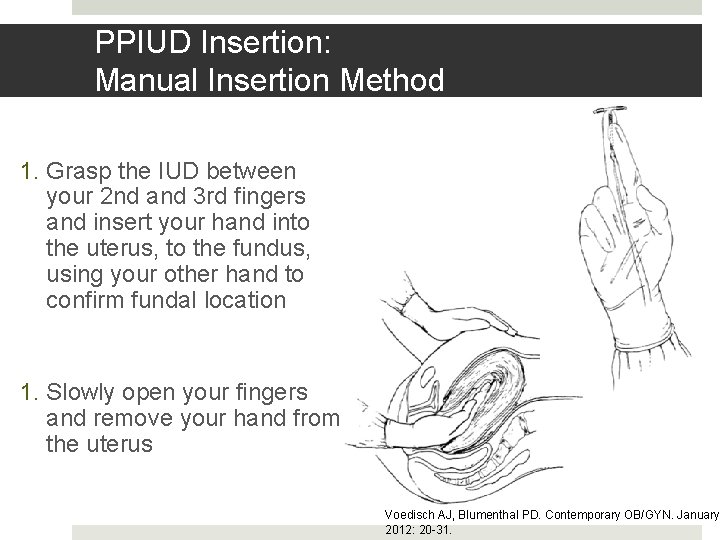
PPIUD Insertion: Manual Insertion Method 1. Grasp the IUD between your 2 nd and 3 rd fingers and insert your hand into the uterus, to the fundus, using your other hand to confirm fundal location 1. Slowly open your fingers and remove your hand from the uterus Voedisch AJ, Blumenthal PD. Contemporary OB/GYN. January 2012: 20 -31.
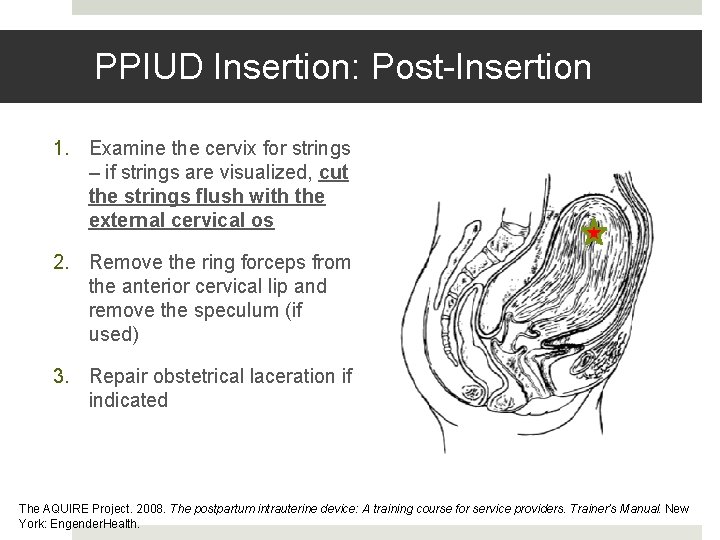
PPIUD Insertion: Post-Insertion 1. Examine the cervix for strings – if strings are visualized, cut the strings flush with the external cervical os 2. Remove the ring forceps from the anterior cervical lip and remove the speculum (if used) 3. Repair obstetrical laceration if indicated The AQUIRE Project. 2008. The postpartum intrauterine device: A training course for service providers. Trainer’s Manual. New York: Engender. Health.
Trans-cesarean IUD Insertion 1. After delivery of the infant and placenta, massage the uterus 2. Perform routine sweep 3. Place the IUD at the fundus 4. Place the IUD strings in the lower uterine segment near the internal cervical os. DO NOT pass the strings through the cervix as this may increase the risk of infection, but ok to trim the strings to the length of the cavity 5. Close the hysterotomy in the standard fashion, taking care not to incorporate the IUD strings into the uterine closure
Complications Insertion Related Uterine perforation Cervical injury Severe pain Vasovagal reaction Post-insertion Expulsion Infection Bothersome bleeding Cramping Malposition Missing strings Partner complaints about strings Failure (pregnancy)
QUESTIONS?