
POSTPARTUM DEPRESSION Educational pamphlet for Greater Lawrence Family

- Slides: 23
POSTPARTUM DEPRESSION: Educational pamphlet for Greater Lawrence Family Health Center perinatal patients Elizandra Adams Capstone Practicum Project RN to BSN Program Saint Anselm College
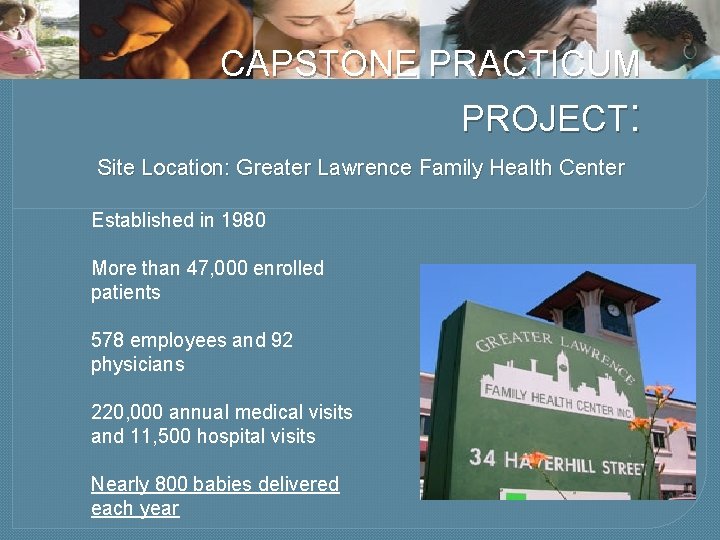
CAPSTONE PRACTICUM PROJECT: Site Location: Greater Lawrence Family Health Center Established in 1980 More than 47, 000 enrolled patients 578 employees and 92 physicians 220, 000 annual medical visits and 11, 500 hospital visits Nearly 800 babies delivered each year
GREATER LAWRENCE FAMILY HEALTH CENTER : LAWRENCE, MA -PROFILE � Nearly 74% of the city’s 76, 377 residents are Latinos � 27. 3% live at or below federal poverty levels � Lowest per capita income in Massachusetts ($15, 913) � 35. 2% of city residents never completed high school � English fluency is reported by only 49% of the community
GREATER LAWRENCE FAMILY HEALTH CENTER : LAWRENCE, MA -PROFILE � 90% of Lawrence school children are minorities � 24. 2% of students have limited English proficiency � Elevated rates of teenage pregnancy � Elevated rates of substance abuse
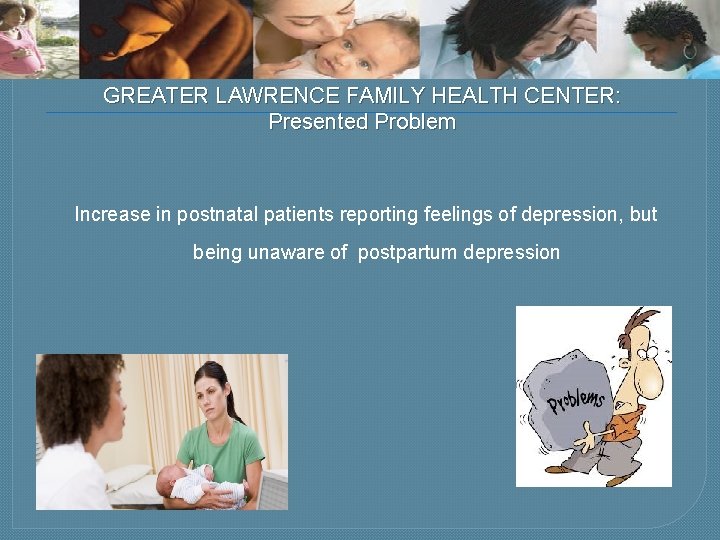
GREATER LAWRENCE FAMILY HEALTH CENTER: Presented Problem Increase in postnatal patients reporting feelings of depression, but being unaware of postpartum depression
GREATER LAWRENCE FAMILY HEALTH CENTER: Project Outcome/Goal Educate childbearing age patients about postpartum depression so if they experience PPD, it will known.
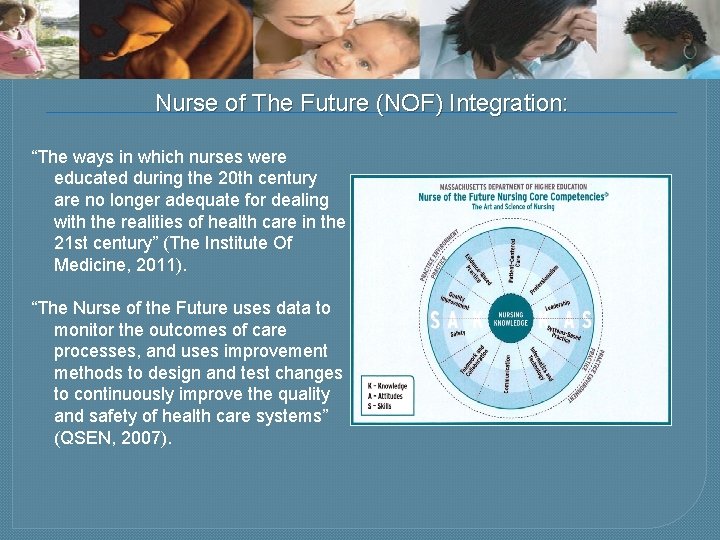
Nurse of The Future (NOF) Integration: “The ways in which nurses were educated during the 20 th century are no longer adequate for dealing with the realities of health care in the 21 st century” (The Institute Of Medicine, 2011). “The Nurse of the Future uses data to monitor the outcomes of care processes, and uses improvement methods to design and test changes to continuously improve the quality and safety of health care systems” (QSEN, 2007).
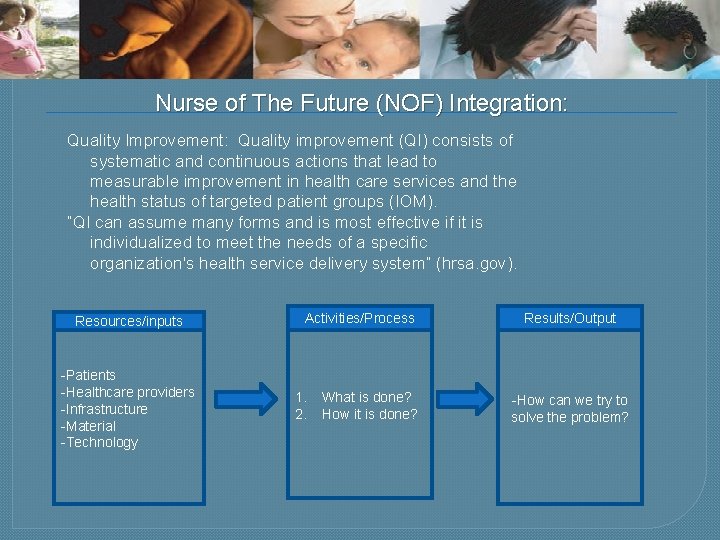
Nurse of The Future (NOF) Integration: Quality Improvement: Quality improvement (QI) consists of systematic and continuous actions that lead to measurable improvement in health care services and the health status of targeted patient groups (IOM). “QI can assume many forms and is most effective if it is individualized to meet the needs of a specific organization's health service delivery system” (hrsa. gov). Resources/inputs -Patients -Healthcare providers -Infrastructure -Material -Technology Activities/Process 1. 2. What is done? How it is done? Results/Output -How can we try to solve the problem?
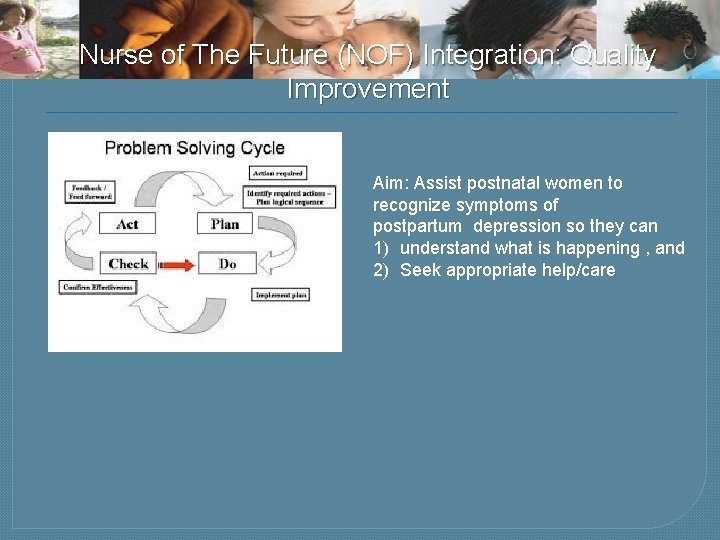
Nurse of The Future (NOF) Integration: Quality Improvement Aim: Assist postnatal women to recognize symptoms of postpartum depression so they can 1) understand what is happening , and 2) Seek appropriate help/care
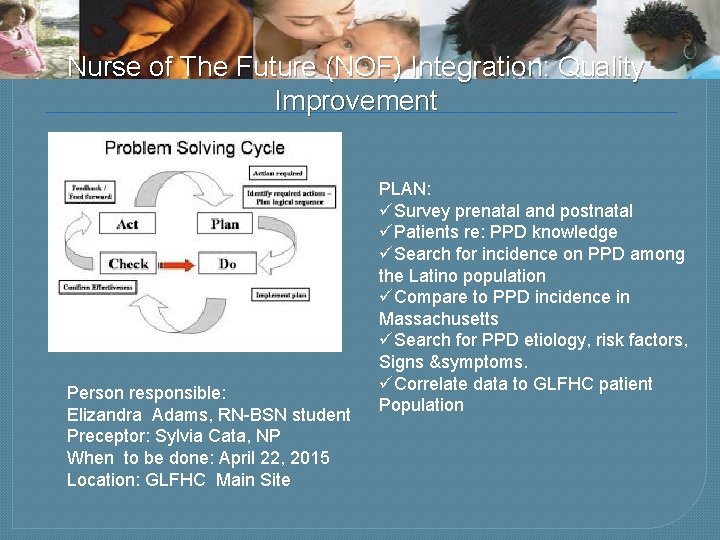
Nurse of The Future (NOF) Integration: Quality Improvement Person responsible: Elizandra Adams, RN-BSN student Preceptor: Sylvia Cata, NP When to be done: April 22, 2015 Location: GLFHC Main Site PLAN: üSurvey prenatal and postnatal üPatients re: PPD knowledge üSearch for incidence on PPD among the Latino population üCompare to PPD incidence in Massachusetts üSearch for PPD etiology, risk factors, Signs &symptoms. üCorrelate data to GLFHC patient Population
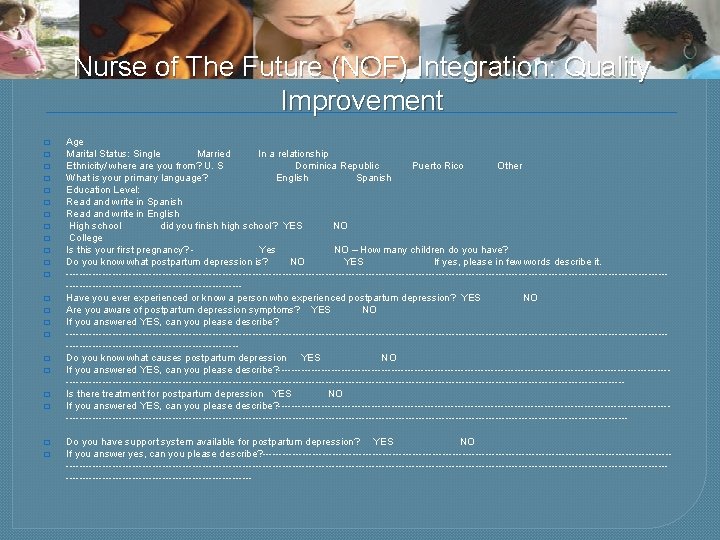
Nurse of The Future (NOF) Integration: Quality Improvement � � � � � � Age Marital Status: Single Married In a relationship Ethnicity/ where are you from? U. S Dominica Republic Puerto Rico Other What is your primary language? English Spanish Education Level: Read and write in Spanish Read and write in English High school did you finish high school? YES NO College Is this your first pregnancy? Yes NO – How many children do you have? Do you know what postpartum depression is? NO YES If yes, please in few words describe it. --------------------------------------------------------------------------------------------------------------------Have you ever experienced or know a person who experienced postpartum depression? YES NO Are you aware of postpartum depression symptoms? YES NO If you answered YES, can you please describe? --------------------------------------------------------------------------------------------------------------------Do you know what causes postpartum depression YES NO If you answered YES, can you please describe? ----------------------------------------------------------------------------------------------------------------------------------------------Is there treatment for postpartum depression YES NO If you answered YES, can you please describe? -----------------------------------------------------------------------------------------------------------------------------------------------Do you have support system available for postpartum depression? YES NO If you answer yes, can you please describe? -----------------------------------------------------------------------------------------------------------------------------------------------------------------------------------
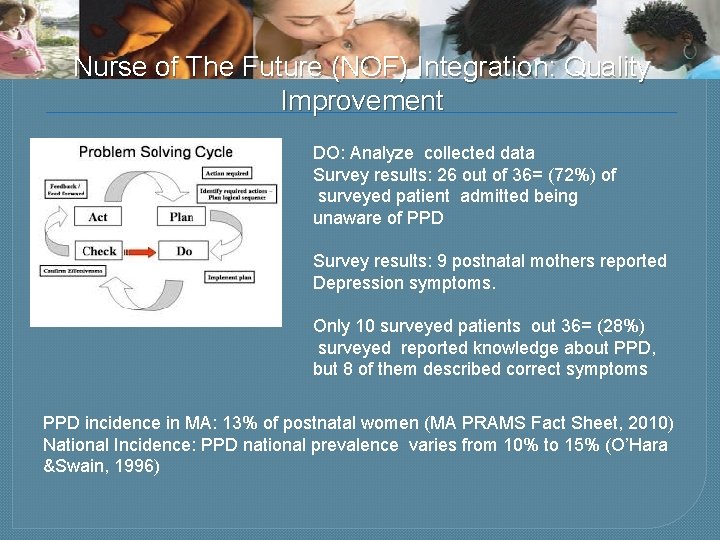
Nurse of The Future (NOF) Integration: Quality Improvement DO: Analyze collected data Survey results: 26 out of 36= (72%) of surveyed patient admitted being unaware of PPD Survey results: 9 postnatal mothers reported Depression symptoms. Only 10 surveyed patients out 36= (28%) surveyed reported knowledge about PPD, but 8 of them described correct symptoms PPD incidence in MA: 13% of postnatal women (MA PRAMS Fact Sheet, 2010) National Incidence: PPD national prevalence varies from 10% to 15% (O’Hara &Swain, 1996)
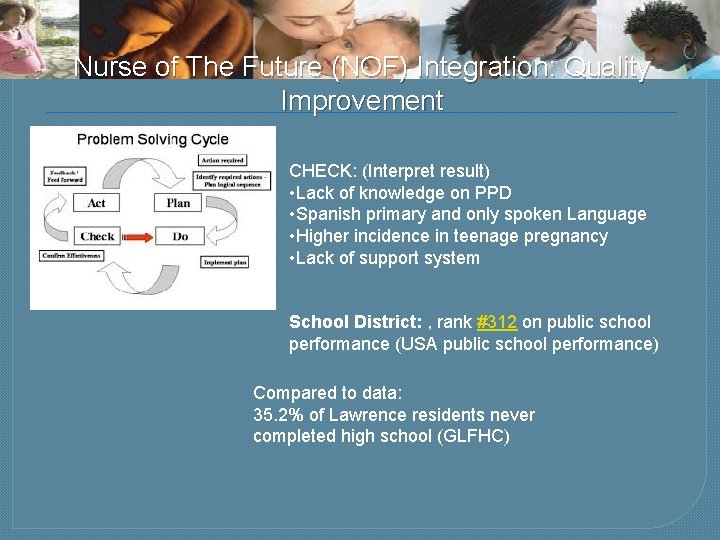
Nurse of The Future (NOF) Integration: Quality Improvement CHECK: (Interpret result) • Lack of knowledge on PPD • Spanish primary and only spoken Language • Higher incidence in teenage pregnancy • Lack of support system School District: , rank #312 on public school performance (USA public school performance) Compared to data: 35. 2% of Lawrence residents never completed high school (GLFHC)
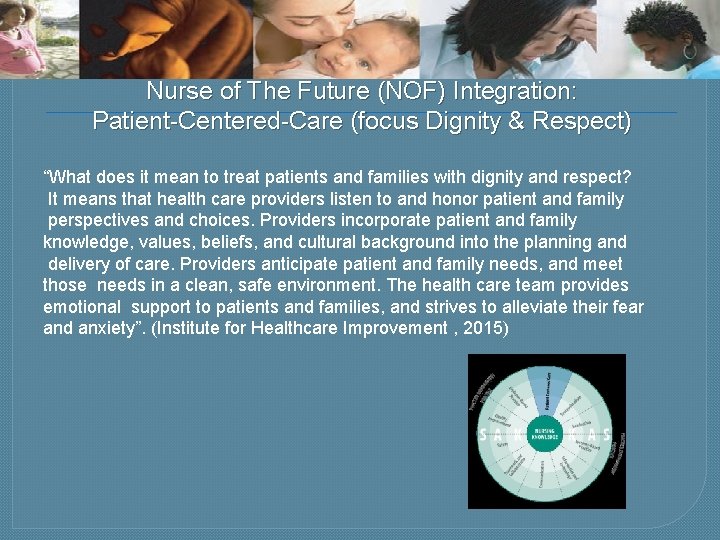
Nurse of The Future (NOF) Integration: Patient-Centered-Care (focus Dignity & Respect) “What does it mean to treat patients and families with dignity and respect? It means that health care providers listen to and honor patient and family perspectives and choices. Providers incorporate patient and family knowledge, values, beliefs, and cultural background into the planning and delivery of care. Providers anticipate patient and family needs, and meet those needs in a clean, safe environment. The health care team provides emotional support to patients and families, and strives to alleviate their fear and anxiety”. (Institute for Healthcare Improvement , 2015)
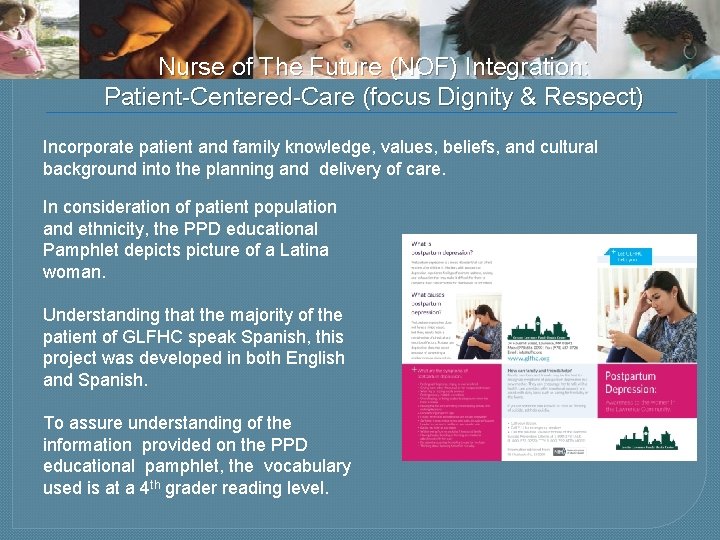
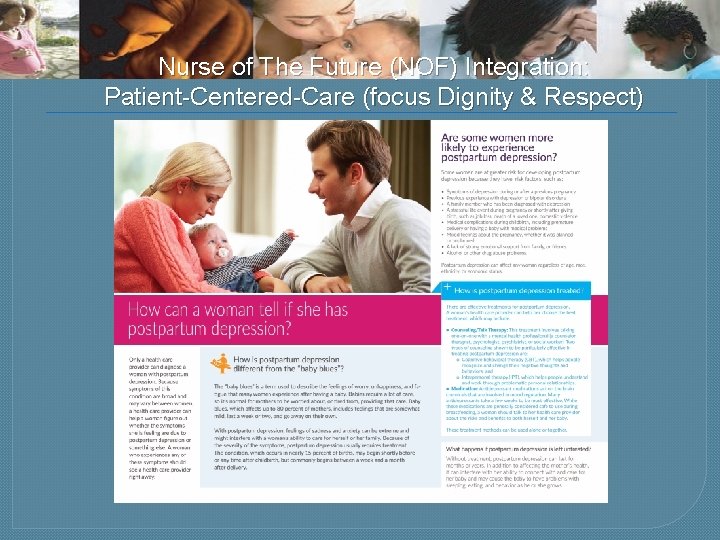
Nurse of The Future (NOF) Integration: Patient-Centered-Care (focus Dignity & Respect) Incorporate patient and family knowledge, values, beliefs, and cultural background into the planning and delivery of care. In consideration of patient population and ethnicity, the PPD educational Pamphlet depicts picture of a Latina woman. Understanding that the majority of the patient of GLFHC speak Spanish, this project was developed in both English and Spanish. To assure understanding of the information provided on the PPD educational pamphlet, the vocabulary used is at a 4 th grader reading level.
Nurse of The Future (NOF) Integration: Patient-Centered-Care (focus Dignity & Respect)
Why is so important to educate perinatal women on PPD? � New mothers do not know what to expect � Women with PPD have strong feelings of sadness, anxiety or despair which can interfere with their daily tasks � PPD can impact the health of the infants and the mother and requirements and requires treatment. � PPD increase the chances form maternal substance abuse � Co-Morbidity
Why is so important to educate perinatal women on PPD? � Compromised parenting � Reduce attachment � Higher stress levels � Can potentially effect brain development � Jeopardize infant language � Increase prevalence of behaviors disorders in older children
Facilitators Patients willing to answer PPD survey Health Care Providers willing to apply PPD survey Elizabeth Reinke who is the GLFHC Maternal Health Coordinator Sylvia Cata- NP (my preceptor) Kelmy Rosado – Graphic Designer
Barriers • Cost of printing educational material • Satisfied with the status quo • Not enough mental health care providers in the community • Lack of PPD support group in the community • Only 15 minutes per office visit
Project Implementation& Measures Pilot scheduled to Start May, 5 2015 in celebration of Mother’s Day Results of this project will be measured in 3 months from the implementation date, through Midas Touch Report. Greater Lawrence Family Health Center will report number of patient diagnosed with PPD to DPH, as part of The Act Relative to Postpartum Depression (PPD): Chapter 313 of the Acts of 2010, signed into law by Deval Patrick on August 19, 2010
QUESTIONS?
REFERENCES” American Association of Colleges of Nursing (2008). Three Essentials of Baccalaureate Education for Professional Nursing Practice (2 nd ed. ). Washington DC http: //www. apa. org/pi/women/programs/depression/postpartum. aspx Centers for Disease Control and Prevention. Prevalence of self-reported postpartum depressive symptoms--17 states, 2004 -2005. MMWR. Morbidity and mortality weekly report. Apr 11 2008; 57(14): 361 -366. Greater Lawrence Family Health Center website (About us). U. S. Department of Health and Humans Service. (2010). Quality Improvement. Retrieved from http: //www. hrsa. gov/quality/toolbox/methodology/qualityimprovement/ Ko JY, Farr SL, Dietz PM, Robbins CL. Depression and treatment among U. S. pregnant and nonpregnant women of reproductive age, 2005 -2009. Journal of women’s health. Aug 2012; 21(8): 830 -836. O’Hara MW. Postpartum depression: what we know. Journal of clinical psychology. Dec 2009; 65(12): 1258 -1269. Massachusetts Department of Higher Education Nurse of the Future Competency Committee. (2010) Retrieved from : the Future Competency Committee. (2010). Retrieved from : http: //www. iom. edu/~/media/Files/Report%20 Files/2010/The-Future-of. Nursing/Nursing%20 Scope%20 of%20 Practice%202010%20 Brief. pdf Nurse of the future nursing core competencies. Boston: Massachusetts Department of Higher Education. Substance Abuse and Mental Health Services Administration, Results from the 2011 National Survey on Drug Use and Health: Mental Health Findings, NSDUH Series H-45, HHS Publication No. (SMA) 12 -4725. Rockville, MD: Substance Abuse and Mental Health Services Administration, 2012. .