
PostOperative IntraAbdominal Abscess after Appendectomy Are Drains Necessary
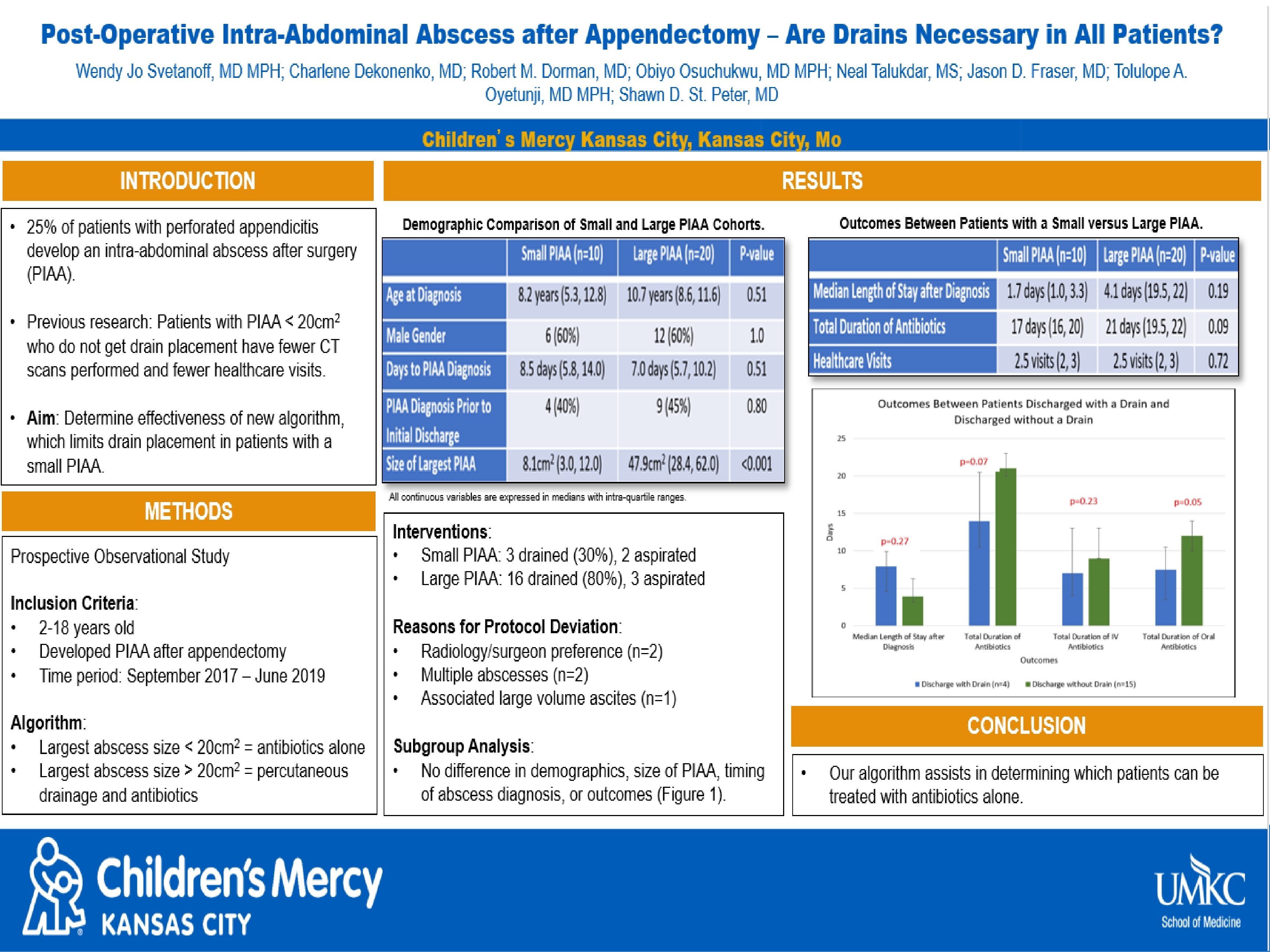
Post-Operative Intra-Abdominal Abscess after Appendectomy – Are Drains Necessary in All Patients? Wendy Jo Svetanoff, MD MPH; Charlene Dekonenko, MD; Robert M. Dorman, MD; Obiyo Osuchukwu, MD MPH; Neal Talukdar, MS; Jason D. Fraser, MD; Tolulope A. Oyetunji, MD MPH; Shawn D. St. Peter, MD Children’s Mercy Kansas City, Mo INTRODUCTION • 25% of patients with perforated appendicitis develop an intra-abdominal abscess after surgery (PIAA). RESULTS Outcomes Between Patients with a Small versus Large PIAA. Demographic Comparison of Small and Large PIAA Cohorts. • Previous research: Patients with PIAA < 20 cm 2 who do not get drain placement have fewer CT scans performed and fewer healthcare visits. • Aim: Determine effectiveness of new algorithm, which limits drain placement in patients with a small PIAA. METHODS Prospective Observational Study Inclusion Criteria: • 2 -18 years old • Developed PIAA after appendectomy • Time period: September 2017 – June 2019 Algorithm: • Largest abscess size < 20 cm 2 = antibiotics alone • Largest abscess size > 20 cm 2 = percutaneous drainage and antibiotics All continuous variables are expressed in medians with intra-quartile ranges. Interventions: • Small PIAA: 3 drained (30%), 2 aspirated • Large PIAA: 16 drained (80%), 3 aspirated Reasons for Protocol Deviation: • Radiology/surgeon preference (n=2) • Multiple abscesses (n=2) • Associated large volume ascites (n=1) Subgroup Analysis: • No difference in demographics, size of PIAA, timing of abscess diagnosis, or outcomes (Figure 1). CONCLUSION • Our algorithm assists in determining which patients can be treated with antibiotics alone.
- Slides: 1