
Postoperative gout flare after facial abscess of odontogenic
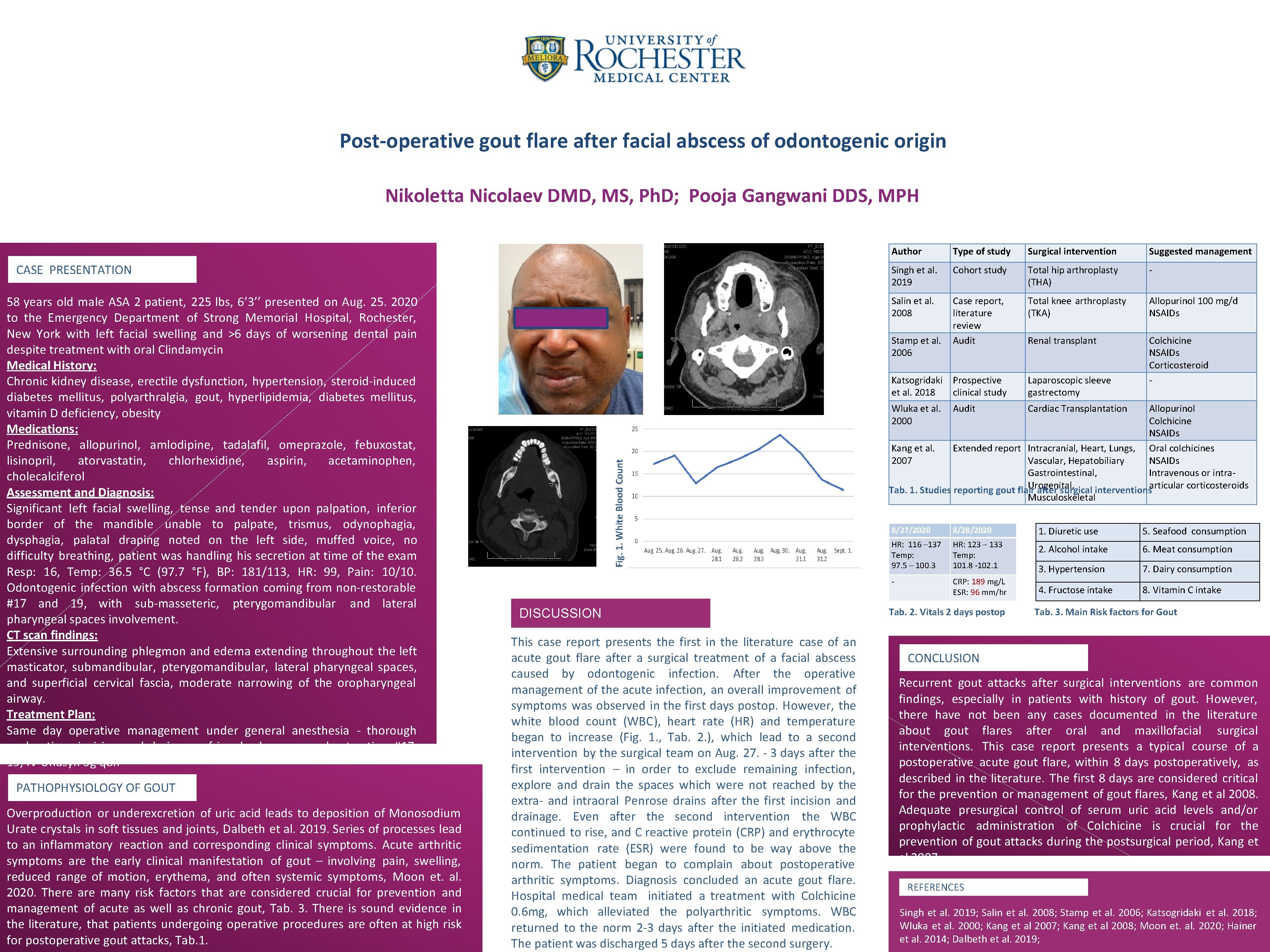
Post-operative gout flare after facial abscess of odontogenic origin Nikoletta Nicolaev DMD, MS, Ph. D; Pooja Gangwani DDS, MPH CASE PRESENTATION PATHOPHYSIOLOGY OF GOUT Overproduction or underexcretion of uric acid leads to deposition of Monosodium Urate crystals in soft tissues and joints, Dalbeth et al. 2019. Series of processes lead to an inflammatory reaction and corresponding clinical symptoms. Acute arthritic symptoms are the early clinical manifestation of gout – involving pain, swelling, reduced range of motion, erythema, and often systemic symptoms, Moon et. al. 2020. There are many risk factors that are considered crucial for prevention and management of acute as well as chronic gout, Tab. 3. There is sound evidence in the literature, that patients undergoing operative procedures are often at high risk for postoperative gout attacks, Tab. 1. Type of study Surgical intervention Suggested management Singh et al. 2019 Cohort study Total hip arthroplasty (THA) - Salin et al. 2008 Case report, literature review Audit Total knee arthroplasty (TKA) Allopurinol 100 mg/d NSAIDs Renal transplant Colchicine NSAIDs Corticosteroid - Stamp et al. 2006 Fig. 1. White Blood Count 58 years old male ASA 2 patient, 225 lbs, 6’ 3’’ presented on Aug. 25. 2020 to the Emergency Department of Strong Memorial Hospital, Rochester, New York with left facial swelling and >6 days of worsening dental pain despite treatment with oral Clindamycin Medical History: Chronic kidney disease, erectile dysfunction, hypertension, steroid-induced diabetes mellitus, polyarthralgia, gout, hyperlipidemia, diabetes mellitus, vitamin D deficiency, obesity Medications: Prednisone, allopurinol, amlodipine, tadalafil, omeprazole, febuxostat, lisinopril, atorvastatin, chlorhexidine, aspirin, acetaminophen, cholecalciferol Assessment and Diagnosis: Significant left facial swelling, tense and tender upon palpation, inferior border of the mandible unable to palpate, trismus, odynophagia, dysphagia, palatal draping noted on the left side, muffed voice, no difficulty breathing, patient was handling his secretion at time of the exam Resp: 16, Temp: 36. 5 °C (97. 7 °F), BP: 181/113, HR: 99, Pain: 10/10. Odontogenic infection with abscess formation coming from non-restorable #17 and 19, with sub-masseteric, pterygomandibular and lateral pharyngeal spaces involvement. CT scan findings: Extensive surrounding phlegmon and edema extending throughout the left masticator, submandibular, pterygomandibular, lateral pharyngeal spaces, and superficial cervical fascia, moderate narrowing of the oropharyngeal airway. Treatment Plan: Same day operative management under general anesthesia - thorough exploration, incision and drainage of involved spaces and extraction #17, 19; IV Unasyn 3 g q 8 h Author DISCUSSION This case report presents the first in the literature case of an acute gout flare after a surgical treatment of a facial abscess caused by odontogenic infection. After the operative management of the acute infection, an overall improvement of symptoms was observed in the first days postop. However, the white blood count (WBC), heart rate (HR) and temperature began to increase (Fig. 1. , Tab. 2. ), which lead to a second intervention by the surgical team on Aug. 27. - 3 days after the first intervention – in order to exclude remaining infection, explore and drain the spaces which were not reached by the extra- and intraoral Penrose drains after the first incision and drainage. Even after the second intervention the WBC continued to rise, and C reactive protein (CRP) and erythrocyte sedimentation rate (ESR) were found to be way above the norm. The patient began to complain about postoperative arthritic symptoms. Diagnosis concluded an acute gout flare. Hospital medical team initiated a treatment with Colchicine 0. 6 mg, which alleviated the polyarthritic symptoms. WBC returned to the norm 2 -3 days after the initiated medication. The patient was discharged 5 days after the second surgery. Katsogridaki Prospective et al. 2018 clinical study Laparoscopic sleeve gastrectomy Wluka et al. 2000 Audit Cardiac Transplantation 8/27/2020 8/28/2020 1. Diuretic use 5. Seafood consumption HR: 116 – 137 Temp: 97. 5 – 100. 3 HR: 123 – 133 Temp: 101. 8 -102. 1 2. Alcohol intake 6. Meat consumption 3. Hypertension 7. Dairy consumption - CRP: 189 mg/L ESR: 96 mm/hr 4. Fructose intake 8. Vitamin C intake Allopurinol Colchicine NSAIDs Kang et al. Extended report Intracranial, Heart, Lungs, Oral colchicines 2007 Vascular, Hepatobiliary NSAIDs Gastrointestinal, Intravenous or intra. Urogenital, Tab. 1. Studies reporting gout flair after surgical interventionsarticular corticosteroids Musculoskeletal Tab. 2. Vitals 2 days postop Tab. 3. Main Risk factors for Gout CONCLUSION Recurrent gout attacks after surgical interventions are common findings, especially in patients with history of gout. However, there have not been any cases documented in the literature about gout flares after oral and maxillofacial surgical interventions. This case report presents a typical course of a Patients w 8 days postoperatively, as postoperative acute gout flare, within described in the literature. The first 8 days are considered critical for the prevention or management of gout flares, Kang et al 2008. Adequate presurgical control of serum uric acid levels and/or prophylactic administration of Colchicine is crucial for the prevention of gout attacks during the postsurgical period, Kang et al 2007. REFERENCES Singh et al. 2019; Salin et al. 2008; Stamp et al. 2006; Katsogridaki et al. 2018; Wluka et al. 2000; Kang et al 2007; Kang et al 2008; Moon et. al. 2020; Hainer et al. 2014; Dalbeth et al. 2019;
- Slides: 1