
Postneodarwinistic Theories of Evolution From the Selfish Gene
- Slides: 34
Postneodarwinistic Theories of Evolution - From the Selfish Gene to Frozen Evolution Jaroslav Flegr Department of philosophy and history of science Prague 2008
Outline • Darwinisms, neodarwinisms and evolution of adaptive traits by means of natural selection • Model of selfish gene – a theory of evolution of adaptive traits in sexual organisms • Shortcomings of theory of selfish gene – Context-dependent phenotypic expression of gene (epistasis) – Context-dependent impact of biological trait on biological fitness – Frequency dependent selection (ESS) • Theory of frozen plasticity
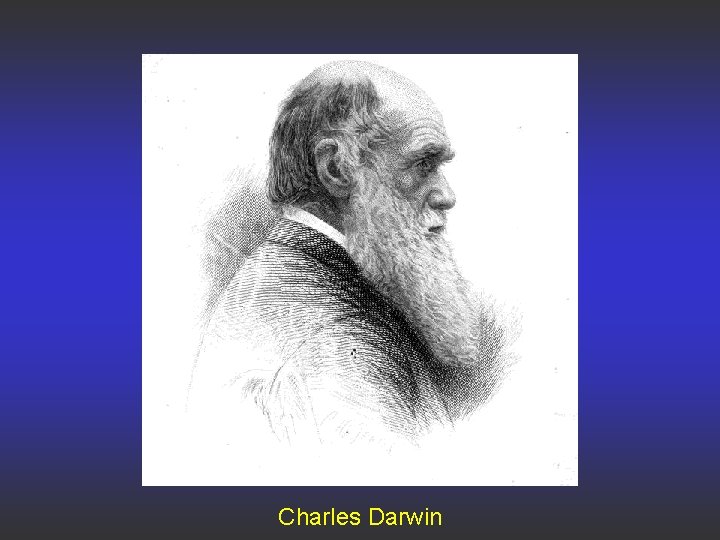
Charles Darwin
Darwinistic explanation of the origin of adaptive traits • An average number of offspring/parent > 1 • Populations are stable in a long term • Therefore, only a fraction of the young survive and reproduce • Organisms in populations differ • Probability of survival and reproduction (fitness) depends on properties of an individual • Offspring inherit properties and fitness of their parents • Therefore, useful (adaptive) traits (structures and behavioral patterns accumulate in populations
What is wrong with darwinistic theory of origin of adaptations? • An average number of offspring/parent > 1 • Populations are stable in a long term • Therefore, only a fraction of the young survive and reproduce • Organisms in populations differ • Probability of survival and reproduction (fitness) depends on properties of an individual • Offspring inherit properties and fitness of their parents • Therefore, useful (adaptive) traits (structures and behavioral patterns accumulate in populations
What is wrong with darwinistic theory of origin of adaptations? • An average number of offspring/parent > 1 • Populations are stable in a long term • Therefore, only a fraction of the young survive and reproduce • Organisms in populations differ • Probability of survival and reproduction (fitness) depends on properties of an individual • Offspring inherit properties and fitness of their parents • Therefore, useful (adaptive) traits (structures and behavioral patterns accumulate in populations
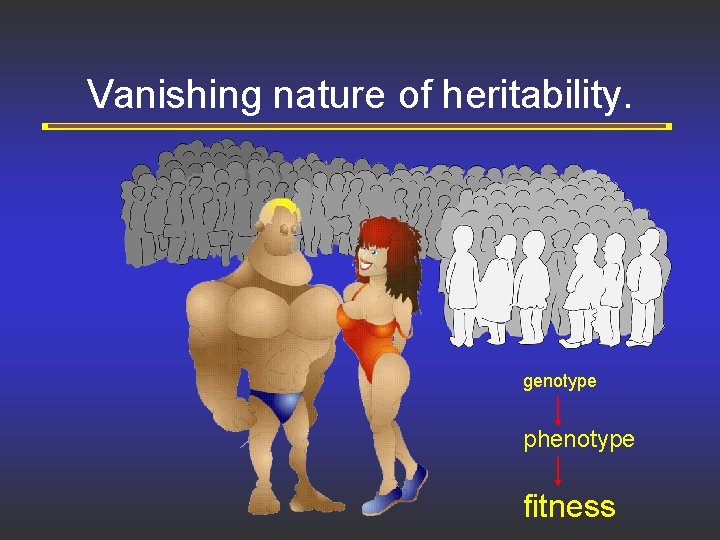
Vanishing nature of heritability. genotype phenotype fitness
Richard Dawkins
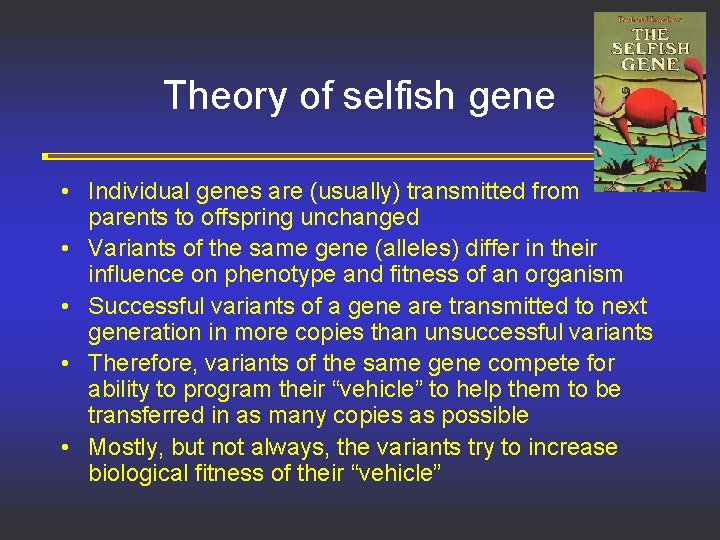
Theory of selfish gene • Individual genes are (usually) transmitted from parents to offspring unchanged • Variants of the same gene (alleles) differ in their influence on phenotype and fitness of an organism • Successful variants of a gene are transmitted to next generation in more copies than unsuccessful variants • Therefore, variants of the same gene compete for ability to program their “vehicle” to help them to be transferred in as many copies as possible • Mostly, but not always, the variants try to increase biological fitness of their “vehicle”
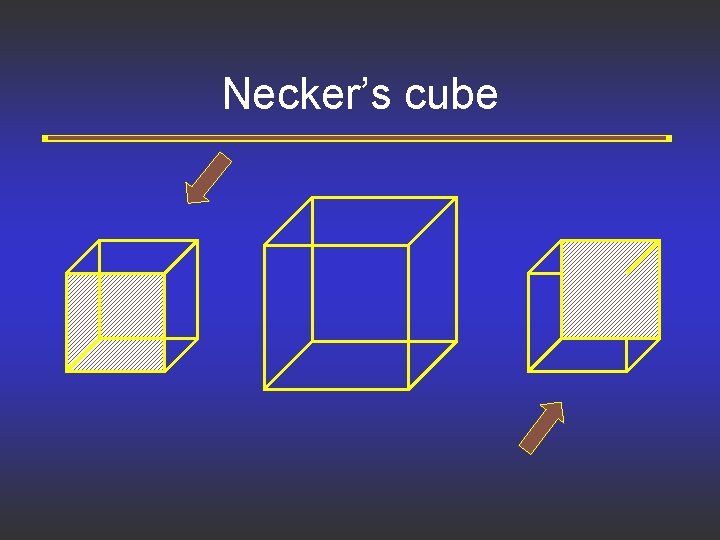
Necker’s cube
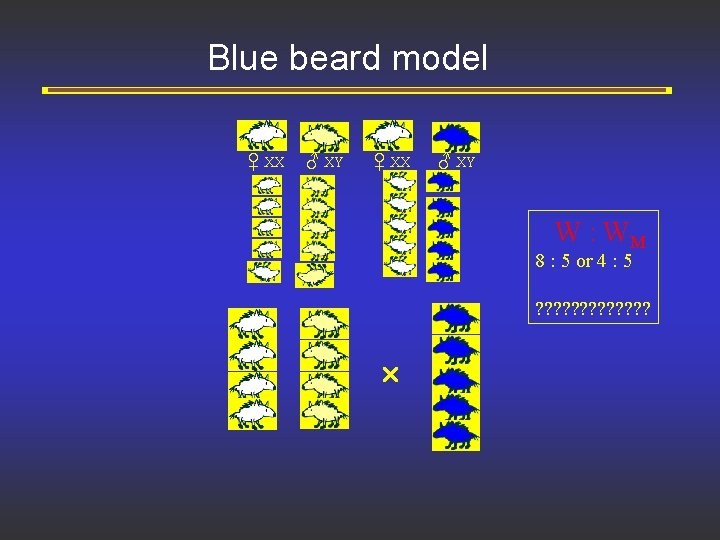
Blue beard model ♀ XX ♂ XY W : WM 8 : 5 or 4 : 5 ? ? ? ?
Theory of selfish gene • Explains origin of adaptations in sexual organisms • Explains evolutionary origin and success of “blue beard” genes • Explains evolutionary origin and success of an important category of altruistic traits – Under certain conditions, an organism could transmit more copies of its genes by helping in reproduction to its relatives than by its own reproduction (helpers, bees, ants)
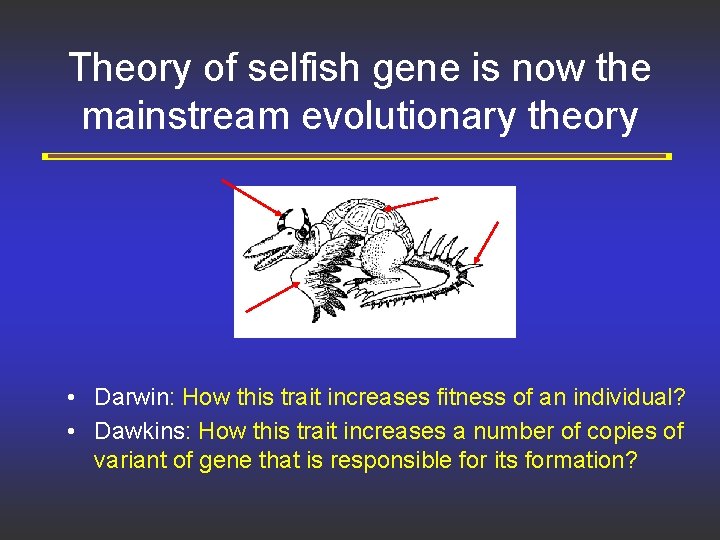
Theory of selfish gene is now the mainstream evolutionary theory • Darwin: How this trait increases fitness of an individual? • Dawkins: How this trait increases a number of copies of variant of gene that is responsible for its formation?
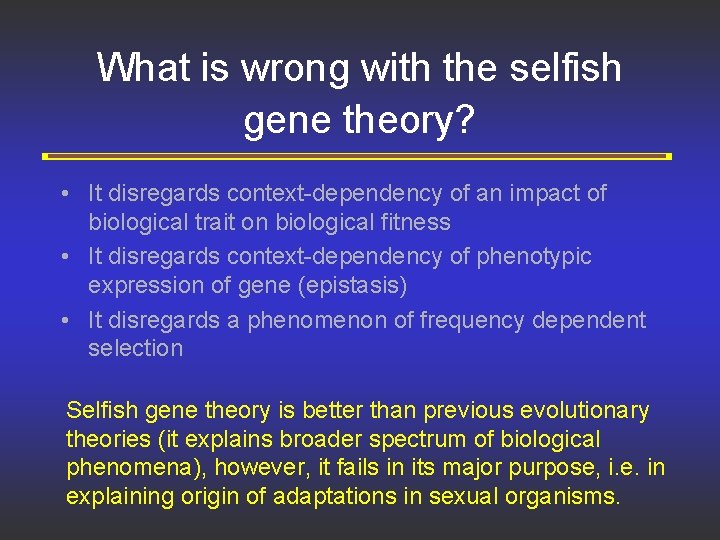
What is wrong with the selfish gene theory? • It disregards a phenomenon of frequency dependent selection • It disregards context-dependency of an impact of biological trait on biological fitness • It disregards context-dependency of phenotypic expression of gene (epistasis)
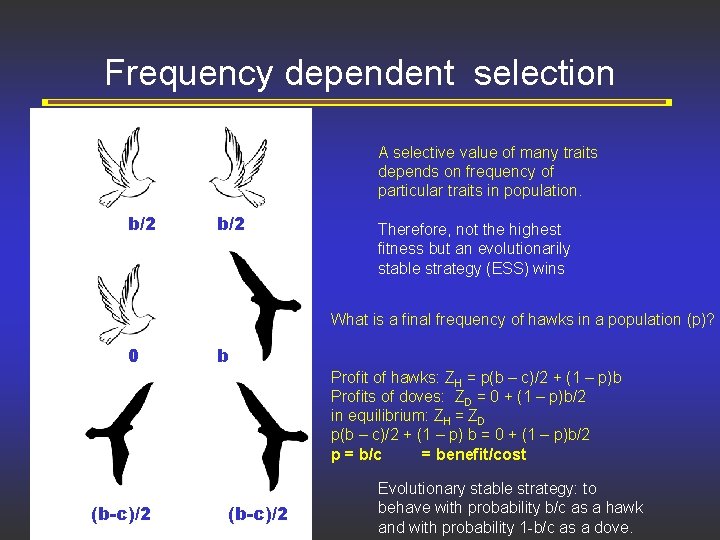
Frequency dependent selection A selective value of many traits depends on frequency of particular traits in population. b/2 Therefore, not the highest fitness but an evolutionarily stable strategy (ESS) wins What is a final frequency of hawks in a population (p)? 0 b Profit of hawks: ZH = p(b – c)/2 + (1 – p)b Profits of doves: ZD = 0 + (1 – p)b/2 in equilibrium: ZH = ZD p(b – c)/2 + (1 – p) b = 0 + (1 – p)b/2 p = b/c = benefit/cost (b-c)/2 Evolutionary stable strategy: to behave with probability b/c as a hawk and with probability 1 -b/c as a dove.
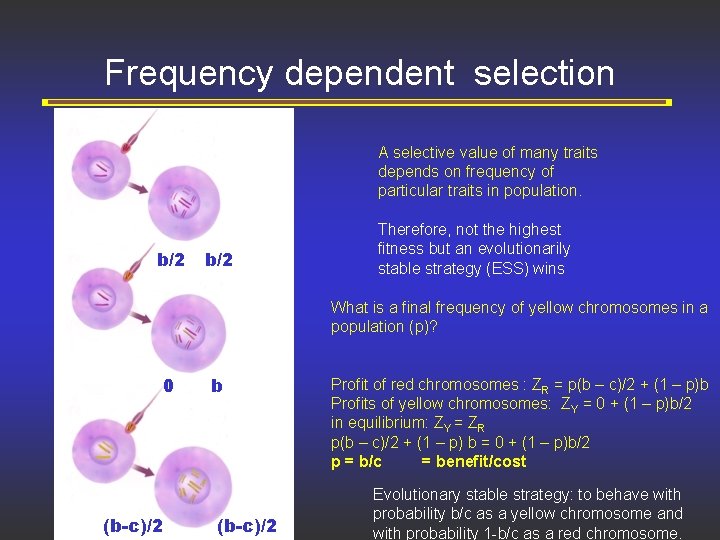
Frequency dependent selection A selective value of many traits depends on frequency of particular traits in population. b/2 Therefore, not the highest fitness but an evolutionarily stable strategy (ESS) wins What is a final frequency of yellow chromosomes in a population (p)? 0 (b-c)/2 b (b-c)/2 Profit of red chromosomes : ZR = p(b – c)/2 + (1 – p)b Profits of yellow chromosomes: ZY = 0 + (1 – p)b/2 in equilibrium: ZY = ZR p(b – c)/2 + (1 – p) b = 0 + (1 – p)b/2 p = b/c = benefit/cost Evolutionary stable strategy: to behave with probability b/c as a yellow chromosome and with probability 1 -b/c as a red chromosome.
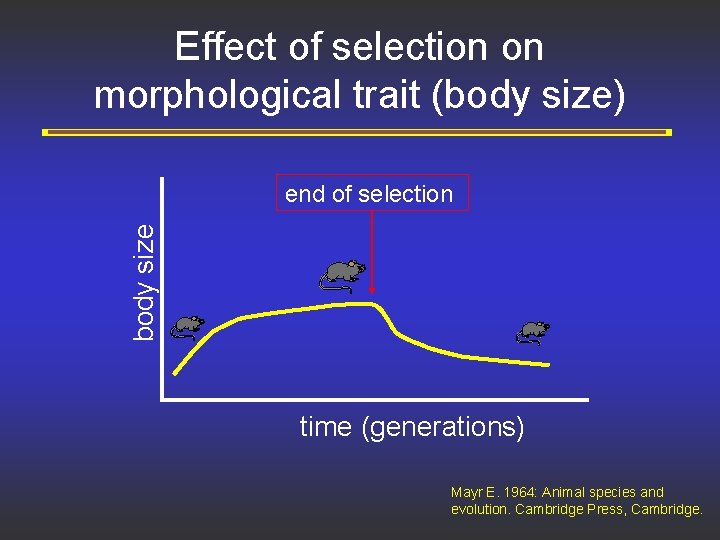
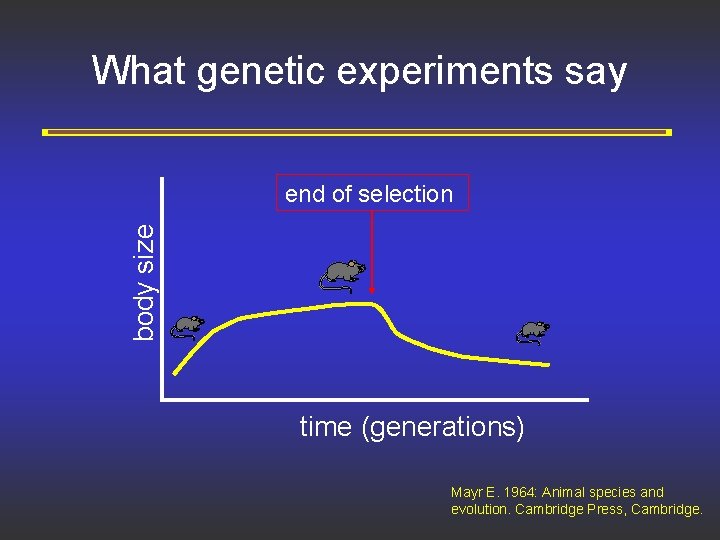
Effect of selection on morphological trait (body size) body size end of selection time (generations) Mayr E. 1964: Animal species and evolution. Cambridge Press, Cambridge.
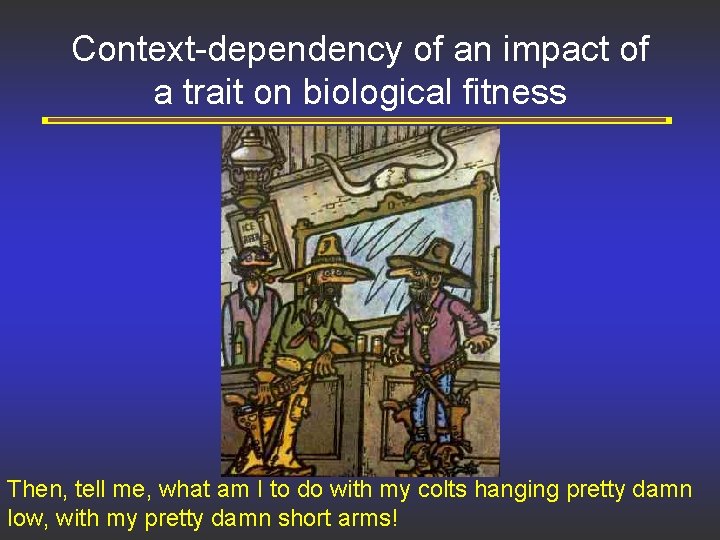
Context-dependency of an impact of a trait on biological fitness Then, tell me, what am I to do with my colts hanging pretty damn low, with my pretty damn short arms!
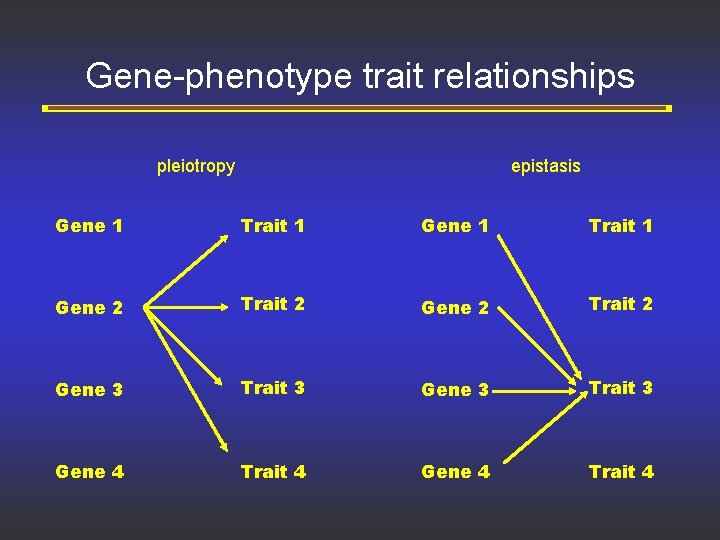
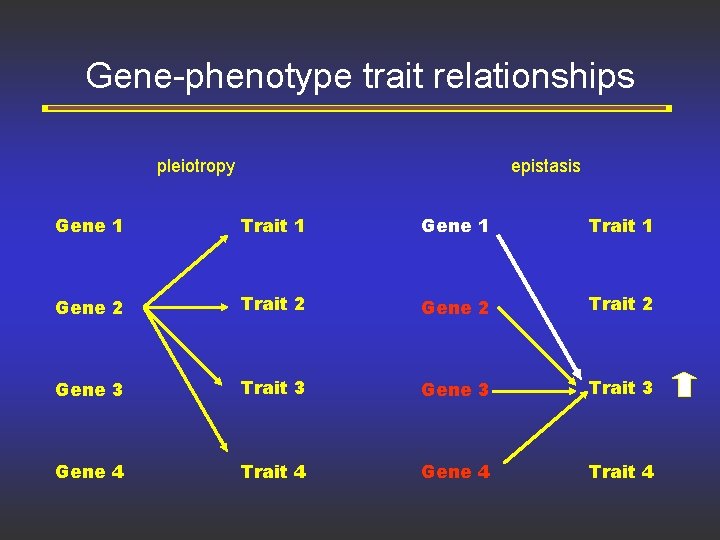
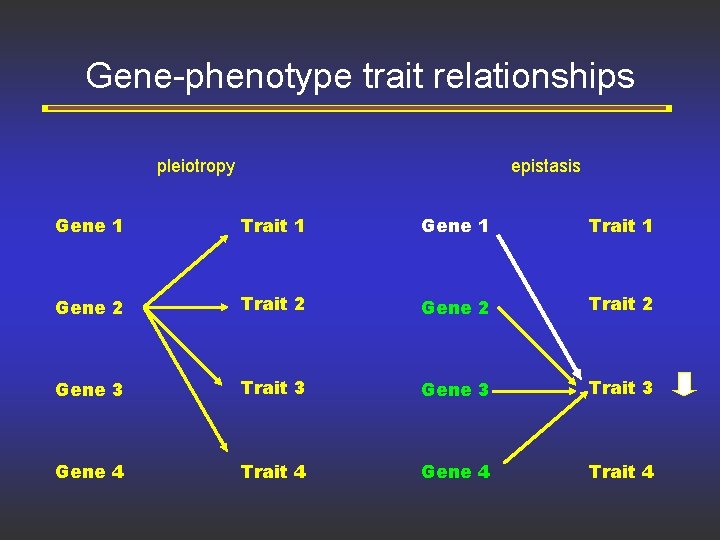
Gene-phenotype trait relationships pleiotropy epistasis Gene 1 Trait 1 Gene 2 Trait 2 Gene 3 Trait 3 Gene 4 Trait 4
Gene-phenotype trait relationships pleiotropy epistasis Gene 1 Trait 1 Gene 2 Trait 2 Gene 3 Trait 3 Gene 4 Trait 4
Gene-phenotype trait relationships pleiotropy epistasis Gene 1 Trait 1 Gene 2 Trait 2 Gene 3 Trait 3 Gene 4 Trait 4
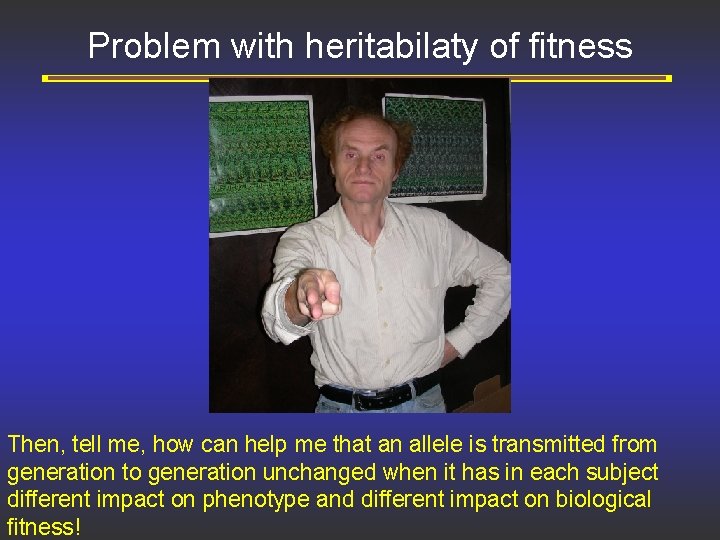
Problem with heritabilaty of fitness Then, tell me, how can help me that an allele is transmitted from generation to generation unchanged when it has in each subject different impact on phenotype and different impact on biological fitness!
What is wrong with the selfish gene theory? • It disregards context-dependency of an impact of biological trait on biological fitness • It disregards context-dependency of phenotypic expression of gene (epistasis) • It disregards a phenomenon of frequency dependent selection Selfish gene theory is better than previous evolutionary theories (it explains broader spectrum of biological phenomena), however, it fails in its major purpose, i. e. in explaining origin of adaptations in sexual organisms.
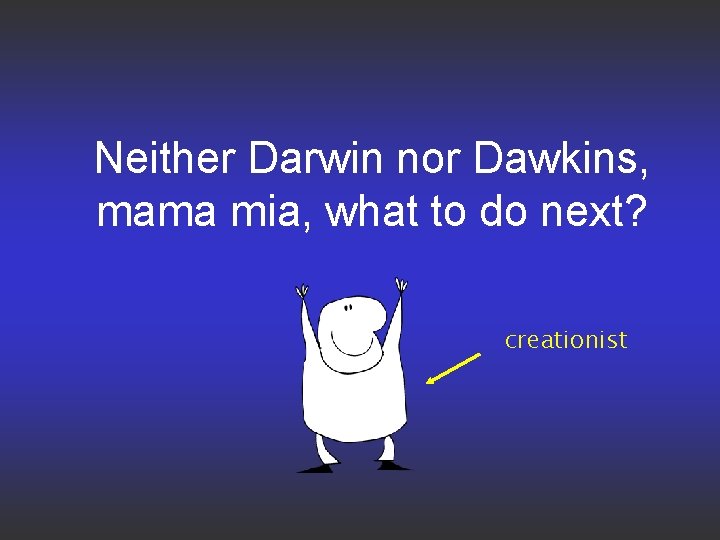
Neither Darwin nor Dawkins, mama mia, what to do next? creationist
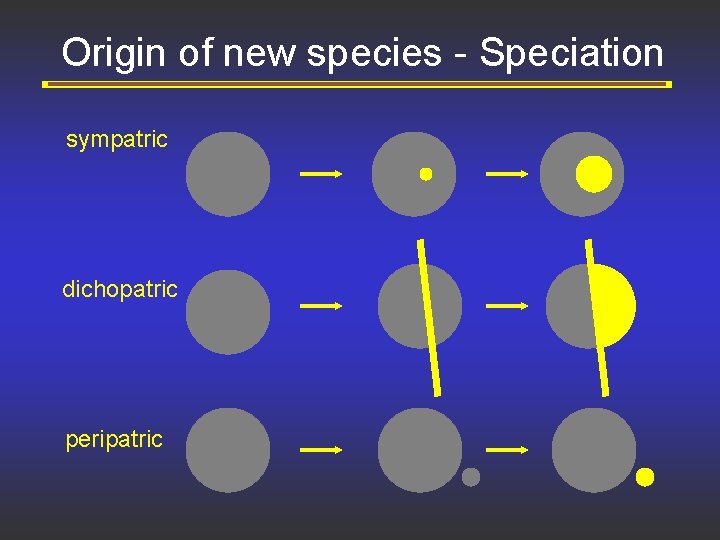
Origin of new species - Speciation sympatric dichopatric peripatric
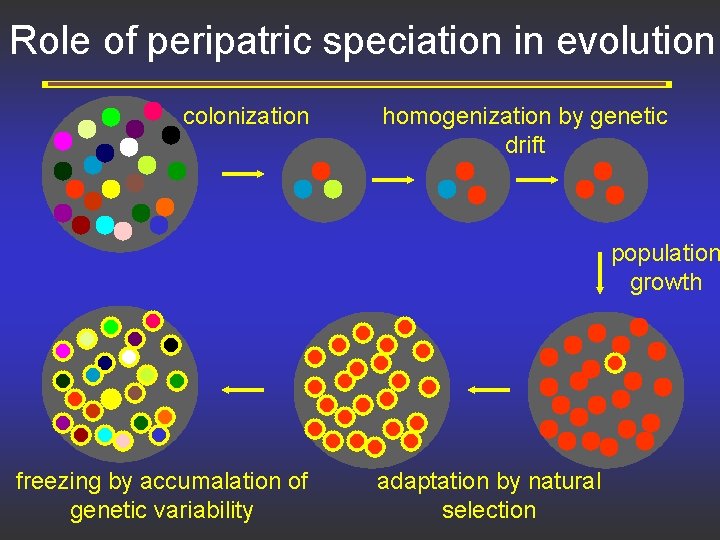
Role of peripatric speciation in evolution colonization homogenization by genetic drift population growth freezing by accumalation of genetic variability adaptation by natural selection
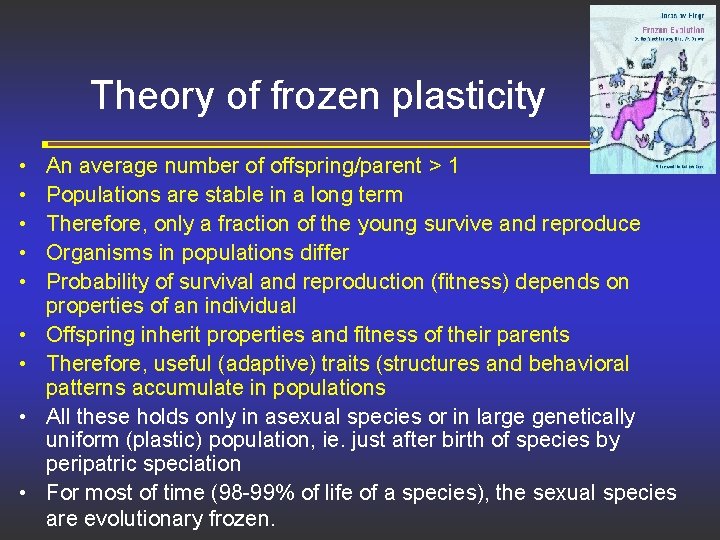
Theory of frozen plasticity • • • An average number of offspring/parent > 1 Populations are stable in a long term Therefore, only a fraction of the young survive and reproduce Organisms in populations differ Probability of survival and reproduction (fitness) depends on properties of an individual Offspring inherit properties and fitness of their parents Therefore, useful (adaptive) traits (structures and behavioral patterns accumulate in populations All these holds only in asexual species or in large genetically uniform (plastic) population, ie. just after birth of species by peripatric speciation For most of time (98 -99% of life of a species), the sexual species are evolutionary frozen.
What genetic experiments say body size end of selection time (generations) Mayr E. 1964: Animal species and evolution. Cambridge Press, Cambridge.
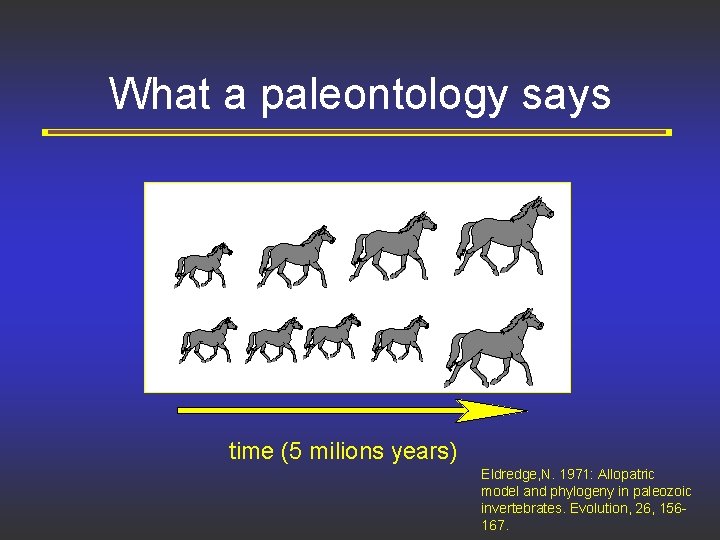
What a paleontology says time (5 milions years) Eldredge, N. 1971: Allopatric model and phylogeny in paleozoic invertebrates. Evolution, 26, 156167.
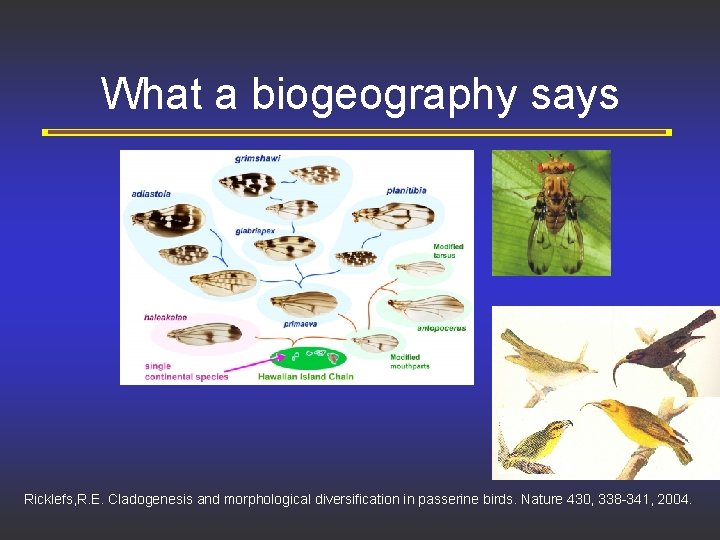
What a biogeography says Ricklefs, R. E. Cladogenesis and morphological diversification in passerine birds. Nature 430, 338 -341, 2004.
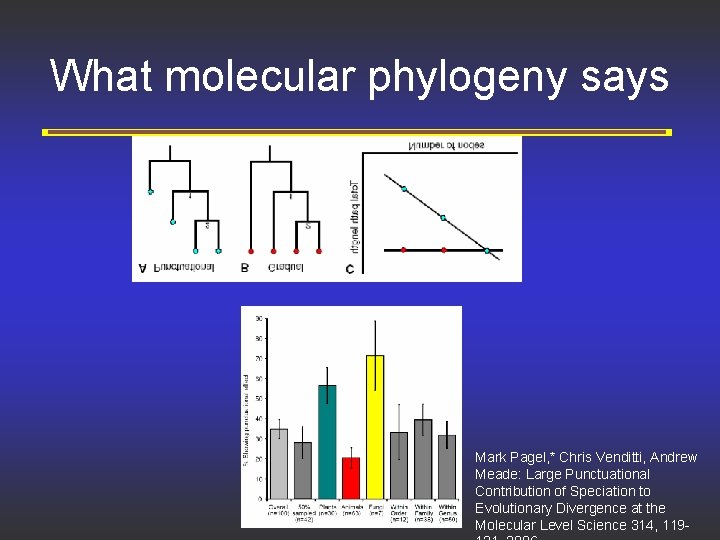
What molecular phylogeny says Mark Pagel, * Chris Venditti, Andrew Meade: Large Punctuational Contribution of Speciation to Evolutionary Divergence at the Molecular Level Science 314, 119 -
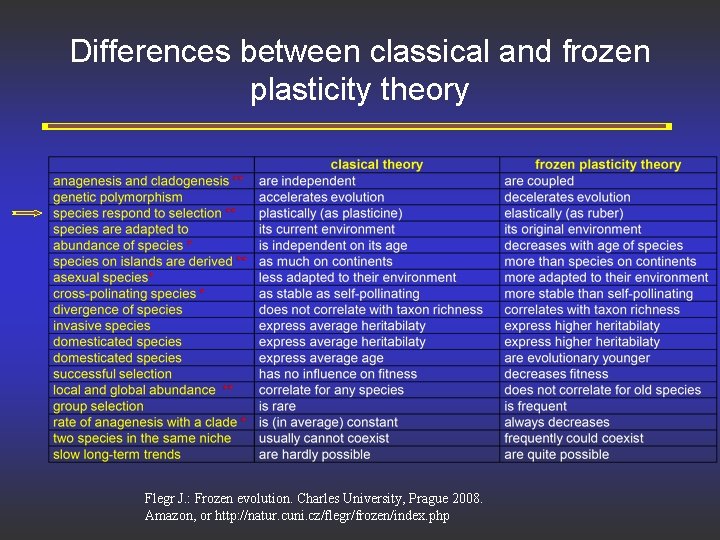
Differences between classical and frozen plasticity theory Flegr J. : Frozen evolution. Charles University, Prague 2008. Amazon, or http: //natur. cuni. cz/flegr/frozen/index. php
Conclusions • Neither darwinism, nor neodarwinism can explain adaptive evolution in sexual species • Selfish gene model could operate only in systems without contextdependent gene expression and context dependent fitness • Theory of evolutionarily stable strategies shows that sexual species respond to selection elastically • After peripatric speciation, a new species turns plastic • After restoration of genetic polymorphism, the specie freezes and rest of its existence just passively waits for its extinction • Frozen plasticity theory could explain broader spectrum of biological phenomena than classical evolutionary theory