
POSTMORTEM INTERVAL ASSESSMENT ON SKELETAL REMAINS A REVIEW
- Slides: 17
POSTMORTEM INTERVAL ASSESSMENT ON SKELETAL REMAINS: A REVIEW Edda Guareschi, Nicola Cucurachi, Giovanni Lanzi Department of Human Anatomy, Pharmacology and Medical-Forensic Sciences Legal Medecine Section University of Parma Italy
Aims of Post Mortem Interval assessment of human remains: - Justice (civil and criminal) - Politics/history (war and mass disasters) - Archaeology It is important to distinguish archaeological from current judicial cases in order to manage financial resources (ethical and economic issues). In judicial cases: PMI and generic/specific identification are analysed.
Body decomposition and skeletonization processes (removal of soft tissue from bone) follow the scheme of thanatological phenomena: - Abiotics: immediate (loss of consciousness, breathing, circulation) and consecutive (body cooling, rigor mortis, hypostasis. . . ) - Transformative adipocere…) (putrefaction, mummification,
Most significant variables affecting body decay rate are: - Temperature - Surface or burial (depth) - Access by insects , carnivores/rodents - Body trauma - Humidity/aridity, rainfall - Body size and weight - Embalming - Clothing - Soil p. H (adapted from Mann, Bass and Meadows, 1990)
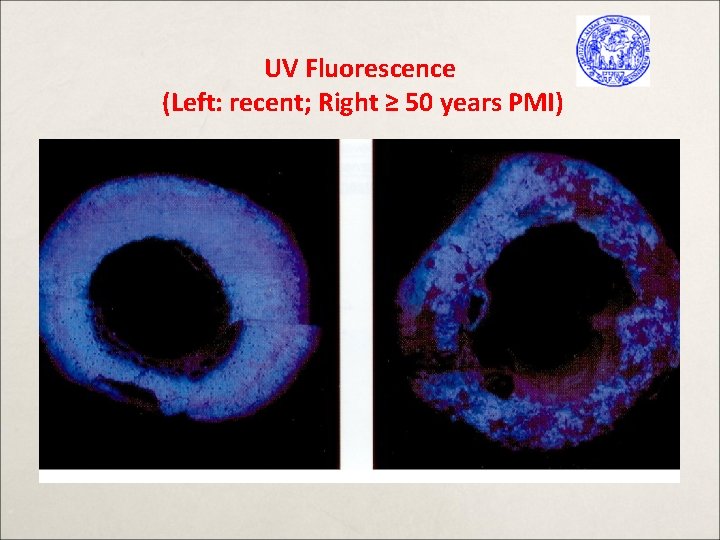
PMI present estimation methods: a)Bone biochemistry methods: - Anti-human serum reaction (5 -10 years PMI) - Nitrogen bone content (50 years PMI) and aminoacid bone content (50 -100 years PMI, Knight, 1968) - Bone mineralization determination/hydroxyapatite matrix - UV fluorescence (50 -100 years PMI) - Lipids degradation (cutoff of 70 -100 years old) - Connective tissue proteins immunohistochemical assay - DNA degradation (Perry et al. , 1988) - Luminol chemiluminescence (no luminol chemiluminescence after 80 years PMI; F. Introna et al. , 1999)
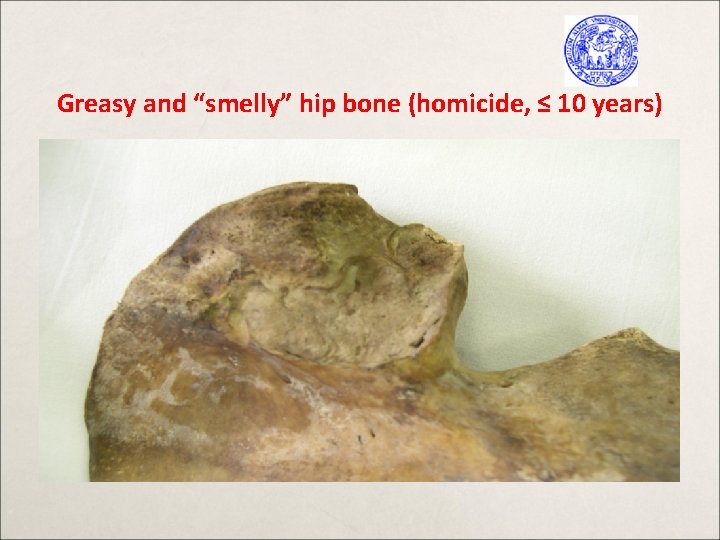
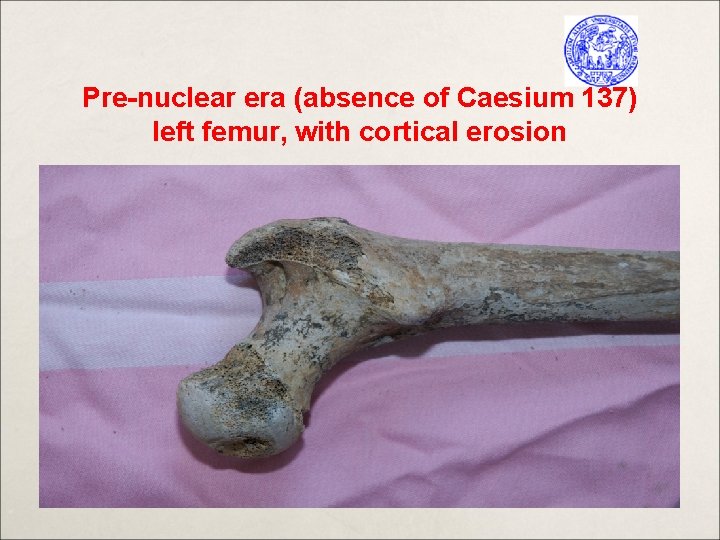
b) Methods based on physics: - Weight, volume and density (fossil bone density 1. 2 g/cm 3 at 15°C, due to partial substitution of organic component with soil chemicals; recent bone density 1, 7 -2, 2 –mind mineralization due to long time deposit in specific soils. S. Berg Methods of forensic science, vol. 2, Ed. Landquist, F. , 1963) - Colour (light exposure, moulds, stains. . . ) - Greasiness and odour (≤ 10 years) - Cracks, cortical erosion and peeling off
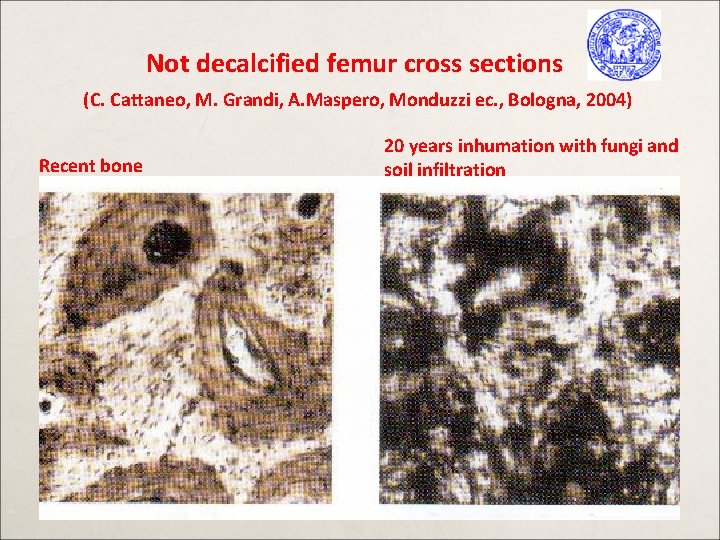
c) Histological methods (optic and scanning electron microscopy): - Algae, fungal hyphae, moulds, rootlets and carbonised material invading even dense cortical tissue via bone vascular channels and, longitudinally, along the Haversian canals, or via ‘osteoclastic’ tunneling into the bone (found in late middle age specimen and in 20 years PMI. . . )
d) Methods based on radionuclides decay: -C 14 (carbon), has a half-time of 5730 +- 40 years-error margin-, more reliable to distinguish between ancient and modern bones (cost, destructive) -Sr 90 (strontium), present since the beginning of nuclear era, can be affected by diagenesis (variation in the environmental concentrations of isotopes through time) but it’s useful in dating pre- or post- World War II remains -Equilibrium estimation between two naturally occurring radio-isotopes, 210 Po (polonium) and 210 Pb (lead) Swift, 1998 -Analysis of U, 234 U/238 U ratio, 238 Pu, 239 and 240 Pu (plutonium)
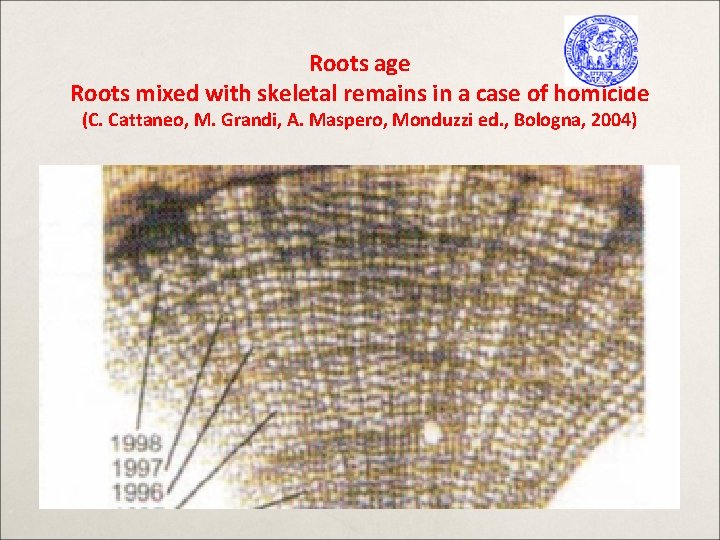
e) Entomology methods (valid for relatively short PMIs as days, weeks, months; generally based on diptera-fly and coleoptera-beetle life cycles, but also many other insect species) f) Botany (analysis of roots or plants entwined with the remains and roots/plants age, seasonal nature etc. ) and palynology methods (pollen, spores, algal cysts…, mainly archaeological in mummies and bog bodies analysis, Willey and Heilman, 1987)
Which one is the best? 1) No method is the most reliable if singly considered, it’s always better to rely upon a combination of methods (3 or more) 2) It depends on the question asked (f. i. radionuclide methods are employed to distinguish between pre- and post-nuclear era, therefore between judicial and archaeological cases) 3) The forensic anthropologist experience is necessary and required anyway, to choose methods and to interpret results
UV Fluorescence (Left: recent; Right ≥ 50 years PMI)
Greasy and “smelly” hip bone (homicide, ≤ 10 years)
Pre-nuclear era (absence of Caesium 137) left femur, with cortical erosion
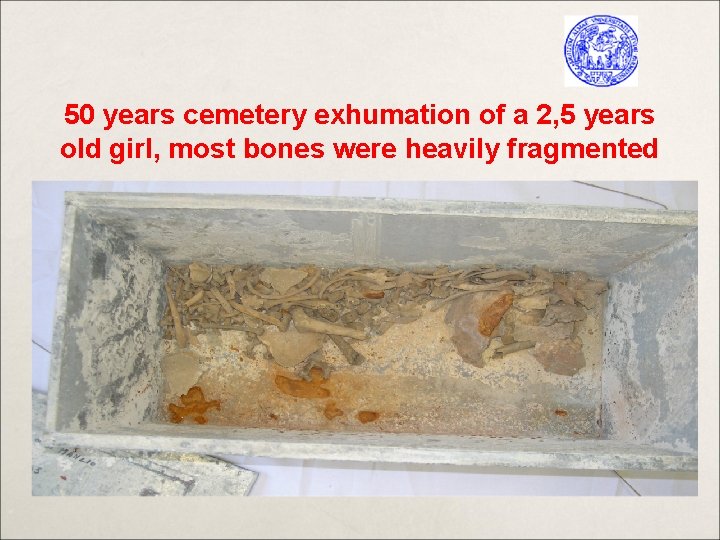
50 years cemetery exhumation of a 2, 5 years old girl, most bones were heavily fragmented
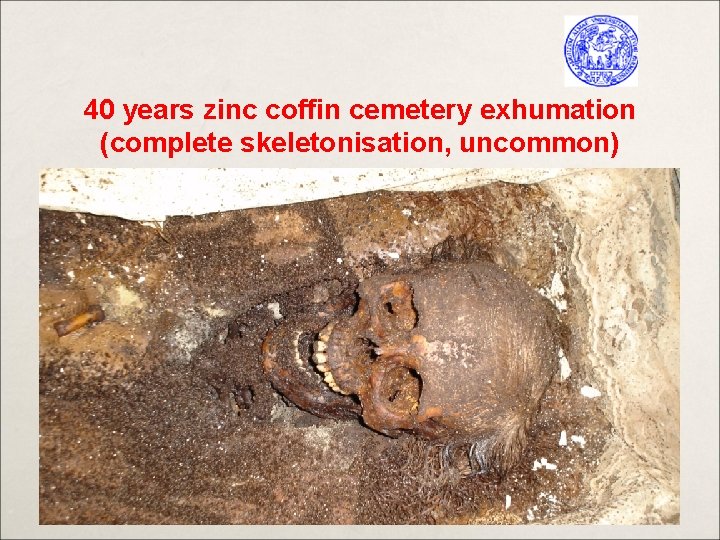
40 years zinc coffin cemetery exhumation (complete skeletonisation, uncommon)
Not decalcified femur cross sections (C. Cattaneo, M. Grandi, A. Maspero, Monduzzi ec. , Bologna, 2004) Recent bone 20 years inhumation with fungi and soil infiltration
Roots age Roots mixed with skeletal remains in a case of homicide (C. Cattaneo, M. Grandi, A. Maspero, Monduzzi ed. , Bologna, 2004)