
Postmodernism What Is Postmodernism O The term was
- Slides: 30
Postmodernism
What Is Postmodernism O The term was coined in 1949, and was applied in the field of architecture to define a polemical attitude against the aseptic rationalism of Modernism and to propose a new mobile and composite vision. O Robert Venturi: “I like elements which are hybrid rather than ‘pure, ’ compromising rather than ‘clean’, […] accommodating rather than excluding. […] I am for messy vitality over obvious unity. […] I prefer ‘bothand’ to ‘either-or, ’ black and white, and sometimes gray, to black or white. […] An architecture of complexity and contradiction must embody the difficult unity of inclusion rather than the easy unity of exclusion. ”
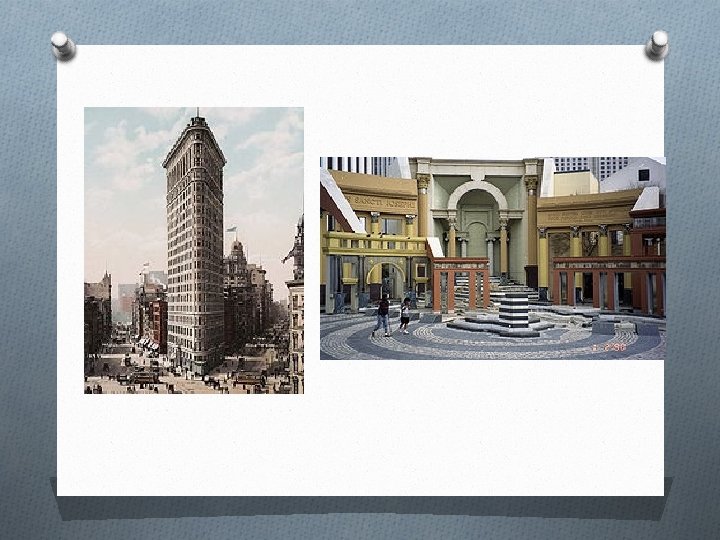
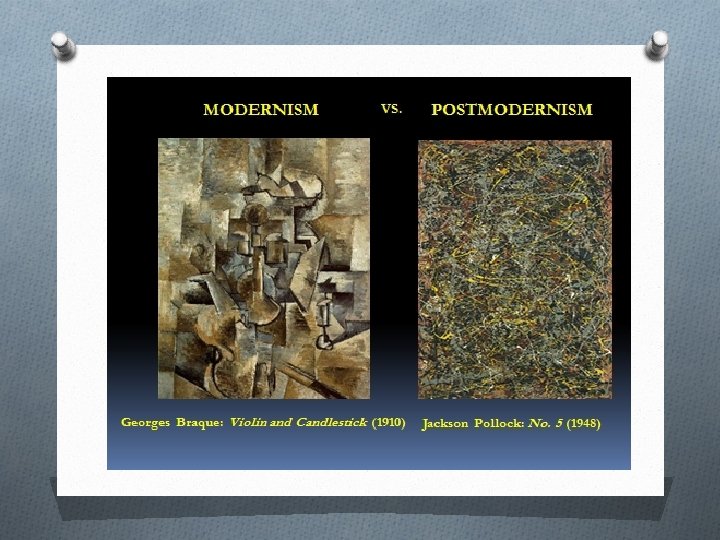
Postmodernism vs. Modernism O Modernism is, generally speaking, a reaction against modernity and its presumption of rationality, but in architecture it totally accepts rational logic, planning regular structures devoid of aesthetic eccentricities – see the Flatiron Building di New York (1903). O Architectural Postmodernism privileges “Baroque” contaminations of styles and forms, like in the New Orleans Piazza d’Italia (1978).
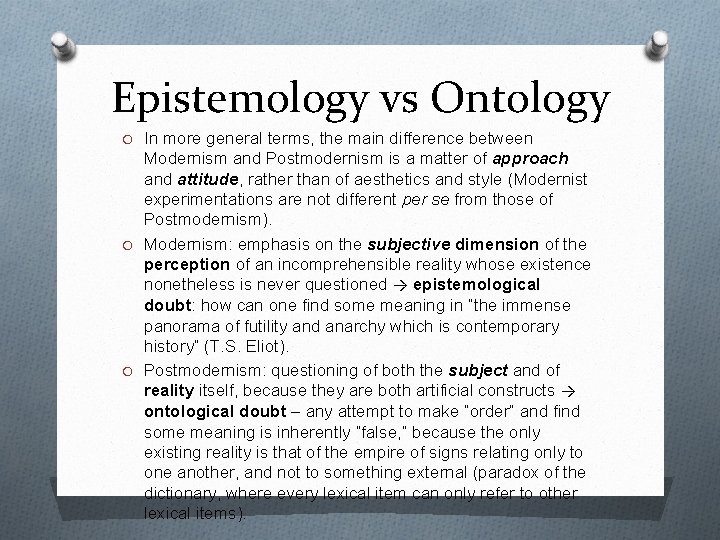
Epistemology vs Ontology O In more general terms, the main difference between Modernism and Postmodernism is a matter of approach and attitude, rather than of aesthetics and style (Modernist experimentations are not different per se from those of Postmodernism). O Modernism: emphasis on the subjective dimension of the perception of an incomprehensible reality whose existence nonetheless is never questioned → epistemological doubt: how can one find some meaning in “the immense panorama of futility and anarchy which is contemporary history” (T. S. Eliot). O Postmodernism: questioning of both the subject and of reality itself, because they are both artificial constructs → ontological doubt – any attempt to make “order” and find some meaning is inherently “false, ” because the only existing reality is that of the empire of signs relating only to one another, and not to something external (paradox of the dictionary, where every lexical item can only refer to other lexical items).
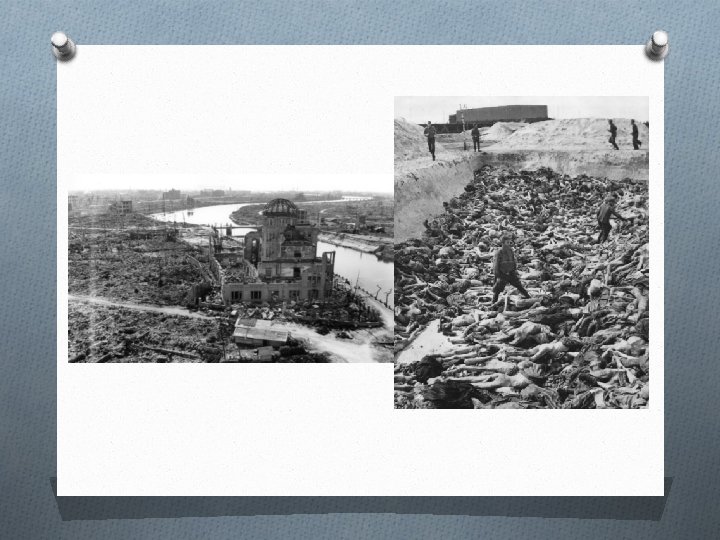
After the Holocaust(s) World War I: inauguration of the crisis of Western modernity (and of the Modernist reaction) World War II: global cultural shock, because the possibility of an ultimate apocalypse becomes clear and present with the Holocaust of millions of Jew and members of “inferior” groups, and the atomic bombings of Hiroshima and Nagasaki.
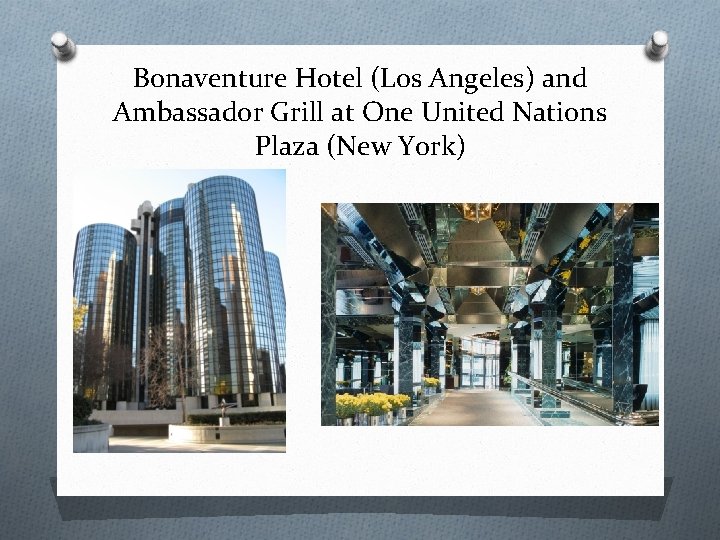
Postmodern Trauma Postmodernism is the reaction to this collective trauma– it tries to elaborate it by substituting it with totally fictive creations that avoid to deal with the “Real, ” because the Real is unbearable, and therefore it is erased from the plan of existence. Modernism: Real = object of a never-ending quest (even if doomed to fail) of some “deep” meaning vs. Postmodernism: “surreality” made of reflecting surfaces, that do not mirror “reality, ” but other mirrors → triumph of selfreferentiality.
Bonaventure Hotel (Los Angeles) and Ambassador Grill at One United Nations Plaza (New York)
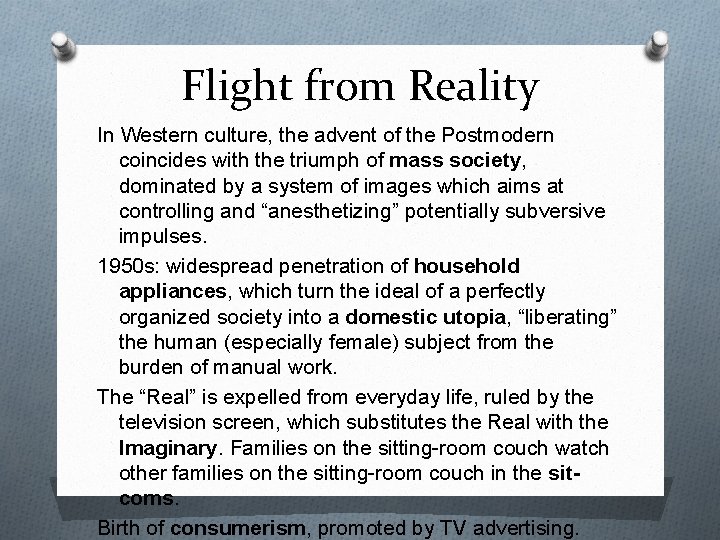
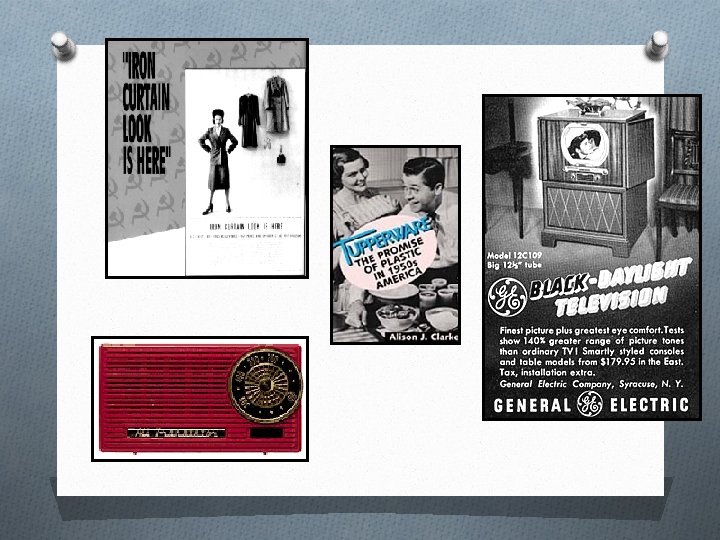
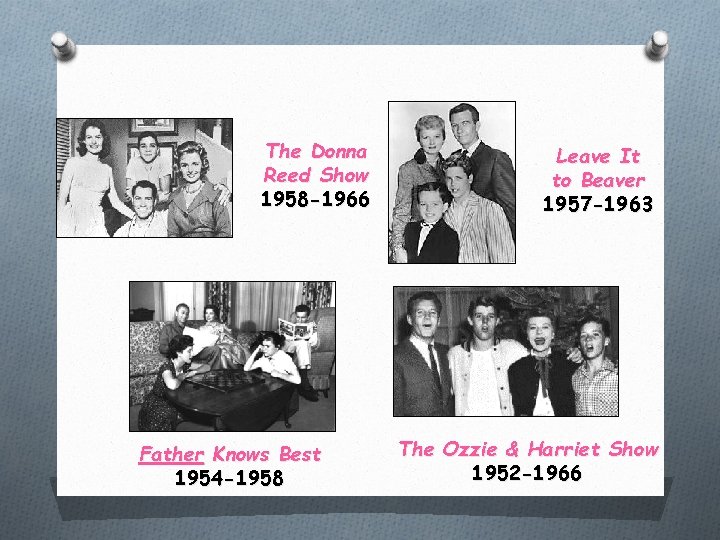
Flight from Reality In Western culture, the advent of the Postmodern coincides with the triumph of mass society, dominated by a system of images which aims at controlling and “anesthetizing” potentially subversive impulses. 1950 s: widespread penetration of household appliances, which turn the ideal of a perfectly organized society into a domestic utopia, “liberating” the human (especially female) subject from the burden of manual work. The “Real” is expelled from everyday life, ruled by the television screen, which substitutes the Real with the Imaginary. Families on the sitting-room couch watch other families on the sitting-room couch in the sitcoms. Birth of consumerism, promoted by TV advertising.
The Donna Reed Show 1958 -1966 Father Knows Best 1954 -1958 Leave It to Beaver 1957 -1963 The Ozzie & Harriet Show 1952 -1966
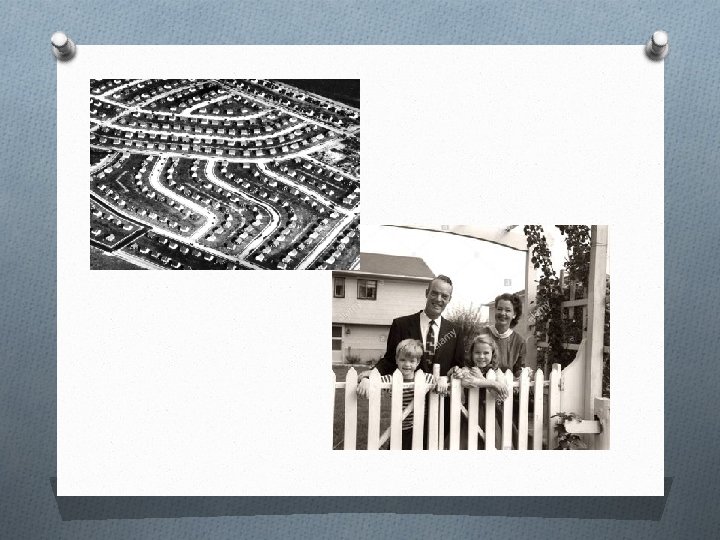
A Suburban Utopia (or Dystopia? ) If American modernity is characterized by urbanization, postmodernity is marked by “suburbanization. ” The families of the middle class, celebrated as the only American social class, move away from the downtowns, crowded and chaotic, to the new Arcadia of the suburbs, to live in single-family homes with all comforts. Suburban reality is de-centered, both because it is far from the city centers, but also because it has no center, no “downtown” – it is an undifferentiated agglomerate of housing units which are all alike, sprawled in spirals that do not converge anywhere, like a literal u-topia (a non-place). In some sense, postmodernity creates a “tranquilized” version of the dystopian nightmare announced da W. B. Yeats in “The Second Coming” (1920): “The center cannot hold” (and “Things fall apart” – “Mere anarchy is loosed on the world”…)
“Tranquilized” America In the 1950 s the USA are literally “tranquilized. ” In a letter, poet Robert Lowell uses the expression “tranquilized Fifties, ” but it is not only a metaphor: especially women, secluded in their “dream houses, ” feel that they are somehow living in a nightmare, and become massively dependent on tranquilizers…
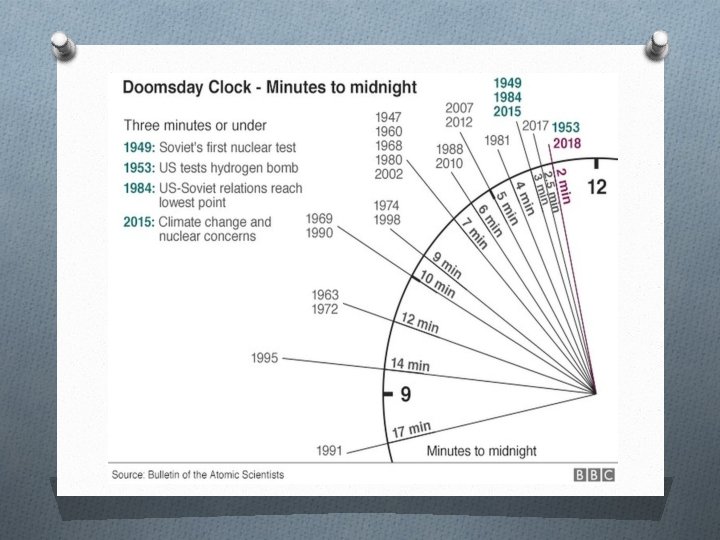
The Cold War In the 1950 s the USA are involved in the Cold War, the ideological, political economic and cultural conflict between the Western “liberal” world and the Communist bloc dominated by the USSR. The Commission for Anti-American Activities chaired by Senator Joseph Mc Carthy persecutes anyone suspected of Communist sympathies in a new Witch Hunt. In 1953 Julius e Ethel Rosenberg, accused of espionage for the USSR, are executed. In 1961 the Soviet Union builds the Berlin Wall, to separate the “communist” section from those controlled by the Western countries, and anti-Castro forces try and fail a coup d’état in Cuba. In 1962 the Cuban missile crisis brings the world on the verge of a nuclear war, finally averted after frantic diplomatic efforts. In 1947 the Bulletin of the Atomic Scientists begins to monitor the Doomsday Clock, that measures the time remaining before the end of the world…
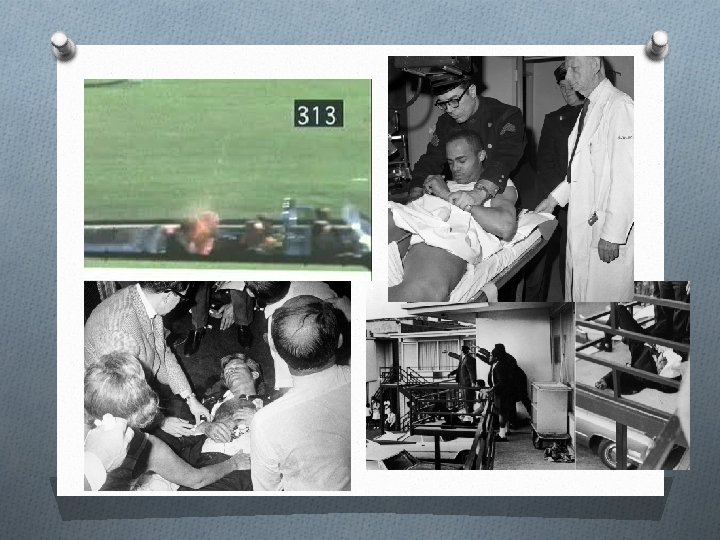
The (Brief) Kennedy Era In 1960 John Fitzgerald Kenendy is elected US President and inaugurates a new “era, ”characterized by faith in the future and the target of reaching and overcoming a New Frontier that is the final sum of a series of frontiers – social and economic, cultural, racial, and even space frontiers (the space race becomes one of the ways the Cold War is fought without weapons). On 11. 23. 1963 Kennedy is murdered in Dallas, opening an era of major political killings – in 1965 Malcolm X is assassinated, followed by John’s brother, Bob Kennedy, and Martin Luther King in 1968.
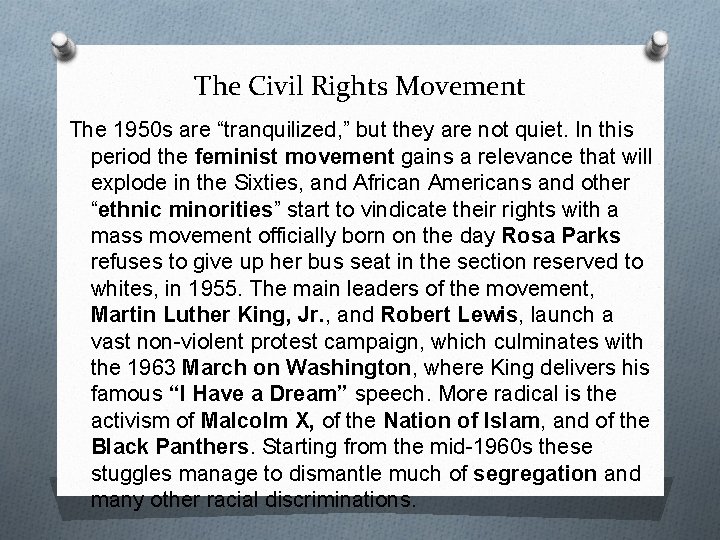
The Civil Rights Movement The 1950 s are “tranquilized, ” but they are not quiet. In this period the feminist movement gains a relevance that will explode in the Sixties, and African Americans and other “ethnic minorities” start to vindicate their rights with a mass movement officially born on the day Rosa Parks refuses to give up her bus seat in the section reserved to whites, in 1955. The main leaders of the movement, Martin Luther King, Jr. , and Robert Lewis, launch a vast non-violent protest campaign, which culminates with the 1963 March on Washington, where King delivers his famous “I Have a Dream” speech. More radical is the activism of Malcolm X, of the Nation of Islam, and of the Black Panthers. Starting from the mid-1960 s these stuggles manage to dismantle much of segregation and many other racial discriminations.
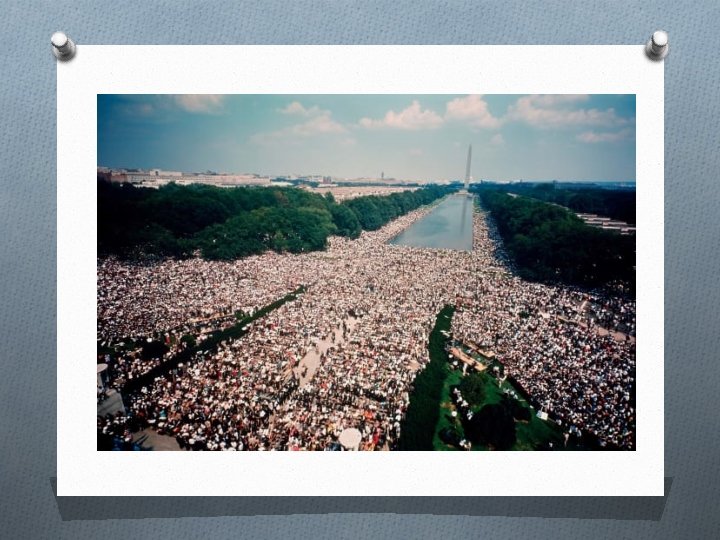
The Vietnam War The Vietnam war breaks in 1955. In 1956 the elections that should have pacified the country, and would have presumably seen the victory of the Communist party, are boycotted under the pressure of the USA. President Kennedy increases the American involvement in the war, which further escalates under Lyndon B. Johnson, after the Tonkin Gulf incident (1964). At the beginning of 1968 the Têt Offensive turns the tide of the war in favor of North Vietnam. The War will end with the Communist victory in 1975, and the flight of the last officers of the US Embassy from Saigon.
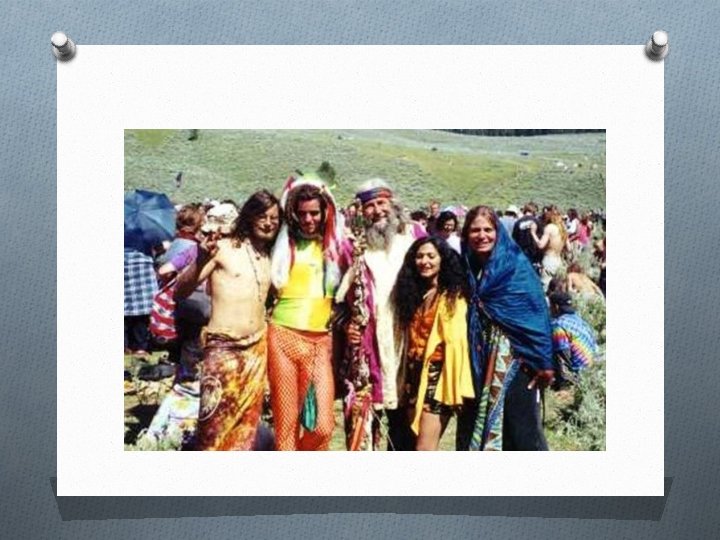
The Peace and Hippie Movements The American involvement in the Vietnam war causes the reaction of the Peace Movement, which sees for the first time in history a huge participation of youth on the political and social scene wuth the so-called counterculture, based on the values of peace, equality, the return to nature and the breaking down of bourgeois morality (culminating with the 1967 Summer of Love and the 1969 Woodstock musical festival). The Hippies promote a totally free and unconventional behavior, and the refusal to adhere to the rules of “decency, ” also as regards fashion, hairstyles and the consumption of drugs.
Postmodern literature In the 1950 s and especially in the 1960 s literature becomes “postmodern. ” Instead of projecting a more truthful image of reality than the one constructed by mass media, Postmodernism exasperates artificiality, openly revealing its non-naturalness, and turns it into a virtual reality not anchored anymore to the “true” reality, which is considered as irrelevant, or even nonexisting. The space of the (literary, artistic, cinematic…) text becomes the only “real” space…
Postmodern pastiche O Pastiche: O French term, derived from the Italiano pasticcio O It denotes a techniques which “pastes” heterogenous elements together, without trying to harmonize them. O Pastiche is often parodistic O It combines different genres and style to reflect the incomprehensible chos of “hyperreality” (a hyperbolic representation of reality which looks more “real” that the “real” itself) O It questions the existence of “reality, ” substituted the endless play of images produced by global communication
Metafiction O Metafiction: O Technique which stresses the artificiality of fiction. O It abolishes the principle of “willful suspension of disbelief” (Coleridge, 1817). O It destabilizes the“authority” of the author, who becomes an artifical element together with the elements of the text. O Historiographic metafiction mixes documented historical events and characters with totally invented events and characters, without distinguishing between them. It shows the artificiality not only of fiction, but also of historiography, because it is based on the same protocols of contruction of plot, discourse, and their meanings.
Distortione of space and time Postmodernism brings to its most extreme consequences the rupture in the orders of time and space introduced by Modernism, but rather than translating it into the ironical but also tragic forms of Joyce or Eliot, it uses it to promote a sort of “euphoric irresponsability toward the“external” world.