
Posterior Triangle Sternomastoid Sternocleidomastoid Cleido clavicle Mastoid process

- Slides: 28
Posterior Triangle
Sternomastoid Sternocleidomastoid Cleido = clavicle
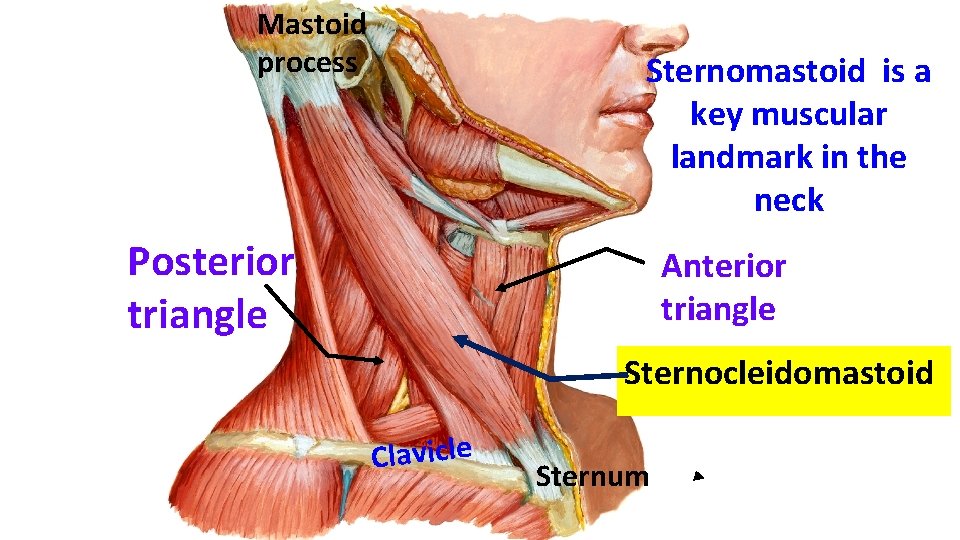
Mastoid process Sternomastoid is a key muscular landmark in the neck Posterior triangle Anterior triangle Sternocleidomastoid Clavicle Sternum
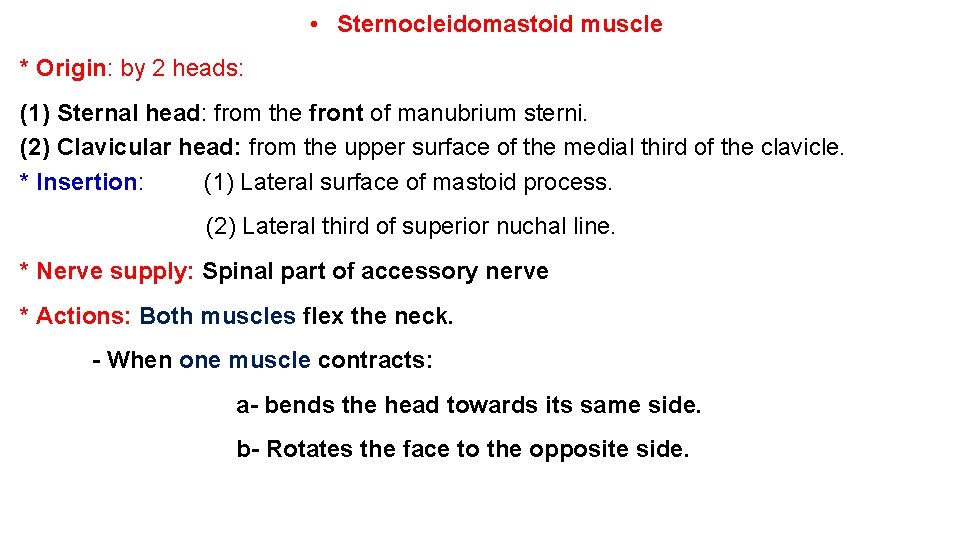
• Sternocleidomastoid muscle * Origin: by 2 heads: (1) Sternal head: from the front of manubrium sterni. (2) Clavicular head: from the upper surface of the medial third of the clavicle. * Insertion: (1) Lateral surface of mastoid process. (2) Lateral third of superior nuchal line. * Nerve supply: Spinal part of accessory nerve * Actions: Both muscles flex the neck. - When one muscle contracts: a- bends the head towards its same side. b- Rotates the face to the opposite side.
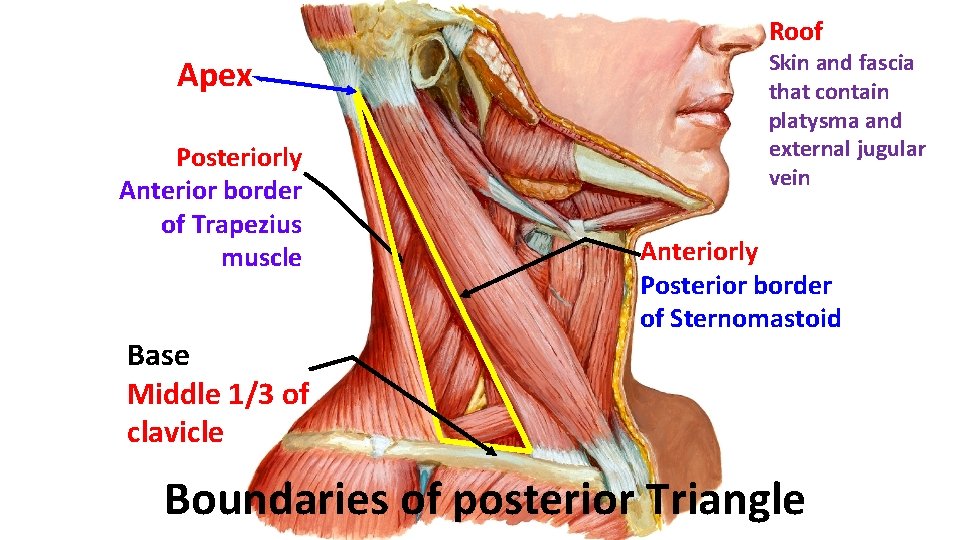
Roof Apex Posteriorly Anterior border of Trapezius muscle Skin and fascia that contain platysma and external jugular vein Anteriorly Posterior border of Sternomastoid Base Middle 1/3 of clavicle Boundaries of posterior Triangle
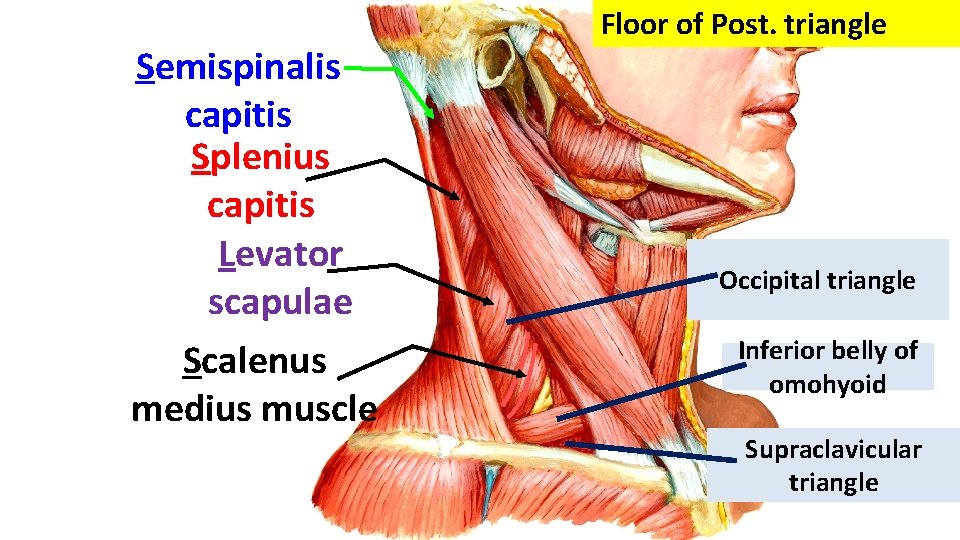
Semispinalis capitis Splenius capitis Levator scapulae Scalenus medius muscle Floor of Post. triangle Occipital triangle Inferior belly of omohyoid Supraclavicular triangle
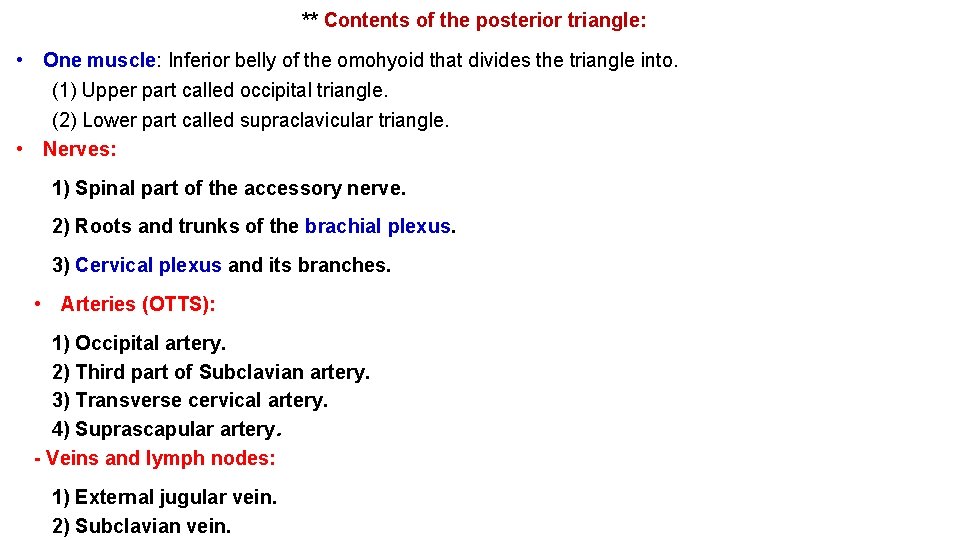
** Contents of the posterior triangle: • One muscle: Inferior belly of the omohyoid that divides the triangle into. (1) Upper part called occipital triangle. (2) Lower part called supraclavicular triangle. • Nerves: 1) Spinal part of the accessory nerve. 2) Roots and trunks of the brachial plexus. 3) Cervical plexus and its branches. • Arteries (OTTS): 1) Occipital artery. 2) Third part of Subclavian artery. 3) Transverse cervical artery. 4) Suprascapular artery. - Veins and lymph nodes: 1) External jugular vein. 2) Subclavian vein.
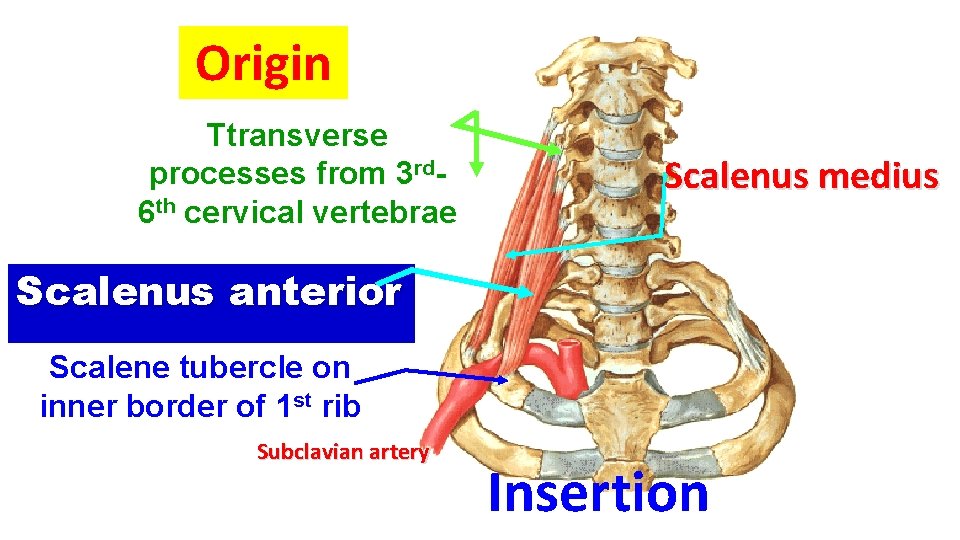
Origin Ttransverse processes from 3 rd 6 th cervical vertebrae Scalenus medius Scalenus anterior Scalene tubercle on inner border of 1 st rib Subclavian artery Insertion
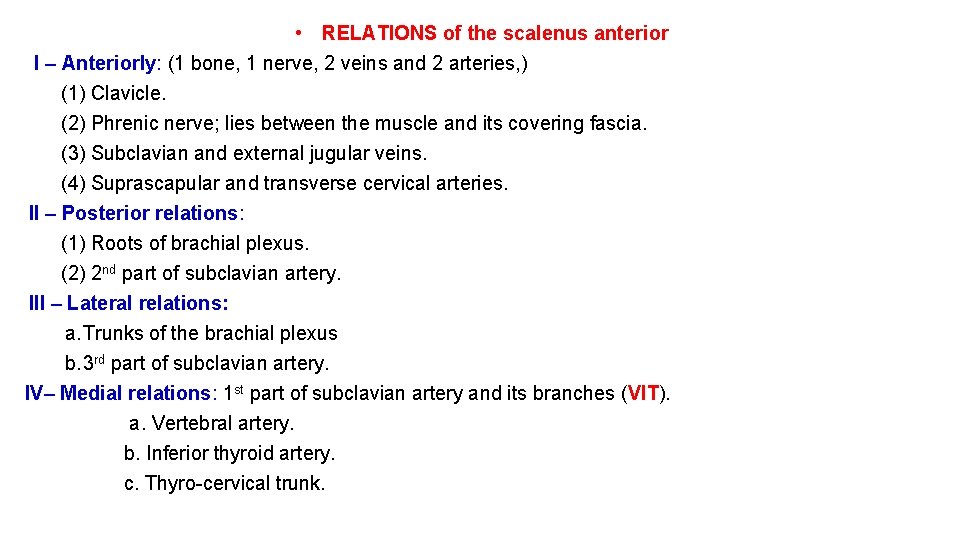
• RELATIONS of the scalenus anterior I – Anteriorly: (1 bone, 1 nerve, 2 veins and 2 arteries, ) (1) Clavicle. (2) Phrenic nerve; lies between the muscle and its covering fascia. (3) Subclavian and external jugular veins. (4) Suprascapular and transverse cervical arteries. II – Posterior relations: (1) Roots of brachial plexus. (2) 2 nd part of subclavian artery. III – Lateral relations: a. Trunks of the brachial plexus b. 3 rd part of subclavian artery. IV– Medial relations: 1 st part of subclavian artery and its branches (VIT). a. Vertebral artery. b. Inferior thyroid artery. c. Thyro cervical trunk.
Anterior Triangle
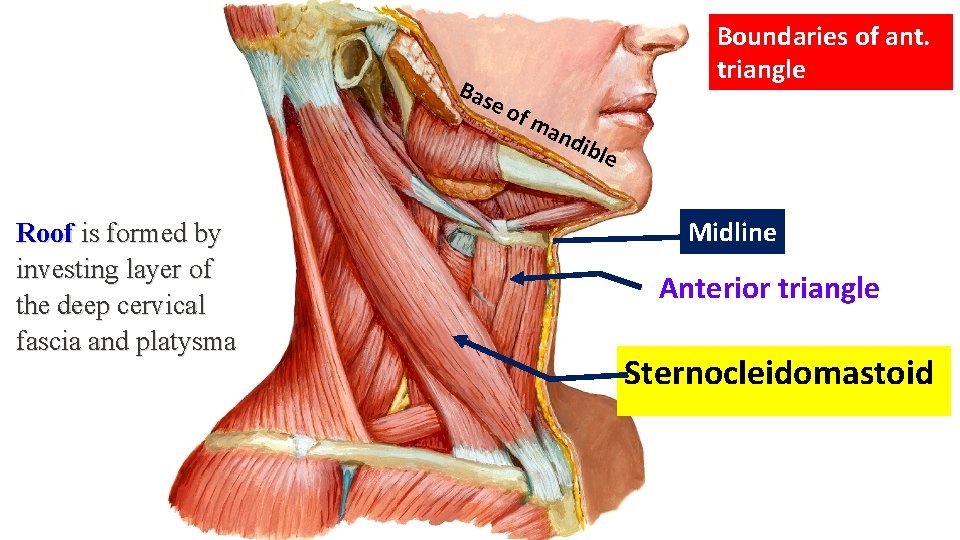
Bas eo Boundaries of ant. triangle fm Roof is formed by investing layer of the deep cervical fascia and platysma and ible Midline Anterior triangle Sternocleidomastoid
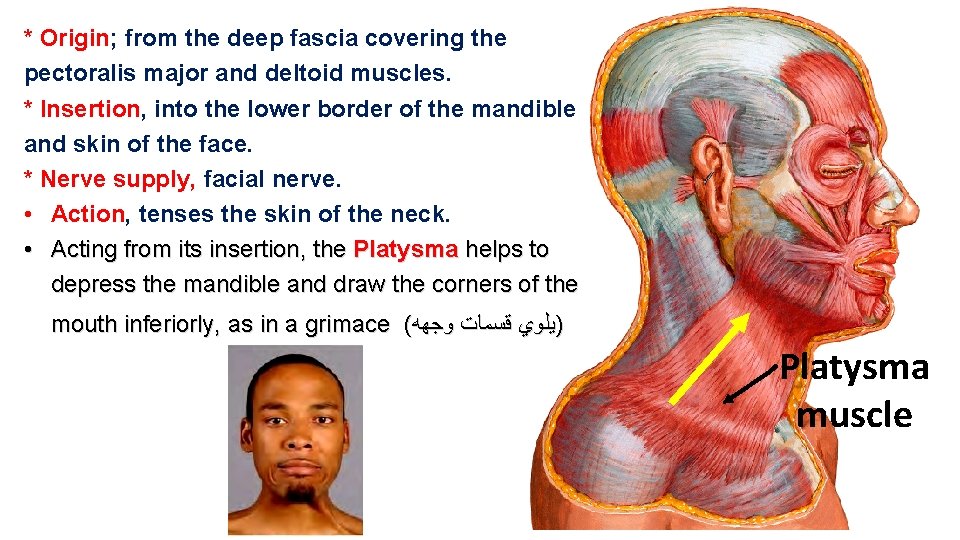
* Origin; from the deep fascia covering the pectoralis major and deltoid muscles. * Insertion, into the lower border of the mandible and skin of the face. * Nerve supply, facial nerve. • Action, tenses the skin of the neck. • Acting from its insertion, the Platysma helps to depress the mandible and draw the corners of the mouth inferiorly, as in a grimace ( )ﻳﻠﻮﻱ ﻗﺴﻤﺎﺕ ﻭﺟﻬﻪ Platysma muscle
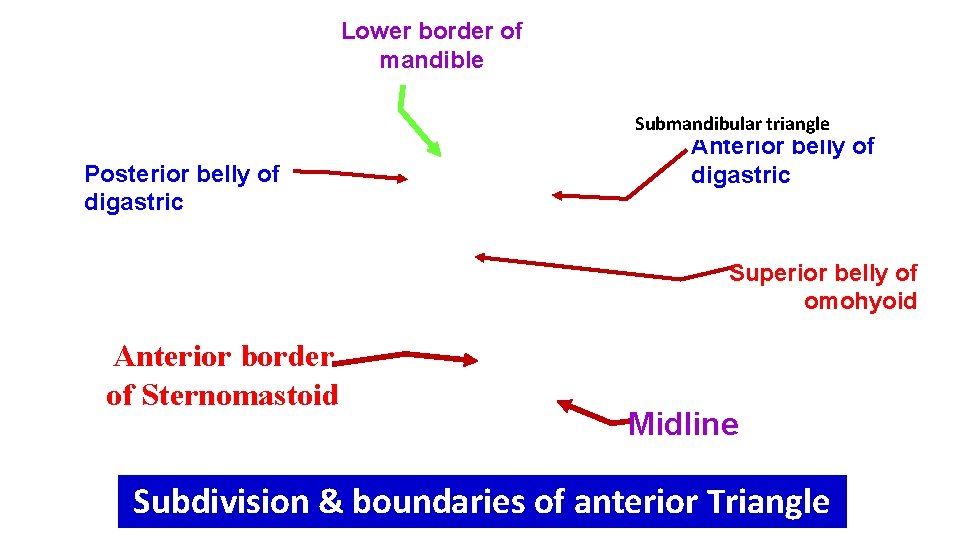
Lower border of mandible Submandibular triangle Posterior belly of digastric Anterior belly of digastric Superior belly of omohyoid Anterior border of Sternomastoid Midline Subdivision & boundaries of anterior Triangle
Floor of the anterior triangles Mylohyoid muscle
* Contents of submandibular (digastric) triangle (1) Submandibular gland. (2) Submandibular ganglion. (3) Submandibular lymph nodes. (4) Facial artery. (5) Common facial vein. (6) Hypoglossal nerve. (7) Lingual nerve.
* Contents of the carotid artery : (1) 3 carotid arteries Common, Internal and External carotid artery (its branches ASLFO-P- Dinar) 1) Ascend ing pharyngeal artery. 2) Superior thyroid artery. Carotid sheath 3) Lingual artery. VAN 4) Facial artery. 1. IJV 5) Occipital artery (below posterior belly of digastric). 2. CCA & ICA 6) Posterior auricular (above the posterior belly of digastric) 3. Vagus N (2) Internal jugular vein and 3 of its tributaries (SLF): 1) Superior thyroid vein. 2) Lingual vein. 3) Common facial vein. (3) Last 3 cranial nerves, 10 th (Vagus) , 11 th (Spinal root of accessory nerve) and 12 th (Hpoglossal nerve). (4) Ansa cervicalis infront the carotid sheath. (5) Cervical sympathetic chain behind the carotid sheath.
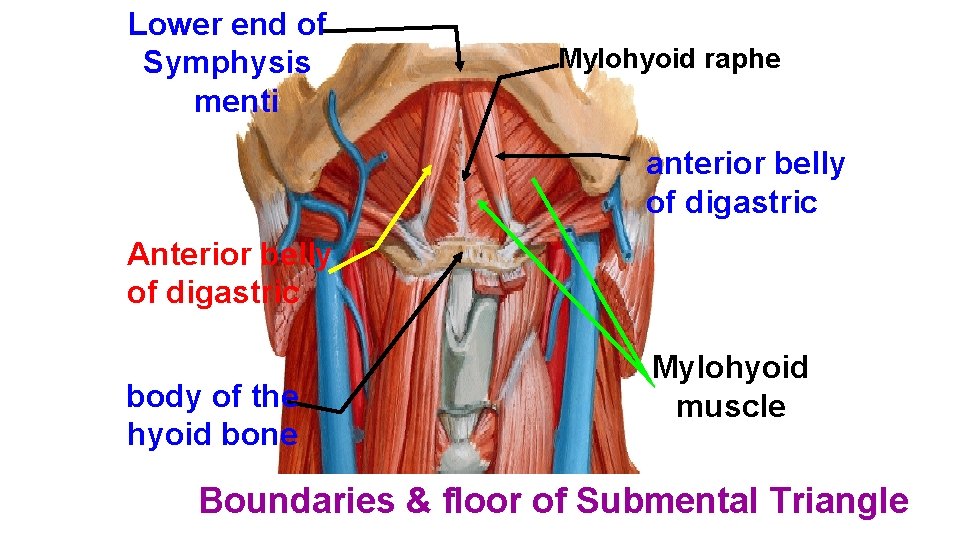
Lower end of Symphysis menti Mylohyoid raphe anterior belly of digastric Anterior belly of digastric body of the hyoid bone Mylohyoid muscle Boundaries & floor of Submental Triangle
Submental triangle * Boundaries 1 - Anterior belly of digastric (on both sides) 2 - Hyoid bone (posteriorly). * Floor, 2 mylohyoid mu scles and mylohyoid raphe. * Contents 1 Submental artery. 2 Submental vein. 3 Submental lymph nodes. 4 Nerve to mylohyoid muscle. 5 Beginning of anterior jugular veins.
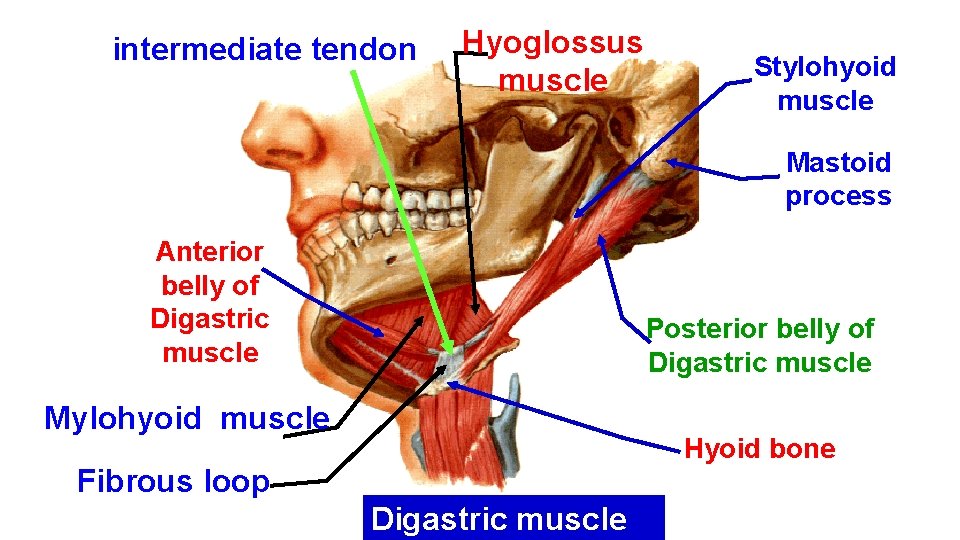
intermediate tendon Hyoglossus muscle Stylohyoid muscle Mastoid process Anterior belly of Digastric muscle Posterior belly of Digastric muscle Mylohyoid muscle Hyoid bone Fibrous loop Digastric muscle
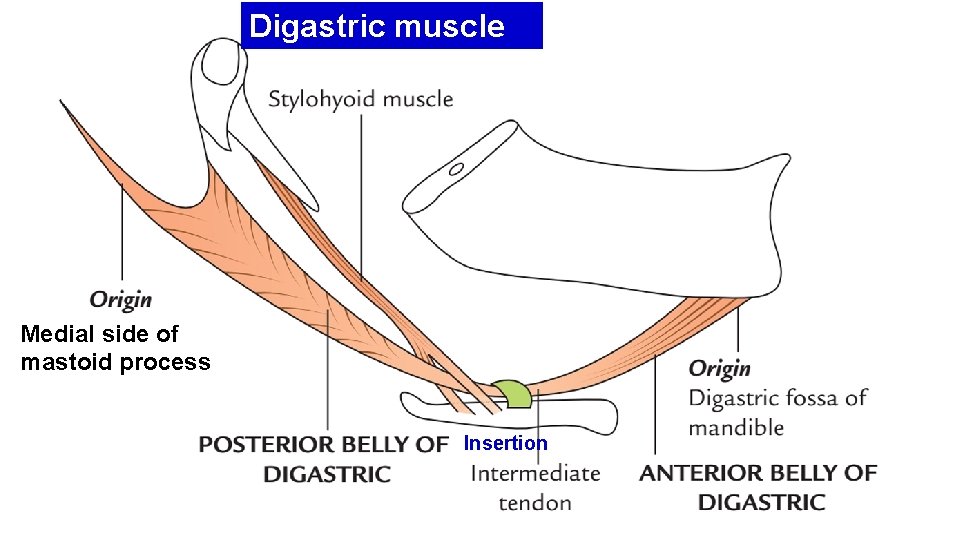
Digastric muscle Medial side of mastoid process Insertion
Digastric muscle * Origin: it has 2 bellies: (1) Anterior Belly: from the digastric fossa on the lower border of mandible close to symphysis menti. (2) Posterior belly: from digastric notch on medial surface of the mastoid process. * Insertion: into intermediate tendon which is connected to the hyoid bone by a fibrous loop. * Nerve supply: (1) Anterior Belly: by nerve to mylohyoid (from 1 st pharyngeal arch). (2) Posterior belly: by facial nerve (from the 2 nd pharyngeal arch). * Action: (1) Depresses the mandible (opening the mouth). (2) Elevates the hyoid bone during swallowing.
v Stylohyoid muscle: - Origin: from the styloid process. - Insertion: Its tendon split around the intermediate tendon of digastric muscle to end in the body of the hyoid bone. - Nerve supply: from the facial nerve (2 nd pharyngeal arch). - Action: elevate the hyoid bone.
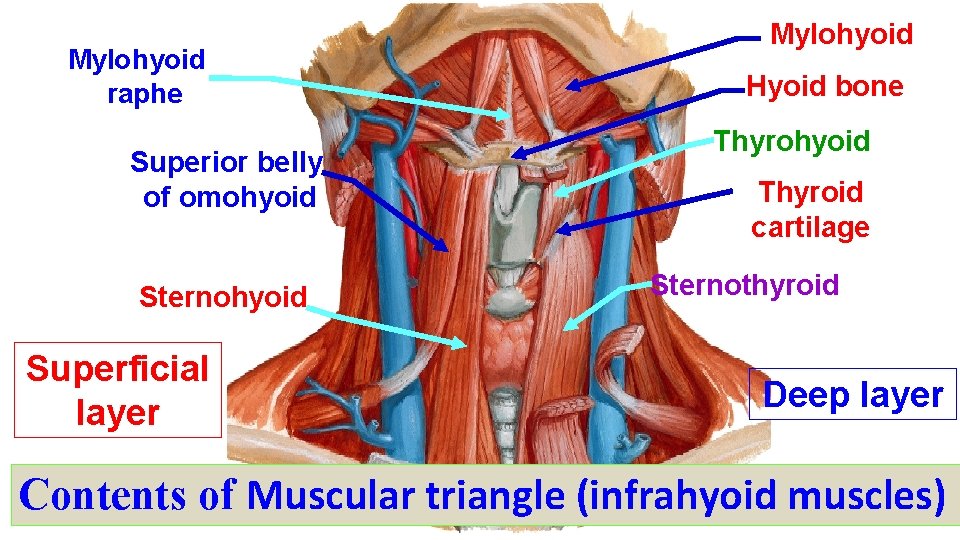
Mylohyoid raphe Superior belly of omohyoid Sternohyoid Superficial layer Mylohyoid Hyoid bone Thyrohyoid Thyroid cartilage Sternothyroid Deep layer Contents of Muscular triangle (infrahyoid muscles)
MYLOHYOID MUSCLE (Diaphragma oris) "Oral diaphragm" It is a thin sheet of muscle which forms the floor of the mouth Origin: mylohyoid line in the inner of body of the mandible. Insertion: The anterior part of both muscles inserted into a median raphe extending from the symphysis menti to the body of hyoid bone. The posterior fibers are inserted into the body of hyoid. Nerve supply: nerve to mylohyoid, a branch of inferior alveolar nerve of mandibular nerve (from 1 st pharyngeal arch). . Action ( of both muscles ) : (1)They support the floor of the mouth. (2)They elevate the floor of the mouth and hyoid bone during 1 st stage of deglutition. (3) Depression of the mandible.
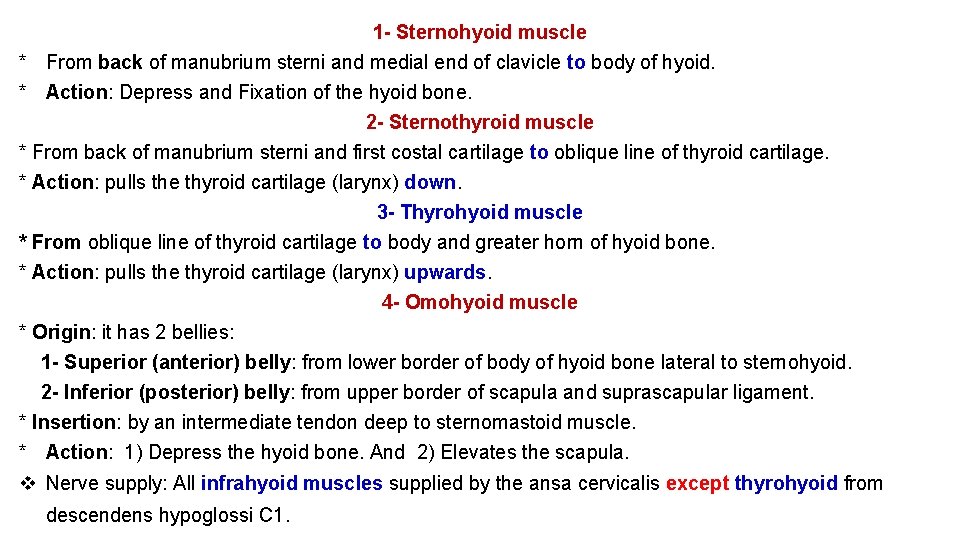
1 - Sternohyoid muscle * From back of manubrium sterni and medial end of clavicle to body of hyoid. * Action: Depress and Fixation of the hyoid bone. 2 - Sternothyroid muscle * From back of manubrium sterni and first costal cartilage to oblique line of thyroid cartilage. * Action: pulls the thyroid cartilage (larynx) down. 3 - Thyrohyoid muscle * From oblique line of thyroid cartilage to body and greater horn of hyoid bone. * Action: pulls the thyroid cartilage (larynx) upwards. 4 - Omohyoid muscle * Origin: it has 2 bellies: 1 - Superior (anterior) belly: from lower border of body of hyoid bone lateral to sternohyoid. 2 - Inferior (posterior) belly: from upper border of scapula and suprascapular ligament. * Insertion: by an intermediate tendon deep to sternomastoid muscle. * Action: 1) Depress the hyoid bone. And 2) Elevates the scapula. v Nerve supply: All infrahyoid muscles supplied by the ansa cervicalis except thyrohyoid from descendens hypoglossi C 1.
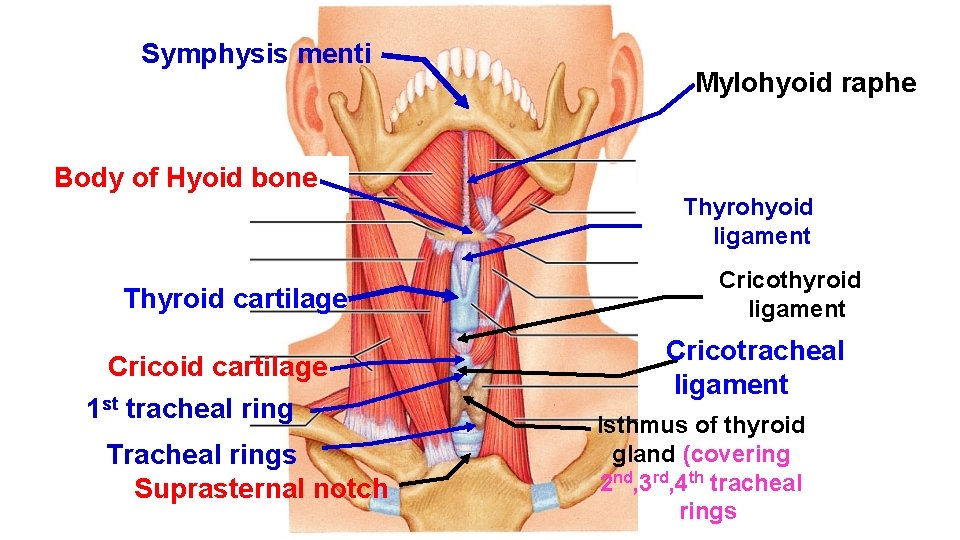
Symphysis menti Mylohyoid raphe Body of Hyoid bone Thyrohyoid ligament Thyroid cartilage Cricoid cartilage 1 st tracheal ring Tracheal rings Suprasternal notch Cricothyroid ligament Cricotracheal ligament Isthmus of thyroid gland (covering 2 nd, 3 rd, 4 th tracheal rings
Th ank Qu you est ion s