
Posterior Column Medial Lemniscus Pathway This is an
- Slides: 7
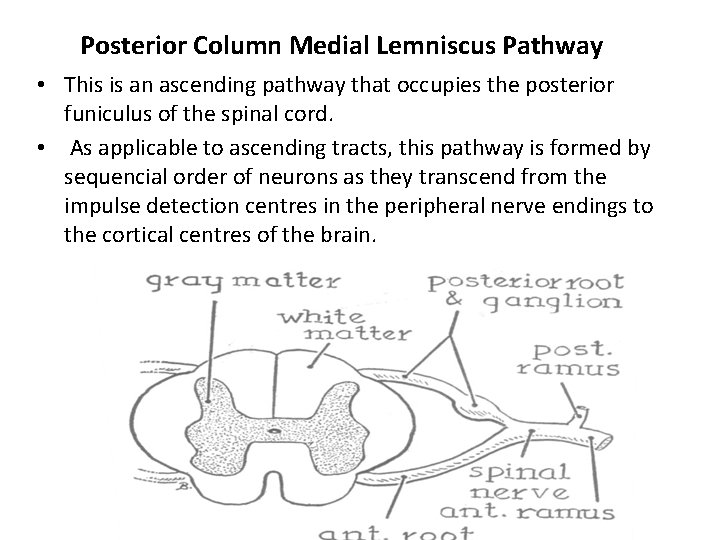
Posterior Column Medial Lemniscus Pathway • This is an ascending pathway that occupies the posterior funiculus of the spinal cord. • As applicable to ascending tracts, this pathway is formed by sequencial order of neurons as they transcend from the impulse detection centres in the peripheral nerve endings to the cortical centres of the brain.
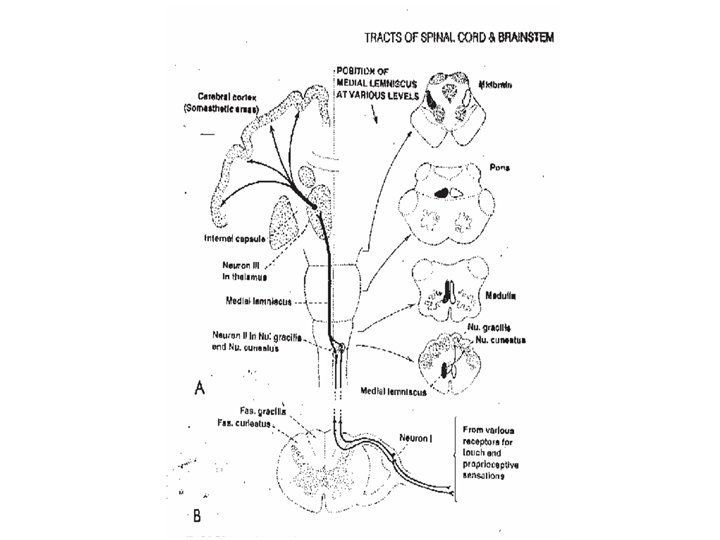
• The Posterior Column – Medial Lemniscus Pathway is unique in that they are formed by the central processes of the first order neurons located in the dorsal root ganglion. These constitute the fasciculus gracilis and fasciculus cuneatus which together form the posterior column of the spinal cord. • The fibres of the fasciculi are regionally located in their passage tract that is, sacral, lumbar and lower thoracic are located medially in the fasciculus gracilis while the upper thoracic and cervical are located laterally in the fasciculus. • The fibres of the fasciculi ascend up till the medulla where they synapse with the nucleus gracilis and nucleus cuneatus to form the second order neurons. • The axons of nucleus gracilis and nucleus cuneatus which are second order neurons in this pathway run as the internal arcuate fibres. • The fibres then decussate in the medulla to form the great sensory decussation. After decussation, the internal arcuate fibres ascend on the opposite side as the medial lemniscus to reach the thalamus.
• From the thalamus the third order neurons pass through the internal capsule and then the corona radiata to reach the somatosensory areas of the cortex where the appropriate interpretations are done concerning the functional attribute relating to the pathway. • The tract is related to the sensations of various aspects of touch and pressure. These include: • Sensations of light touch which recognizes a feeling of gentle skin touch, • Tactile localization which recognizes the specific area of touch, • Tactile discrimination which is the recognition of two different points touched in the skin simultaneously, • Stereognosis which is the recognition of the shape of an object in the hand. • The tract also carries sensation of proprioceptive impulses which is related to position and movement. • Impulses related to the sense of vibration are also carried by the posterior column medial lemniscus pathway.
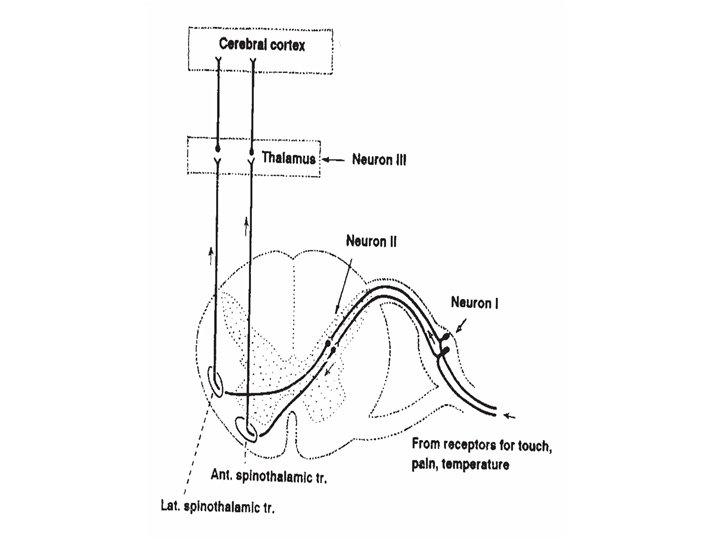
Spinothalamic tract • First order neurons in the dorsal root ganglia and the central processes enter the spinal cord and synapse with the grey matter at the posterior column to form the second order neurons. • Thereafter the axons of the second order neurons which form the anterior andlateral spinothalamic tracts cross over to the other side of the cord across the white commissure. • The fibres of the lateral spinothalamic tract cross within the same segment of cord while those of the anterior spinothalamic tract may ascend one or two segments of the cord before crossing over.
• Fibres of the anterior spinothalamic tract enter the lateral funiculus and ascend though the medulla, pons and midbrain (spinal lemniscus) to end in the thalamus. The axons of the third order neurons ascend to the cortex • The lateral spinothalamic travel equally in the lateral funiculus of the cord to reach the thalamus where third order neurons give axons that reach the cortex • Functions • Anterior Spinothalamic Tract – sensations of crude touch and pressure • Lateral Spinothalamic Tract – pain and temperature