
Poster Session Guideline Implementation A Survey on the
- Slides: 1
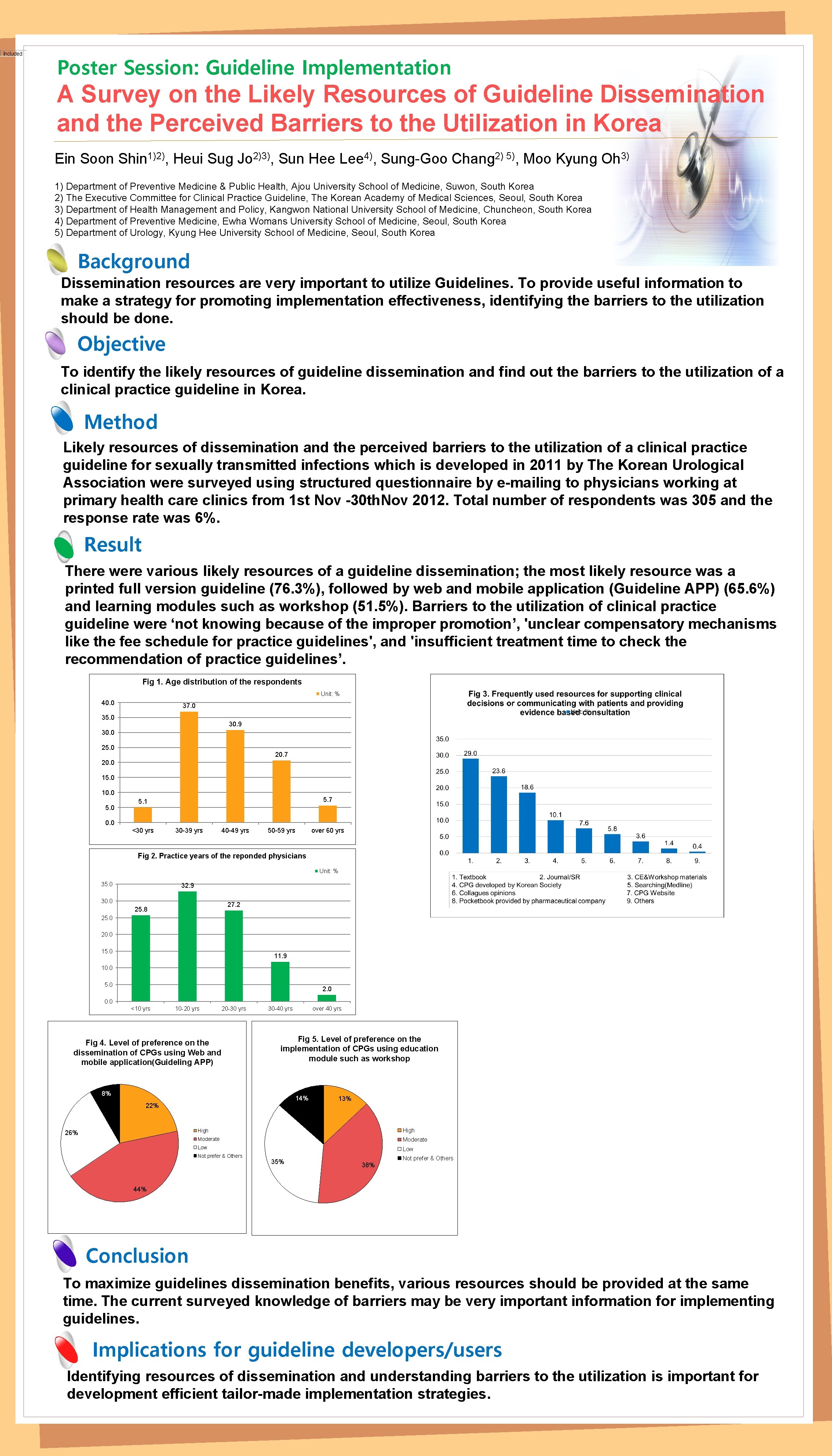
Poster Session: Guideline Implementation A Survey on the Likely Resources of Guideline Dissemination and the Perceived Barriers to the Utilization in Korea Ein Soon Shin 1)2), Heui Sug Jo 2)3), Sun Hee Lee 4), Sung-Goo Chang 2) 5), Moo Kyung Oh 3) 1) Department of Preventive Medicine & Public Health, Ajou University School of Medicine, Suwon, South Korea 2) The Executive Committee for Clinical Practice Guideline, The Korean Academy of Medical Sciences, Seoul, South Korea 3) Department of Health Management and Policy, Kangwon National University School of Medicine, Chuncheon, South Korea 4) Department of Preventive Medicine, Ewha Womans University School of Medicine, Seoul, South Korea 5) Department of Urology, Kyung Hee University School of Medicine, Seoul, South Korea Background Dissemination resources are very important to utilize Guidelines. To provide useful information to make a strategy for promoting implementation effectiveness, identifying the barriers to the utilization should be done. Objective To identify the likely resources of guideline dissemination and find out the barriers to the utilization of a clinical practice guideline in Korea. Method Likely resources of dissemination and the perceived barriers to the utilization of a clinical practice guideline for sexually transmitted infections which is developed in 2011 by The Korean Urological Association were surveyed using structured questionnaire by e-mailing to physicians working at primary health care clinics from 1 st Nov -30 th. Nov 2012. Total number of respondents was 305 and the response rate was 6%. Result There were various likely resources of a guideline dissemination; the most likely resource was a printed full version guideline (76. 3%), followed by web and mobile application (Guideline APP) (65. 6%) and learning modules such as workshop (51. 5%). Barriers to the utilization of clinical practice guideline were ‘not knowing because of the improper promotion’, 'unclear compensatory mechanisms like the fee schedule for practice guidelines', and 'insufficient treatment time to check the recommendation of practice guidelines’. Fig 1. Age distribution of the respondents Unit: % 40. 0 37. 0 35. 0 30. 9 30. 0 25. 0 20. 7 20. 0 15. 0 10. 0 5. 7 5. 1 0. 0 <30 yrs 30 -39 yrs 40 -49 yrs 50 -59 yrs over 60 yrs Fig 2. Practice years of the reponded physicians Unit: % 35. 0 32. 9 30. 0 27. 2 25. 8 25. 0 20. 0 15. 0 11. 9 10. 0 5. 0 2. 0 0. 0 <10 yrs 10 -20 yrs 20 -30 yrs Fig 4. Level of preference on the dissemination of CPGs using Web and mobile application(Guideling APP) 30 -40 yrs Fig 5. Level of preference on the implementation of CPGs using education module such as workshop 8% 14% 22% 26% over 40 yrs 13% High Moderate Low Not prefer & Others 35% 38% Not prefer & Others 44% Conclusion To maximize guidelines dissemination benefits, various resources should be provided at the same time. The current surveyed knowledge of barriers may be very important information for implementing guidelines. Implications for guideline developers/users Identifying resources of dissemination and understanding barriers to the utilization is important for development efficient tailor-made implementation strategies.