Poster POS 6 Session name Treatment Devices Day
- Slides: 1
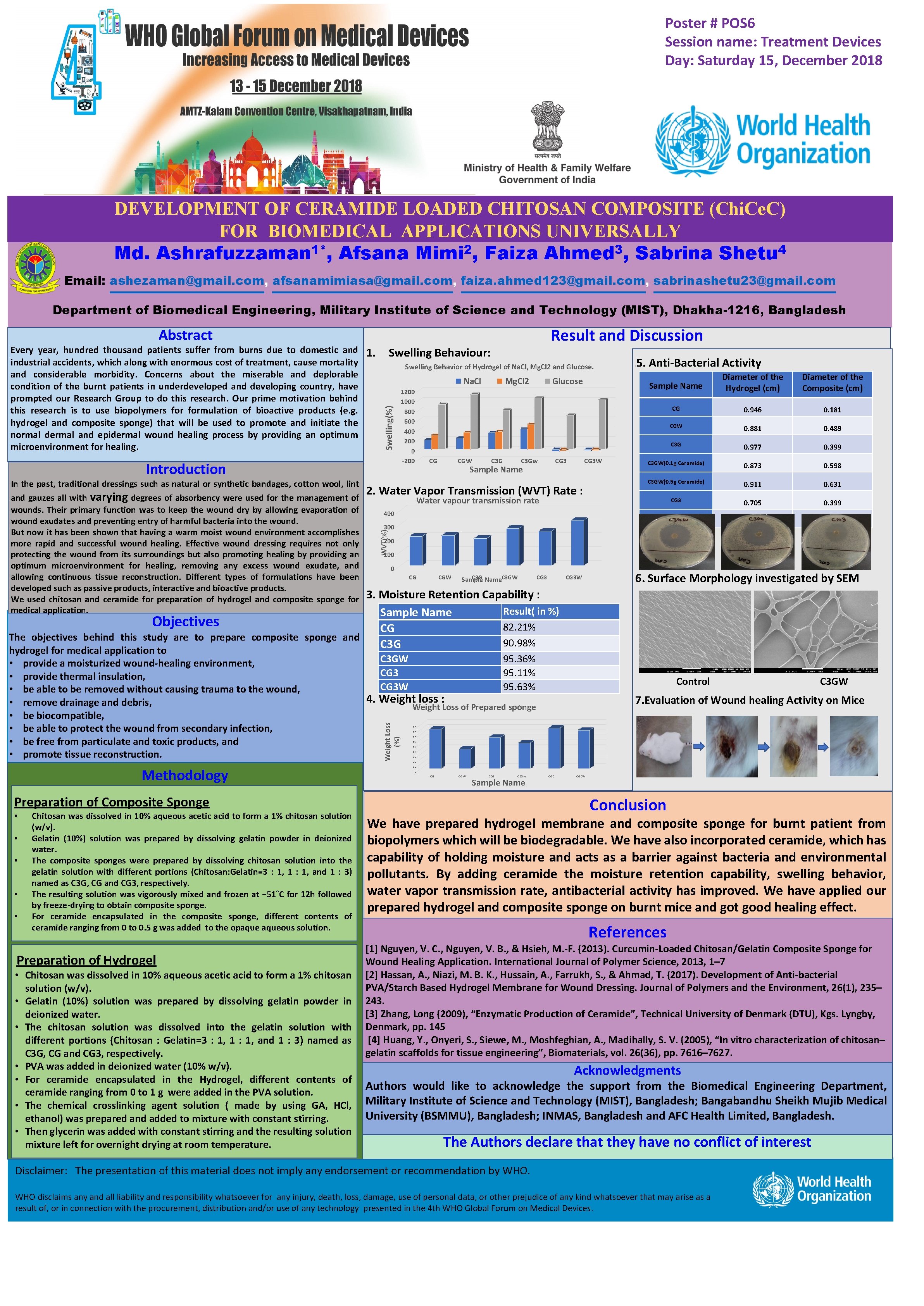
Poster # POS 6 Session name: Treatment Devices Day: Saturday 15, December 2018 DEVELOPMENT OF CERAMIDE LOADED CHITOSAN COMPOSITE (Chi. Ce. C) FOR BIOMEDICAL APPLICATIONS UNIVERSALLY 1* 2 3 4 Md. Ashrafuzzaman , Afsana Mimi , Faiza Ahmed , Sabrina Shetu Email: ashezaman@gmail. com, afsanamimiasa@gmail. com, faiza. ahmed 123@gmail. com, sabrinashetu 23@gmail. com Department of Biomedical Engineering, Military Institute of Science and Technology (MIST), Dhakha-1216, Bangladesh Result and Discussion Abstract 1. Swelling Behaviour: Swelling Behavior of Hydrogel of Na. Cl, Mg. Cl 2 and Glucose. Na. Cl Swelling(%) Every year, hundred thousand patients suffer from burns due to domestic and industrial accidents, which along with enormous cost of treatment, cause mortality and considerable morbidity. Concerns about the miserable and deplorable condition of the burnt patients in underdeveloped and developing country, have prompted our Research Group to do this research. Our prime motivation behind this research is to use biopolymers formulation of bioactive products (e. g. hydrogel and composite sponge) that will be used to promote and initiate the normal dermal and epidermal wound healing process by providing an optimum microenvironment for healing. Introduction and gauzes all with varying degrees of absorbency were used for the management of wounds. Their primary function was to keep the wound dry by allowing evaporation of wound exudates and preventing entry of harmful bacteria into the wound. But now it has been shown that having a warm moist wound environment accomplishes more rapid and successful wound healing. Effective wound dressing requires not only protecting the wound from its surroundings but also promoting healing by providing an optimum microenvironment for healing, removing any excess wound exudate, and allowing continuous tissue reconstruction. Different types of formulations have been developed such as passive products, interactive and bioactive products. We used chitosan and ceramide for preparation of hydrogel and composite sponge for medical application. CG CGW C 3 G Glucose C 3 Gw CG 3 Sample Name CG 3 W 2. Water Vapor Transmission (WVT) Rate : Sample Name Diameter of the Hydrogel (cm) Diameter of the Composite (cm) CG 0. 946 0. 181 CGW 0. 881 0. 489 C 3 G 0. 977 0. 399 C 3 GW(0. 1 g Ceramide) 0. 873 0. 598 C 3 GW(0. 5 g Ceramide) 0. 911 0. 631 CG 3 0. 705 0. 399 CG 3 W 0. 691 0. 282 Water vapour transmission rate 400 300 WVT(%) In the past, traditional dressings such as natural or synthetic bandages, cotton wool, lint 1200 1000 800 600 400 200 0 -200 Mg. Cl 2 5. Anti-Bacterial Activity [ 200 100 0 CG CGW C 3 G Name. C 3 GW Sample CG 3 W 6. Surface Morphology investigated by SEM 3. Moisture Retention Capability : Result( in %) Sample Name Objectives 82. 21% CG The objectives behind this study are to prepare composite sponge and 90. 98% C 3 G hydrogel for medical application to Methodology C 3 GW CG 3 W 95. 36% 95. 11% 95. 63% 4. Weight loss : • • Chitosan was dissolved in 10% aqueous acetic acid to form a 1% chitosan solution (w/v). Gelatin (10%) solution was prepared by dissolving gelatin powder in deionized water. The composite sponges were prepared by dissolving chitosan solution into the gelatin solution with different portions (Chitosan: Gelatin=3 : 1, 1 : 1, and 1 : 3) named as C 3 G, CG and CG 3, respectively. The resulting solution was vigorously mixed and frozen at − 51˚C for 12 h followed by freeze-drying to obtain composite sponge. For ceramide encapsulated in the composite sponge, different contents of ceramide ranging from 0 to 0. 5 g was added to the opaqueous solution. Preparation of Hydrogel • Chitosan was dissolved in 10% aqueous acetic acid to form a 1% chitosan solution (w/v). • Gelatin (10%) solution was prepared by dissolving gelatin powder in deionized water. • The chitosan solution was dissolved into the gelatin solution with different portions (Chitosan : Gelatin=3 : 1, 1 : 1, and 1 : 3) named as C 3 G, CG and CG 3, respectively. • PVA was added in deionized water (10% w/v). • For ceramide encapsulated in the Hydrogel, different contents of ceramide ranging from 0 to 1 g were added in the PVA solution. • The chemical crosslinking agent solution ( made by using GA, HCl, ethanol) was prepared and added to mixture with constant stirring. • Then glycerin was added with constant stirring and the resulting solution mixture left for overnight drying at room temperature. C 3 GW 7. Evaluation of Wound healing Activity on Mice 90 80 70 60 50 40 30 20 10 0 CG CGW C 3 Gw Sample Name Preparation of Composite Sponge • Control Weight Loss of Prepared sponge Weight Loss (%) provide a moisturized wound-healing environment, provide thermal insulation, be able to be removed without causing trauma to the wound, remove drainage and debris, be biocompatible, be able to protect the wound from secondary infection, be free from particulate and toxic products, and promote tissue reconstruction. • • CG 3 W Conclusion We have prepared hydrogel membrane and composite sponge for burnt patient from biopolymers which will be biodegradable. We have also incorporated ceramide, which has Conclusions capability of holding moisture and acts as a barrier against bacteria and environmental pollutants. By adding ceramide the moisture retention capability, swelling behavior, water vapor transmission rate, antibacterial activity has improved. We have applied our prepared hydrogel and composite sponge on burnt mice and got good healing effect. References [1] Nguyen, V. C. , Nguyen, V. B. , & Hsieh, M. -F. (2013). Curcumin-Loaded Chitosan/Gelatin Composite Sponge for Wound Healing Application. International Journal of Polymer Science, 2013, 1– 7 [2] Hassan, A. , Niazi, M. B. K. , Hussain, A. , Farrukh, S. , & Ahmad, T. (2017). Development of Anti-bacterial PVA/Starch Based Hydrogel Membrane for Wound Dressing. Journal of Polymers and the Environment, 26(1), 235– 243. [3] Zhang, Long (2009), “Enzymatic Production of Ceramide”, Technical University of Denmark (DTU), Kgs. Lyngby, Denmark, pp. 145 [4] Huang, Y. , Onyeri, S. , Siewe, M. , Moshfeghian, A. , Madihally, S. V. (2005), “In vitro characterization of chitosan– gelatin scaffolds for tissue engineering”, Biomaterials, vol. 26(36), pp. 7616– 7627. Acknowledgments Authors would like to acknowledge the support from the Biomedical Engineering Department, Military Institute of Science and Technology (MIST), Bangladesh; Bangabandhu Sheikh Mujib Medical University (BSMMU), Bangladesh; INMAS, Bangladesh and AFC Health Limited, Bangladesh. The Authors declare that they have no conflict of interest Disclaimer: The presentation of this material does not imply any endorsement or recommendation by WHO disclaims any and all liability and responsibility whatsoever for any injury, death, loss, damage, use of personal data, or other prejudice of any kind whatsoever that may arise as a result of, or in connection with the procurement, distribution and/or use of any technology presented in the 4 th WHO Global Forum on Medical Devices.