
PostDeployment Stress and Reintegration Mary Beth Heller Ph

Post-Deployment Stress and Reintegration Mary Beth Heller, Ph. D. Equal Justice Works Leadership Development Training October 23, 2014
Learning Objectives • What is post-deployment stress? • Can we measure post-deployment stress? • What is the relationship between post-deployment stress and PTSD? • How can we support veterans during post-deployment adjustment?

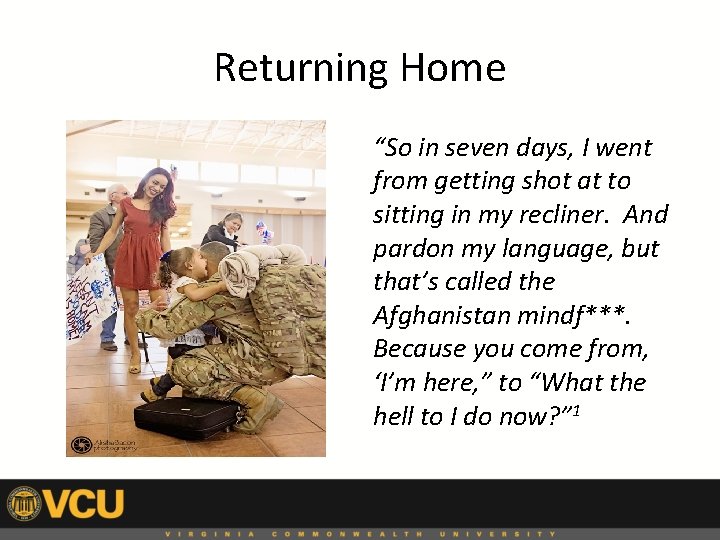
Returning Home “So in seven days, I went from getting shot at to sitting in my recliner. And pardon my language, but that’s called the Afghanistan mindf***. Because you come from, ‘I’m here, ” to “What the hell to I do now? ” 1
Altered Perspectives “…you lose a sense of what normalcy is like…You forget what it’s like to watch TV and sit on the couch and you just…you lose all that. ” “When I came back from Iraq, the biggest story in the news was Janet Jackson’s wardrobe malfunction at the Super Bowl. And it kind of rattled me, because I looked around and said, “Is this what America is paying attention to? ” And I think that’s a common experience for veterans coming home, because such a small percentage of the American population is immediately affected. . . So there’s a real disconnect, a profound disconnect, from the personal side of this war. ” “None of the guys have any work ethic. All they care about is getting drunk or high after their shift. In the Army you did what you were told. I just can’t relate to any of them anymore. ”
Now, After (December 2010) SSG Kyle Hausmann-Stokes US Army, Infantry, OIF 07 -08 http: //www. youtube. com/watch? v=Nk. Ww. Z 9 Zt. PEI from 3: 05 -5: 10
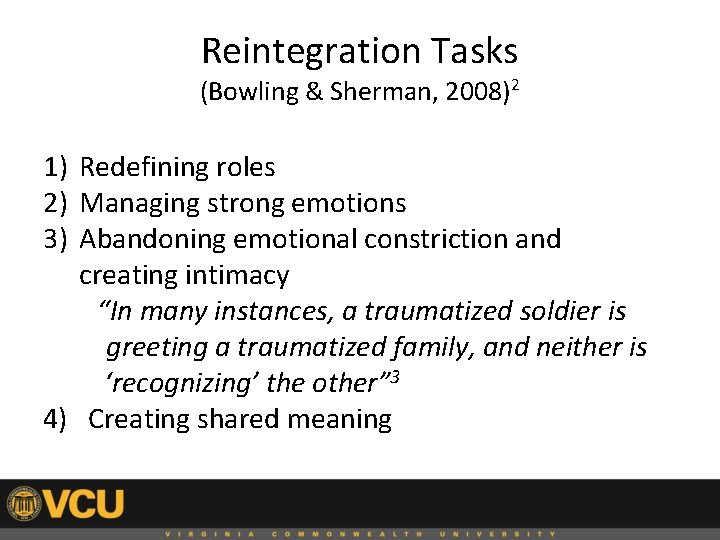
Reintegration Tasks (Bowling & Sherman, 2008)2 1) Redefining roles 2) Managing strong emotions 3) Abandoning emotional constriction and creating intimacy “In many instances, a traumatized soldier is greeting a traumatized family, and neither is ‘recognizing’ the other” 3 4) Creating shared meaning

Measuring Post-Deployment Stress • Post-Deployment Health Reassessment Program (PDHRA)4 • Required by Do. D since March 2005, 3 -6 months post-deployment • 2004 study 5 • PTSD symptoms • Depression • General distress • Anger • Relationship problems • With exception of relationship problems (due to small sample size), all mental health problems increased by 200% - 500% at 120 days
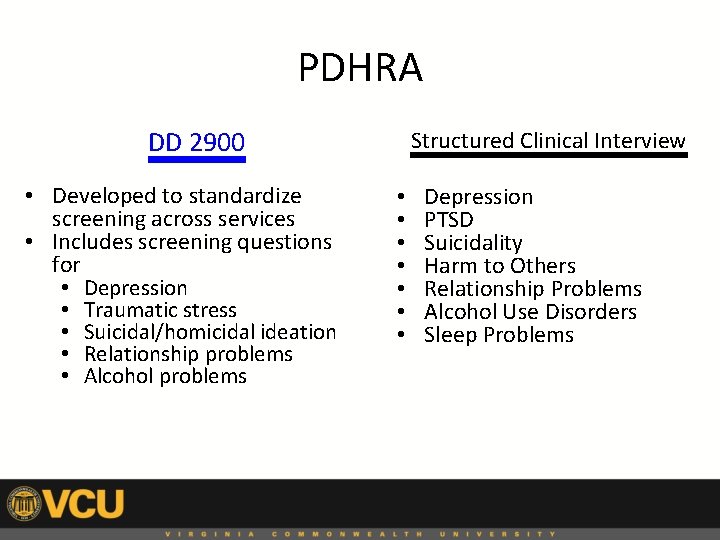
PDHRA DD 2900 • Developed to standardize screening across services • Includes screening questions for • Depression • Traumatic stress • Suicidal/homicidal ideation • Relationship problems • Alcohol problems Structured Clinical Interview • • Depression PTSD Suicidality Harm to Others Relationship Problems Alcohol Use Disorders Sleep Problems
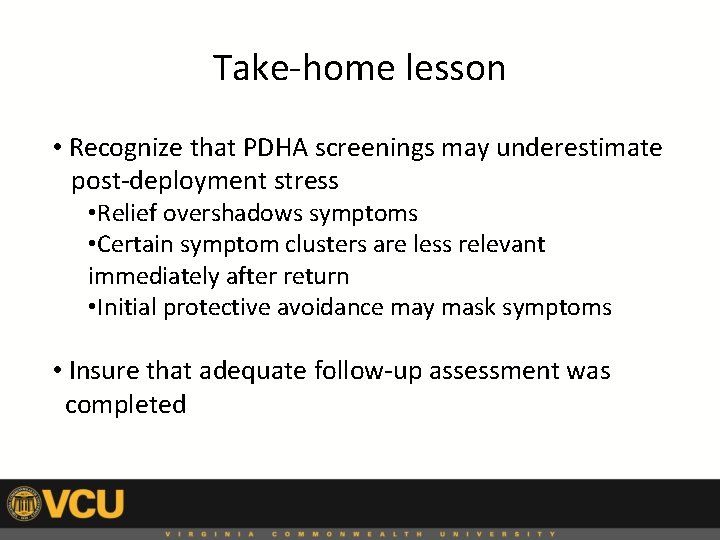
Take-home lesson • Recognize that PDHA screenings may underestimate post-deployment stress • Relief overshadows symptoms • Certain symptom clusters are less relevant immediately after return • Initial protective avoidance may mask symptoms • Insure that adequate follow-up assessment was completed
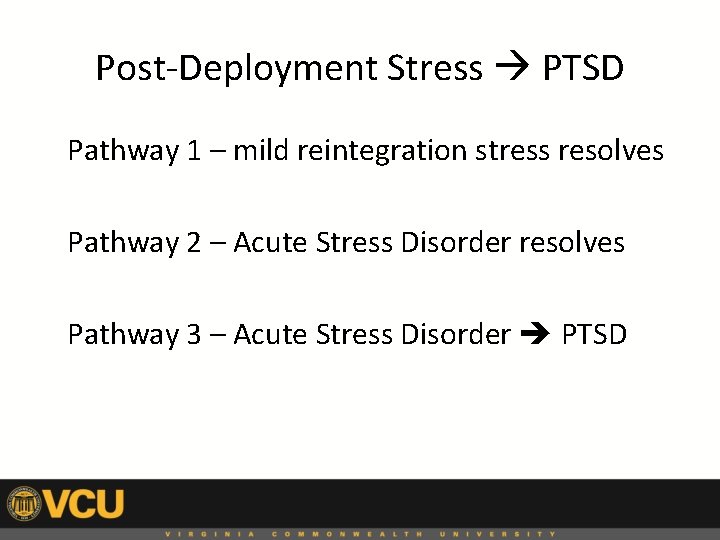
Post-Deployment Stress PTSD Pathway 1 – mild reintegration stress resolves Pathway 2 – Acute Stress Disorder resolves Pathway 3 – Acute Stress Disorder PTSD
References and Resources 1 Finley, E. P. (2011). Fields of Combat: Understanding PTSD Among Veterans of Iraq and Afghanistan. Ithaca, NY: Cornell University Press. 2 Bowling, U. B. & Sherman, M. D. (2008). Welcoming them home: Supporting service members and their families in navigating the tasks of reintegration. Professional Psychology: Research and Practice, 39(4), 451 -458. 3 Hutchinson, J. & Banks-Williams. L. (2006). Clinical issues and treatment considerations for new veterans: Soldiers of the wars in Iraq and Afghanistan. Primary Psychiatry, 13(3), 66 -71. 4 Bliese, P. , Wright, K, Adler, A. , Hoge, C. & Prayner, R. (2005). Post. Deployment Psychological Screening: Interpreting and Scoring DD Form 2900. US Army Medical Research Unit – Europe. 5 Bliese, P. D. , Wright, K. M. , Adler, A. B. , Thomas, J. L. , & Hoge, C. W. (2007). Timing of postcombat mental health assessments. Psychological Services, 4(3), 141 -148.
- Slides: 12