
PostAccident Waste Management in Ukraine Challenges and Steps



- Slides: 20
Post-Accident Waste Management in Ukraine: Challenges and Steps Needed to Resolve the Accident Waste Problem T. Kilochytska, State Nuclear Regulatory Inspectorate of Ukraine L. Zinkevich, State Agency of Ukraine on Exclusion Zone Management I. Shybetskyi, Radioenvironmental Centre of National Academy of Sciences of Ukraine J. Krone, DBE TECHNOLOGY Gmb. H, Peine, Germany International Conference on the Safety of Radioactive Waste Management 21 -25 November, 2016, Vienna, Austria 16 May 2006 JC 2 nd Review Meeting, Presentation of Ukraine 1
Content q q q q History of accident waste in Ukraine The main places of localization Volumes, activity, characteristics Challenges of accident waste management Steps to resolve the problem of accident waste Lessons learnt Conclusions
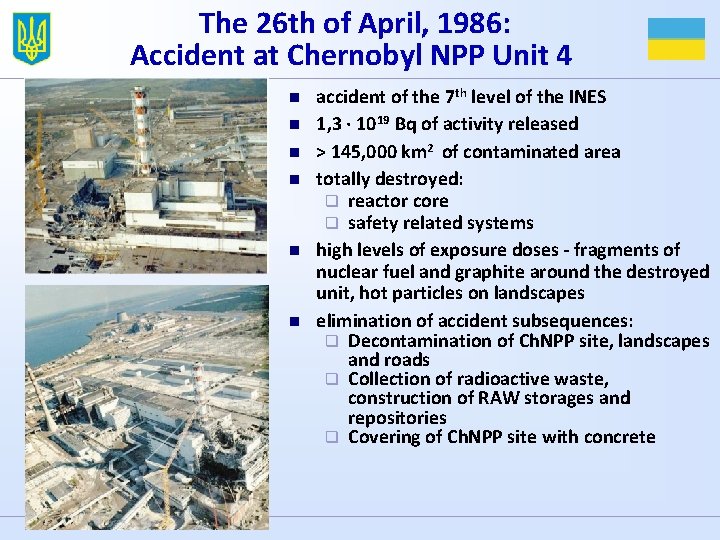
The 26 th of April, 1986: Accident at Chernobyl NPP Unit 4 n n n accident of the 7 th level of the INES 1, 3 · 1019 Bq of activity released ˃ 145, 000 km 2 of contaminated area totally destroyed: q reactor core q safety related systems high levels of exposure doses - fragments of nuclear fuel and graphite around the destroyed unit, hot particles on landscapes elimination of accident subsequences: q Decontamination of Ch. NPP site, landscapes and roads q Collection of radioactive waste, construction of RAW storages and repositories q Covering of Ch. NPP site with concrete
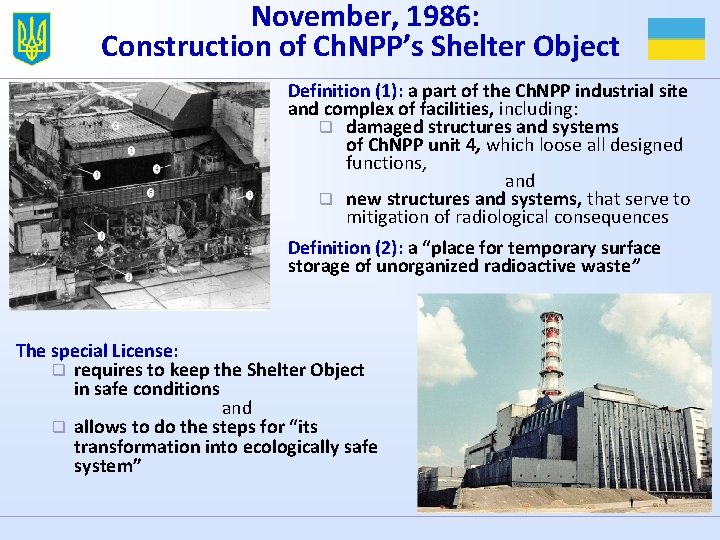
November, 1986: Construction of Ch. NPP’s Shelter Object Definition (1): a part of the Ch. NPP industrial site and complex of facilities, including: q damaged structures and systems of Ch. NPP unit 4, which loose all designed functions, and q new structures and systems, that serve to mitigation of radiological consequences Definition (2): a “place for temporary surface storage of unorganized radioactive waste” The special License: q requires to keep the Shelter Object in safe conditions and q allows to do the steps for “its transformation into ecologically safe system”
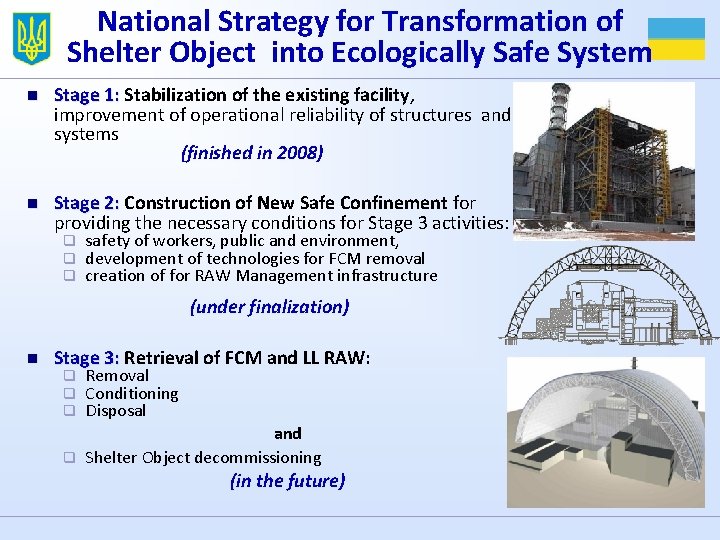
National Strategy for Transformation of Shelter Object into Ecologically Safe System n Stage 1: Stabilization of the existing facility, improvement of operational reliability of structures and systems (finished in 2008) n Stage 2: Construction of New Safe Confinement for providing the necessary conditions for Stage 3 activities: q q q safety of workers, public and environment, development of technologies for FCM removal creation of for RAW Management infrastructure (under finalization) n Stage 3: Retrieval of FCM and LL RAW: q q q Removal Conditioning Disposal and q Shelter Object decommissioning (in the future)
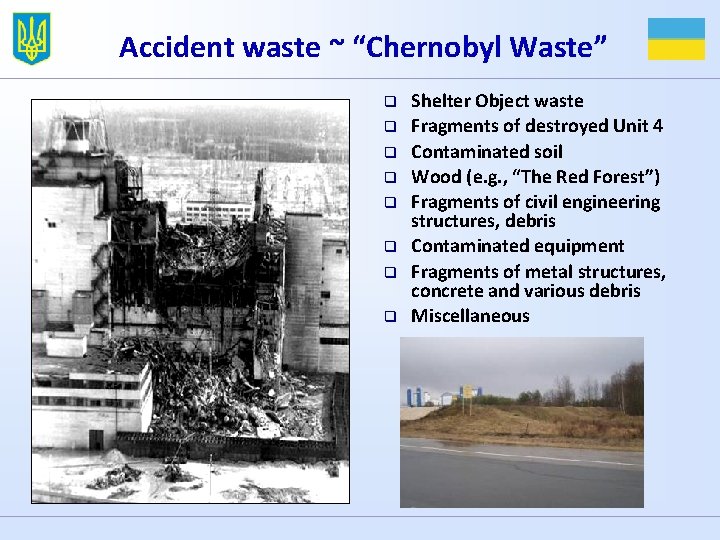
Accident waste ~ “Chernobyl Waste” q q q q Shelter Object waste Fragments of destroyed Unit 4 Contaminated soil Wood (e. g. , “The Red Forest”) Fragments of civil engineering structures, debris Contaminated equipment Fragments of metal structures, concrete and various debris Miscellaneous
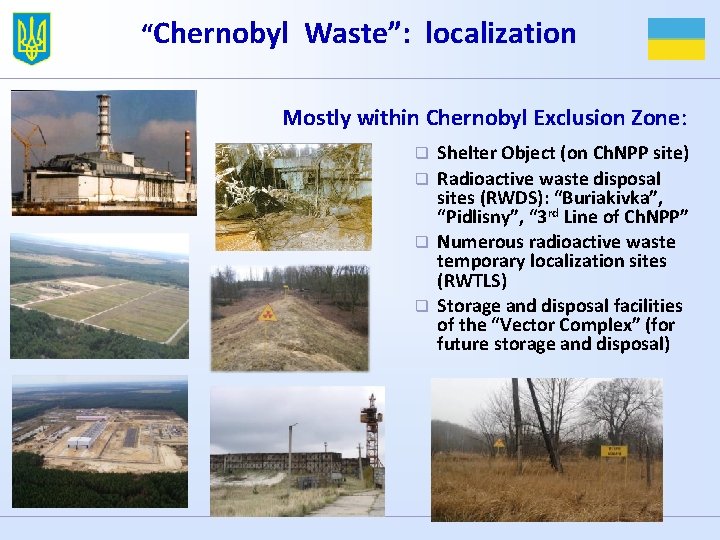
“Chernobyl Waste”: localization Mostly within Chernobyl Exclusion Zone: Shelter Object (on Ch. NPP site) q Radioactive waste disposal sites (RWDS): “Buriakivka”, “Pidlisny”, “ 3 rd Line of Ch. NPP” q Numerous radioactive waste temporary localization sites (RWTLS) q Storage and disposal facilities of the “Vector Complex” (for future storage and disposal) q
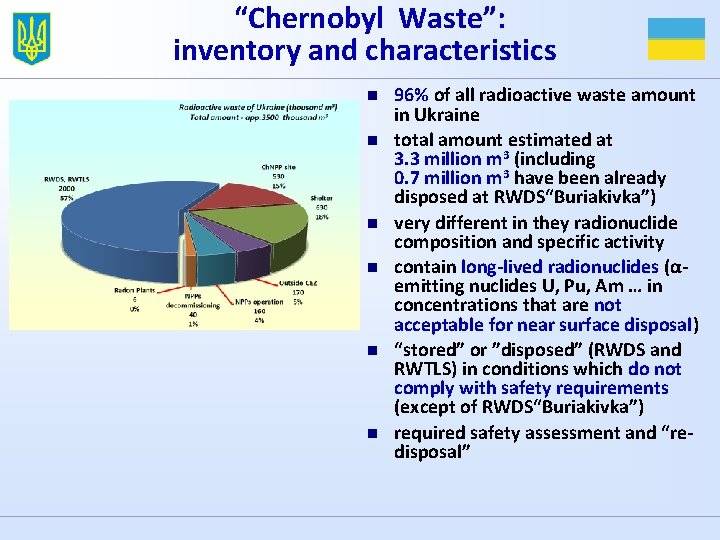
“Chernobyl Waste”: inventory and characteristics n n n 96% of all radioactive waste amount in Ukraine total amount estimated at 3. 3 million m 3 (including 0. 7 million m 3 have been already disposed at RWDS“Buriakivka”) very different in they radionuclide composition and specific activity contain long-lived radionuclides (αemitting nuclides U, Pu, Am … in concentrations that are not acceptable for near surface disposal) “stored” or ”disposed” (RWDS and RWTLS) in conditions which do not comply with safety requirements (except of RWDS“Buriakivka”) required safety assessment and “redisposal”
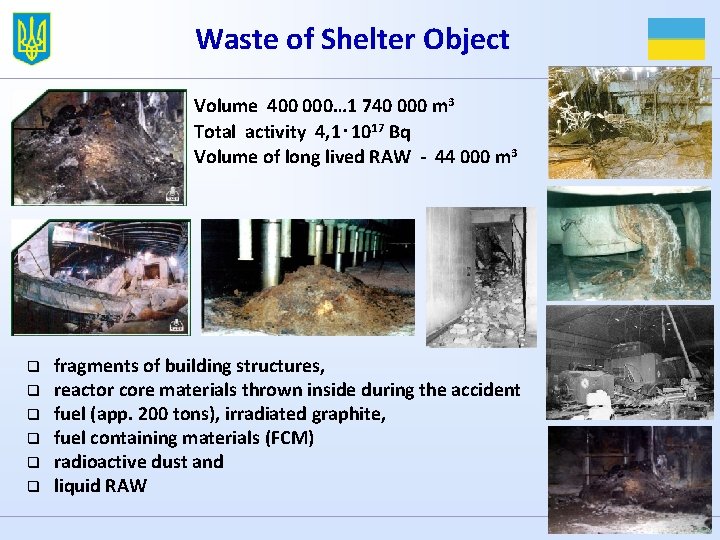
Waste of Shelter Object Volume 400 000… 1 740 000 m 3 Total activity 4, 1‧ 1017 Bq Volume of long lived RAW - 44 000 m 3 q q q fragments of building structures, reactor core materials thrown inside during the accident fuel (app. 200 tons), irradiated graphite, fuel containing materials (FCM) radioactive dust and liquid RAW
National Policy and Strategy q Radioactive Waste Management Strategy in Ukraine (approved by the Order of Government № 990, 19 August 2009) q National Program of Radioactive Waste Management (approved by Low of Ukraine № 516 -VI, 17 Sept 2008) q National RAW Management Fond
Challenges of accident waste management (1): RAW classification Current classification defines two types of RAW depending on disposal method: q 1 st type: RAW to be disposed in Near-surface disposal facility (low- and intermediate level short-lived RAW) and q 2 nd type: RAW to be disposed in Geological disposal facility (high-level RAW, long-lived RAW – Shelter’s FCM) Current classification: q does not support a cost-effective waste disposal (large amount of “Chernobyl waste” requires a geological disposal due to high content of α-emitting nuclides) q does not define “Chernobyl waste” as a separate class
Challenges of accident waste management (2): safety requirements n n Presence of long-lived radionuclides constitutes the main problem with nearsurface disposal of “Chernobyl waste” IAEA and Ukrainian safety requirements for near-surface disposal: q IAEA, GSG-1: RAW with a specific activity of long-lived alpha emitting nuclides of up to 400 Bq/g on can be disposed in near-surface facilities; Ukraine: a limit of 0. 1 Bq/g is often applied q IAEA, SSR 5: a dose constraint for the future exposure by a disposal facility should not exceed of 0. 3 m. Sv a year; Ukraine: this limit is 0. 01 m. Sv a year Ukraine: very "strict" intrusion scenarios are used for safety assessments of the disposal facility (e. g. , the direct consumption of water from a well drilled into the waste pile at the end of the institutional control period) Due to strict national safety requirements, the majority of accident waste would require geological disposal. It would be practically impossible due to economic considerations q n
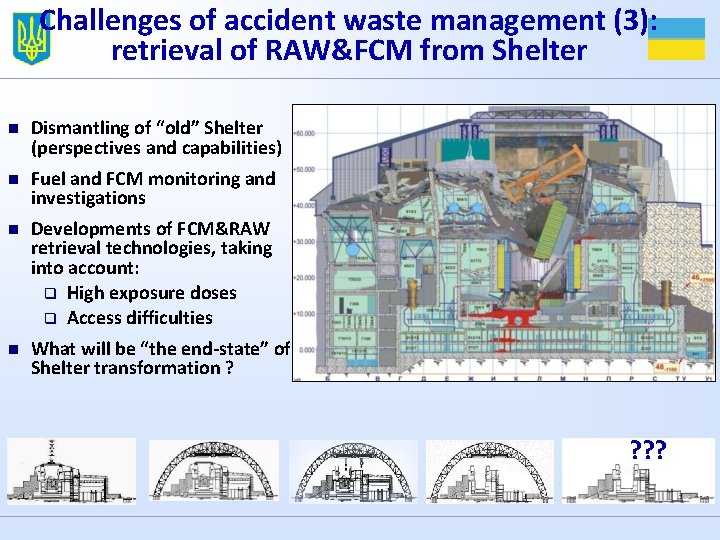
Challenges of accident waste management (3): retrieval of RAW&FCM from Shelter n Dismantling of “old” Shelter (perspectives and capabilities) n Fuel and FCM monitoring and investigations n Developments of FCM&RAW retrieval technologies, taking into account: q High exposure doses q Access difficulties n What will be “the end-state” of Shelter transformation ? ? ? ?
Steps to resolve the problem of accident waste management (1) n Implementation of new waste classification scheme First type: landfill repository for VLLW, Sweden (In Ukraine Buriakivka) Second type: surface repository for LLW, France (in Ukraine – Vector) Class Description Disposal option Very Low Level Waste (VLLW) not determined in Ukraine large volumes of waste in Ukraine can be classified as VLLW Landfill repositories (first type) Low Level Waste (LLW) corresponds to existing shortlived waste Intermed. Level Waste (ILW) High Level Waste (HLW) Third type: GR at intermediate depth for disposal of ILW (SFR, Sweden) Surface repositories (second type) Repository corresponds to existing longat interim depth lived waste (third type) corresponds to existing heat- Deep geological repository generating HLW (fourth type) The new classification system provide significant savings in waste management by cost effectively allocating waste to the most optimal repository solution for each waste class [Project U 4. 01/08 -C , 2012] Fourth type: DGR (KBS-3 V, Sweden) DGR (VDH, Sweden) for co-disposal for disposal of HLW of ILW and HLW
Steps to resolve the problem of accident waste management (2) n Updating of National Safety Standards It is necessary to eliminate excessive conservatism in some of the Ukrainian requirements for RAW disposal and to bring them into line with international best practices (SSR-5, GSR Part 5) n Improvement of Waste Characterization To best benefit from the new classification system improvements in sorting and characterization processes are needed. Improved characterization and sorting of RAW will require appropriate planning taking into account: q the specific characteristics of the accident waste q appropriate waste acceptance criteria for disposal
Steps to resolve the problem of accident waste management (3) n Specific WAC for “Chernobyl waste” Special, less restrictive Waste Acceptance Criteria (WAC) for VLLW and LLW accident waste disposal facilities within the Ch. EZ, could be established based on safety assessments that take credit for the special restrictions q These WAC can be derived from estimates of potential radiation exposure to critical groups living completely outside of the Ch. EZ and would be applicable only to accident waste q n According to the Draft of Strategy for future development of Chernobyl Exclusion Zone: q 10 km zone (a special industrial zone) will never be populated q Other territories will serve as “buffer zone”
Lessons learned (1): management of accident waste n Strategical view is needed: Is existing system of RAW management appropriate to solve the problem of accident waste (predisposal and disposal)? q Is existing “concept of RAW disposability” appropriate to solve the problem of accident waste? q If not: “What” should be revised and updated (classification, safety requirements for RAW disposal, characterization methods, financial assurance)? q n Special WAC for disposal in surface repositories Status and restrictions of special zone should be approved on the Governmental level q “Safety case” for near-surface disposal of accident waste needs to be discussed involving interested parties q Additional (specific) safety requirements should be established q
Lessons learned (2): activities on Shelter Object Transformation n n Since 1998 the implementation of large project “Shelter Implementation Plan” has been supported by international community New Safe Confinement (“Arch” project) costs 1, 5 billions Euros. Dismantling and removal of RAW&FCM require much more funding After 30 years after the accident: q RAW&FCM still should be characterized q dismantling of Shelter’s structures and retrieval of RAW&FCM require the additional RAW management infrastructure q development of technologies for RAW&FCM retrieval requires R&D support q involvement of international experience is needed Revision of National Strategy (2001) for Shelter Object is needed
Conclusions n Solving the problem of management of “Chernobyl waste” requires: a systematic review of the existing norms and regulations with respect to best international practice of radioactive waste management q improvement of the existing classification / characterization of radioactive waste with a focus on disposal q improvement of the safety assessment approaches for licensing the disposal of accident waste, taking into account relevant safety features and site specific conditions q involving of international experience and support to plan and perform safety related activity on the Shelter Object transformation q
Thank you for your attention!