
Post Treatment How Do We Support Problem Gamblers
Post Treatment: How Do We Support Problem Gamblers in Recovery Mark Vander Linden, MSW Iowa Department of Public Health Jim Wuelfing, NRPP Massachusetts Council on Compulsive Gambling
Overview of the Session n What do we do now to support recovery? n Defining recovery n Supporting all pathways to recovery n What do we mean by recovery support services? n Two state experiences Iowa n Massachusetts n n Where do we go from here?
n. How would you define recovery?
A recovery definition n A process of change through which individuals improve their health and wellness, live a self-directed life, and strive to reach their full potential.
Four major dimensions that support a life in recovery n Health: Overcoming or managing one's disease(s) as well as living in a physically and emotionally healthy way. n Home: A stable and safe place to live. n Purpose: Meaningful daily activities, such as a job, school, volunteerism, family caretaking, or creative endeavors, and the independence, income, and resources to participate in society. n Community: Relationships and social networks that provide support, friendship, love, and hope.

Supporting All Pathways to Recovery n Scope of Recovery n n Primary and Secondary n Types of Recovery n n n Abstinence-based Moderation-based Medicated-assisted n Context of Recovery n n n Solo Treatment-assisted Peer-assisted n Framework of Recovery n n n Religious Spiritual Secular n Recovery Identity n n n Neutral Recovery-positive Recovery-negative n Recovery Termination n In Recovery Recovered Recovering
ROSC n Recovery oriented systems of care health and human service organizations that affirm hope for recovery, exemplify a strength-based (as opposed to pathology-focused) orientation, and offer a wide spectrum of services aimed at the support of long-term recovery.
Recovery Oriented Systems of Care (ROSC) n Focus on n A strength-based recovery focus (rather than pathology focus) on all services n Long-term recovery moving away from an acute care model for the treatment of a chronic illness n Partnerships emphasizing recovery-linked service practices n Community components geared toward building recovery capital.
Recovery Community Organization n Is an independent, non-profit organization led and governed by local communities of recovery. The broadly defined recovery community – people in long-term recovery, their families, friends and allies, including recovery-focused addiction and recovery professionals – includes organizations whose members reflect many pathways to recovery.
Defining Peer Recovery Support n Peer-based recovery support is the process of giving and receiving non-professional, non-clinical assistance to achieve long-term recovery from severe alcohol and/or other drug-related problems. This support is provided by people who are experientially credentialed to assist others in initiating recovery, maintaining recovery, and enhancing the quality of personal and family life in long-term recovery. From Peer-based Addiction Recovery Support: History, Theory, Practice and Scientific Evaluation by William L. White
Recovery Support Services n All-Recovery Groups n Recovery Training Series n Family Support Groups n Recovery Housing Project n Recovery Social Events n Recovery Works! n Telephone Recovery Support n Recovery Coaching
n. The Iowa Experience
Iowa’s ROSC Definition ROSC supports person-centered and selfdirected approaches to care that build on the strengths and resilience of individuals, families and communities to take responsibility for their sustained health, wellness, and recovery from alcohol and drug problems and problem gambling. A ROSC offers a comprehensive menu of services and supports that can be combined and readily adjusted to meet the individual’s needs and chosen pathway to recovery.
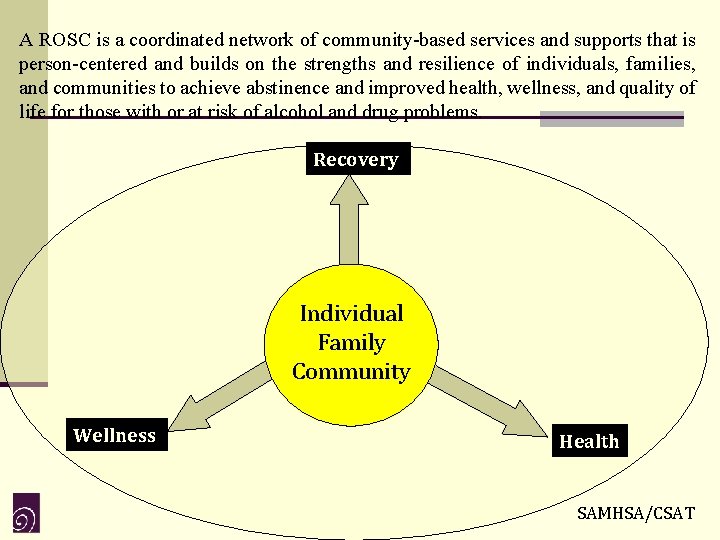
A ROSC is a coordinated network of community-based services and supports that is person-centered and builds on the strengths and resilience of individuals, families, and communities to achieve abstinence and improved health, wellness, and quality of life for those with or at risk of alcohol and drug problems. Recovery Individual V Family Community Wellness Health SAMHSA/CSAT
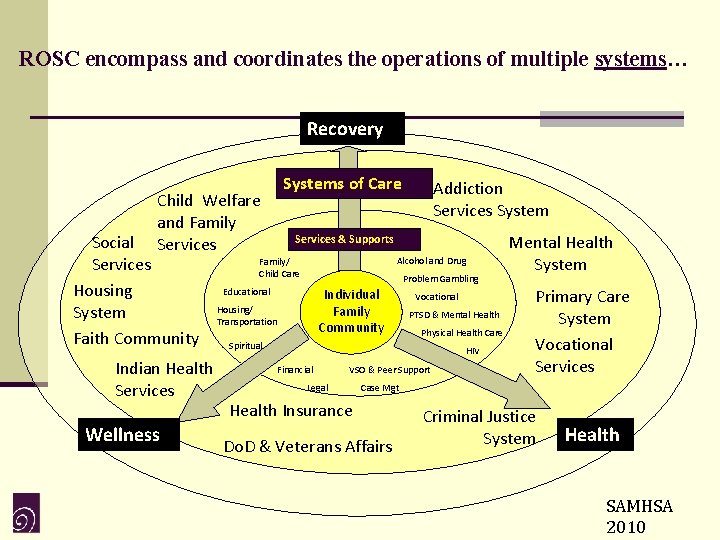
ROSC encompass and coordinates the operations of multiple systems… Recovery Child Welfare and Family Services Social Services Housing System Faith Community Indian Health Services Wellness Systems of Care Addiction Services System Services & Supports Alcohol and Drug Family/ Child Care Problem Gambling Individual Family Community Educational Housing/ Transportation Vocational PTSD & Mental Health Physical Health Care Spiritual HIV Financial VSO & Peer Support Legal Mental Health System Primary Care System Vocational Services Case Mgt Health Insurance Do. D & Veterans Affairs Criminal Justice System Health SAMHSA 2010
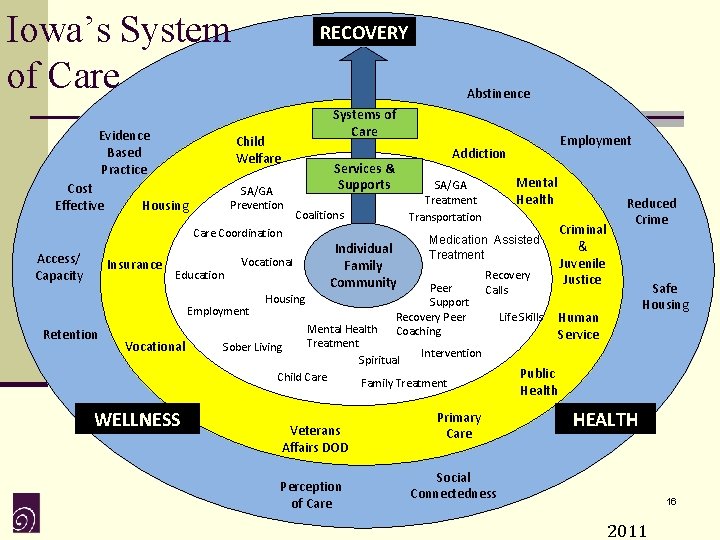
Iowa’s System of Care Evidence Based Practice Cost Effective RECOVERY Abstinence Systems of Care Child Welfare SA/GA Prevention Housing Services & Supports Access/ Capacity Insurance Education Vocational Employment Retention Vocational WELLNESS Individual Family Community Housing Mental Health SA/GA Treatment Transportation Coalitions Care Coordination Medication Assisted Treatment Peer Support Recovery Peer Coaching Recovery Calls Mental Health Treatment Sober Living Intervention Spiritual Child Care Family Treatment Veterans Affairs DOD Perception of Care Employment Addiction Primary Care Life Skills Criminal & Juvenile Justice Reduced Crime Safe Housing Human Service Public Health HEALTH Social Connectedness 16 2011
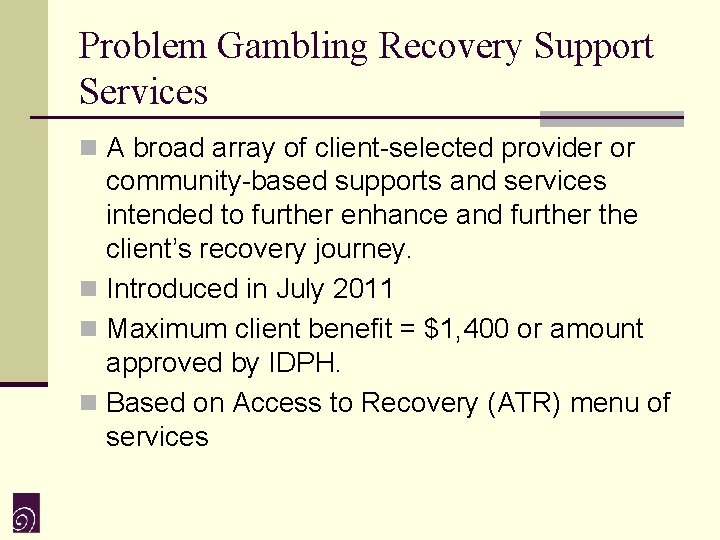
Problem Gambling Recovery Support Services n A broad array of client-selected provider or community-based supports and services intended to further enhance and further the client’s recovery journey. n Introduced in July 2011 n Maximum client benefit = $1, 400 or amount approved by IDPH. n Based on Access to Recovery (ATR) menu of services
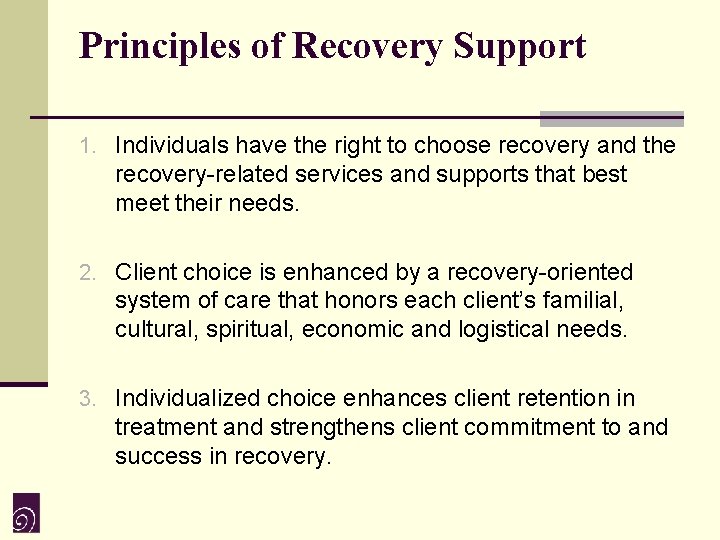
Principles of Recovery Support 1. Individuals have the right to choose recovery and the recovery-related services and supports that best meet their needs. 2. Client choice is enhanced by a recovery-oriented system of care that honors each client’s familial, cultural, spiritual, economic and logistical needs. 3. Individualized choice enhances client retention in treatment and strengthens client commitment to and success in recovery.
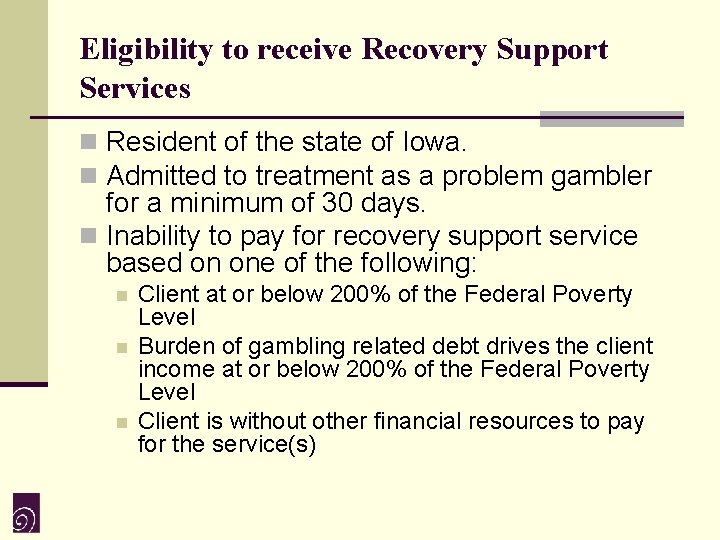
Eligibility to receive Recovery Support Services n Resident of the state of Iowa. n Admitted to treatment as a problem gambler for a minimum of 30 days. n Inability to pay for recovery support service based on one of the following: n n n Client at or below 200% of the Federal Poverty Level Burden of gambling related debt drives the client income at or below 200% of the Federal Poverty Level Client is without other financial resources to pay for the service(s)
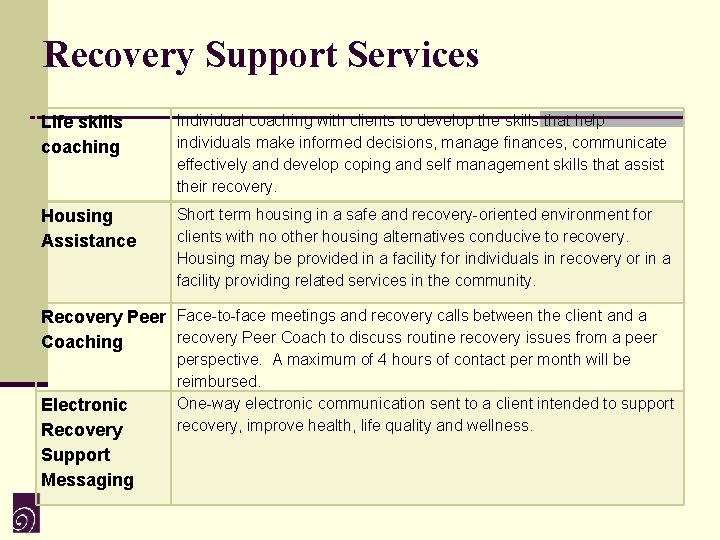
Recovery Support Services Life skills coaching Individual coaching with clients to develop the skills that help individuals make informed decisions, manage finances, communicate effectively and develop coping and self management skills that assist their recovery. Housing Assistance Short term housing in a safe and recovery-oriented environment for clients with no other housing alternatives conducive to recovery. Housing may be provided in a facility for individuals in recovery or in a facility providing related services in the community. Recovery Peer Face-to-face meetings and recovery calls between the client and a recovery Peer Coach to discuss routine recovery issues from a peer Coaching Electronic Recovery Support Messaging perspective. A maximum of 4 hours of contact per month will be reimbursed. One-way electronic communication sent to a client intended to support recovery, improve health, life quality and wellness.
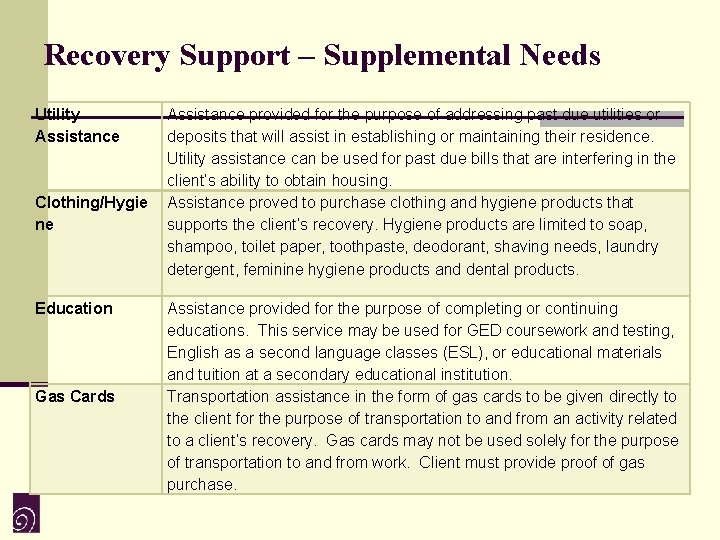
Recovery Support – Supplemental Needs Utility Assistance Clothing/Hygie ne Education Gas Cards Assistance provided for the purpose of addressing past due utilities or deposits that will assist in establishing or maintaining their residence. Utility assistance can be used for past due bills that are interfering in the client’s ability to obtain housing. Assistance proved to purchase clothing and hygiene products that supports the client’s recovery. Hygiene products are limited to soap, shampoo, toilet paper, toothpaste, deodorant, shaving needs, laundry detergent, feminine hygiene products and dental products. Assistance provided for the purpose of completing or continuing educations. This service may be used for GED coursework and testing, English as a second language classes (ESL), or educational materials and tuition at a secondary educational institution. Transportation assistance in the form of gas cards to be given directly to the client for the purpose of transportation to and from an activity related to a client’s recovery. Gas cards may not be used solely for the purpose of transportation to and from work. Client must provide proof of gas purchase.
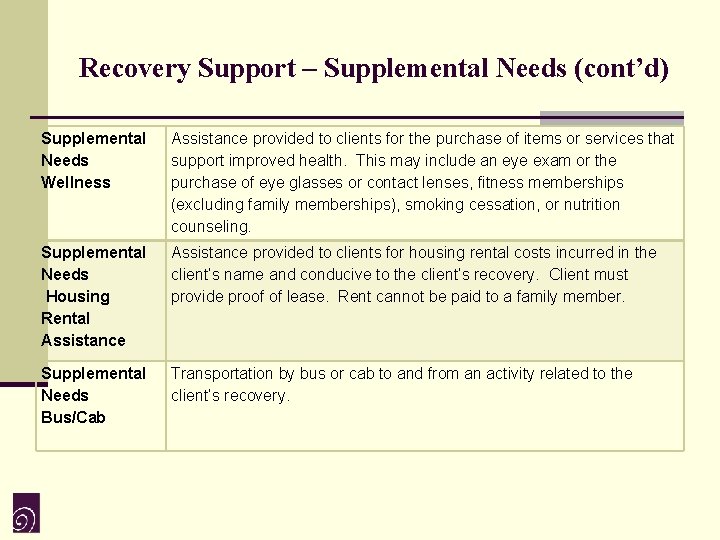
Recovery Support – Supplemental Needs (cont’d) Supplemental Needs Wellness Assistance provided to clients for the purchase of items or services that support improved health. This may include an eye exam or the purchase of eye glasses or contact lenses, fitness memberships (excluding family memberships), smoking cessation, or nutrition counseling. Supplemental Needs Housing Rental Assistance provided to clients for housing rental costs incurred in the client’s name and conducive to the client’s recovery. Client must provide proof of lease. Rent cannot be paid to a family member. Supplemental Needs Bus/Cab Transportation by bus or cab to and from an activity related to the client’s recovery.
n. The Massachusetts Experience
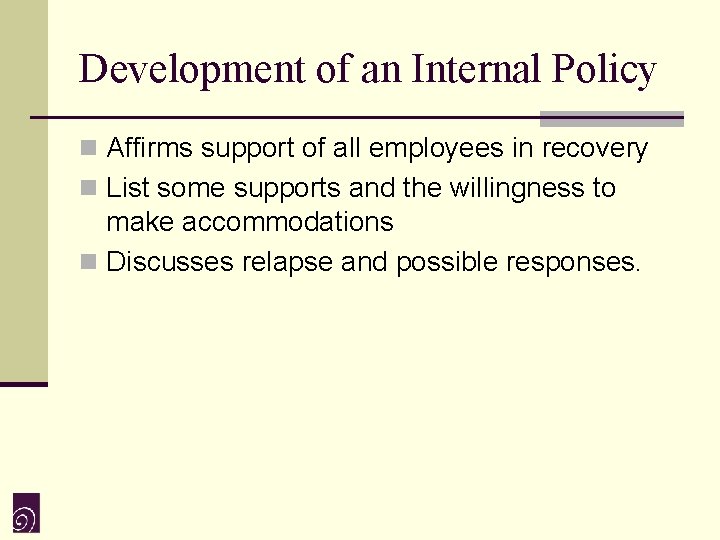
Development of an Internal Policy n Affirms support of all employees in recovery n List some supports and the willingness to make accommodations n Discusses relapse and possible responses.
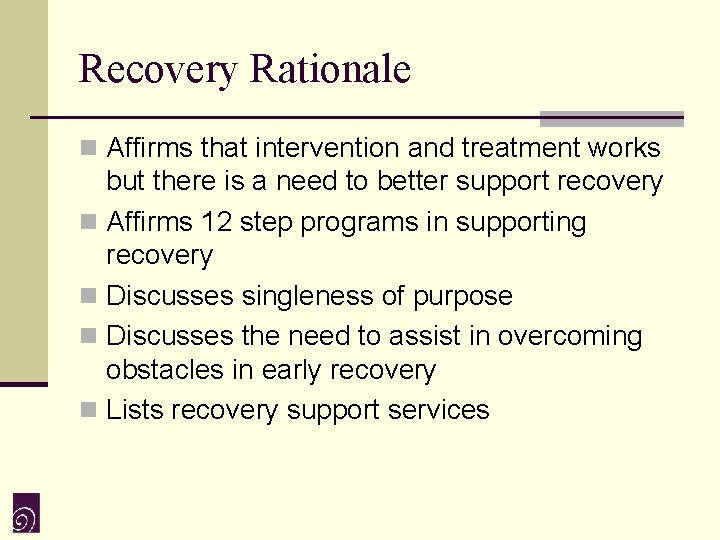
Recovery Rationale n Affirms that intervention and treatment works but there is a need to better support recovery n Affirms 12 step programs in supporting recovery n Discusses singleness of purpose n Discusses the need to assist in overcoming obstacles in early recovery n Lists recovery support services
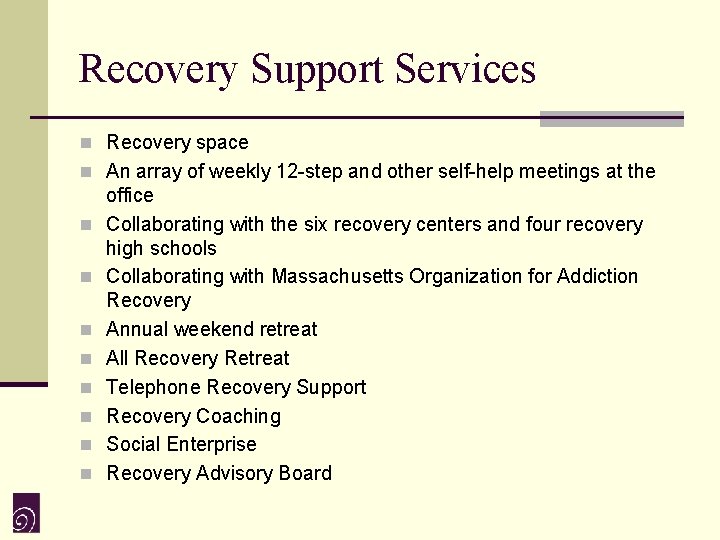
Recovery Support Services n Recovery space n An array of weekly 12 -step and other self-help meetings at the n n n n office Collaborating with the six recovery centers and four recovery high schools Collaborating with Massachusetts Organization for Addiction Recovery Annual weekend retreat All Recovery Retreat Telephone Recovery Support Recovery Coaching Social Enterprise Recovery Advisory Board
n. So. . . Where do we go from here?
Thank you! n. Any further questions or comments?
Contact Information n Mark Vander Linden Executive Officer Iowa Department of Public Health 515 -281 -8802 mark. vanderlinden@idph. iowa. gov n Jim Wuelfing Director of Prevention and Recovery Massachusetts Council on Compulsive Gambling 617 -426 -4554 or jim@masscompulsivegambling. org
- Slides: 29