
Post Traumatic Stress Disorder JANIS CARTER GERARD BYRNE
Post Traumatic Stress Disorder JANIS CARTER & GERARD BYRNE Department of Psychiatry University of Queensland janiscarter@onaustralia. com. au www. therapywithyoga. com. g. byrne@psychiatry. uq. edu. au
Overview of the presentation u u u What is it? Why is it important? Key Symptoms of PTSD Causal factors contributing to the development of PTSD How to assess or diagnose? – Types of assessment tools and the examples of assessment tools u u u Treatments available? Yoga : alternative therapy for PTSD : personal experience Reflective practice: Case study
What is it? u It is a disorder following severe trauma where the individual in order to cope with inner turmoil develops a constellation of symptoms including re-experiencing symptoms, avoidance symptoms and arousal symptoms. Although these symptoms are an adaptation, in the long run they are maladaptive for the individual and society.
Why is it important? u Kessler et al: Lifetime prevalence 7. 8% u Women 10. 4 and men 5. 0% u More prevalent in war veterans – 25% US war veterans u PTSD sufferers at risk to developing other psychiatric disorder especially alcohol dependence
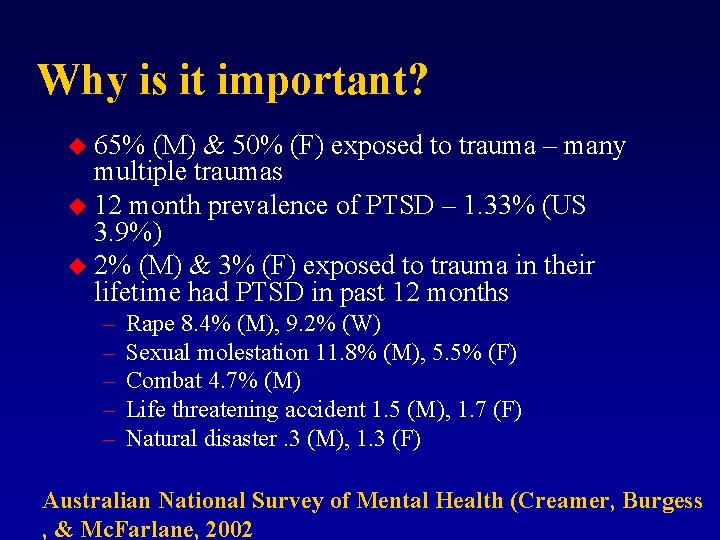
Why is it important? u 65% (M) & 50% (F) exposed to trauma – many multiple traumas u 12 month prevalence of PTSD – 1. 33% (US 3. 9%) u 2% (M) & 3% (F) exposed to trauma in their lifetime had PTSD in past 12 months – – – Rape 8. 4% (M), 9. 2% (W) Sexual molestation 11. 8% (M), 5. 5% (F) Combat 4. 7% (M) Life threatening accident 1. 5 (M), 1. 7 (F) Natural disaster. 3 (M), 1. 3 (F) Australian National Survey of Mental Health (Creamer, Burgess , & Mc. Farlane, 2002
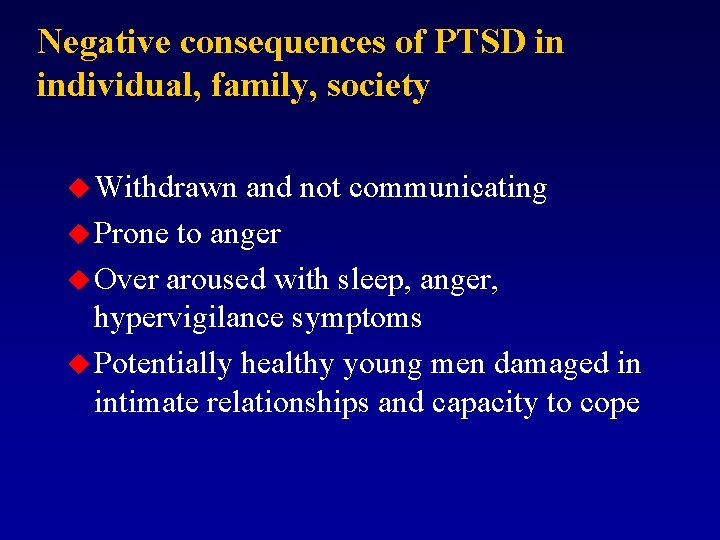
Negative consequences of PTSD in individual, family, society u Withdrawn and not communicating u Prone to anger u Over aroused with sleep, anger, hypervigilance symptoms u Potentially healthy young men damaged in intimate relationships and capacity to cope
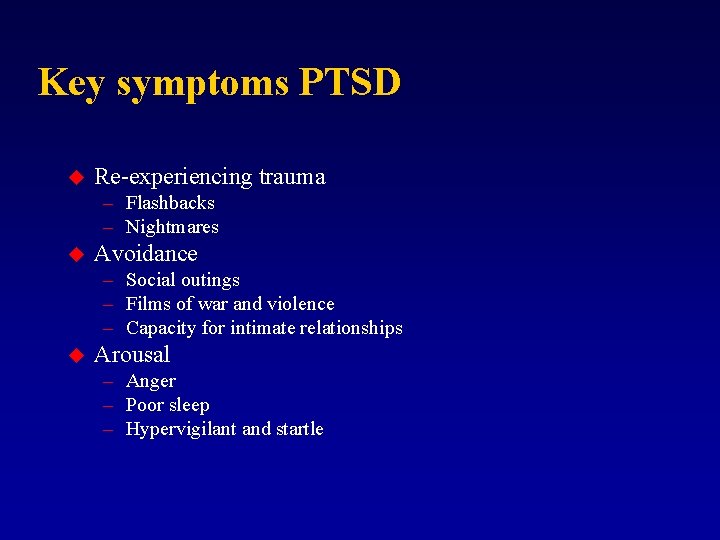
Key symptoms PTSD u Re-experiencing trauma – Flashbacks – Nightmares u Avoidance – Social outings – Films of war and violence – Capacity for intimate relationships u Arousal – Anger – Poor sleep – Hypervigilant and startle
Factors contributing to development of PTSD u Pre-trauma risk factors u Trauma – related factors u Post trauma factors
Factors contributing to development of PTSD : Pre-trauma risk factors u Biological mechanisms u Psychological mechanisms
Factors contributing to development of PTSD : Pre-trauma risk factors u Biological – Genetic predisposition – (ref) – Attenuated cortisol levels – (Hawk, et al, 2000)
Factors contributing to development of PTSD : Pre-trauma risk factors u Psychological – Pre-existing depression and anxiety disorders – Early history of adversity and exposure to traumatic events – Cognitive-behavioral » Distortion in schema, primary assumption, and automatic thoughts » Maladaptive learning – Fear conditioning & Avoidance learning Psychodynamic
Factors contributing to development of PTSD : Pre-trauma risk factors u Psychodynamic – Ego – Dystonic / ego defence aspects of PTSD » Difficulty in integrating the trauma images / beliefs about the self to make a coherent self narrative » The conscious mind tries to assimilate into ordinary experience » The intrusive thoughts rise up from the unconscious, particularly, when the conscious mind is unable to defend itself u u Beliefs such as one’s belief is in one’s control Images of violence/injury/near death Ref: Brewin, Dalgliesh and Joseph, 1996
Factors contributing to development of PTSD : Trauma – related factors u Type of trauma eg Interpersonal trauma u Perceived degree of life threat u Predictability and controllability u Duration and frequency
Factors contributing to development of PTSD : Post trauma factors u Level of social support u Validation of the experience u Opportunities to “process” the trauma
Why Diagnose and Categorize? u. A means of making sense of our observations of the world. u In health care as a basis for developing a plan for management
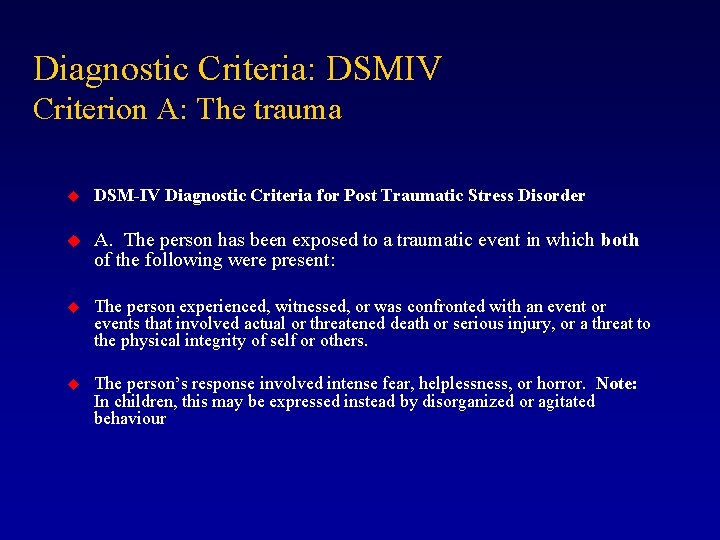
Diagnostic Criteria: DSMIV Criterion A: The trauma u DSM-IV Diagnostic Criteria for Post Traumatic Stress Disorder u A. The person has been exposed to a traumatic event in which both of the following were present: u The person experienced, witnessed, or was confronted with an event or events that involved actual or threatened death or serious injury, or a threat to the physical integrity of self or others. u The person’s response involved intense fear, helplessness, or horror. Note: In children, this may be expressed instead by disorganized or agitated behaviour
Diagnostic criteria: DSMIV cont Criterion B: Re-experiencing u u u B. The traumatic event is persistently re-experienced in one (or more) of the following ways: recurrent and intrusive distressing recollections of the event, including images, thoughts, or perceptions. Note: In young children, repetitive play may occur in which themes or aspects of the trauma are expressed. recurrent distressing dreams of the event. Note: In children, there may be frightening dreams without recognizable content.
Diagnostic criteria: DSMIV cont Criterion B: Re-experiencing cont u u u acting or feeling as if the traumatic event were recurring (includes a sense of reliving the experience, illusions, hallucinations, and dissociative flashback episodes, including those that occur on awakening or when intoxicated). Note: in young children, trauma-specific reenactment may occur. Intense psychological distress at exposure to internal or external cues that symbolize or resemble an aspect of the traumatic event. physiological reactivity on exposure to internal or external cues that symbolize or resemble an aspect of the traumatic event.
Diagnostic criteria: DSMIV cont Criterion C: Avoidance u C. Persistent avoidance of stimuli associated with the trauma and numbing of general responsiveness (not present before the trauma), as indicated by three (or more) of the following: u efforts to avoid thoughts, feelings, or conversations associated with the trauma u efforts to avoid activities, places, or people that arouse recollections of the trauma
Diagnostic criteria: DSMIV cont Criterion C: Avoidance cont u u u inability to recall an important aspect of the trauma markedly diminished interest or participation in significant activities feeling of detachment or estrangement from others restricted range of affect (e. g. , unable to have loving feelings) sense of a foreshortened future (e. g. , does not expect to have a career, marriage, children, or a normal life span)
Diagnostic criteria: DSMIV cont Criterion D : Arousal u D. Persistent symptoms of increased arousal (not present before the trauma), as indicated by two (or more) of the following: u difficulty falling or staying asleep u irritability or outbursts of anger u difficulty concentrating u hypervigilance u exaggerated startle response
Diagnostic criteria: DSMIV cont Criterion E: Duration of disturbance u E. Duration of the disturbance (symptoms in Criteria B, C, and D) is more than 1 month.
Diagnostic criteria: DSMIV cont Criterion F: Significant distress u F. The disturbance causes clinically significant distress or impairment in social, occupational, or other important areas of functioning
Diagnostic criteria: DSMIV cont u Specify if: u Acute: if duration of symptoms is less than 3 months u Chronic: If duration of symptoms is 3 months or more
Diagnostic criteria: DSMIV cont u Specify if: u With Delayed Onset: if onset of symptoms is at least 6 months after the stressor
Diagnostic criteria: DSMIV cont u Patient must meet criteria A-F for the diagnosis to be made
Assessment of PTSD u Structured Diagnostic Interview – Aim: Confirming diagnosis – – – u Structured Clinical Interview for DSM (SCID) Structured Interview for PTSD (SI-PTSD) Clinician-Administered PTSD Scale (CAPS) PTSD Interview PTSD Symptom Scale Interview (PSS-I) Self report questionnaires : Aim: Screening – – – – Impact of Event Scale-revised (IES-R) Mississippi Scale for Combat-Related PTSD Keane PTSD Scale of the MMPI-2 Penn Inventory for Posttraumatic Stress Posttraumatic Diagnostic Scale (PTDS) PTSD checklist (PCL) Los Angeles Symptom checklist (LASC)
Example of screening for PTSD u Are you troubled by any vivid memories or unwanted dreams? u Do you avoid things which remind you of any event from the past? u Do you at times feel emotionally numb? u Are you irritable or constantly on edge? ACPMH, Australian Centre for Posttraumatic mental Health
Example of Structured Diagnostic Interview assessment methods: Davidson Scale u u u u STRUCTURED INTERVIEW FOR POST TRAUMATIC STRESS DISORDER (SI-PTSD: Adapted for DSM-IV from Davidson et al, 1989) A. EXPERIENCE OF TRAUMA Have you ever experienced an extremely stressful event, such as serious physical injury, combat, rape, assault, captivity, being kidnapped, being burned, seeing loss of life, or your own life being threatened, destruction of property, threat or harm to your family? (If yes) How did you react? Probes: What do you remember about it? Were you exposed to combat?
Davidson Scale: u Were you a POW? u How long were you in that situation? u What was the worst thing about it for you? u How old were you at the time of this event? u NB: If more than one event, relate the following questions to the u event that appears to be most closely related to symptoms.
Davidson Scale cont Criterion A: The trauma u A. 1 Has the subject experienced, witnessed, or been confronted with an event or events that involved actual or threatened death or serious injury, or a threat to the physical integrity of self or others? If yes, did the person’s response involve intense fear, helplessness, or horror? u Yes: Continue with interview u No: Terminate
Davidson Scale cont u A. 2 Define the event. (Identify by the numbers below; narrative comment may be added). u 1 = Combat u 2 = Physical assault/attack 3 = Seeing someone killed or hurt u u u 4 = Natural disaster 5 = Personal injury in accident 6 = Complicated bereavement 7 = Threat or close call 8 = Life threatening illness 9 = Captivity 10 = Other
Davidson Scale cont u Now I would like to ask you about some problems people sometimes have after that kind of experience. I will ask you a few questions about each problem to find out how severe it has been for you. In particular, I need to know for each problem area how bad it was when it was at its worst, and how bad it has been in the last four weeks. Is that clear?
Davidson Scale: Re-experiencing Criterion B: Recurrent Intrusive Recollections u B. 1 u Have you experienced painful images or memories of your experiences which you couldn’t get out of your mind, even though you may have wanted to? Probes: Have these been recurrent? How often are you troubled by the memories? Have they been distressing? When these problems were at their worst, how bad were they? How bad have these problems been over the last four weeks? u u u RECURRENT INTRUSIVE RECOLLECTIONS
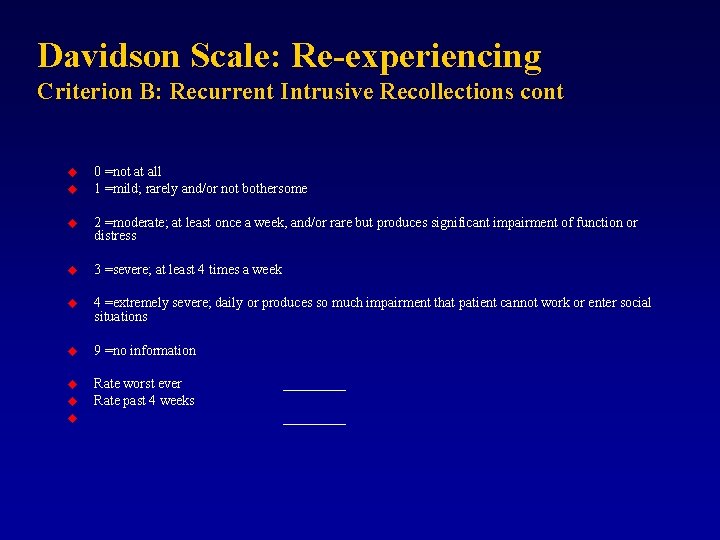
Davidson Scale: Re-experiencing Criterion B: Recurrent Intrusive Recollections cont u u 0 =not at all 1 =mild; rarely and/or not bothersome u 2 =moderate; at least once a week, and/or rare but produces significant impairment of function or distress u 3 =severe; at least 4 times a week u 4 =extremely severe; daily or produces so much impairment that patient cannot work or enter social situations u 9 =no information u Rate worst ever Rate past 4 weeks u u _________
Davidson Scale: Re-experiencing B 2: Dreams u B. 2 DREAMS I’d like to ask you about your dreams. Have you had repeated dreams of violence, death, or other themes related to your experience? u Probes: u How frequent are these dreams? u Do you wake up sweating or shouting? Trembling? Palpitations? Trouble breathing? u
Davidson Scale: Re-experiencing B 2: Dreams cont u u u Are the nightmares so bad that your spouse (partner) does not sleep in the bed, or in the same room? Were these of actual scenes you were involved in? Do you recognise people in the dream? Are these dreams of the event? When these problems were at their worst, how bad were they? How bad have these problems been over the last four weeks?
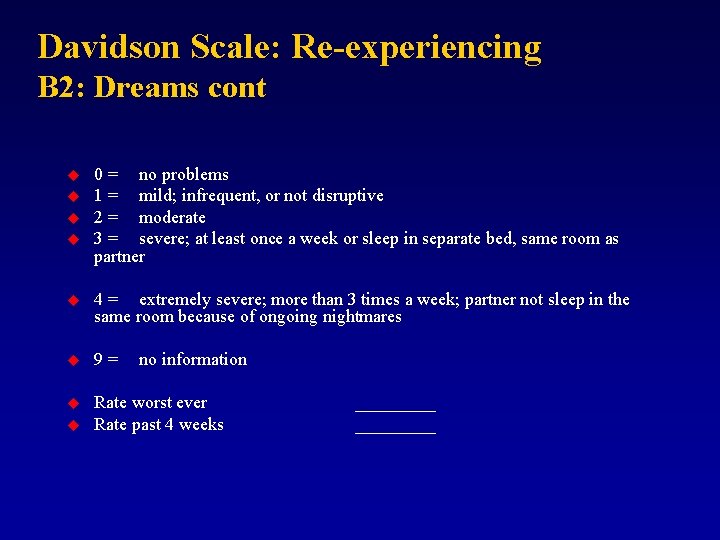
Davidson Scale: Re-experiencing B 2: Dreams cont u u 0 = no problems 1 = mild; infrequent, or not disruptive 2 = moderate 3 = severe; at least once a week or sleep in separate bed, same room as partner u 4 = extremely severe; more than 3 times a week; partner not sleep in the same room because of ongoing nightmares u 9= u Rate worst ever Rate past 4 weeks u no information _________
Davidson Scale: Re-experiencing B 3: Acting or feeling as if event were recurring u u u u B. 3 ACTING OR FEELING AS IF EVENT WERE RECURRING At times have you reacted to something as if you were back in the traumatic situation? Has it seemed that the event was recurring or that you were living through it again? Probes: Do you try to escape from the reminder (sound, etc)? Do you hide, shout, attack someone, or act as if you were going to attack someone? How often does this happen? When these problems were at their worst, how bad were they? How bad have these problems been over the last four weeks?
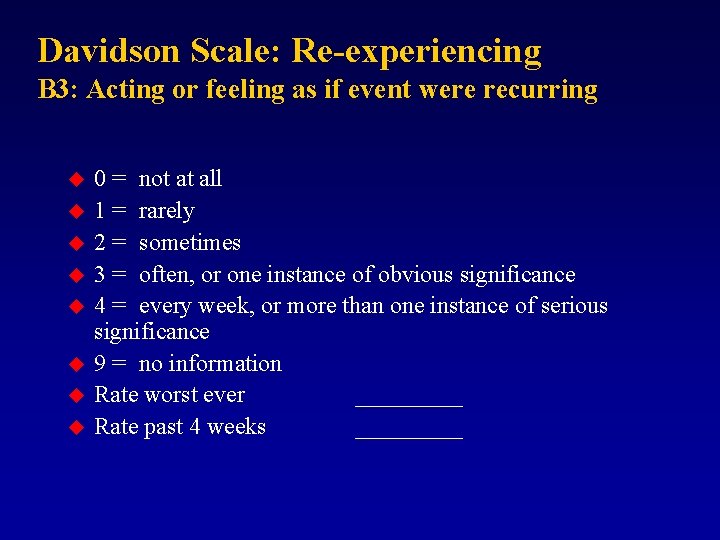
Davidson Scale: Re-experiencing B 3: Acting or feeling as if event were recurring u u u u 0 = not at all 1 = rarely 2 = sometimes 3 = often, or one instance of obvious significance 4 = every week, or more than one instance of serious significance 9 = no information Rate worst ever _____ Rate past 4 weeks _____
Davidson Scale: Re-experiencing B 4: Intense psychological distress on exposure to reminders u u u u B. 4 INTENSE PSYCHOLOGICAL DISTRESS ON EXPOSURE TO REMINDERS Do any of the symptoms occur, or get worse, if something reminds you of the stressful event? Probes: For example, TV programs, weather conditions, news, Anzac Day, recent disasters involving the loss of life, loss of good friends, etc. Do these things make you feel angry, sad, irritable, anxious, frightened? Have you ever had to see your doctor or come into hospital because reminders have made you upset? When these problems were at their worst, how bad were they? How bad have these problems been over the last four weeks?
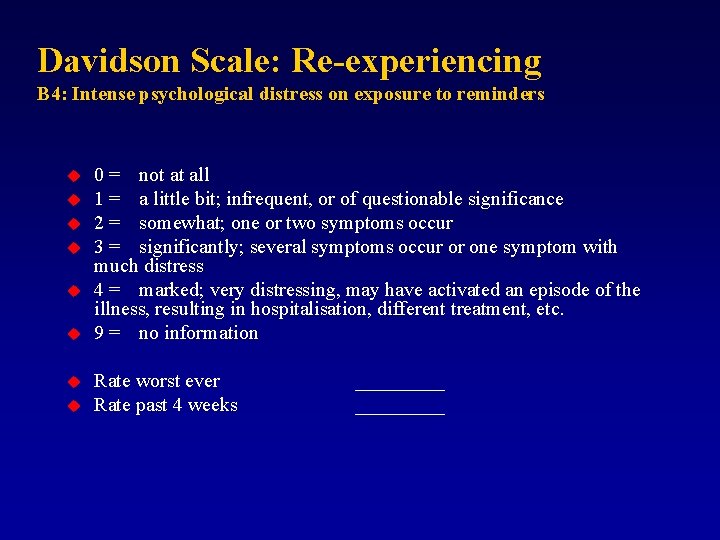
Davidson Scale: Re-experiencing B 4: Intense psychological distress on exposure to reminders u u u u 0 = not at all 1 = a little bit; infrequent, or of questionable significance 2 = somewhat; one or two symptoms occur 3 = significantly; several symptoms occur or one symptom with much distress 4 = marked; very distressing, may have activated an episode of the illness, resulting in hospitalisation, different treatment, etc. 9 = no information Rate worst ever Rate past 4 weeks _________
Davidson Scale: Re-experiencing B 5: Physiological Reactivity u u u u u B. 5 PHYSIOLOGICAL REACTIVITY Does exposure to an event that reminds you of, or resembles the trauma, cause you to have any physical response? NB: Do not include nightmares Probes: When you are reminded of your combat experiences, do you have problems like sweating, trembling, heart racing, nausea, hyperventilating, feeling frozen? Are these symptoms distressing? Have you ever seen a doctor because of these problems? When these problems were at their worst, how bad were they? How bad have these problems been over the last four weeks?
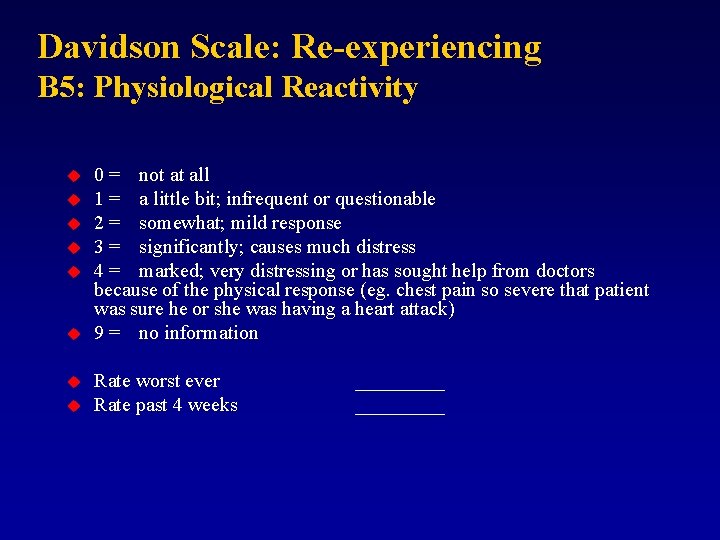
Davidson Scale: Re-experiencing B 5: Physiological Reactivity u u u u 0 = not at all 1 = a little bit; infrequent or questionable 2 = somewhat; mild response 3 = significantly; causes much distress 4 = marked; very distressing or has sought help from doctors because of the physical response (eg. chest pain so severe that patient was sure he or she was having a heart attack) 9 = no information Rate worst ever Rate past 4 weeks _________
Davidson Scale: Avoidance Criterion C 1: Avoidance of thoughts and feelings u u u u u C. 1 AVOIDANCE OF THOUGHTS AND FEELINGS Do you try to avoid thoughts or feelings about the trauma? Probes: How do you try to avoid the thoughts and feelings? Do you try not to talk about it? Have you used alcohol or drugs to block thoughts or feelings? Do you try to stay busy or move house a lot to block thoughts or feelings? Is your life affected by attempts to avoid thoughts or feelings? When these problems were at their worst, how bad were they? How bad have these problems been over the last four weeks?
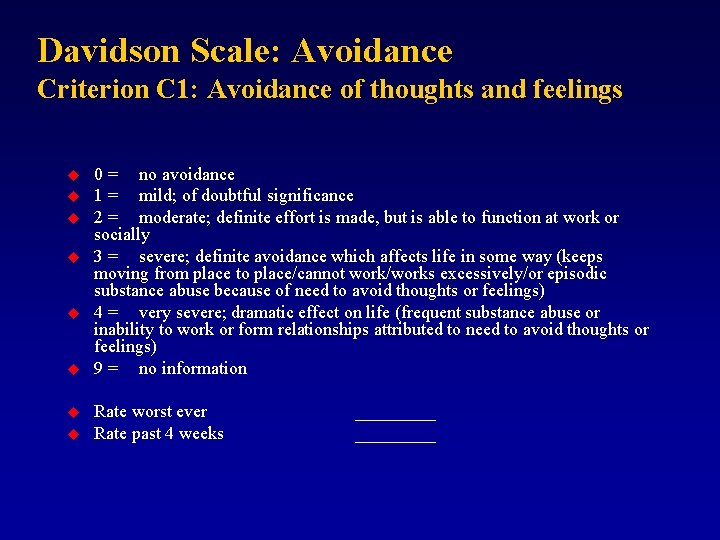
Davidson Scale: Avoidance Criterion C 1: Avoidance of thoughts and feelings u u u u 0 = no avoidance 1 = mild; of doubtful significance 2 = moderate; definite effort is made, but is able to function at work or socially 3 = severe; definite avoidance which affects life in some way (keeps moving from place to place/cannot work/works excessively/or episodic substance abuse because of need to avoid thoughts or feelings) 4 = very severe; dramatic effect on life (frequent substance abuse or inability to work or form relationships attributed to need to avoid thoughts or feelings) 9 = no information Rate worst ever Rate past 4 weeks _________
Davidson Scale: Avoidance Criterion C 2: Avoidance of situations or activities u u u u C. 2 AVOIDANCE OF SITUATIONS OR ACTIVITIES Do you avoid activities, places, or people, that remind you of the event? Probes: For example, movies, noisy places, veterans’ meetings, funerals, airports, other places. Does this avoidance affect your ability to work or your social life in any way? When these problems were at their worst, how bad were they? How bad have these problems been over the last four weeks?
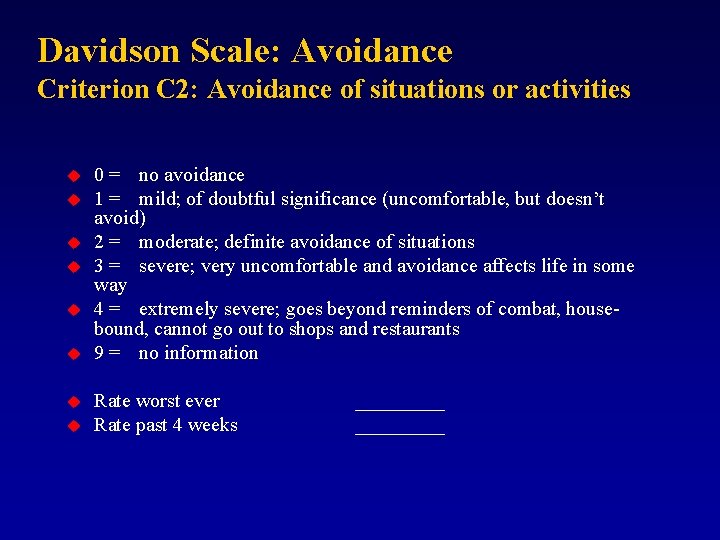
Davidson Scale: Avoidance Criterion C 2: Avoidance of situations or activities u u u u 0 = no avoidance 1 = mild; of doubtful significance (uncomfortable, but doesn’t avoid) 2 = moderate; definite avoidance of situations 3 = severe; very uncomfortable and avoidance affects life in some way 4 = extremely severe; goes beyond reminders of combat, housebound, cannot go out to shops and restaurants 9 = no information Rate worst ever Rate past 4 weeks _________
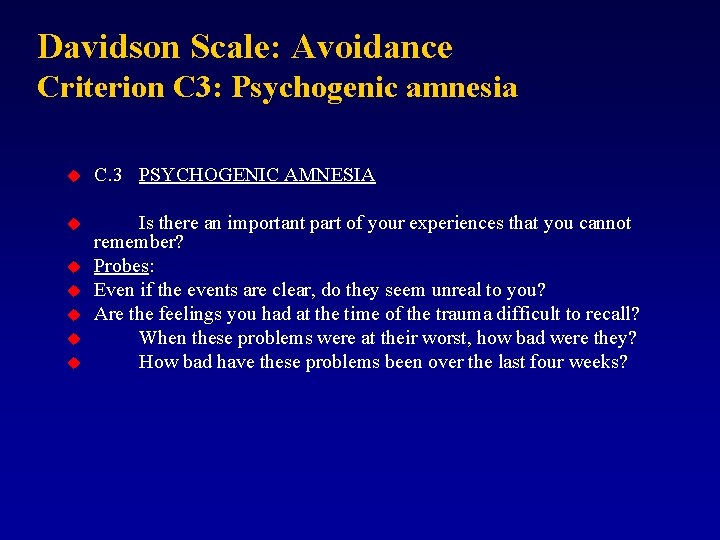
Davidson Scale: Avoidance Criterion C 3: Psychogenic amnesia u C. 3 PSYCHOGENIC AMNESIA u Is there an important part of your experiences that you cannot remember? Probes: Even if the events are clear, do they seem unreal to you? Are the feelings you had at the time of the trauma difficult to recall? When these problems were at their worst, how bad were they? How bad have these problems been over the last four weeks? u u u
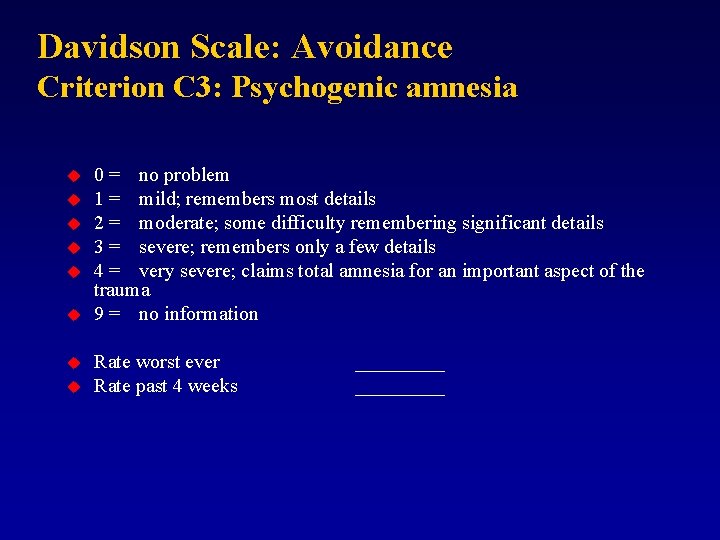
Davidson Scale: Avoidance Criterion C 3: Psychogenic amnesia u u u u 0 = no problem 1 = mild; remembers most details 2 = moderate; some difficulty remembering significant details 3 = severe; remembers only a few details 4 = very severe; claims total amnesia for an important aspect of the trauma 9 = no information Rate worst ever Rate past 4 weeks _________
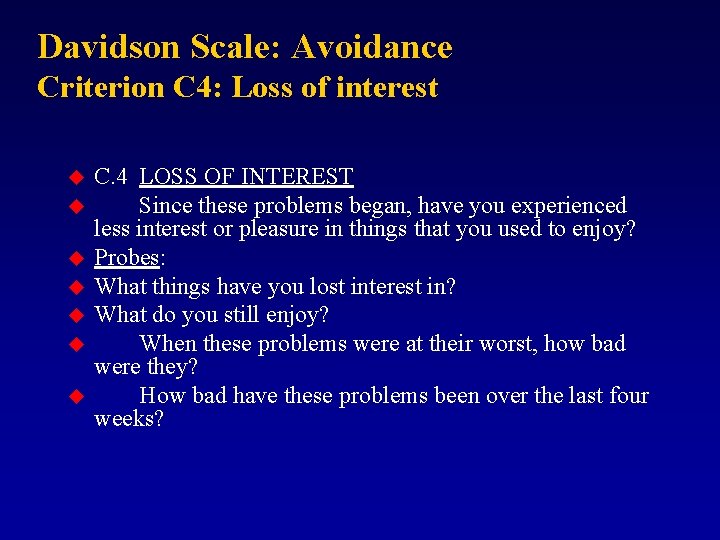
Davidson Scale: Avoidance Criterion C 4: Loss of interest u u u u C. 4 LOSS OF INTEREST Since these problems began, have you experienced less interest or pleasure in things that you used to enjoy? Probes: What things have you lost interest in? What do you still enjoy? When these problems were at their worst, how bad were they? How bad have these problems been over the last four weeks?
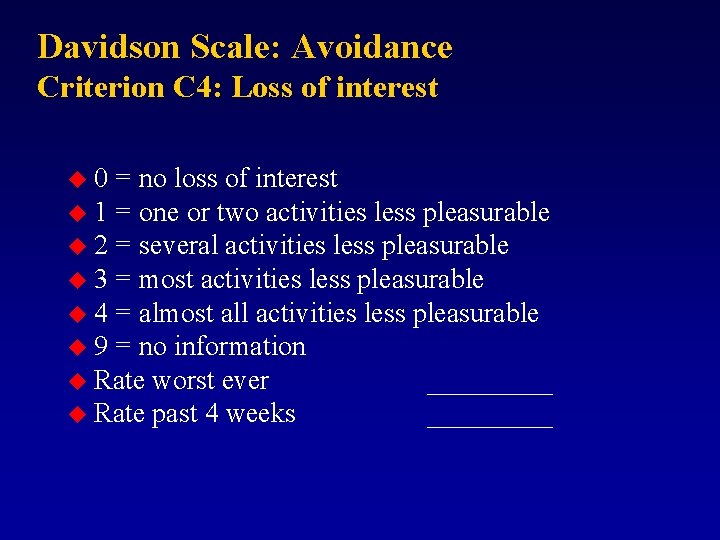
Davidson Scale: Avoidance Criterion C 4: Loss of interest u 0 = no loss of interest u 1 = one or two activities less pleasurable u 2 = several activities less pleasurable u 3 = most activities less pleasurable u 4 = almost all activities less pleasurable u 9 = no information u Rate worst ever _____ u Rate past 4 weeks _____
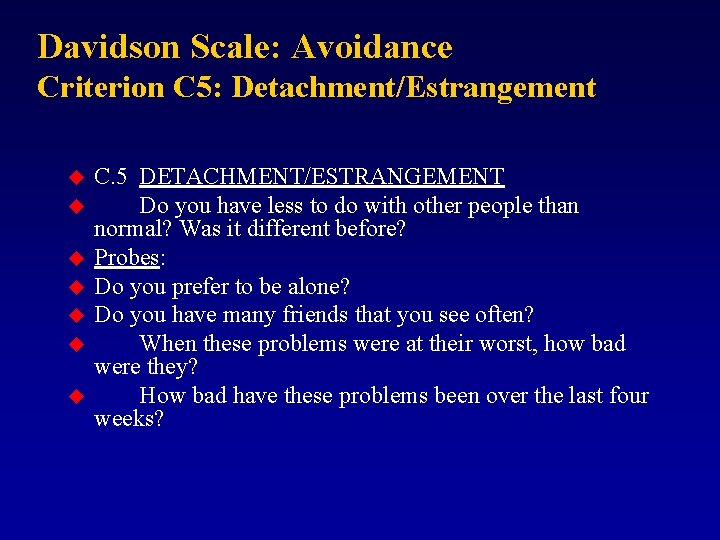
Davidson Scale: Avoidance Criterion C 5: Detachment/Estrangement u u u u C. 5 DETACHMENT/ESTRANGEMENT Do you have less to do with other people than normal? Was it different before? Probes: Do you prefer to be alone? Do you have many friends that you see often? When these problems were at their worst, how bad were they? How bad have these problems been over the last four weeks?
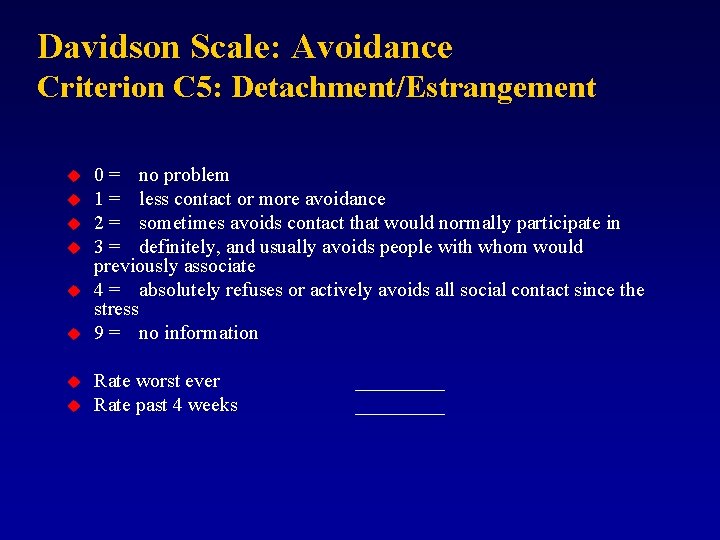
Davidson Scale: Avoidance Criterion C 5: Detachment/Estrangement u u u u 0 = no problem 1 = less contact or more avoidance 2 = sometimes avoids contact that would normally participate in 3 = definitely, and usually avoids people with whom would previously associate 4 = absolutely refuses or actively avoids all social contact since the stress 9 = no information Rate worst ever Rate past 4 weeks _________
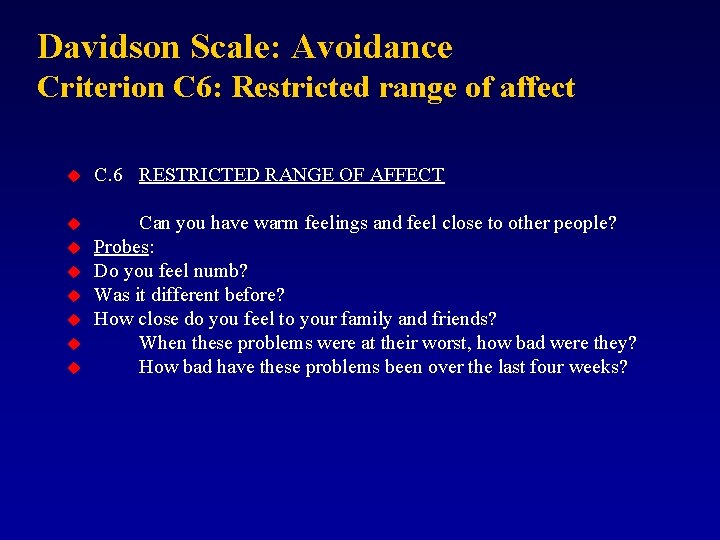
Davidson Scale: Avoidance Criterion C 6: Restricted range of affect u C. 6 RESTRICTED RANGE OF AFFECT u Can you have warm feelings and feel close to other people? Probes: Do you feel numb? Was it different before? How close do you feel to your family and friends? When these problems were at their worst, how bad were they? How bad have these problems been over the last four weeks? u u u
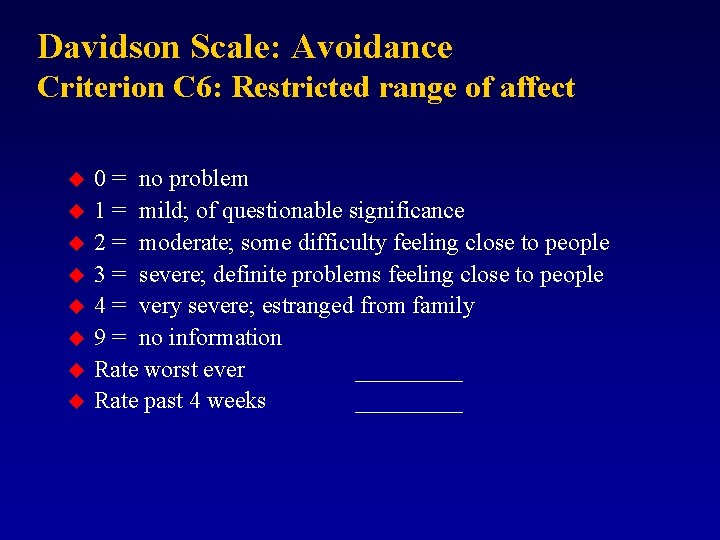
Davidson Scale: Avoidance Criterion C 6: Restricted range of affect u u u u 0 = no problem 1 = mild; of questionable significance 2 = moderate; some difficulty feeling close to people 3 = severe; definite problems feeling close to people 4 = very severe; estranged from family 9 = no information Rate worst ever _____ Rate past 4 weeks _____
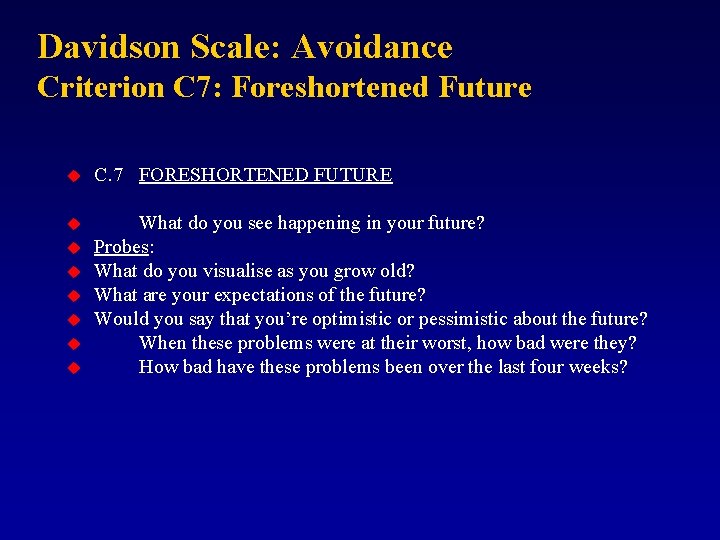
Davidson Scale: Avoidance Criterion C 7: Foreshortened Future u C. 7 FORESHORTENED FUTURE u What do you see happening in your future? Probes: What do you visualise as you grow old? What are your expectations of the future? Would you say that you’re optimistic or pessimistic about the future? When these problems were at their worst, how bad were they? How bad have these problems been over the last four weeks? u u u
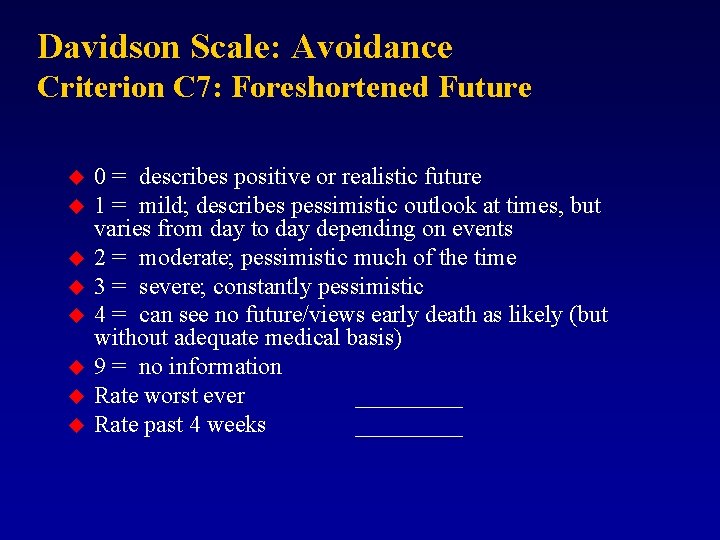
Davidson Scale: Avoidance Criterion C 7: Foreshortened Future u u u u 0 = describes positive or realistic future 1 = mild; describes pessimistic outlook at times, but varies from day to day depending on events 2 = moderate; pessimistic much of the time 3 = severe; constantly pessimistic 4 = can see no future/views early death as likely (but without adequate medical basis) 9 = no information Rate worst ever _____ Rate past 4 weeks _____
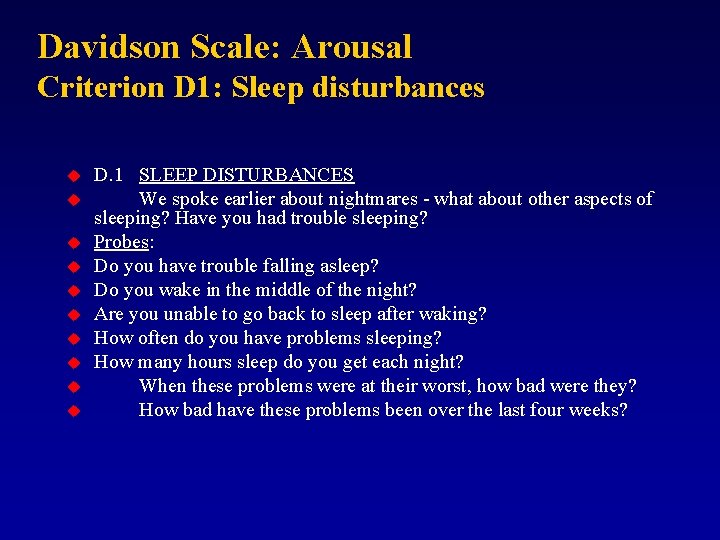
Davidson Scale: Arousal Criterion D 1: Sleep disturbances u u u u u D. 1 SLEEP DISTURBANCES We spoke earlier about nightmares - what about other aspects of sleeping? Have you had trouble sleeping? Probes: Do you have trouble falling asleep? Do you wake in the middle of the night? Are you unable to go back to sleep after waking? How often do you have problems sleeping? How many hours sleep do you get each night? When these problems were at their worst, how bad were they? How bad have these problems been over the last four weeks?
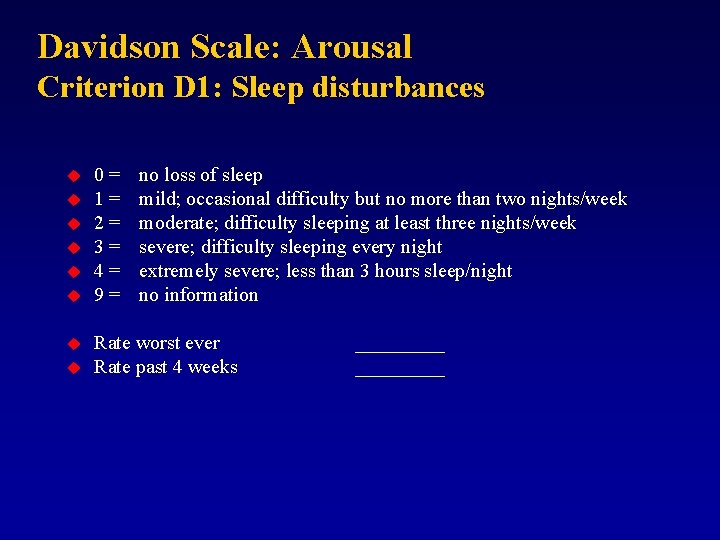
Davidson Scale: Arousal Criterion D 1: Sleep disturbances u u u u 0= 1= 2= 3= 4= 9= no loss of sleep mild; occasional difficulty but no more than two nights/week moderate; difficulty sleeping at least three nights/week severe; difficulty sleeping every night extremely severe; less than 3 hours sleep/night no information Rate worst ever Rate past 4 weeks _________
Davidson Scale: Arousal Criterion D 2: Irritability u u u u u D. 2 IRRITABILITY Are you more irritable or more easily annoyed than before the trauma? Probes: How do you show your feelings? Have you had angry outbursts? How often do you get angry or irritable? Have others commented on your irritability? When these problems were at their worst, how bad were they? How bad have these problems been over the last four weeks?
Davidson Scale: Arousal Criterion D 2: Irritability u u u u 0 = not at all 1 = mild; occasional feelings of annoyance or anger which may go unnoticed by others 2 = moderate; increased feelings of annoyance, becomes snappy or argumentative at least once every 2 weeks, others may have commented 3 = severe; almost constantly irritable or angry/often loses temper or has significant impairment in ability to relate to others as a result of this 4 = very severe; preoccupied with anger or feelings of retaliation, overtly aggressive or assaultive /marked impairment in function 9 = no information Rate worst ever _____ Rate past 4 weeks _____
Davidson Scale: Arousal Criterion D 3: Impairment in memory/concentration u u u u u D. 3 IMPAIRMENT IN MEMORY/CONCENTRATION Have you noticed any trouble concentrating? Probes: Is it hard to keep your mind on things? Can you pay attention easily? What about reading or watching TV? Are you forgetful? Do your problems with concentration interfere with your life in any way? When these problems were at their worst, how bad were they? How bad have these problems been over the last four weeks
Davidson Scale: Arousal Criterion D 3: Impairment in memory/concentration u u u u 0 = no difficulty 1 = patient acknowledges slight problem: (serial subtraction, 1 mistake out of 5) 2 = patient describes definite difficulty: (serial subtraction, 2 mistakes out of 5) 3 = interferes with daily activities, job, etc: (serial subtraction, 3 mistakes out of 5) 4 = constant problems, unable to do simple tasks: (serial subtraction, 4 or 5 mistakes, or will not even attempt subtraction) 9 = not recorded Rate worst ever _____ Rate past 4 weeks _____
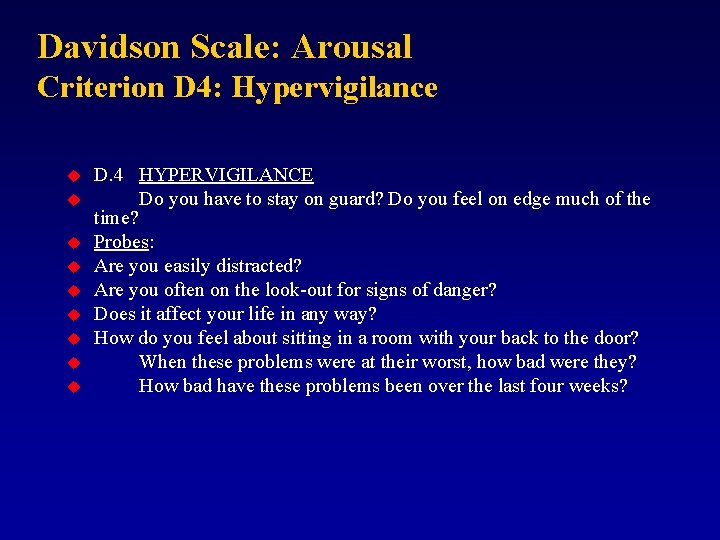
Davidson Scale: Arousal Criterion D 4: Hypervigilance u u u u u D. 4 HYPERVIGILANCE Do you have to stay on guard? Do you feel on edge much of the time? Probes: Are you easily distracted? Are you often on the look-out for signs of danger? Does it affect your life in any way? How do you feel about sitting in a room with your back to the door? When these problems were at their worst, how bad were they? How bad have these problems been over the last four weeks?
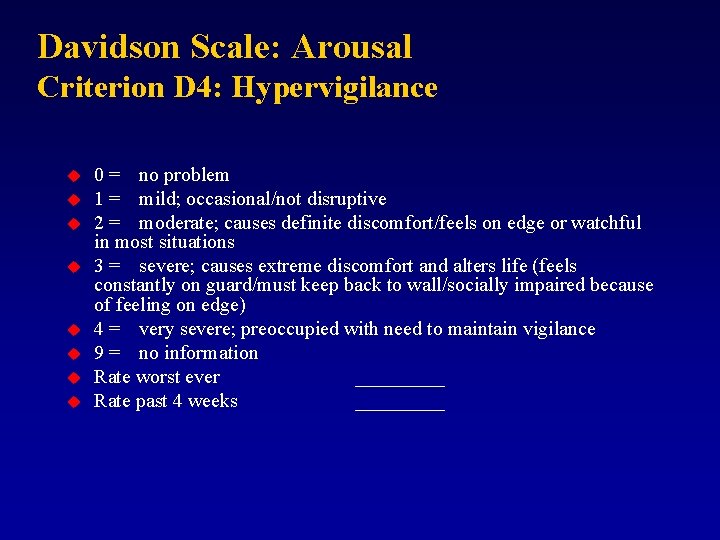
Davidson Scale: Arousal Criterion D 4: Hypervigilance u u u u 0 = no problem 1 = mild; occasional/not disruptive 2 = moderate; causes definite discomfort/feels on edge or watchful in most situations 3 = severe; causes extreme discomfort and alters life (feels constantly on guard/must keep back to wall/socially impaired because of feeling on edge) 4 = very severe; preoccupied with need to maintain vigilance 9 = no information Rate worst ever _____ Rate past 4 weeks _____
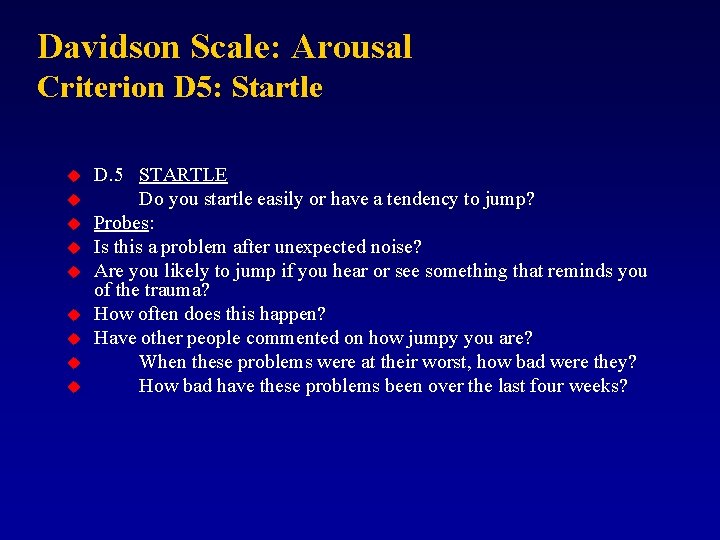
Davidson Scale: Arousal Criterion D 5: Startle u u u u u D. 5 STARTLE Do you startle easily or have a tendency to jump? Probes: Is this a problem after unexpected noise? Are you likely to jump if you hear or see something that reminds you of the trauma? How often does this happen? Have other people commented on how jumpy you are? When these problems were at their worst, how bad were they? How bad have these problems been over the last four weeks?
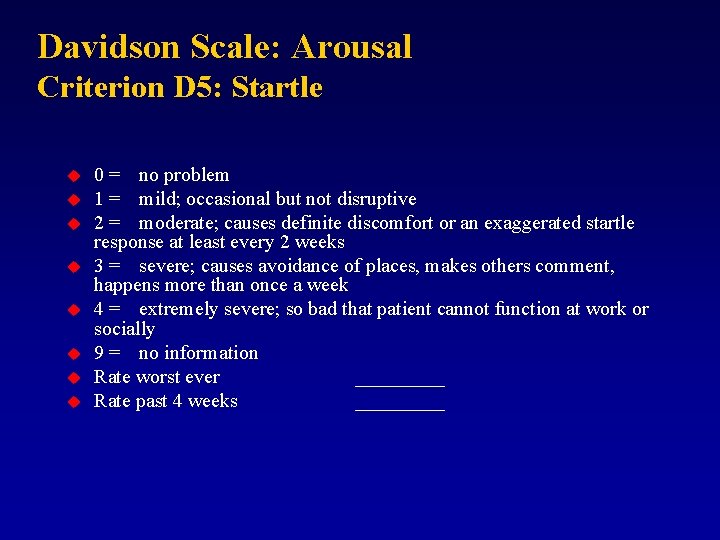
Davidson Scale: Arousal Criterion D 5: Startle u u u u 0 = no problem 1 = mild; occasional but not disruptive 2 = moderate; causes definite discomfort or an exaggerated startle response at least every 2 weeks 3 = severe; causes avoidance of places, makes others comment, happens more than once a week 4 = extremely severe; so bad that patient cannot function at work or socially 9 = no information Rate worst ever _____ Rate past 4 weeks _____
Davidson Scale : Duration Criterion E u E: DURATION: (if not already clear) u How long have these symptoms lasted altogether?
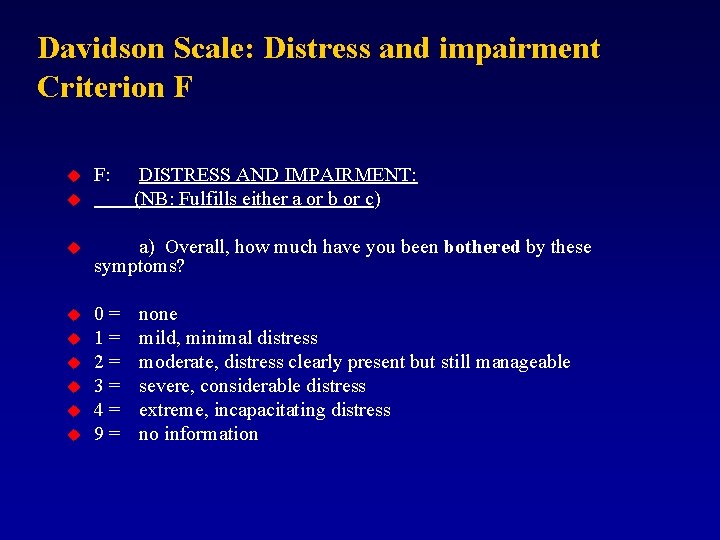
Davidson Scale: Distress and impairment Criterion F u F: u DISTRESS AND IMPAIRMENT: (NB: Fulfills either a or b or c) u a) Overall, how much have you been bothered by these symptoms? u 0= 1= 2= 3= 4= 9= u u u none mild, minimal distress moderate, distress clearly present but still manageable severe, considerable distress extreme, incapacitating distress no information
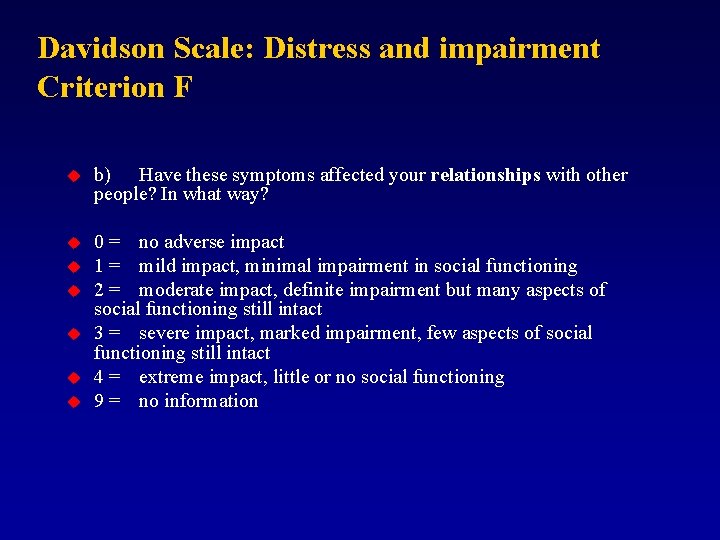
Davidson Scale: Distress and impairment Criterion F u b) Have these symptoms affected your relationships with other people? In what way? u 0 = no adverse impact 1 = mild impact, minimal impairment in social functioning 2 = moderate impact, definite impairment but many aspects of social functioning still intact 3 = severe impact, marked impairment, few aspects of social functioning still intact 4 = extreme impact, little or no social functioning 9 = no information u u u

Davidson Scale: Distress and impairment Criterion F u c) Have these symptoms affected your work or your ability to work? u 0 = no adverse impact 1 = mild impact, minimal impairment in occupational functioning 2 = moderate impact, definite impairment but many aspects of occupational functioning still intact 3 = severe impact, marked impairment, few aspects of occupational functioning still intact 4 = extreme impact, little or no occupational functioning 9 = no information u u u
Davidson scale: Diagnostic status u DIAGNOSTIC STATUS: u Note: A cut-off score of two or more on a particular symptom, as recommended by Davidson et al (1989), is used below. However, a more conservative cut-off of three or more is probably more appropriate to make a formal diagnosis of PTSD.
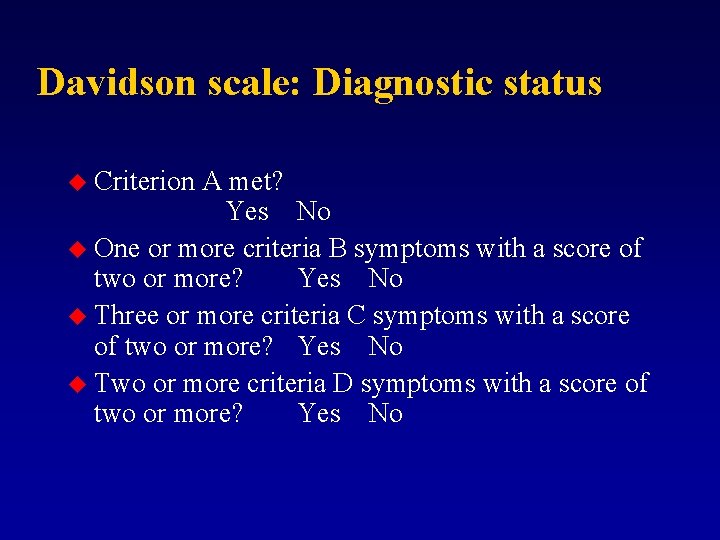
Davidson scale: Diagnostic status u Criterion A met? Yes No u One or more criteria B symptoms with a score of two or more? Yes No u Three or more criteria C symptoms with a score of two or more? Yes No u Two or more criteria D symptoms with a score of two or more? Yes No
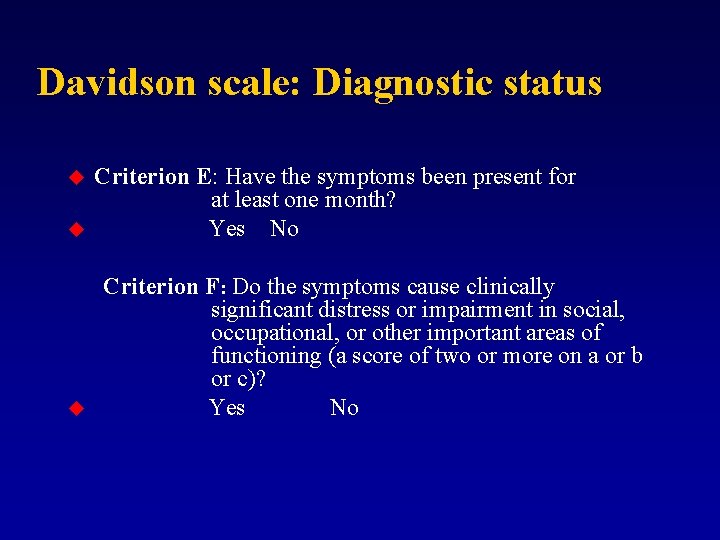
Davidson scale: Diagnostic status u u u Criterion E: Have the symptoms been present for at least one month? Yes No Criterion F: Do the symptoms cause clinically significant distress or impairment in social, occupational, or other important areas of functioning (a score of two or more on a or b or c)? Yes No
Davidson scale: Diagnostic status u PTSD Diagnosis: (Criteria A to F met)? Yes No
Adapted for DSM-IV by Mark Creamer (1997). Davidson, J. , Smith, R. , & Kudler, H. (1989). Validity and reliability of the DSM-III criteria for posttraumatic stress disorder: Experience with a structured interview. Journal of Nervous and Mental Disease, 177, 336 -41
Managing of PTSD u Assessment u Crisis stabilisation : Removal from trauma u Engagement in treatment u Education about the trauma, PTSD and treatment u Resolution of anger, shame and guilt through appropriate treatments u Response to family needs
Treatment options of PTSD u Pharmacotherapy u Group (medication) treatment u Brief psychodynamic psychotherapy u Various kinds of Cognitive behaviour therapy (CBT) u Alternative therapy : Yoga, Qi Gong
Treatment of PTSD cont u Various kinds of Cognitive behaviour therapy treatments: – Exposure therapy (EX) via imagery » Eye Movement Desensitization and Reprocessing (EMDR) – Systematic desensitization (SD) – Relaxation techniques including progressive muscular relaxation, meditation, pleasant imagery, breathing training, anger management – Assertiveness training – Cognitive therapy : Restructuring of negative thoughts
Treatment of PTSD cont u Cognitive behaviour therapy: cont – Communication skills in groups or marital therapy – Dealing with alcohol dependence – Preparing for stress reactions (“Stress inoculation training (SIT)”) – Cognitive processing therapy (CPT)
Treatment of PTSD cont : Alternative therapy : Yoga u What is it? u Why I have used Yoga? u Method used u The level of treatment effectiveness – Two years study which has comprised 5 series of pilot studies to develop and evaluate the effectiveness of the Yoga method with PTSD population u Lessons learned thus far
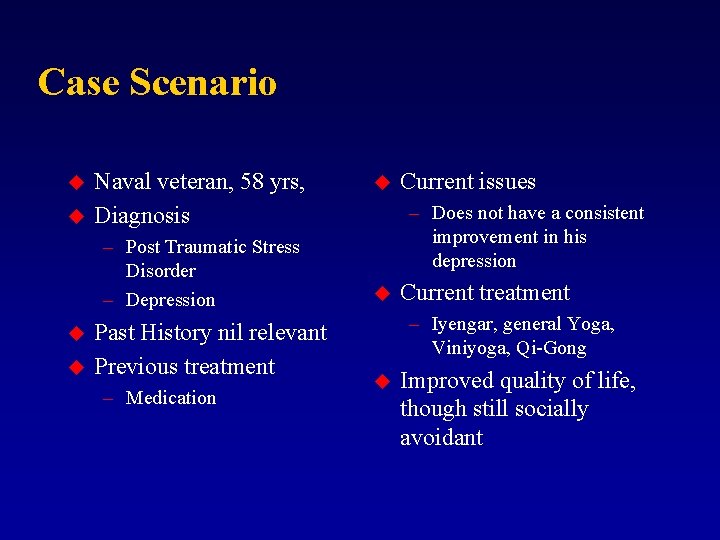
Case Scenario u u Naval veteran, 58 yrs, Diagnosis – Post Traumatic Stress Disorder – Depression u u Past History nil relevant Previous treatment – Medication u Current issues – Does not have a consistent improvement in his depression u Current treatment – Iyengar, general Yoga, Viniyoga, Qi-Gong u Improved quality of life, though still socially avoidant
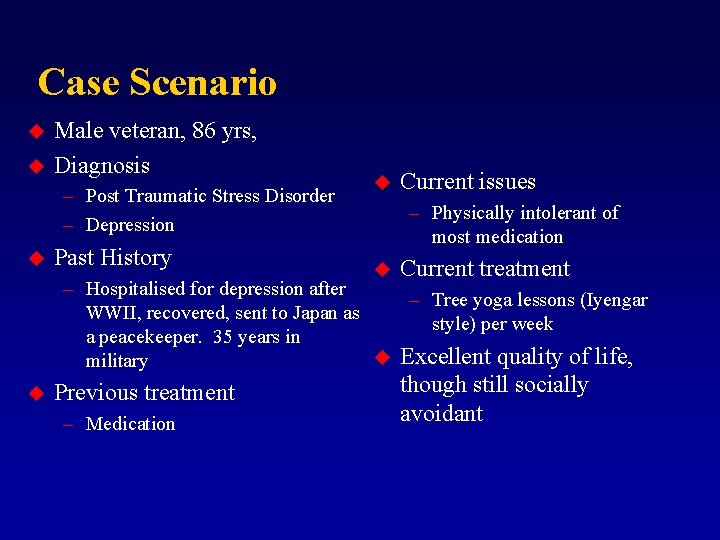
Case Scenario u u Male veteran, 86 yrs, Diagnosis – Post Traumatic Stress Disorder – Depression u Past History u Current issues – Physically intolerant of most medication u Current treatment – Hospitalised for depression after – Tree yoga lessons (Iyengar WWII, recovered, sent to Japan as style) per week a peacekeeper. 35 years in u Excellent quality of life, military u Previous treatment – Medication though still socially avoidant
- Slides: 84