
POST TRAUMATIC STRESS DISORDER IN CHILDREN By Tami
POST TRAUMATIC STRESS DISORDER IN CHILDREN By Tami Jo Redinger
DEFINITION The development of characteristic symptoms that occur following direct or indirect exposure to a traumatic or terrifying event in which physical harm was threatened, witnessed, or actually experienced

INTRO VIDEO https: //www. youtube. com/watch? v=z 8 v. Zx. Da 2 KPM
EXAMPLE Sonny was picked on from the time he started school. He was average height and thin. Other children called him names like "nerdy boy" or "geeko". He was pushed around, and, in later school years, boys threw things at him. Because he was identified as a victim, other children seemed to condone pushing him around. In his elementary school years, he was depressed and hated going to school. In middle school, he started to become angry. In high school, he began to read about the boys who shot at Columbine.

PREVALENCE o. Studies show that PTSD occurs in 1%-14% of the population o. Most individuals who experience life-threatening traumas show some symptoms of PTSD immediately, however only about 30% are vulnerable to have this disorder, and/or suffer the most chronic and terrifying events that maintain these symptoms as an enduring syndrome a month after the threats are gone. orepresentative sample of over 10, 000 adolescents aged 13 -18 5% of adolescents have met criteria for PTSD in their lifetime 8% prevalence in girls versus 2. 3% in boys the prevalence increases with age
CAUSAL FACTORS oviolent assaults ofire ophysical or sexual abuse osenseless acts of violence (such as school or neighborhood shootings) onatural or manmade disasters ocar accidents o. Bullying at school owitnessing another person go through these kinds of traumatic events odiagnoses of life-threatening medical illnesses

SYMPTOMS o. Re-experiencing the event recurrent and intrusive (unwanted) memories of the event distressing dreams or nightmares of the event acting or feeling as though the event were happening again (flashbacks) distress and fear when reminded of the event physiological reactivity (feeling jumpy, startled, or anxious) when reminded of the event o Persistent avoidance of any reminders of the event avoiding thinking about or talking about the trauma avoiding activities, places, or people that are reminders of the event no memory of an important aspect of the event lack of interest and participation in activities (due to wishing to avoid cues of the event) feeling detached or estranged from others limited range of emotions sense that they will not live to graduate college, get married, have kids, etc. o. Persistent feelings of anxiety or physical reactivity difficulty falling or staying asleep cranky, irritable, or angry problems paying attention or concentrating overly aware of noises or other cues that remind them of the event (smells, visual cues) exaggerated startle response
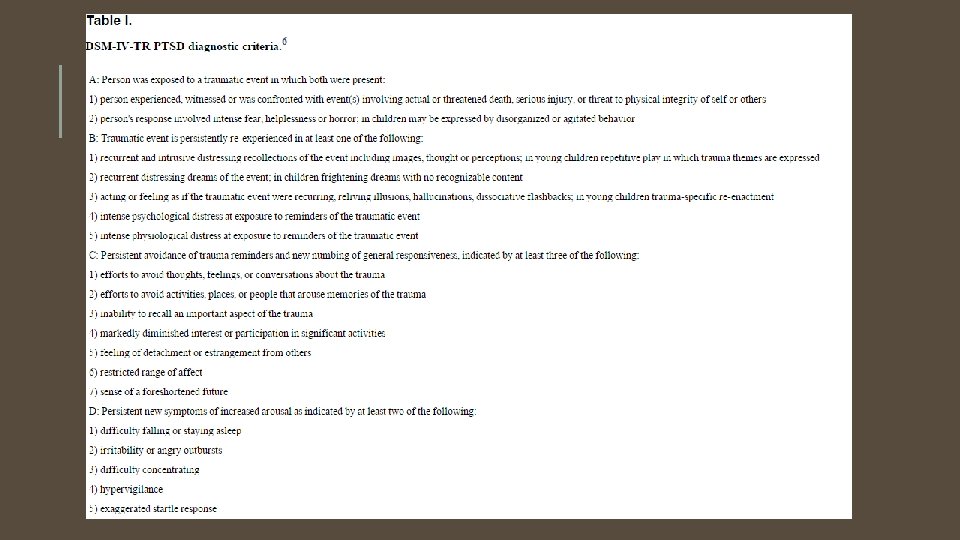
DIAGNOSIS o. The current diagnostic criteria for PTSD require that children have experienced, witnessed, or learned of a traumatic event, defined as one that is terrifying, shocking, and potentially threatening to life, safety, or physical integrity of self or others. o. The child must also meet at least one re-experiencing criteria, three avoidant/numbing criteria, and two hyperarousal criteria. Children must meet minimal duration criteria of at least 1 month, and they must show functional impairment in an important area (school, peers, family, etc). o. Accurately diagnosing PTSD in children is challenging.
INTERVENTION o. Cognitive-behavioral therapy o. Depression Medication o. Selective serotonin reuptake inhibitors (SSRI) o. Group therapy or support groups o. Play Therapy o. Psychological First Aid o. Specialized Interventions
OUTCOMES o. Many people with PTSD often don’t seek professional help because they don’t recognize the link between their symptoms and the trauma they experienced. o. There is not much information on PTSD in children o. More studies are being done
SOURCES http: //kidshealth. org/parent/positive/talk/ptsd. html http: //www. ptsd. va. gov/professional/treatment/children/ptsd_in_children_and _adolescents_overview_for_professionals. asp http: //www. giftfromwithin. org/html/helping_traumatized_children_at_school. ht ml https: //www. youtube. com/watch? v=z 8 v. Zx. Da 2 KPM http: //www. ncbi. nlm. nih. gov/pmc/articles/PMC 3181905/
- Slides: 12