
POST TERM PREGNANCY Definitions postdates pregnancy patient who



- Slides: 15
POST TERM PREGNANCY
Definitions: postdates pregnancy - patient who has not delivered by end of 42 nd week or 294 days from first day of last menstrual period (LMP) prolonged pregnancy - exceeds 40 weeks (280 days) from known time of ovulation
Incidence: v v 27 percent of pregnancies deliver in the 40 th and 41 st week. 5. 5 percent deliver at ≥ 42 weeks.
Incidence: pregnancies dated by first trimester ultrasound examination: ≥ 41 weeks ranges from 5 to 11 percent ≥ 42 weeks is about 2 percent
Causes: Ø Ø Ø The commonest cause is error in calculation of gestational age. Congenital anomalies like anencephaly which disrupt foetal pitutary adrenal axis and rare maternal enzyme deficiencie(placental sulphatase. In most cases cause is not known.
Risk Factors Maternal or paternal personal history of postterm birth Nulliparity Male fetus Maternal obesity Older maternal age lower socioeconomic groups
Pathogenesis: amniotic fluid volume decreases � amniotic fluid volume reaches maximum at 24 weeks, constant until 37 weeks, then decreases � decreased amniotic fluid volume associated with decreased fetal movement and fetal heart rate decelerations
A. Fetal Complications Still birth rate increases significantly at term with advancing gestation. It is 0. 35/1000 pregnancies at 37 weeks While 2. 12/1000 pregnancies at 43 weeks.
Meconium aspiration Macrosomia Asphyxia before, during and after delivery Fractures and Peripheral nerve injury Pneumonia Septicaemia Intra cranial hemorrhage
Dysmaturity (postmaturity syndrome) Incidence 20% stage 1 - alert facial expression; recent weight loss with decreased subcutaneous fat and muscle mass stage 2 - green meconium staining of skin and umbilicus, fetal distress, hypoxia stage 3 - yellow staining of nails, skin and umbilicus indicative of prolonged passage of meconium
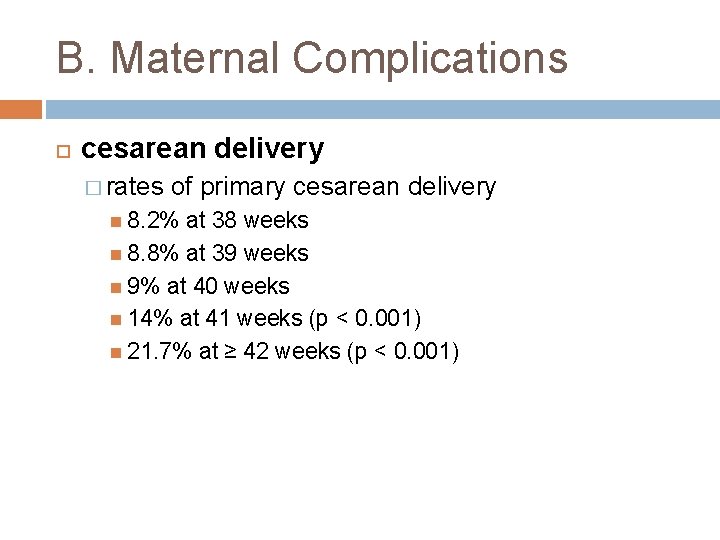
B. Maternal Complications cesarean delivery � rates of primary cesarean delivery 8. 2% at 38 weeks 8. 8% at 39 weeks 9% at 40 weeks 14% at 41 weeks (p < 0. 001) 21. 7% at ≥ 42 weeks (p < 0. 001)
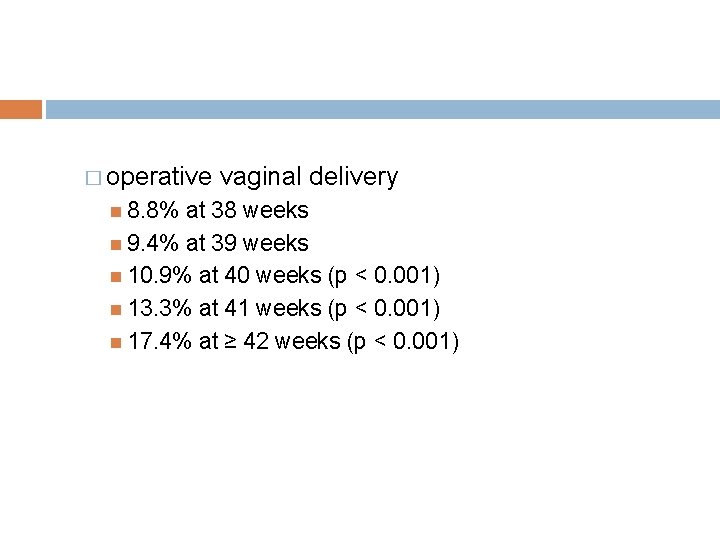
� operative 8. 8% vaginal delivery at 38 weeks 9. 4% at 39 weeks 10. 9% at 40 weeks (p < 0. 001) 13. 3% at 41 weeks (p < 0. 001) 17. 4% at ≥ 42 weeks (p < 0. 001)
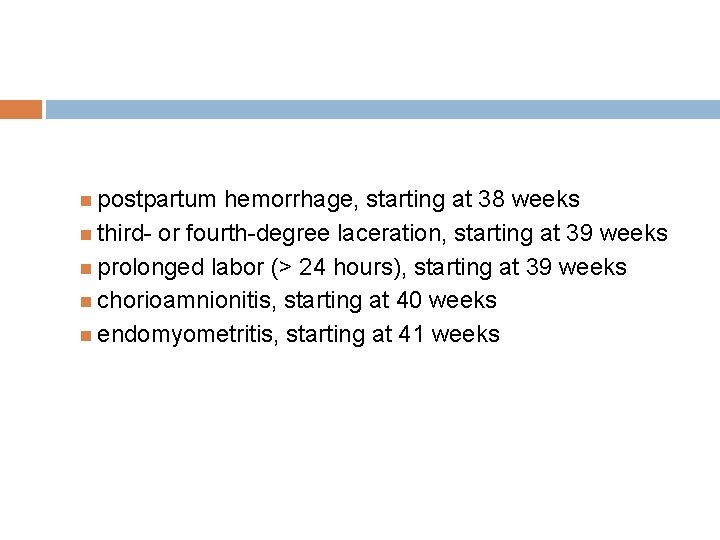
postpartum hemorrhage, starting at 38 weeks third- or fourth-degree laceration, starting at 39 weeks prolonged labor (> 24 hours), starting at 39 weeks chorioamnionitis, starting at 40 weeks endomyometritis, starting at 41 weeks
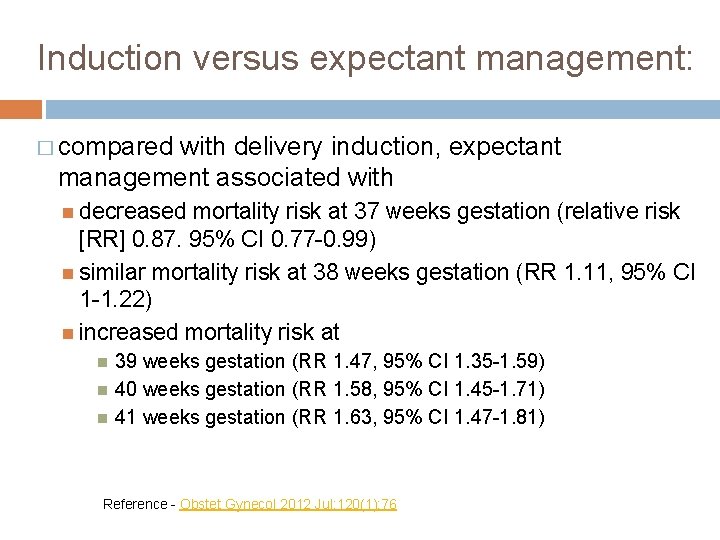
Induction versus expectant management: � compared with delivery induction, expectant management associated with decreased mortality risk at 37 weeks gestation (relative risk [RR] 0. 87. 95% CI 0. 77 -0. 99) similar mortality risk at 38 weeks gestation (RR 1. 11, 95% CI 1 -1. 22) increased mortality risk at 39 weeks gestation (RR 1. 47, 95% CI 1. 35 -1. 59) 40 weeks gestation (RR 1. 58, 95% CI 1. 45 -1. 71) 41 weeks gestation (RR 1. 63, 95% CI 1. 47 -1. 81) Reference - Obstet Gynecol 2012 Jul; 120(1): 76
Prevention: Recording LMP and calculating EDD at the time of first ANC visit. Routine early ultrasound for dating of pregnancy. Review of antenatal card and ultra sonographic reports in terms of fetal growth. Sweeping of membranes from 38 wks onwards decreases number of pregnancies going beyond 41 and 42 wks. As soon as prematurity is ruled out in high risk cases induction of labour will prevent post maturity.