
POST SECONDARY INFORMATION SLIDESHOW Agenda Grad 2021 the

- Slides: 29
POST SECONDARY INFORMATION SLIDESHOW
Agenda Grad 2021: the new grad program Post Secondary Options & Requirements Scholarships and Bursaries Online Resources
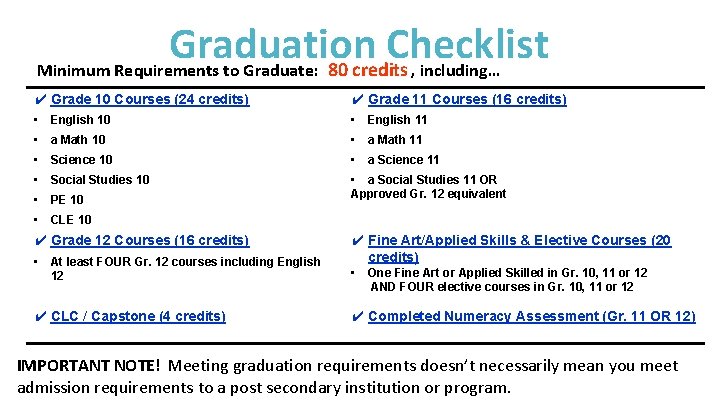
Graduation Checklist Minimum Requirements to Graduate: 80 credits , including… ✔ Grade 10 Courses (24 credits) ✔ Grade 11 Courses (16 credits) • English 10 • English 11 • a Math 10 • a Math 11 • Science 10 • a Science 11 • Social Studies 10 • PE 10 • a Social Studies 11 OR Approved Gr. 12 equivalent • CLE 10 ✔ Grade 12 Courses (16 credits) • At least FOUR Gr. 12 courses including English 12 ✔ CLC / Capstone (4 credits) ✔ Fine Art/Applied Skills & Elective Courses (20 credits) • One Fine Art or Applied Skilled in Gr. 10, 11 or 12 AND FOUR elective courses in Gr. 10, 11 or 12 ✔ Completed Numeracy Assessment (Gr. 11 OR 12) IMPORTANT NOTE! Meeting graduation requirements doesn’t necessarily mean you meet admission requirements to a post secondary institution or program.
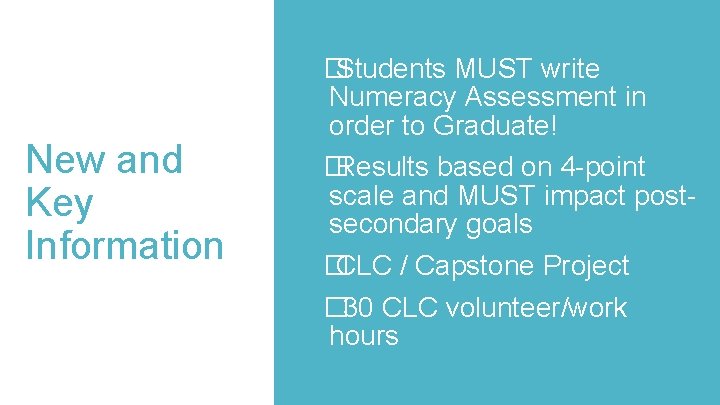
New and Key Information �Students MUST write Numeracy Assessment in order to Graduate! �Results based on 4 -point scale and MUST impact postsecondary goals �CLC / Capstone Project � 30 CLC volunteer/work hours
Graduates in Good Standing In order to Participate in Commencement Ceremonies in June, Grads are expected to meet the following criteria: ▪ Passing all required classes for Graduation (including online and night school courses) by mid-June ▪ All fees paid (return those library books!)
• It is the student’s responsibility to research post secondary admission requirements and be aware of the application processes & deadlines. • Always go directly to the post secondary websites for info. Don’t rely on friends! • CLC Teachers, Ms. O’Leary, Ms. Sharpe & Ms. Mc. Ardle • Info available on the Career Centre website (wsscareercentre. wordpress. com) Post Secondary Applications & Admission
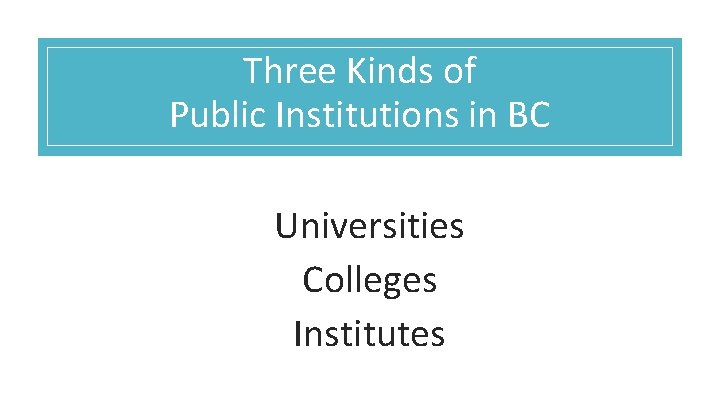
Three Kinds of Public Institutions in BC Universities Colleges Institutes
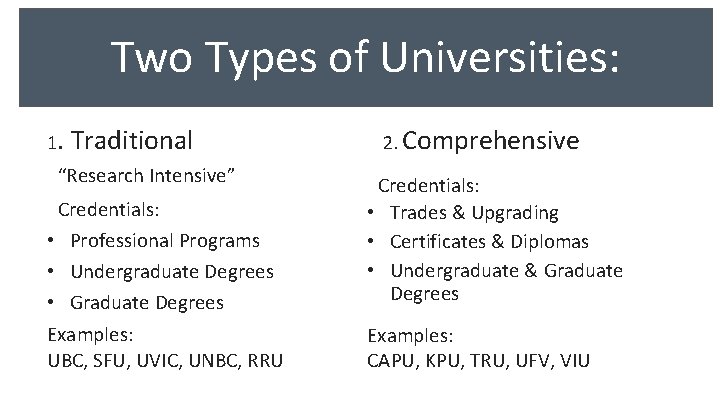
Two Types of Universities: 1. Traditional “Research Intensive” 2. Comprehensive Credentials: • Professional Programs • Undergraduate Degrees • Graduate Degrees Credentials: • Trades & Upgrading • Certificates & Diplomas • Undergraduate & Graduate Degrees Examples: UBC, SFU, UVIC, UNBC, RRU Examples: CAPU, KPU, TRU, UFV, VIU
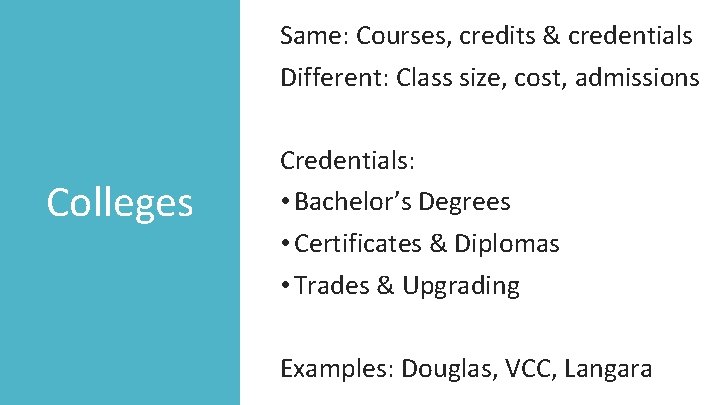
Same: Courses, credits & credentials Different: Class size, cost, admissions Colleges Credentials: • Bachelor’s Degrees • Certificates & Diplomas • Trades & Upgrading Examples: Douglas, VCC, Langara
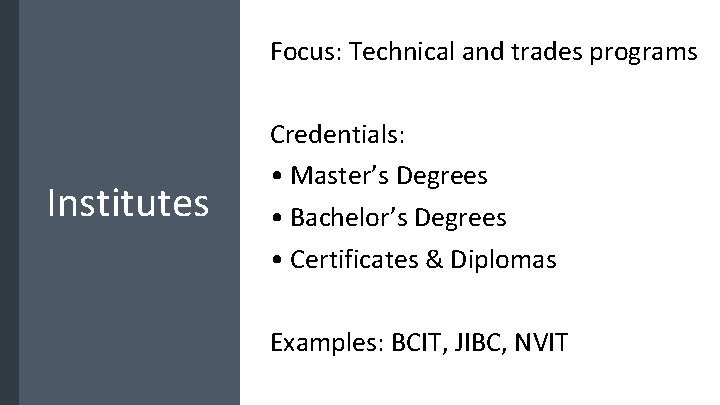
Focus: Technical and trades programs Institutes Credentials: • Master’s Degrees • Bachelor’s Degrees • Certificates & Diplomas Examples: BCIT, JIBC, NVIT
Credentials and Pathways
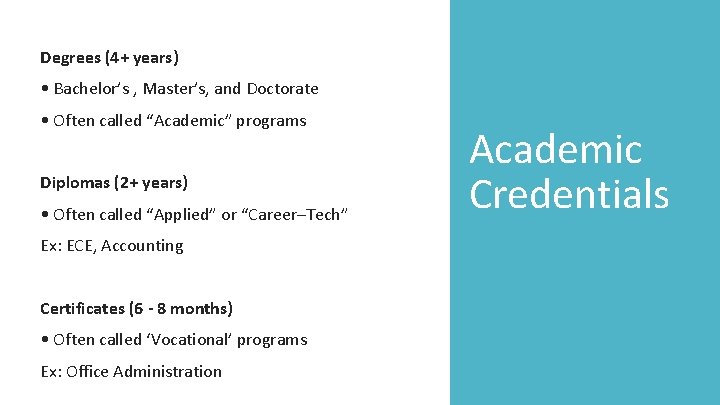
Degrees (4+ years) • Bachelor’s , Master’s, and Doctorate • Often called “Academic” programs Diplomas (2+ years) • Often called “Applied” or “Career–Tech” Ex: ECE, Accounting Certificates (6 - 8 months) • Often called ‘Vocational’ programs Ex: Office Administration Academic Credentials
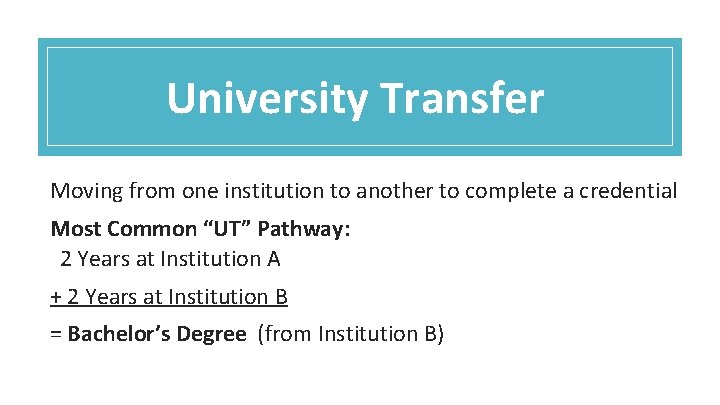
University Transfer Moving from one institution to another to complete a credential Most Common “UT” Pathway: 2 Years at Institution A + 2 Years at Institution B = Bachelor’s Degree (from Institution B)
University Transfer Advantages: • Access, choice and flexibility • Lower total cost for program • Smaller class size • Strong academic outcomes Challenge: • Requires more planning
Don’t have to know it all on Day One! Choosing an Academic Pathway Post-Secondary is about exploring: • What you like • What you’re good at • Where this can lead you Many students change their mind! Patience and flexibility are key
Modern Academic Pathways. Earning multiple credentials is becoming more common Examples: • Diploma + Degree • Degree + Graduate Degree • Trade + Diploma/Degree
3 Kinds of Admission Understanding Admissions
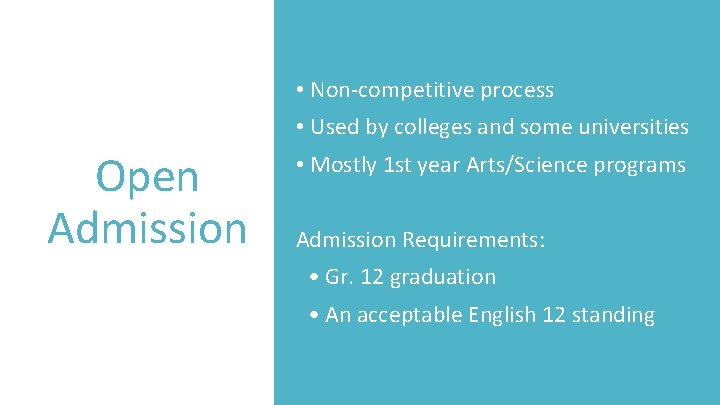
• Non-competitive process • Used by colleges and some universities Open Admission • Mostly 1 st year Arts/Science programs Admission Requirements: • Gr. 12 graduation • An acceptable English 12 standing
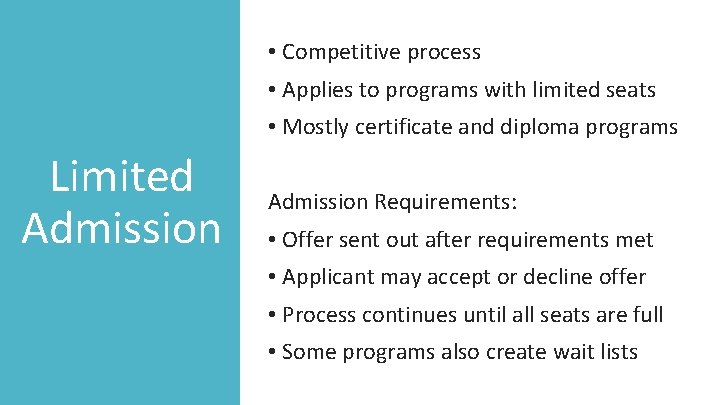
• Competitive process • Applies to programs with limited seats • Mostly certificate and diploma programs Limited Admission Requirements: • Offer sent out after requirements met • Applicant may accept or decline offer • Process continues until all seats are full • Some programs also create wait lists
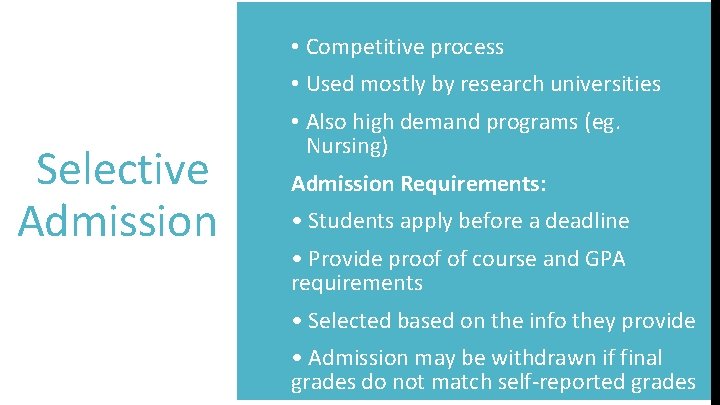
• Competitive process • Used mostly by research universities Selective Admission • Also high demand programs (eg. Nursing) Admission Requirements: • Students apply before a deadline • Provide proof of course and GPA requirements • Selected based on the info they provide • Admission may be withdrawn if final grades do not match self-reported grades
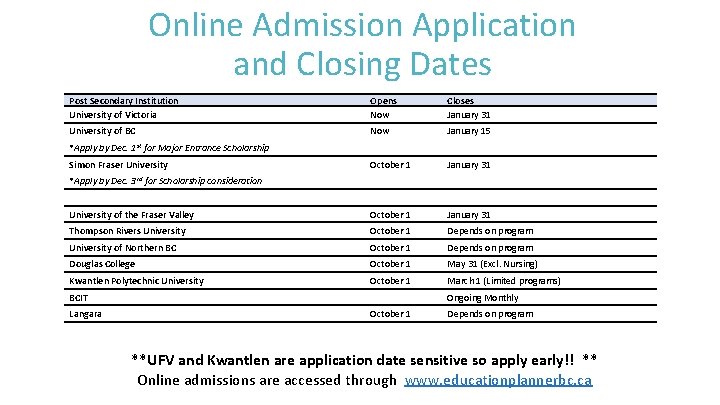
Online Admission Application and Closing Dates Post Secondary Institution University of Victoria Opens Now Closes January 31 University of BC Now January 15 October 1 January 31 University of the Fraser Valley October 1 January 31 Thompson Rivers University October 1 Depends on program University of Northern BC October 1 Depends on program Douglas College October 1 May 31 (Excl. Nursing) Kwantlen Polytechnic University October 1 March 1 (Limited programs) *Apply by Dec. 1 st for Major Entrance Scholarship Simon Fraser University *Apply by Dec. 3 rd for Scholarship consideration BCIT Langara Ongoing Monthly October 1 Depends on program **UFV and Kwantlen are application date sensitive so apply early!! ** Online admissions are accessed through www. educationplannerbc. ca
To Apply: www. educationplannerbc. ca Need PEN# & Credit Card to pay for application fee (different fee for each institution)
University Options in BC UBC • SFU • UVIC • UNBC *Selective Admissions Courses most commonly considered in post-secondary admissions requirements: • English 12 (or equivalent) • Math 11 or 12 (Pre-Calculus or Foundations) • Science (Chemistry, Biology & Physics) • UBC and SFU require a language 11 Exact requirements vary by school and program. Check institutional websites !
Douglas College (Coquitlam/New Westminster) • Some ‘open’, some ‘limited’ admissions • Different deadlines and entrance requirements for each program. • Check carefully! • Applications are now being accepted and are first come, first served
Other Post Secondary Options in BC Technology, Art & Design and Justice Emily Carr University of Art & Design • Programs in Design, Fine Arts & Media Arts • Portfolio required Justice Institute • Programs in Law Enforcement, Sheriff, Fire & Safety, Emergency Management, Health Sciences, Counselling and Community Safety, Conflict Resolution and Aboriginal Programs. Check Websites for Open Houses/Info Nights
Each program has it’s own specific admission requirements. Specific Intake Program (Technology): In addition to academic requirements, an interview, personal statement and letters of reference may be required. Apply early Applications accepted until program seats are filled (limited admission) Continual Intake Program (Trades): Must have completed the minimum admission requirements for first available seat (may be put on a waiting list)
�WSS Career Centre website https: //wsscareercentre. wordpress. com/ �PSBC Website: www. postsecondarybc. ca • Info on all 30 member institutions • Links to their website pages • Useful documents you can download • Annual fall visit of PSBC member institutions to high schools across BC More Info…
Post Secondary Day at Westview 2021 date TBA Representatives from the following institutions and others will be in attendance: • • BCIT Thompson Rivers University Douglas College Trinity Western University Capilano University of the Fraser Valley Canadian Armed Forces College • • Kwantlen Polytechnic University of Northern BC Vancouver Community College University of Victoria Simon Fraser University Vancouver Island University Nicola Valley Institute of Tech
Scholarships & Bursaries • Grade 12’s should be aware of the SD 42 scholarship and bursary booklet (scholarships. sd 42. ca). This booklet usually comes out in late December, early January. • Listen for info in CLC and Grad News • Check out the Career Centre website and head to the scholarships tab, for lots of diverse scholarships!