
Post Operative Wound Infection By Dr Ashraf El


Post Operative Wound Infection By Dr. Ashraf El Zoghby Prof. of General Surgery Ain Shams University 2005
Surgical site infections (SSI): § 3 rd common nosocomial infection. § 14 – 16 % of nosocomial infection. § Hospital stay by one week and added $ 3152 in hospital charges.
inition of SSI Surgical wound is replaced by surgical site to include infections of organ, spaces , deep to skin & soft tissue , as peritoneum and bone. Include Superficial incisional Deep incisional Organ space SSIs Def: infections within 30 days of surgery ( one years if an implant is left in place ).

Surgical Wounds Classifications I Clean: • Without infection or inflammation without entering GIT, genitourinary or respiratory tracts. • e. g : Hernia repair. • Infection rate 1 -3 % II Clean contaminated: • Respiratory, GI , GU , biliary tract entered under controlled conditions. • e. g. cholecystectomy, elective bowel resection. • Infection rate 5 -10%
III Contaminated : Traumatic wounds , major breaks in sterile technique , gross spillage from GIT , acute non purulent inflammation. e. g appendectomy. Infection rate 15 % IV Dirty: Old traumatic wounds , devitalized tissue , existing clinical infection , perforated viscera. e. g Hartmann’s operation for perforated driverticulitis. Infection rate 40 %
Risk factors for SSI : Endogenous : 1 - Iength if hospital stay : Colonization with hospital - related pathogens. Prevention by out patient same day admission setting. 2 - Active infections distant from operative field. ( better to postpone surgery ).
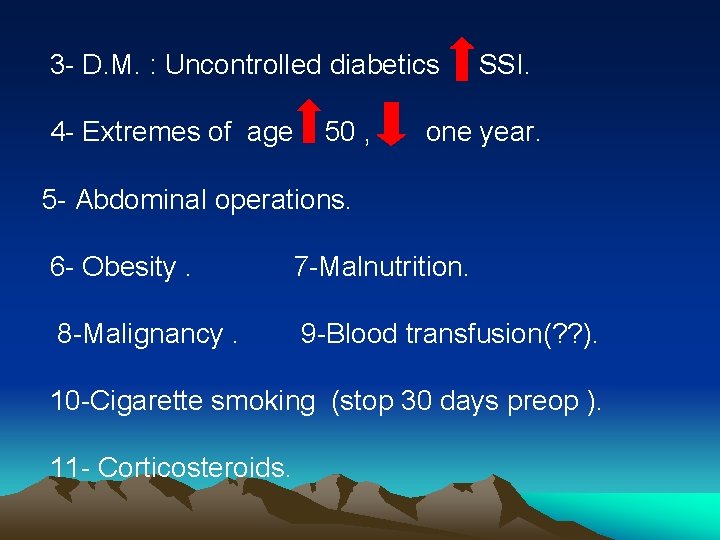
3 - D. M. : Uncontrolled diabetics 4 - Extremes of age 50 , SSI. one year. 5 - Abdominal operations. 6 - Obesity. 7 -Malnutrition. 8 -Malignancy. 9 -Blood transfusion(? ? ). 10 -Cigarette smoking (stop 30 days preop ). 11 - Corticosteroids.
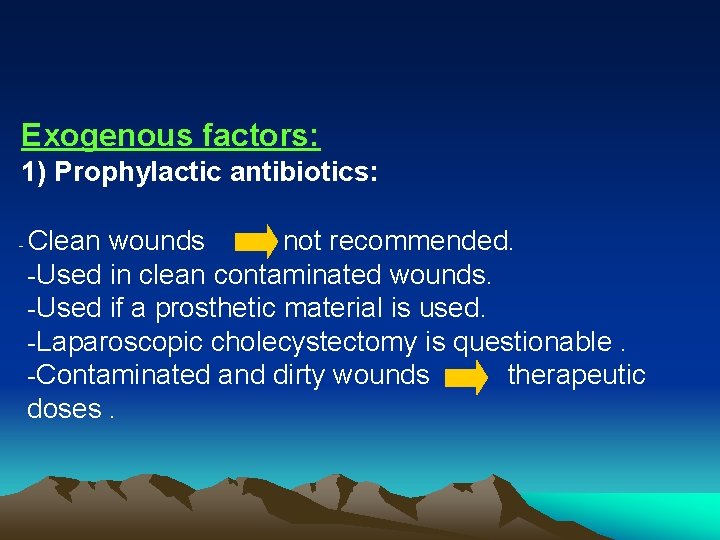
Exogenous factors: 1) Prophylactic antibiotics: - Clean wounds not recommended. -Used in clean contaminated wounds. -Used if a prosthetic material is used. -Laparoscopic cholecystectomy is questionable. -Contaminated and dirty wounds therapeutic doses.

Errors in administration of prophylactic antibiotics : 1. Faulty timing. 2. Inappropriate use for clean wounds. 3. Continuation beyond schedule.

v. Initial dose: §Within 30 minutes of incision , with induction of anaesthesia. §Better to stop “ On call to OR “d. t. poor tissue level. v. Continue for 24 hours (1 -3 doses ). v. Oral antibiotics for elective colonic operations are given for only 24 hours preoperatively to avoid resistant strains.
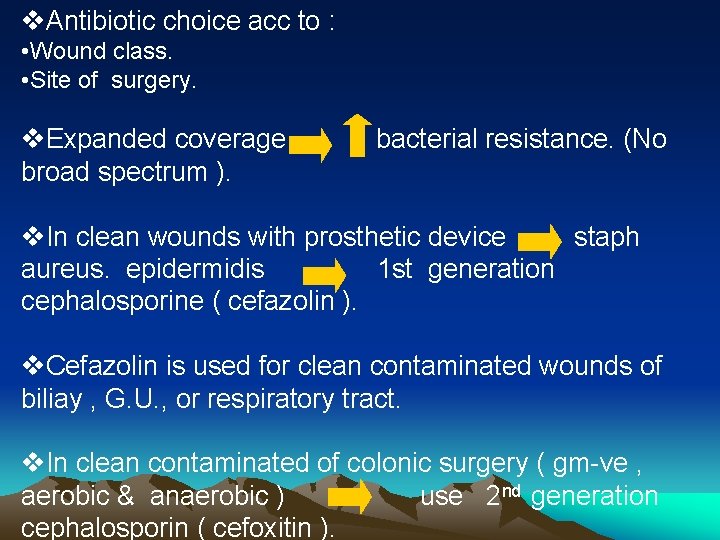
v. Antibiotic choice acc to : • Wound class. • Site of surgery. v. Expanded coverage broad spectrum ). bacterial resistance. (No v. In clean wounds with prosthetic device staph aureus. epidermidis 1 st generation cephalosporine ( cefazolin ). v. Cefazolin is used for clean contaminated wounds of biliay , G. U. , or respiratory tract. v. In clean contaminated of colonic surgery ( gm-ve , aerobic & anaerobic ) use 2 nd generation cephalosporin ( cefoxitin ).
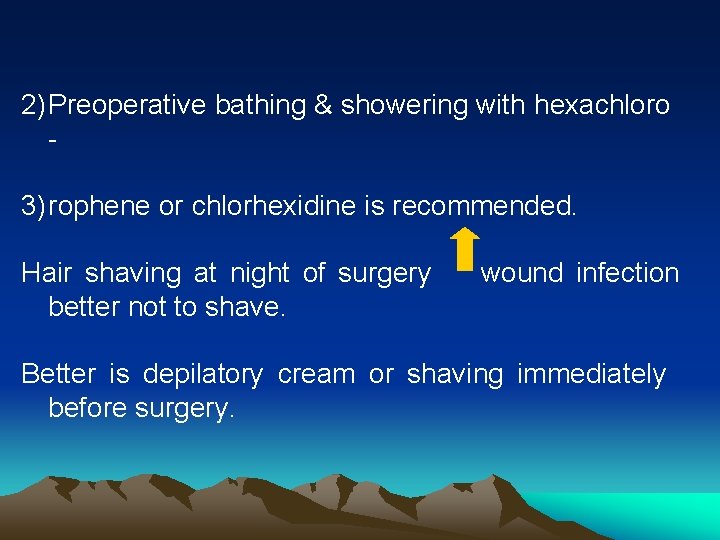
2) Preoperative bathing & showering with hexachloro 3) rophene or chlorhexidine is recommended. Hair shaving at night of surgery better not to shave. wound infection Better is depilatory cream or shaving immediately before surgery.
3) The length of operation is proportional to wound infection , each extrahour doubles wound infection d. t: Risk of contamination. Tissue level of prophylactic antibiotic. v If operation exceeds 3 hs antibiotic. give extra dose of

4) Drains rates of discouraged. wound infection & better v Used to drain localized collection or maintain tissue apposition. v Via separate stabs , use closed suction & early removal.

5) Surgical judgment & technical proficiency are important to SSI. v When to bring the patient to surgery operation to perform. & what v Meticulous tissue handling , haemostasis , avoid cauterization.
6) O. R. ventilation , cleaning & sterilization SSI. 7) Surgeon: keeping nail short, 2 -5 minutes scrub with iodophors or chlorhexidine , remove hand or arm jewelery. 8) Chlorhexidine is superior to alcohol and iodophor in skin preparation as its residual antibacterial activity lasts longer & not affected by blood or serum proteins. v Skin antiseptics used in concentric circles starting at site of incision. v Exclude O. R. personnel with skin infection.

9) Post operative , protect the wound for 24 – 48 hours ( sterile dressing). v Wash hands before and after dressing. v Use sterile technique for dressing changes. 10)Hospital surveillance programs is important for recording rates of SSI , and adequate number of infection control nurses. v Wounds are followed for 30 days.

DIAGNOSIS ØBetween 4 -8 up to 30 days. ØFever , swelling , erythema , unexpected wound pain , tenderness, spontaneous purulent fluid. Ø ± leukocytosis. ØIsolation of organism. ØNecrotizing infection arises within 48 hours by clostridium perfringens or ß haemolytic streptococci. . ØWound cultures are usually not necessary.

TREATMENT üOpen the wound + irrigation + depridment + frequent dressing. üAntibiotics if cellulitis or systemic infections. üProsthetics are removed if possible.

THANK YOU
- Slides: 21