
Post kalaazar dermal leishmaniasis treated with liposomal amphotericin
- Slides: 13
Post kala-azar dermal leishmaniasis treated with liposomal amphotericin B MSF OCA, OCBA Bangladesh, India *Sakib Burza 1, 2, Margriet den Boer 5, Raman Mahajan 1, Temmy Sunyoto 1, Marıa Angeles Lima 3, Asish Kumar Das 4, Patrick Almeida 4, Gaurab Mitra 1, A. Be-Nazir 6, Pradeep Das 7, Koert Ritjmeijer 5 1 Médecins Sans Frontières (MSF), New Delhi, India; 2 Institute of Tropical Medicine, Antwerp, Belgium: 3 MSF, Barcelona, Spain; 4 MSF, Dhaka, Bangaldesh; 5 MSF, Amsterdam, Holland: 6 Communicable Disease Control, Ministry of Health and Family Welfare, Dhaka, Bangladesh, 7 Rajendra Mamorial Research Institute, Patna, India
Post Kala Azar Dermal Leishmaniasis (PKDL) • • Is a complication of visceral leishmaniasis Common in areas endemic for VL caused by L. donovani Characterised by a skin rash after an episode of VL In contrast to VL: – Patients are typically not ill – PKDL is not fatal – Main issue is that of aesthetics • However, is a public health problem: – – – Based on existing evidence, PKDL is a major reservoir of L. donovani In South Asia, PKDL does not self heal Needs to be treated if transmission of disease is to be limited Estimated 5 -10% of VL cases go on to develop PKDL Incidence 4. 8/1000, interval 0 -3 years post initial VL infection
A neglected disease within a neglected disease • Very poor evidence base and understanding of PKDL as a disease process • Limited evidence on pathogenesis or risk factors • Accurate diagnosis is difficult, needs experience and skilled HR • Serological diagnosis difficult to interpret • Very little evidence on management: • No evidence on ‘skin penetration’ of existing drugs • No evidence on ‘end point’ of treatment • Very limited evidence on treatments
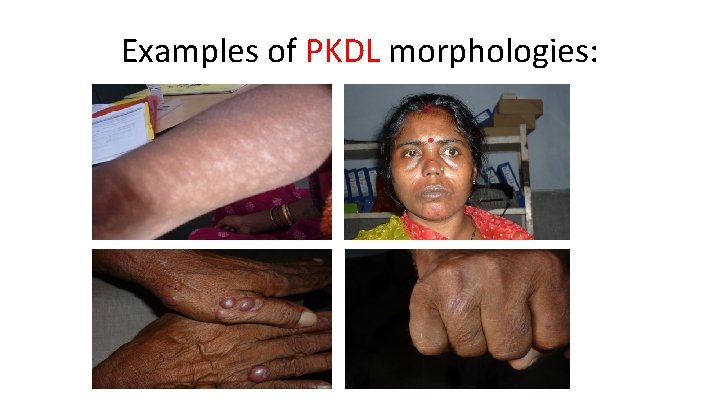
Examples of PKDL morphologies:
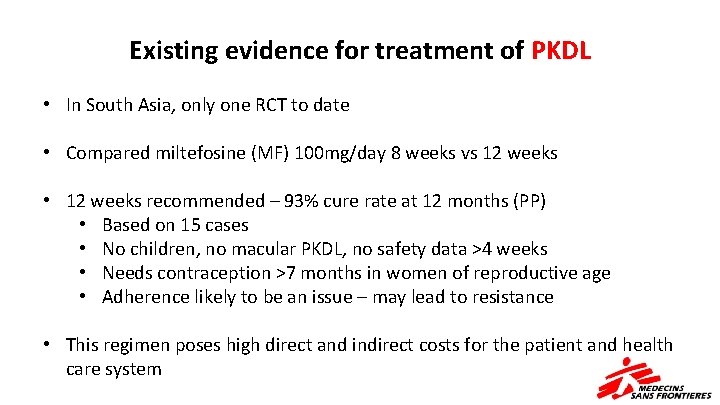
Existing evidence for treatment of PKDL • In South Asia, only one RCT to date • Compared miltefosine (MF) 100 mg/day 8 weeks vs 12 weeks • 12 weeks recommended – 93% cure rate at 12 months (PP) • Based on 15 cases • No children, no macular PKDL, no safety data >4 weeks • Needs contraception >7 months in women of reproductive age • Adherence likely to be an issue – may lead to resistance • This regimen poses high direct and indirect costs for the patient and health care system
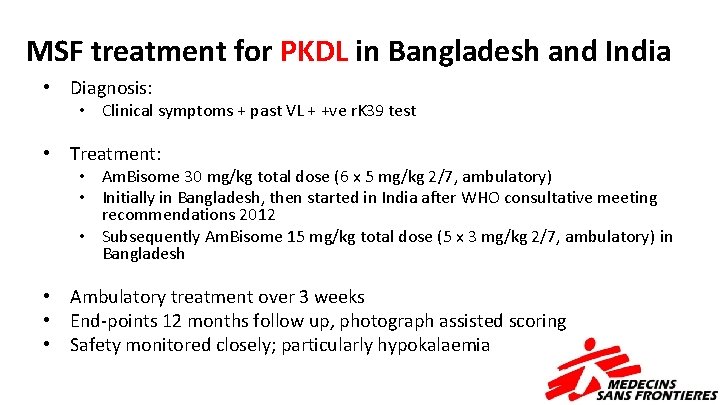
MSF treatment for PKDL in Bangladesh and India • Diagnosis: • Clinical symptoms + past VL + +ve r. K 39 test • Treatment: • Am. Bisome 30 mg/kg total dose (6 x 5 mg/kg 2/7, ambulatory) • Initially in Bangladesh, then started in India after WHO consultative meeting recommendations 2012 • Subsequently Am. Bisome 15 mg/kg total dose (5 x 3 mg/kg 2/7, ambulatory) in Bangladesh • Ambulatory treatment over 3 weeks • End-points 12 months follow up, photograph assisted scoring • Safety monitored closely; particularly hypokalaemia
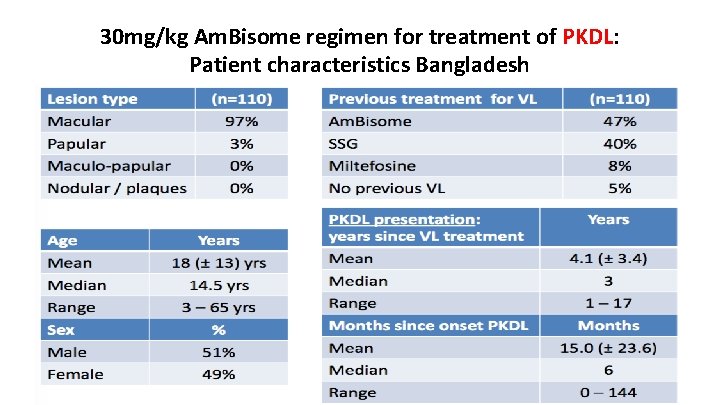
30 mg/kg Am. Bisome regimen for treatment of PKDL: Patient characteristics Bangladesh
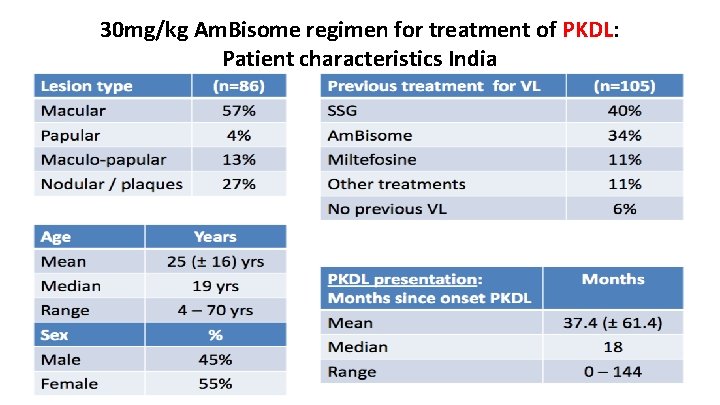
30 mg/kg Am. Bisome regimen for treatment of PKDL: Patient characteristics India
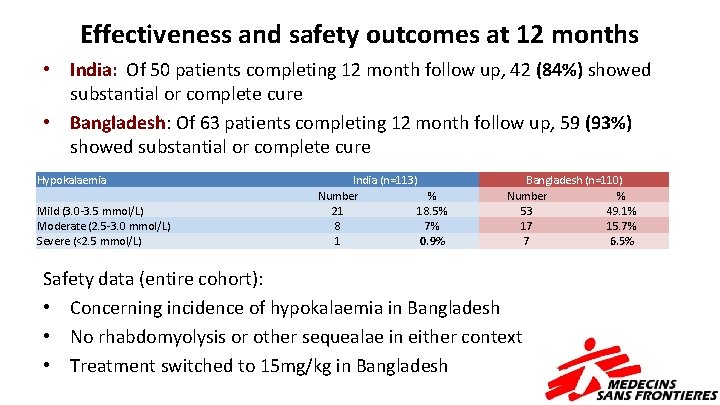
Effectiveness and safety outcomes at 12 months • India: Of 50 patients completing 12 month follow up, 42 (84%) showed substantial or complete cure • Bangladesh: Of 63 patients completing 12 month follow up, 59 (93%) showed substantial or complete cure Hypokalaemia Mild (3. 0 -3. 5 mmol/L) Moderate (2. 5 -3. 0 mmol/L) Severe (<2. 5 mmol/L) India (n=113) Number % 21 18. 5% 8 7% 1 0. 9% Bangladesh (n=110) Number % 53 49. 1% 17 15. 7% 7 6. 5% Safety data (entire cohort): • Concerning incidence of hypokalaemia in Bangladesh • No rhabdomyolysis or other sequealae in either context • Treatment switched to 15 mg/kg in Bangladesh
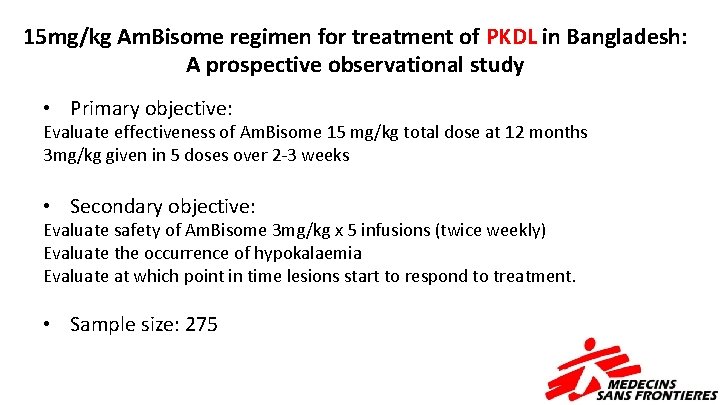
15 mg/kg Am. Bisome regimen for treatment of PKDL in Bangladesh: A prospective observational study • Primary objective: Evaluate effectiveness of Am. Bisome 15 mg/kg total dose at 12 months 3 mg/kg given in 5 doses over 2 -3 weeks • Secondary objective: Evaluate safety of Am. Bisome 3 mg/kg x 5 infusions (twice weekly) Evaluate the occurrence of hypokalaemia Evaluate at which point in time lesions start to respond to treatment. • Sample size: 275
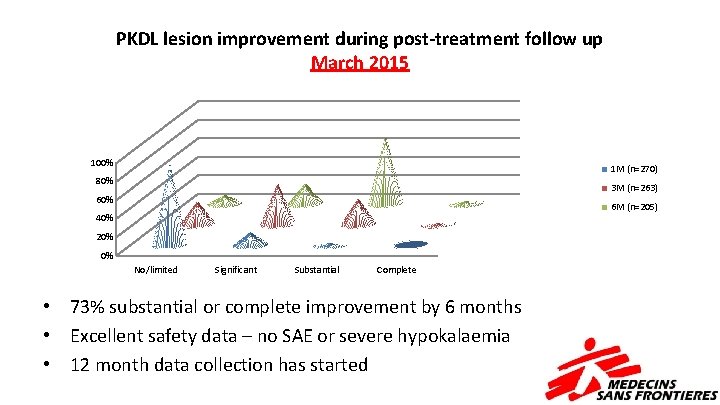
PKDL lesion improvement during post-treatment follow up March 2015 100% 1 M (n=270) 80% 3 M (n=263) 60% 6 M (n=205) 40% 20% 0% No/limited Significant Substantial Complete • 73% substantial or complete improvement by 6 months • Excellent safety data – no SAE or severe hypokalaemia • 12 month data collection has started
Limitations • Difficult to standardise assessment of improvement – very subjective • Irregular quality of photographs in 30 mg/kg groups (improved in 15 mg/kg) • Inclusion was clinical assessment based – negative parasitology did not preclude inclusion
Conclusions • 30 mg/kg Am. Bisome appears effective in the treatment of PKDL • Safety concerns of hypokalaemia in Bangladesh, although not seen in India • 15 mg/kg Am. Bisome appears safe, tolerable and showed good adherence in PKDL • Effectiveness appears to be similar to the higher dose – pending 12 month results becoming available • Urgent need for an alternative shorter course treatment exists for PKDL – Am. Bisome may be considered an appropriate option